Chapitre 1
Breaking the Chains of Financial Bondage
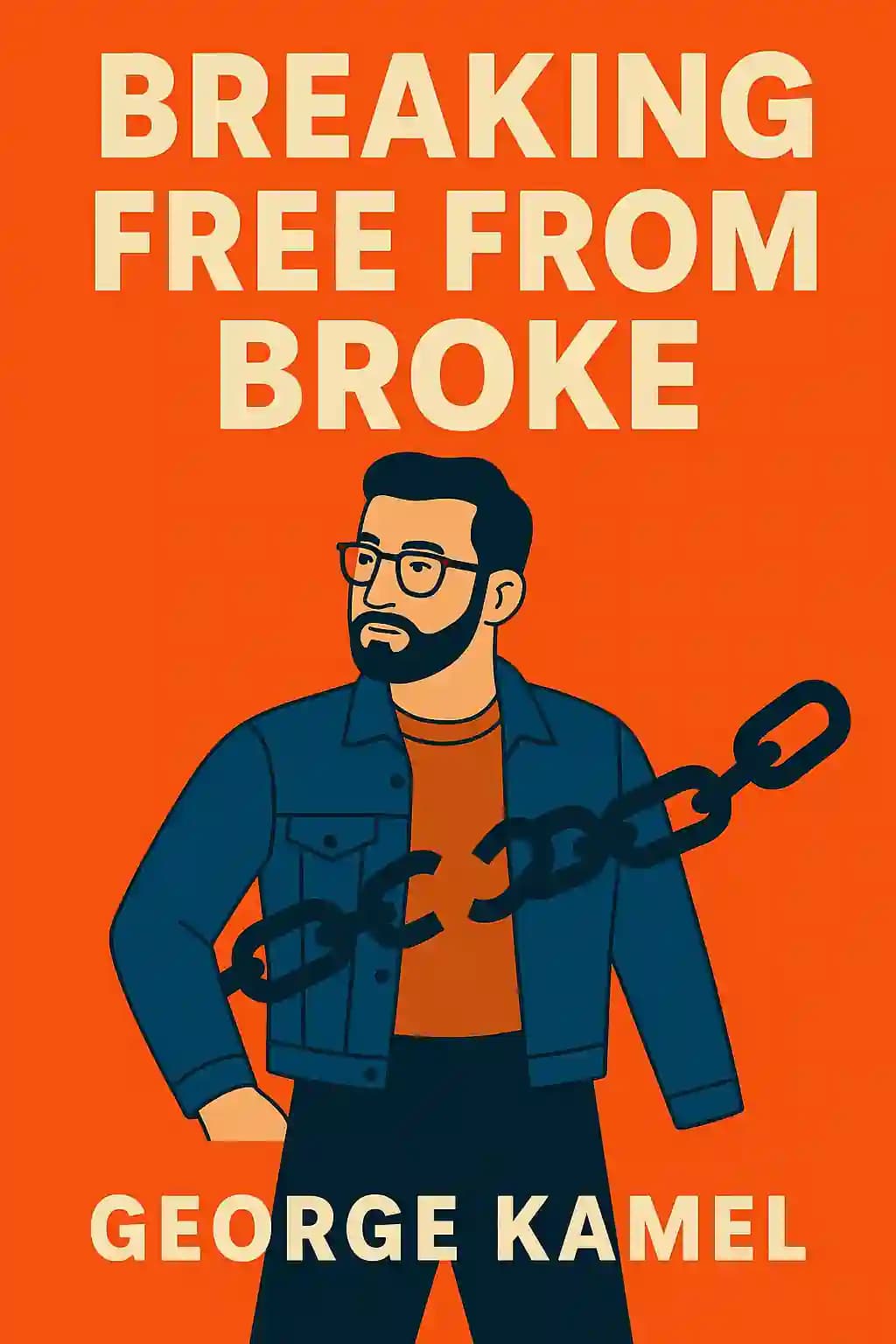
In 1992, a man sold a little blue book called Financial Peace from his car trunk. This common-sense approach to money became a New York Times bestseller with over 3 million copies sold. Today, George Kamel-once a typical broke 20-something drowning in student loans and credit card debt-has transformed those principles into a fresh guide for a new generation. After implementing these financial strategies, George went from negative net worth to millionaire in just a decade, becoming debt-free with a paid-off home by age 32. His story proves that financial freedom isn't reserved for the privileged few-it's available to anyone willing to challenge the system designed to keep us broke. Breaking Free from Broke offers a roadmap to escape the financial traps that have ensnared millions of Americans, delivered with humor and practical wisdom that can transform your relationship with money forever.
Chapitre 2
The Financial Matrix: How We Became Trapped
The belief that "the little man can't get ahead" has become the mantra of average Americans trapped in financial hopelessness. Recent research paints a grim picture: 37% of people struggling financially, 43% having difficulty paying bills, 50% struggling with rent payments, 25% relying on credit cards for necessities, nearly 40% with zero savings, and over half worrying about money daily. We've become passengers "in this Uber ride from hell," letting a system designed to keep us broke determine our financial destination.
This financial trap begins early with no financial literacy education in school and money conversations being taboo at home. We're indoctrinated into believing student loans are necessary "investments," while credit card companies target college students with free pizza and t-shirts. We finance cars that outlast our relationships and buy homes beyond our means. These decisions leave us financially "tapped, trapped, strapped, capped, and zapped."
The paradox is striking: despite living in history's most advanced society, we have less time and money than previous generations. The American Dream feels increasingly out of reach as college costs have increased 400% since the 1980s, housing prices have skyrocketed, and inflation has eroded purchasing power.
But our financial story doesn't have to end this way. Dave Ramsey's proven Baby Steps plan has helped over 10 million people for 30 years: starting with a $1,000 emergency fund, paying off debt using the Debt Snowball, building 3-6 months of expenses, investing 15% for retirement, saving for college, paying off the mortgage, and finally building wealth and giving generously.
This approach is for anyone "sick and tired of being sick and tired"-those who work too hard to feel broke, who are exhausted from the financial treadmill, who want to change their family tree. The key is a paradigm shift away from a system designed to steal your money, margin, options and peace. Like David against Goliath, you can win against the financial system that's been bullying you.
Chapitre 3
The Credit Score Myth: A Debt Management Tool, Not a Wealth Indicator
Like Sisyphus eternally pushing a boulder uphill in Greek mythology, most Americans are trapped in never-ending money struggles due to pervasive financial myths-particularly the obsession with credit scores. According to research, 83 million Americans were financially struggling two years after the pandemic, with 46% losing sleep over finances and 59% worrying about money daily. The credit score, a three-digit number Americans obsess over as much as their weight, has become a false indicator of financial success, with 85% of adults believing a high score signals prosperity.
The FICO score, developed in 1989 by the Fair Isaac Corporation, became the universal tool for evaluating credit risk. Scores range from 300 to 850, with many obsessively pursuing a "perfect" 850 score. Your credit score determines loan approvals, interest rates, job opportunities, insurance rates, and ability to rent cars and housing. But here's the crucial insight: the score comprises payment history (35%), amount owed (30%), length of credit history (15%), new credit (10%), and credit mix (10%)-every factor relates exclusively to debt.
This reveals the score's true nature as a debt management metric, not a wealth indicator. The circular logic is absurd: we want good credit to access debt to build better credit to access more debt. The system actually penalizes responsible behavior-paying off loans early or closing credit accounts lowers your score. Most critically, credit scores ignore income, net worth, and savings, measuring only your relationship with debt. As Rachel Cruze says, "If your credit score is higher than your bank balance, you're headed in the wrong direction."
The liberating truth: you don't need a credit score. By paying off consumer debt and cutting up credit cards, you reclaim control of your income-your greatest wealth-building tool. Without debt activity for 6-12 months, your score becomes "indeterminable"-joining the 32 million Americans who are "credit invisible." This invisibility isn't a problem but a sign of financial freedom.
Living without a credit score requires understanding how to navigate financial situations differently, but it's entirely possible and often advantageous. You can buy cars with cash, rent vehicles with debit cards (every major company allows this), rent apartments (landlords primarily care about income verification and background checks), pass job application screenings (employers can't even see your score, only your credit report), get competitive insurance rates (through independent agents who shop multiple carriers), and even buy a house through manual underwriting (which Kamel himself did in 2019).
Like Sisyphus pushing a boulder uphill eternally, our culture is trapped in an endless cycle of improving credit scores to borrow more, leading only to more debt-an absurd game played to appease lending gods while worshiping at FICO's altar. Living without a credit score isn't just possible-it's better. Though it requires more effort, it beats owing others money for life.
Chapitre 4
Credit Cards: The Gateway Drug to Financial Bondage
Credit cards function as a financial rite of passage and gateway drug to debt. They create a false sense of winning through cash back, miles, and points while building credit scores. In reality, credit card companies have invented a game where they don't lose-getting 2% cash back while paying double-digit interest means consumers aren't winning.
Credit cards have become deeply embedded in American culture, with 80% of Americans having at least one card, though nearly half don't know their interest rate. Despite promises to "never carry a balance," 49% of people fail to pay off their cards monthly. Credit card companies made $106 billion in 2020, explaining their massive advertising budgets and stadium sponsorships. By 2023, outstanding credit card debt hit a record $1 trillion, with average household balances exceeding $14,000 and interest rates averaging 22%.
Credit card companies generate billions through three revenue streams: interest fees (the price paid for borrowing money, expressed as an annual percentage rate around 22%), consumer fees (annual fees ranging from $25-$700+, late fees, balance transfer fees, cash advance fees, expedited payment fees, and foreign transaction fees), and interchange fees (charged to merchants whenever customers use credit cards, ranging from 1.5-2.5% for Visa, Mastercard, and Discover, while American Express charges up to 3.5%).
Most credit card users assume their rewards come from interchange fees charged to merchants, not from people struggling with debt. However, Capital One's 2022 earnings reveal that only 20% of their revenue came from interchange fees, while nearly 75% came from interest charges. A 2023 Federal Reserve study confirmed that credit card rewards represent a $15 billion annual redistribution from lower-income to higher-income consumers. Lower-income cardholders paid $4.14 billion in fees while higher-income users received $1.26 billion in rewards, with credit card companies pocketing the $2.88 billion difference.
People justify keeping credit cards for various reasons, but all have counterarguments:
1. "I pay off my balance monthly" - MIT research shows you still spend more with credit cards because they reduce the pain of purchase while stimulating the brain's reward center.
2. "I need the rewards" - Credit card companies run thousands of experiments annually to get consumers chasing rewards through increased spending. For every dollar spent hoping for a 2% reward, you risk paying 22% interest.
3. "I need fraud protection" - Debit cards have nearly identical protections through the Electronic Fund Transfer Act.
4. "I need them for travel" - Debit cards work perfectly fine for booking flights, renting cars, and reserving hotel rooms.
5. "They're more convenient" - Debit cards offer the same technological convenience without the debt.
6. "I need them for emergencies" - Building an emergency fund provides genuine security without 22% interest.
7. "They make me feel secure" - This false sense of security actually increases stress and anxiety.
8. "I need them for my credit score" - As established earlier, you don't need a credit score to live your financial life.
The credit card industry is fundamentally corrupt, and playing their game isn't worth the perks, even if played perfectly. You can not only survive without credit cards-you can thrive. After cutting up his cards, the author found he built wealth faster, with more confidence and peace.
Chapitre 5
Student Loans: The American Dream Turned Nightmare
The student loan system has become a financial trap that promises the American Dream but delivers a nightmare. With 43 million Americans carrying $1.6 trillion in student loans, the average borrower takes 17-23 years to pay off their debt. At typical rates, a $40,000 loan results in $94,000 in total payments over 20 years. This crisis stems from decades of government policies that made loans easier to obtain while college costs skyrocketed 1,400% since 1977-more than 3.5 times the inflation rate.
The pursuit of higher education through student loans has backfired for millions. Despite being sold on the progression from good grades to college to better jobs and less financial stress, the reality is crushing debt that creates more money problems than it solves. As one biology graduate discovered after accumulating $100,000 in debt, her degree left her worse off than siblings who didn't attend college, struggling with basic expenses and unable to afford a home.
The student loan crisis evolved through government policies starting in 1957 with Sputnik-inspired education initiatives. What began as Eisenhower's low-interest program transformed through Johnson's Higher Education Act, Nixon's creation of Sallie Mae, and its eventual privatization while maintaining government guarantees. By 2005, student loans became nearly impossible to discharge in bankruptcy, and despite Obama's 2010 reforms, costs increased. This system allowed colleges to raise tuition by 1,400% since 1977, with economist Alice Rivlin, who helped create the loan system, admitting, "We unleashed a monster."
College isn't a one-size-fits-all solution. Research shows higher education isn't right for everyone. With 53% of graduates either unemployed or working jobs that don't require degrees, and employment rates for non-graduates (78%) approaching those with degrees (86%), alternatives deserve consideration. The decision should be based on career goals, potential earnings, and personal circumstances rather than blindly following the college path.
Society has convinced students that college degrees are "priceless," worth borrowing any amount for. Today's college appeal isn't just about education but the "experience." Colleges have capitalized on this, upgrading amenities to boost rankings and attract applicants, creating a cycle of increased tuition and profits while students take on massive debt.
The myth of "good debt" has led people to see student loans as "investments" rather than debt, making dangerous assumptions: that they'll get a return, graduate, find a high-paying job, and easily repay loans. A Ramsey Research study found 4 in 10 people don't even categorize student loans as debt. This "good debt" delays dreams-42% delay paying other loans, 14% delay marriage, 44% delay retirement savings, 33% delay homeownership, 35% delay travel, and 16% delay having children.
For those already burdened with student loans, the Debt Snowball method offers hope. Most people following this book's money plan pay off their debt in 18-24 months. For parents and students facing college decisions, debt-free options include taking debt completely off the table and opening college savings accounts like Education Savings Accounts (ESAs) or 529 Plans.
Chapitre 6
Car Loans: Driving Yourself to Financial Ruin
Car payments have become as American as apple pie, but they're financially devastating. With Americans now carrying $1.58 trillion in car loan debt-surpassing student loan debt for the first time-we're facing what Kamel calls "Carmageddon." The average new car costs $48,344 with monthly payments of $733, while used cars average $32,811 with $569 monthly payments. A shocking 17.1% of consumers have monthly payments exceeding $1,000.
The real killer is depreciation: new cars lose 9-11% of their value the moment you drive off the lot and 60% within five years. This means a $40,000 new car becomes worth just $16,000 after five years, despite paying around $50,000 including interest over the typical 70-month loan term. This financial disaster happens while you continue making the same monthly payment regardless of the vehicle's plummeting value.
People justify car payments with flawed reasoning. They believe "you'll always have a car payment," which is false-buying used cars with cash breaks this cycle. Others focus only on affording monthly payments rather than total cost, not realizing that investing that $700 monthly payment from age 22 to 62 could yield over $6 million. The myth that new cars are safer and more reliable ignores that first-year models often have problems, while used cars can be just as dependable with lower insurance costs (27% less for five-year-old vehicles).
Leasing is the most expensive way to operate a vehicle. Though monthly payments appear lower, you're paying for the steepest depreciation period (first 2-3 years) while building zero equity. Leases hide interest rates, charge excessive fees for early termination, mileage overages, and wear-and-tear, and leave you without a vehicle when the term ends.
The best way to buy a car is saving up and purchasing a reliable used vehicle with cash. Only millionaires should consider new cars-the average millionaire drives a four-year-old car with 41,000 miles, and 80% pay cash. The total value of all your vehicles shouldn't exceed half your annual income to avoid tying up wealth in depreciating assets.
The car-buying process should include setting a budget, saving up, finding an ideal car based on practical needs rather than status, researching options thoroughly, checking the car's value, test driving, getting a pre-purchase inspection, negotiating effectively, and paying with cash.
You face a choice between perpetual car payments or financial freedom. Don't buy cars for status or emotional attachment-they're depreciating assets that will eventually rust, get damaged, or be replaced. Buy vehicles that meet your needs with cash, and when tempted to upgrade, consider a thorough detailing instead.
Chapitre 7
The Budget: Your Roadmap to Financial Freedom
Like old-timey slang, budgeting is wildly underrated and misunderstood. In 2013, Kamel was a "ditty bopper" with money-carelessly confident as long as he didn't overdraft. Most people need an "Oh, crap!" moment before changing their ways, whether it's a declined card or a medical bill they can't pay. The truth is, 51% of people earning over $100,000 still live paycheck to paycheck. Budgets aren't boring restrictions-they're the minivans of finance: powerful, spacious, offering peace of mind, and helping you reach new destinations.
Budgets are like minivans-underrated but incredibly practical. They're powerful, putting you in control of your money. They create breathing room by helping you live on less than you make. They offer peace of mind by curbing financial anxiety. And like GPS navigation with lane-keep assist, they help you arrive at new financial destinations by providing clear guardrails for where each dollar should go.
While there are many budgeting methods like 50/30/20 or 80/20, zero-based budgeting is the only one you'll ever need. The formula is simple: Income - Expenses = $0. This doesn't mean emptying your account-it means giving every dollar a job. Contrary to popular belief, a budget doesn't limit freedom-it grants permission to spend intentionally. Despite this, 6 out of 10 Americans don't budget monthly.
Creating a budget requires five key steps: First, add all income sources including take-home pay and side hustles. Second, list all anticipated expenses by category, starting with giving and savings goals. Third, budget to zero by ensuring income minus expenses equals zero, adjusting as needed. Fourth, track your expenses regularly-every dollar that leaves your wallet or account needs a home in your budget. Finally, create a fresh budget before each month begins, accounting for unique expenses like holidays or quarterly bills. Most people need about three months to get comfortable with the process.
People resist budgeting despite wanting financial growth. Common objections include not knowing how to budget (solved by the simple formula), feeling restricted (when budgets actually provide freedom), believing it takes too much time (when it only takes minutes after the initial setup), fearing what they'll discover (when reality is less scary than the unknown), having irregular income (which makes budgeting even more essential), and obsessing over perfect category percentages (when only a few percentages really matter).
After a decade of budgeting experience, Kamel shares his best tips: Surround yourself with financially responsible people, use a budgeting app like EveryDollar for convenience, define your why to stay motivated, replace stress-spending with healthier habits, find an accountability partner, create a miscellaneous category for unexpected expenses, ditch credit cards that hide true spending, learn to say "no" or "not now," and give yourself grace-it takes about three months to master budgeting.
Taking control of your money brings peace and makes your dollars work harder-it feels like getting a raise. Budgeting helps rein in spending, reach savings goals, and increase generosity. When you mind your money, it takes money off your mind, creating true mental freedom.
Chapitre 8
Building Wealth Through Patience and Discipline
When Kamel was a kid, wealth meant Crayola boxes with built-in sharpeners, name-brand Pop-Tarts, and homes with more than one bathroom. Growing up in a modest 996-square-foot home with immigrant parents, he never imagined himself becoming wealthy. But after a decade of following Ramsey principles, he went from $40,000 in debt to debt-free millionaire. The current wealth landscape is bleak-26% of non-retired Americans have zero retirement savings, and 48% have less than $10,000. Social Security averages just $1,700 monthly, approaching poverty levels. But you can opt out of these statistics by following a straightforward wealth-building approach.
The right time to begin investing is after completing Baby Steps 1-3: paying off debt and building a fully funded emergency fund. Then you'll move to Baby Steps 4-7, with steps 4-6 happening simultaneously. Start by investing 15% of your gross household income for retirement (Baby Step 4), then save for your children's college (Step 5), and pay off your home early (Step 6).
Kamel's five-word investing strategy is simple: "Match beats Roth beats Traditional." First, take all the company match available through your employer's retirement plan (401(k), TSP, 403(b)). This is a 100% return on investment. Second, invest in Roth options, using after-tax dollars that grow tax-free. Third, if you haven't reached 15% yet, return to traditional tax-deferred plans.
Within your retirement accounts, invest in mutual funds-specifically growth stock mutual funds with long track records. To reduce risk, diversify evenly (25% each) across four types of mutual funds: Growth and Income funds (stable large companies like Procter & Gamble), Growth funds (companies with rapid growth potential like Amazon), Aggressive Growth funds (higher-risk companies like Zoom), and International funds (non-US companies like Samsung).
The real wealth-building magic comes from compound growth. In most retirement accounts, 80-90% of your final balance comes from growth, not contributions. Your money makes money, which makes more money. A $10,000 investment at age 22 with a 10% average annual return grows to $452,592 after 40 years-with $442,592 coming purely from growth.
In a real-life scenario, a 32-year-old couple investing 15% of their $71,000 household income (about $890 monthly) from age 35 to 65 could yield $2-3.1 million tax-free in retirement, depending on whether they average 10-12% returns. Of their final balance, less than $320,000 would be money they contributed-the rest is all growth.
Building wealth requires a long-term mindset, not financial genius. In our instant-gratification culture, the real secret is patience and delayed gratification. As Hebrews 12:11 reminds us, discipline seems painful at first but produces a harvest later. The quickest way to get rich is actually to get rich slow-through consistent habits, simple strategies, and giving your investments time to compound.
Chapitre 9
Generosity: The Ultimate Expression of Financial Freedom
Generosity represents the pinnacle of financial freedom. The story of Amir and Connie, who paid off $986,000 in debt over ten years and then secretly paid off their children's mortgages too, exemplifies the ultimate purpose of financial margin: enabling a life of giving.
While money can be saved, spent, or given, giving proves to be the most fulfilling option. In our world full of greed, selfishness, and materialism, generosity offers a powerful solution. However, most Americans lack the financial margin to be truly generous, trapped in the paycheck-to-paycheck cycle. Creating financial margin through budgeting and following the Baby Steps ultimately enables both monetary generosity and the freedom to be generous with your time and talents.
Generosity offers numerous scientifically-proven benefits. When we give, our brains release happiness chemicals like dopamine and oxytocin-the "giver's glow." Generous people tend to be happier and make those around them happier too. Research shows generosity lowers stress levels, potentially extending lifespan-volunteers are 40% less likely to develop high blood pressure. Studies even show that helping others doubles the success rate for those in recovery programs, as being others-focused can be a pathway to personal healing and growth.
Whether you have a faith background or not, ancient wisdom offers timeless insights about giving. The spiritual benefits of generosity go far beyond material gain-they include emotional recharging, spiritual refreshment, and a more peaceful life. Since humans were made in God's image (the Original Giver), becoming generous helps us become who we were meant to be. Viewing ourselves as stewards rather than owners of our resources is freeing and changes how we manage money. Plus, thoughtful generosity creates a legacy that can impact generations to come.
You don't need to be a millionaire to practice generosity. Rachel Cruze's advice is perfect: "Give a little... until you can give a lot." The spirit of giving matters more than the amount. If you currently lack financial margin, that's even more reason to follow the Baby Steps and get out of debt. Like John D. Rockefeller who began tithing from his $1.50 weekly salary, start small to build the habit.
As you develop the giving habit, consider three approaches: planned generosity (consistent, monthly giving that becomes part of your routine), spontaneous generosity (heart-led, spur-of-the-moment giving), and outrageous generosity (legacy-level giving that happens at Baby Step 7-with no mortgage, no payments, and plenty in the bank).
Money is just a tool-like a brick that can build a home or break a window. In the wrong hands, it becomes an idol, but when managed well, it can transform lives. Money doesn't change who you are; it magnifies what you already are. If you're stingy while broke, wealth will make you stingier. If you're generous with little, you'll be outrageously generous with much. This money plan is about living free-free from stress, free from debt, and free to use wealth for what truly matters. What matters most isn't what we accumulate, but the lives we impact.