BeFreed
    Categories>Psychology>James Hillman and the Acorn Theory: Psychology of the Soul

    James Hillman and the Acorn Theory: Psychology of the Soul

    14 min
    |
    |
    16. Aug. 2026
    • Psychology
    • Philosophy & Spirituality
    • Self-Growth

    Explore James Hillman’s Acorn Theory and the psychology of the soul. Learn how the daimon and individual image shape human destiny beyond nature and nurture.

    James Hillman and the Acorn Theory: Psychology of the Soul
    0:00 / 0:00
    Wähle die Erzählweise

    Eine Episode. Viele Arten, sie zu hören.

    Dieselben Ideen aus James Hillman and the Acorn Theory: Psychology of the Soul. Wähle Stimme, Tiefe und Tempo, die zu dir passen. Wechsle jederzeit.

    Transkript & Kapitel

    Kapitel 1

    The Image in the Seed

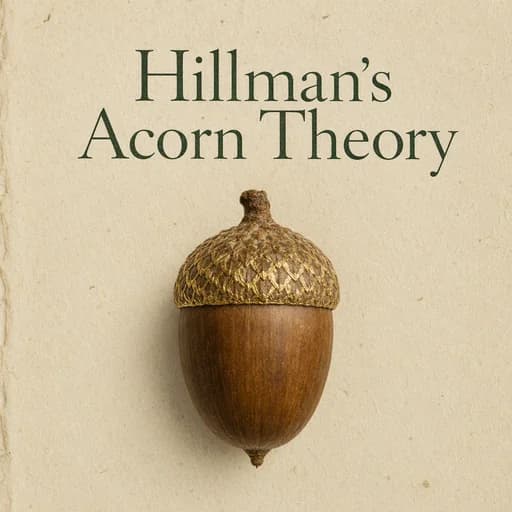
    You might have noticed that when we look at our lives through the lens of modern psychology, we often end up feeling like a collection of historical accidents. If you are preparing to teach or write about James Hillman, you are likely wrestling with the fact that our culture usually tells us we are the product of two things: our genetic code and our childhood environment. It is the classic nature versus nurture debate, and Hillman argues that this framework is fundamentally broken because it leaves out the most important ingredient—you. He proposes something he calls the "acorn theory," a psychological framework that suggests you came into the world with a specific, innate character and calling, much like an acorn carries the pattern of a giant oak tree within its tiny shell. This is not just a poetic metaphor; it is a radical shift in how we understand human destiny. If you have ever looked at a child and seen a flash of a personality that seemed entirely separate from anything they could have learned from their parents, you have seen the acorn. Hillman suggests that instead of being a blank slate formed by trauma or DNA, you are the carrier of an "individual image" that belongs to your soul. This image is what he calls the "daimon"—a term borrowed from the Greeks—and it acts as a silent partner in your life, nudging you toward your true path, often through the very things we call "symptoms" or "problems." For anyone teaching this, the first thing to grasp is that Hillman is trying to "re-vision" psychology by moving it away from a medical model of repair and toward a mythological model of calling. He wants to restore a sense of mystery to human nature, moving past the "trivialized, banal, egocentric pursuit" that modern therapy can sometimes become. By understanding the acorn, you start to see that the quirks, the obsessions, and even the "troubles" of a life might actually be the soul trying to find its way home. This episode is designed to give you the deep architectural map of that theory, so you can help others see their lives not as a series of reactions to the past, but as a slow, beautiful "growing down" into a destiny that was already there at the start. So let's dive into the core of this myth and see why Hillman believed the "parental fallacy" is the biggest hurdle we have to clear.
    Kapitel 2

    Breaking the Parental Fallacy

    The most common mistake you will encounter when teaching Hillman is the tendency for people to fall back into what he calls the "parental fallacy." This is the idea that our parents are the primary cause of who we are—that their mistakes made us "wrong" and their successes made us "right." Hillman turns this on its head by suggesting that the soul actually chooses the parents, the circumstances, and even the body it needs to fulfill its specific destiny. If you are writing about this, you have to emphasize that Hillman isn't saying parents don't matter; he is saying they aren't the explanation for your life. When we over-blame or over-credit our parents, we strip ourselves of our own unique calling. He points out that in our culture, we tend to treat people like cars—taking a "broken" child to a doctor to ask what's wrong, how much it will cost to fix, and when they can be picked up. Hillman’s acorn theory unburdens parents by suggesting they aren't responsible for "creating" the child's destiny; their job is simply to provide a "receiving place" where that destiny can grow down into the world. Think of the famous Texan pianist Van Cliburn. His mother was his piano teacher, but she made a very clear distinction: when she was teaching him, she was not his mother, but his mentor. She recognized that he had a gift that was separate from her as a parent. This distinction is crucial for your students or readers to understand. If we see children as "ours," we miss the "peculiar stranger" who has landed in our midst. Hillman invites you to ask, "Who is this child who happens to be mine?" rather than assuming you are the author of their soul. This shift releases the "toxic bitterness" that often comes from childhood resentment. If your parents were "bad," perhaps that specific lack of parenting was exactly what your daimon needed to force you to develop self-reliance or to find your "family" in the world of ideas or art. By removing the parent as the "cause," Hillman restores the individual's dignity as the carrier of a unique fate. This is the foundation of his "psychology of calling"—it starts with the realization that you are more than your biography.

    Lerne mit dieser Episode weiter

    Vertiefe die Ideen dieser Episode mit einer geführten Lernerfahrung in BeFreed.

    Kapitel 3

    The Daimon and the Logic of the Image

    If the acorn is the theory, the "daimon" is the active force within it. As you explain this to others, you'll need to be very clear about what a daimon is—and what it isn't. Hillman is careful to distinguish it from the Christian concept of a "guardian angel" or the Jungian "Self". While a guardian angel is often seen as a moral protector, the daimon is what Hillman calls an "amoral fate-bearer". It doesn't necessarily care if you are "good" or "balanced" in the way society defines those terms; it only cares that you become yourself. This is a heavy, sometimes dangerous concept to teach because it means the daimon can demand things that are socially inconvenient or even "terrible". Hillman uses the Greek word daimon, the Roman word genius, and the concept of the paradigma from Plato's Myth of Er to describe this innate image. The central logic here is that the soul’s code doesn't follow "developmental time." In standard psychology, we think of ourselves as building blocks—Stage A leads to Stage B. But Hillman argues that the acorn is "all there at once," like a painting where the composition is present before the first brushstroke is even dry. He quotes Picasso’s famous line: "I don’t develop; I am". This means that if you look back at a person's life, you can see the "end" in the "beginning." Take the filmmaker Martin Scorsese. As a child in Manhattan’s Little Italy, he had such severe asthma that he couldn't play in the streets with other kids. Instead, he sat at his window and made frame-by-frame drawings of what he saw outside. At nine years old, he was already making movies. The "symptom" of asthma wasn't just a physical weakness; it was the daimon’s way of forcing the boy into the specific perspective—the "view from the window"—that would define his life's work. When you teach this, you are teaching people to look for the "logic of the image" rather than the "logic of the cause." You are helping them see that their life's "limitations" might actually be the boundaries that define their unique shape.

    Kapitel 4

    Symptoms as Secret Callings

    One of the most practical and transformative aspects of Hillman’s work is how he reinterprets "pathology." For most of us, a symptom—anxiety, an obsession, a weird habit—is something to be cured. But in the acorn theory, these are often the "hints" of the daimon trying to get your attention. If you are writing for an advanced audience, you can dive into the idea that "ineptitude or dysfunction may reveal calling more than talent". This is a profound shift. We usually look for our calling in what we are good at, but Hillman suggests looking at where we are "clumsy" or "driven." He tells the story of Truman Capote, who was an "impossible kid"—throwing tantrums, refusing to go to class, obsessed with his hair. A teacher who "took to him" didn't try to fix his absurdities; she met them with her own imagination, recognizing the "great possibilities" in his strange development. This is what Hillman calls the "mentor system"—having someone see your "beauty" rather than your "diagnosis". He also points to the spy novelist John Le Carré, who was dyslexic and had a miserable childhood. His "symptom" of dyslexia forced him to go deeper into the mechanics of language and observation. When you are teaching this, you can encourage your students to look at their own "troubles" through this lens. If someone has a chronic complaint, they often start to study it so deeply that they become more of an expert than their doctor. That "obsession" with the trouble is often the soul’s way of drawing you into a specific field of knowledge or a specific way of being. Hillman’s goal is a "therapy of ideas," where we change the way we see our problems. Instead of asking "How do I get rid of this?", the question becomes "What is this asking of me?" This turns the patient from a victim of their past into a student of their own destiny. It's a move from "what's wrong" to "what's trying to happen."

    Lerne mit dieser Episode weiter

    Vertiefe die Ideen dieser Episode mit einer geführten Lernerfahrung in BeFreed.

    Kapitel 5

    The Bad Seed and the Shadow of Destiny

    Any honest teaching of Hillman must eventually confront the "Bad Seed"—the reality that some callings seem to lead toward destruction rather than creation. This is where Hillman's theory becomes "indispensable and dangerous". He refuses to simplify evil by blaming it on a bad upbringing. He uses the examples of serial killers like Jeffrey Dahmer or Mary Bell to argue that some people seem "called to evil" from a very early age. Dahmer, for instance, had a "wonderful father" who took responsibility for his son's crimes, yet Jeffrey was showing signs of a "mean face" and a dark fury as early as age four. Hillman suggests that there is a "demonic" call to go beyond human boundaries—a "call to transcendence" that takes an inhuman form. If you are leading a discussion on this, it's important to present this not as a justification for evil, but as a way of acknowledging its "archetypal" reality. Hillman argues that our culture's inability to recognize "demon energy" actually makes it more powerful because it forces it to emerge in destructive, literal ways. He suggests that we need "modes of ritual" and the arts to give these "excessive, extravagant" forces a way to be expressed without harming others. This is why he was so critical of cutting art programs in schools; without a vehicle for the "excessive imagination," those desires move into the streets. He also introduces the difficult idea of "mourning the demonic," which means acknowledging our own capacity for evil so we don't end up being "possessed" by it like Hitler was. This part of the theory is crucial for writers and teachers because it prevents the acorn theory from becoming "new age mush". It acknowledges the "toxic bitterness" that can exist inside the soul's code. It reminds us that destiny is not a "happy ever after" story, but a "fidelity to an image" that can be both beautiful and terrifying.

    Kapitel 6

    Growing Down and the Democracy of Calling

    One of the most beautiful "flips" in Hillman’s framework is the move from "growing up" to "growing down." In our culture, we think of maturity as a linear ascent—climbing the ladder, getting higher, reaching the top. But Hillman argues that the soul’s task is to "grow down" into the world, to inhabit the body, the family, and the community more fully. He points out that children often feel like "strangers" who have landed in a family that doesn't fit them; the work of a life is to slowly "become more involved and attached" to the duties and pleasures of being human. This leads to what he calls a "democratic revision of vocation". You don't have to be a Mozart or a Churchill to have a calling. In his chapter on "mediocrity," Hillman argues that there is "no mediocrity of soul". Calling is not just about what you do—your job or your career—but about the way you do it. He detaches vocation from "success" or "talent" and places it in the territory of "style" and "character". You might be "called" to be a friend, a mother, or even a tax collector. He gives the example of someone who was always good with numbers and became a tax auditor for the IRS. While that might seem like an "embarrassing" job to some, when you look at the "archetypal nature of taxation" and its role in every civilization, you can see it as a legitimate calling. This is a vital point for anyone teaching this subject: calling is about "performance in the job" and "character is the mystery, and it is individual". It’s about how your unique "image" leaves its mark on whatever task you are given. This democratization makes the theory accessible to everyone, not just the "eminent" or the "famous". It tells the listener that their life, exactly as it is, has a purpose that "has come with them into the world".

    Lerne mit dieser Episode weiter

    Vertiefe die Ideen dieser Episode mit einer geführten Lernerfahrung in BeFreed.

    Kapitel 7

    A Practical Playbook for the Soul

    If you are preparing to teach this, you need a way to move these ideas from the abstract into the lived experience of your audience. The first step is to shift the "temporal architecture" of their thinking. Encourage them to "read their life backward". Instead of asking "What happened to me in childhood that made me like this?", ask "What was I like then that explains why I am doing this now?" Look for the "accidents" and "curiosities" of the past and see if they have a "hint" in them, like Churchill’s concussion that led to his great reading. You can provide a few specific "questions" for identifying daimon moments. First, ask: "What do people always want from me?" This often reveals your "utility" to the world, which is a major indicator of calling. Second, look at your "failures" and "ineptitudes." Where have you been most "driven" or "obsessed," even if it didn't lead to a traditional success? That "unquenchable urge" is the sound of the daimon. Third, look for the "invisible" mentors—not just your parents, but the teachers or "strange people" who excited your imagination or saw your beauty when you were young. A common pitfall to avoid is treating the acorn theory as "predestination." Hillman is clear that this isn't Calvinism; it’s not all "written in the book" before you get here. There is still room for choices, accidents, and the "ego factor". But there is also "something else" at work. Teach your students to develop a "sensitivity" to these other forces, a "more reverential way of living" that asks what the "invisibles" want. Another pitfall is the search for a "quick answer." Hillman’s answers are "slow". He suggests that happiness is a "by-product" of practicing a talent you were meant to use, not a goal to be pursued directly. Your "job" as a teacher or writer is to provide the "food for the imagination" that the acorn needs to grow. You are helping people "keep the invisibles attached," ensuring they don't lose that sense of purpose that makes life more than just a struggle for economic survival.

    Kapitel 8

    The Thread of Character

    As we wrap up this exploration of the soul's code, it's worth reflecting on the central "myth" Hillman has left us with. He doesn't ask us to believe this as a scientific "truth" but to "entertain" it as a story that might make our lives prosper. The core insight is that you are not a victim of your past, your parents, or your genetics. You are the carrier of a "particularity" that is yours alone, a "thread of individual character" that determines how you live through even the most difficult experiences. Whether you become a celebrity or live a life of "quiet mediocrity," the daimon is present, demanding that you become more fully who you already are. Hillman’s work is a "therapy of ideas" because it gives us a new way to see ourselves—not as "accidents of the Big Bang" or "results" of past causes, but as beings with a reason for being here. It restores the "sense of beauty" to psychology, suggesting that our souls yearn for more than just "health" or "adjustment"—they yearn for "fidelity to an image". As you take these ideas into your own teaching or writing, you might find that simply holding this "idea" in mind changes the way you look at a child, a student, or your own reflection. It unburdens you from the heavy weight of the "parental fallacy" and opens up a space where your "symptoms" can finally speak their true names. Thank you for taking the time to sit with these "slow answers" and for your willingness to "re-vision" the human soul alongside James Hillman. I encourage you to take one "trouble" or "oddity" from your own history this week and look at it not as a problem to be fixed, but as a "hint" of the daimon. See what happens when you treat your own life as a mystery to be explored rather than a case to be solved. The oak is already there, and the work of "growing down" is just beginning.

    ★★★★★

    Du hast das Ende von James Hillman and the Acorn Theory: Psychology of the Soul erreicht

    “Seit 23 Tagen nutze ich die App jeden Tag. Sie ist jetzt Teil meiner täglichen Routine.”

    jayallen

    Bestes Zitat aus James Hillman and the Acorn Theory: Psychology of the Soul

    “

    The acorn theory suggests you came into the world with a specific, innate character and calling, much like an acorn carries the pattern of a giant oak tree within its tiny shell.

    ”
    R

    Generated by Rachel

    Eingabefrage

    A lesson on James Hillman's 'Acorn Theory' from 'The Soul's Code', specifically designed for someone preparing to teach or write about the subject, focusing on the core psychological framework and its implications for individual destiny.

    Moderatorstimmen
    Lenaplay
    Wissensquellen
    On Soul, Character and Calling : A Conversation with James Hillman
    link
    https://www.scott.london/interviews/hillman.html
    The Soul's Code by James Hillman — Acorn Theory, Daimon, and the Psychology of Calling | Seba
    link
    https://www.seba.health/library/the-psyche/hillman-souls-code/
    James Hillman, The Soul's Code - Personal Transformation
    link
    https://www.personaltransformation.com/james_hillman.html
    The Soul's Code: In Search of Character and Calling
    link
    https://ia601909.us.archive.org/25/items/the-souls-code-in-search-of-character-and-calling-james-hillman/The%20Soul%E2%80%99s%20Code_%20In%20Search%20of%20Character%20and%20Calling%20%28%20PDFDrive.com%20%29.pdf
    The Parental Fallacy
    link
    https://www.thesunmagazine.org/articles/25374-the-parental-fallacy

    Häufig gestellte Fragen

    James Hillman's Acorn Theory is a psychological framework suggesting that every individual enters the world with an innate character and calling. Much like an acorn contains the pattern of a giant oak tree, Hillman argues that humans carry an individual image or soul's code that defines their destiny. This theory challenges the traditional nature versus nurture debate by proposing that we are not merely products of genetics or environment, but carriers of a specific, pre-existing essence.

    In Hillman's archetypal psychology, the daimon is a term borrowed from the Greeks representing a silent partner or guiding spirit within the soul. This daimon acts as a guardian of your individual image, constantly nudging you toward your true path in life. Often, the daimon communicates through what modern psychology labels as symptoms or problems, signaling that the individual is being called to fulfill their unique purpose and character rather than just reacting to historical accidents.

    Traditional psychology often views human development as a result of the nature versus nurture debate, focusing on genetic codes and childhood environments. Hillman argues this framework is fundamentally broken because it ignores the soul. The Acorn Theory suggests that instead of being a blank slate formed by trauma or DNA, you possess an innate personality and calling that is entirely separate from what is learned from parents or inherited through biology, representing a radical shift in understanding human destiny.

    Von Columbia University Alumni | in San Francisco entwickelt

    BeFreed vereint eine globale Gemeinschaft wissbegieriger Menschen

    4.7

    Durchschnittsbewertung

    7.840+ App-Bewertungen

    BeFreed-Community

    Ehrlich, ich habe die App noch gar nicht komplett erkundet, aber nach den letzten Tagen bin ich schwer beeindruckt… BeFreed spielt in einer ganz anderen Liga als alle anderen Lern-Apps, die ich benutzt habe. Es ist unglaublich fesselnd und verbessert tatsächlich die Konzentration — perfekt für alle Doomscroller!

    @ladyInfinity

    Ich habe BeFreed vor genau 23 Tagen gekauft und es seitdem jeden einzelnen Tag benutzt. Es ist fest in meinen Arbeitsalltag und meine Lernroutine eingebettet.

    @jayallen

    Die App hat ehrlich gesagt alle meine Erwartungen übertroffen. Ich kann sie zu jedem beliebigen Thema Audio erstellen lassen, und das Ergebnis ist beeindruckend. Mein Fachgebiet ist eine Spezialisierung in Psychotherapie, sehr interdisziplinär — trotzdem sind die Antworten sehr präzise.

    @Raguipa

    Am meisten schätze ich, wie sehr es mein Scrollen reduziert hat – ich verbringe weniger Zeit mit Suchen und mehr Zeit damit, Wissen aufzunehmen. Die Kombination aus kompletten Hörbüchern, Podcasts und den Lernplänen ist brillant.

    @colonyofcreatorsNGO

    Ich bin seit 24 Jahren PhotoReading-Trainer für beschleunigtes Lernen… Bücher, Lesen und Lernen sind mein Ding, und BeFreed liefert einen innovativen Ansatz, Wissen leicht konsumierbar aufzubereiten und zu vermitteln — wirklich gut gemacht.

    @BeFreed user

    Es ist nicht nur eine Buchzusammenfassungs-App: Ich habe die Option „Fun Reading“ ausprobiert — eine viel bessere Zusammenfassung und ein besserer Weg, Ideen zu erfassen als auf die klassische Art. Allein das ist den Preis wert.

    @austinakon

    Ich liebe diese App. Ich benutze sie seit ein paar Tagen und kann nicht aufhören zuzuhören. Ein großartiger Einstieg.

    @jcrules328

    Ich mag das Programm wirklich sehr; ich teste es jetzt seit etwa einem Monat und finde, es ist ein echtes Juwel. Es funktioniert so gut, weil ich mit BeFreed meine eigenen Themen erstellen kann, und die Stimme ist großartig — mit unbegrenzter Auswahl an Erzählstimmen.

    @DanielCZ

    Ehrlich, ich habe die App noch gar nicht komplett erkundet, aber nach den letzten Tagen bin ich schwer beeindruckt… BeFreed spielt in einer ganz anderen Liga als alle anderen Lern-Apps, die ich benutzt habe. Es ist unglaublich fesselnd und verbessert tatsächlich die Konzentration — perfekt für alle Doomscroller!

    @ladyInfinity

    Ich habe BeFreed vor genau 23 Tagen gekauft und es seitdem jeden einzelnen Tag benutzt. Es ist fest in meinen Arbeitsalltag und meine Lernroutine eingebettet.

    @jayallen

    Die App hat ehrlich gesagt alle meine Erwartungen übertroffen. Ich kann sie zu jedem beliebigen Thema Audio erstellen lassen, und das Ergebnis ist beeindruckend. Mein Fachgebiet ist eine Spezialisierung in Psychotherapie, sehr interdisziplinär — trotzdem sind die Antworten sehr präzise.

    @Raguipa

    Am meisten schätze ich, wie sehr es mein Scrollen reduziert hat – ich verbringe weniger Zeit mit Suchen und mehr Zeit damit, Wissen aufzunehmen. Die Kombination aus kompletten Hörbüchern, Podcasts und den Lernplänen ist brillant.

    @colonyofcreatorsNGO

    Ich bin seit 24 Jahren PhotoReading-Trainer für beschleunigtes Lernen… Bücher, Lesen und Lernen sind mein Ding, und BeFreed liefert einen innovativen Ansatz, Wissen leicht konsumierbar aufzubereiten und zu vermitteln — wirklich gut gemacht.

    @BeFreed user

    Es ist nicht nur eine Buchzusammenfassungs-App: Ich habe die Option „Fun Reading“ ausprobiert — eine viel bessere Zusammenfassung und ein besserer Weg, Ideen zu erfassen als auf die klassische Art. Allein das ist den Preis wert.

    @austinakon

    Ich liebe diese App. Ich benutze sie seit ein paar Tagen und kann nicht aufhören zuzuhören. Ein großartiger Einstieg.

    @jcrules328

    Ich mag das Programm wirklich sehr; ich teste es jetzt seit etwa einem Monat und finde, es ist ein echtes Juwel. Es funktioniert so gut, weil ich mit BeFreed meine eigenen Themen erstellen kann, und die Stimme ist großartig — mit unbegrenzter Auswahl an Erzählstimmen.

    @DanielCZ

    Ich liebe es, nützliche, verdichtete Informationen und Ideen in einem 8–15-minütigen Audio im Podcast-Stil zu bekommen. Ich bin eigentlich kein Podcast-Fan, weil da so viel Füllmaterial dabei ist — aber hier fällt das alles weg.

    @BeFreed user

    Ich bin gerade dabei, meine Doktorarbeit abzuschließen, und muss viel unbekanntes Material lesen… Bei BeFreed gibst du einfach einen Prompt ein, die App findet Quellenmaterial für dich und erstellt einen Audio-Podcast. Ich finde den Ablauf in BeFreed schlanker als bei NotebookLM.

    @Brad

    Ich suche oft auf YouTube nach etwas zum Anhören — beim Frühstückmachen, Spazierengehen oder Pendeln — und BeFreed bietet einen noch gezielteren Ansatz, ohne Werbung und ohne Füllmaterial!

    @BeFreed user

    Das absolut Beste an dieser Plattform ist ihre Vielseitigkeit. Es gibt buchstäblich kein Thema, das nicht geht. Sie meistert alles, was man ihr gibt… Es ist selten, ein Lerntool ohne Einschränkungen zu finden, das seine Versprechen wirklich hält.

    @jayallen

    BeFreed ist fantastisch. Das benutzerfreundliche Design bedeutet, dass ich weniger Zeit mit Navigieren und mehr Zeit mit Lernen verbringe. Die Mischung aus Hörbüchern, Podcasts und Lernplänen ist eine geniale Kombination, die meinen Alltag komplett verändert hat.

    @BeFreed user

    Am Anfang habe ich eine Weile gebraucht, um zu verstehen, wie man Podcasts auf Italienisch erstellt — und dann: boom! Es ist so großartig! Ich kann mir jedes Thema erklären lassen, und das macht es richtig gut und richtig clever!

    @matteo77

    BeFreed ist meine tägliche App für Hörbücher geworden… Am besten gefällt mir, dass man seinen Text einfügt und ein Audio bekommt, das man unterwegs anhören kann.

    @kotanzu1

    Ich liebe es, nützliche, verdichtete Informationen und Ideen in einem 8–15-minütigen Audio im Podcast-Stil zu bekommen. Ich bin eigentlich kein Podcast-Fan, weil da so viel Füllmaterial dabei ist — aber hier fällt das alles weg.

    @BeFreed user

    Ich bin gerade dabei, meine Doktorarbeit abzuschließen, und muss viel unbekanntes Material lesen… Bei BeFreed gibst du einfach einen Prompt ein, die App findet Quellenmaterial für dich und erstellt einen Audio-Podcast. Ich finde den Ablauf in BeFreed schlanker als bei NotebookLM.

    @Brad

    Ich suche oft auf YouTube nach etwas zum Anhören — beim Frühstückmachen, Spazierengehen oder Pendeln — und BeFreed bietet einen noch gezielteren Ansatz, ohne Werbung und ohne Füllmaterial!

    @BeFreed user

    Das absolut Beste an dieser Plattform ist ihre Vielseitigkeit. Es gibt buchstäblich kein Thema, das nicht geht. Sie meistert alles, was man ihr gibt… Es ist selten, ein Lerntool ohne Einschränkungen zu finden, das seine Versprechen wirklich hält.

    @jayallen

    BeFreed ist fantastisch. Das benutzerfreundliche Design bedeutet, dass ich weniger Zeit mit Navigieren und mehr Zeit mit Lernen verbringe. Die Mischung aus Hörbüchern, Podcasts und Lernplänen ist eine geniale Kombination, die meinen Alltag komplett verändert hat.

    @BeFreed user

    Am Anfang habe ich eine Weile gebraucht, um zu verstehen, wie man Podcasts auf Italienisch erstellt — und dann: boom! Es ist so großartig! Ich kann mir jedes Thema erklären lassen, und das macht es richtig gut und richtig clever!

    @matteo77

    BeFreed ist meine tägliche App für Hörbücher geworden… Am besten gefällt mir, dass man seinen Text einfügt und ein Audio bekommt, das man unterwegs anhören kann.

    @kotanzu1

    Erfahren Sie mehr darüber, wie BeFreed im Web diskutiert wird
    129.7K19.5K
    55.2K19.2K
    154.2K10827355
    48.1K2.5K
    81.2K6.6K
    82.3K1.8K
    Starten Sie Ihre Lernreise, jetzt
    BeFreed-App
    BeFreed

    Lernen Sie alles, personalisiert

    DiscordLinkedIn
    Empfohlene Buchzusammenfassungen
    Crucial ConversationsThe Perfect MarriageInto the WildNever Split the DifferenceAttachedGood to GreatSay Nothing
    Trendkategorien
    Self HelpCommunication SkillRelationshipMindfulnessPhilosophyInspirationProductivity
    Leselisten von Prominenten
    Elon MuskCharlie KirkBill GatesSteve JobsAndrew HubermanJoe RoganJordan Peterson
    Preisgekrönte Sammlung
    Pulitzer PrizeNational Book AwardGoodreads Choice AwardsNobel Prize in LiteratureNew York TimesCaldecott MedalNebula Award
    Empfohlene Themen
    ManagementAmerican HistoryWarTradingStoicismAnxietySex
    Beste Bücher nach Jahr
    2025 Best Non Fiction Books2024 Best Non Fiction Books2023 Best Non Fiction Books
    Empfohlene Autoren
    Chimamanda Ngozi AdichieGeorge OrwellO. J. SimpsonBarbara O'NeillWinston ChurchillCharlie Kirk
    BeFreed vs. andere Apps
    BeFreed vs. Other Book Summary AppsBeFreed vs. ElevenReaderBeFreed vs. ReadwiseBeFreed vs. Anki
    Lernwerkzeuge
    Knowledge VisualizerAI Podcast Generator
    Informationen
    Über unsarrow
    Preisearrow
    FAQarrow
    Blogarrow
    Karrierearrow
    Partnerschaftenarrow
    Botschafter-Programmarrow
    Verzeichnisarrow
    BeFreed
    Try now
    © 2026 BeFreed
    NutzungsbedingungenDatenschutzrichtlinie
    BeFreed

    Lernen Sie alles, personalisiert

    DiscordLinkedIn
    Empfohlene Buchzusammenfassungen
    Crucial ConversationsThe Perfect MarriageInto the WildNever Split the DifferenceAttachedGood to GreatSay Nothing
    Trendkategorien
    Self HelpCommunication SkillRelationshipMindfulnessPhilosophyInspirationProductivity
    Leselisten von Prominenten
    Elon MuskCharlie KirkBill GatesSteve JobsAndrew HubermanJoe RoganJordan Peterson
    Preisgekrönte Sammlung
    Pulitzer PrizeNational Book AwardGoodreads Choice AwardsNobel Prize in LiteratureNew York TimesCaldecott MedalNebula Award
    Empfohlene Themen
    ManagementAmerican HistoryWarTradingStoicismAnxietySex
    Beste Bücher nach Jahr
    2025 Best Non Fiction Books2024 Best Non Fiction Books2023 Best Non Fiction Books
    Lernwerkzeuge
    Knowledge VisualizerAI Podcast Generator
    Empfohlene Autoren
    Chimamanda Ngozi AdichieGeorge OrwellO. J. SimpsonBarbara O'NeillWinston ChurchillCharlie Kirk
    BeFreed vs. andere Apps
    BeFreed vs. Other Book Summary AppsBeFreed vs. ElevenReaderBeFreed vs. ReadwiseBeFreed vs. Anki
    Informationen
    Über unsarrow
    Preisearrow
    FAQarrow
    Blogarrow
    Karrierearrow
    Partnerschaftenarrow
    Botschafter-Programmarrow
    Verzeichnisarrow
    BeFreed
    Try now
    © 2026 BeFreed
    NutzungsbedingungenDatenschutzrichtlinie

    Mehr davon

    Buchcover von The Soul's Code
    The Soul's Code
    James Hillman
    7 min
    Buchcover von Outwitting the Devil: Napoleon Hill's Hidden Masterpiece
    source 1Summary of "Outwitting the Devil" Book by Napoleon HillOutwitting the Devil: Why Napoleon Hill Hid It Until After He DiedOutwitting The Devil by Napoleon Hill: Summary & Quotes - inspired ...
    6 sources
    Outwitting the Devil: Napoleon Hill's Hidden Masterpiece
    Miles and Eli dive deep into Napoleon Hill's controversial 1938 manuscript that was hidden for 70 years. They explore how to break free from 'drifting' and mental imprisonment through definiteness of purpose, self-discipline, and conscious thinking in our modern digital age.
    30 min
    Buchcover von Unlocking Atkinson's Arcane Wisdom
    The KybalionThe Master Key SystemAsk and It Is Given
    9 sources
    Unlocking Atkinson's Arcane Wisdom
    Explore William Walker Atkinson's mystical philosophy that replaces God with 'The Law' as the cosmic principle. Discover his teachings on consciousness, the astral plane, and harnessing mental magnetism for personal power.
    37 min
    Buchcover von Falling to Heaven
    Falling to Heaven
    James L. Ferrell
    Challenges conventional wisdom on happiness, offering fresh insights into gospel paradoxes that transform hearts and minds through Christ's teachings.
    28 min
    Buchcover von Hard Choices and the Art of Self-Creation
    The Middle PassageMan and His SymbolsMeeting the shadowModern Man in Search of a Soul
    29 sources
    Hard Choices and the Art of Self-Creation
    Struggling with a big life decision? Learn why logic fails in hard choices and how to use meaning and responsibility to author your own life.
    30 min
    Buchcover von Discover Your True Calling Through Science
    source 1source 2source 3127 Hobbies for Adults in 2025 (Your Ultimate Guide)
    6 sources
    Discover Your True Calling Through Science
    Jackson and Eli reveal how to find your life's passion using personality science, deliberate practice research, and happiness psychology. Transform from aimless searching to strategic self-development.
    9 min
    Buchcover von Life of Meaning
    Life of Meaning
    James Hollis
    Find your purpose: Ancient wisdom for modern spiritual seekers.
    26 min
    Buchcover von Huberman & Greene: Unlocking Your Life's Purpose
    Robert Greene: A Process for Finding & Achieving Your Unique ...How to Find Your Purpose | Robert Greene & Dr. Andrew HubermanFinding Your Life's Purpose: Insights from Greene and HubermanEpisode: Robert Greene: A Process for Finding & Achieving Your Unique Purpose | Ask Huberman Lab
    6 sources
    Huberman & Greene: Unlocking Your Life's Purpose
    Discover how Robert Greene and Andrew Huberman reveal the secrets to finding your unique purpose through childhood clues, emotional engagement, and authentic self-discovery. Learn practical steps to escape societal conditioning and live your true calling.
    9 min