Kapitel 1
The Mind's Hidden Controls: Unlocking Your Brain's Full Potential
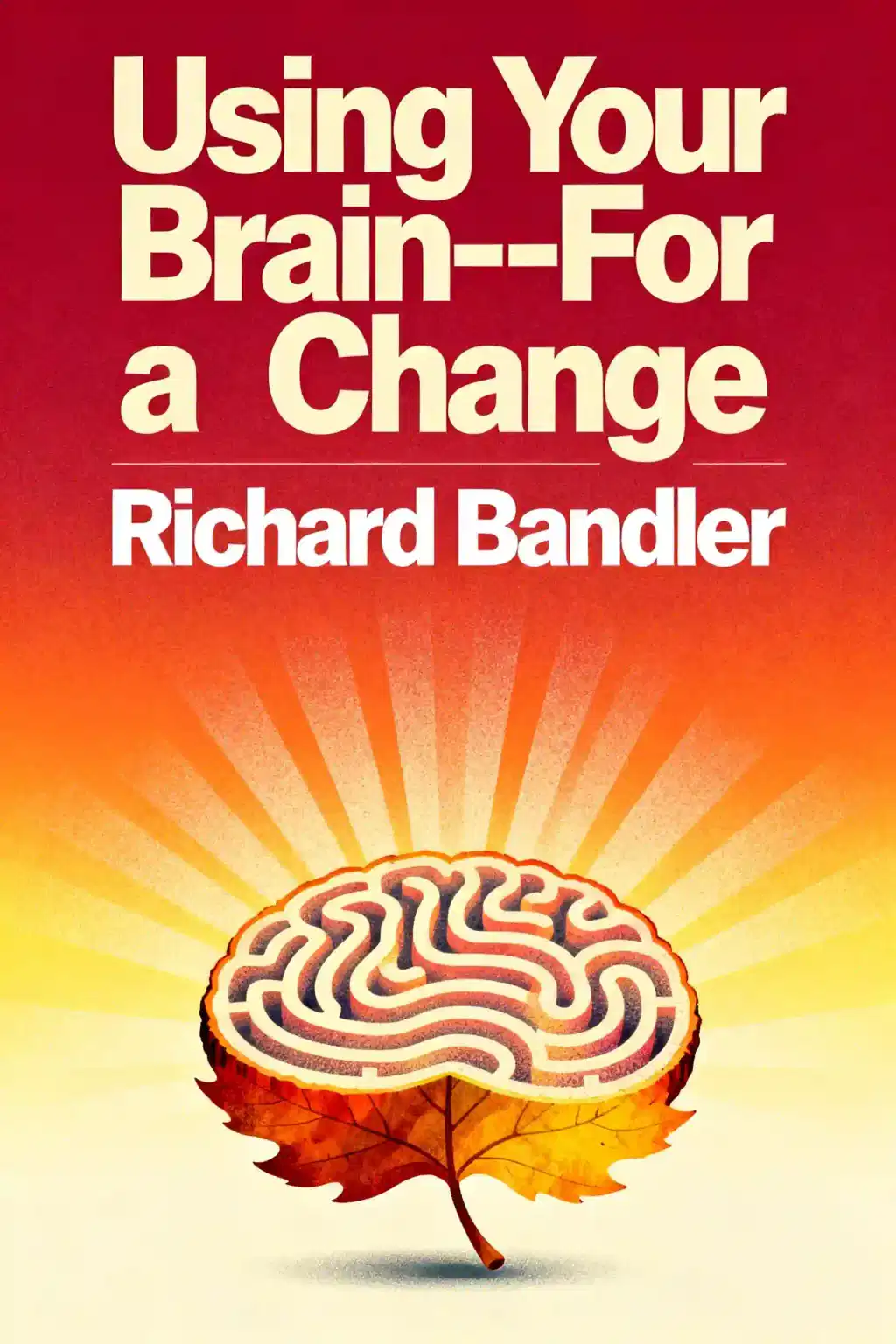
Richard Bandler's groundbreaking work has revolutionized how we understand the mind, earning him a devoted following among everyone from corporate executives to therapists. "Using Your Brain for a Change" has become a cornerstone text in the personal development world, with figures like Tony Robbins citing it as a major influence. What makes this book particularly fascinating is how it contradicts conventional psychology-while traditional therapy might take months or years to create change, Bandler demonstrates techniques that can transform phobias, depression, and limiting beliefs in minutes. Despite initial skepticism from the academic community when first published in the 1980s, these methods have since been validated through decades of practical application, making this work as relevant today as when it first appeared. The book's central premise is deceptively simple yet revolutionary: we can learn to consciously control the unconscious processes that drive our emotions and behaviors.
Kapitel 2
The Autopilot Problem: Taking Control of Your Mental Bus
Most people don't deliberately use their brains-they let their minds run on autopilot. Your brain, like a machine without an off switch, constantly generates internal experiences even without external stimulation. It often replays unpleasant memories or creates anxiety about future events that may never happen. "Most people are prisoners of their own brains," Bandler explains. "It's as if they are chained to the last seat of the bus and someone else is driving."
This mental autopilot creates strange contradictions in our behavior. Many people claim they don't have photographic memories, yet they can vividly recall unpleasant experiences repeatedly. We meticulously plan for disappointment by creating expectations that reality can't match. The problem isn't that our brains can't learn-it's that they learn too quickly and too well, even absorbing useless or harmful patterns.
Phobias demonstrate this remarkable learning capacity: one traumatic experience creates such thorough learning that a person reliably produces terror at every encounter with the trigger. We learn faster than computers, often through single-trial experiences, linking sensations and responses automatically like Pavlov's dogs. This rapid associative learning happens constantly, as when a song becomes forever linked with memories of a special person.
Therapists unknowingly create problems by linking negative feelings to neutral contexts. For instance, couples therapists who have partners air grievances while maintaining eye contact inadvertently connect negative feelings to their partner's face. Virginia Satir uses the same linking process constructively by having couples recall positive memories while looking at each other.
Unlike traditional psychology with its extensive manual of disorders and not a single page describing health, Bandler approaches human change as a modeling problem-figuring out how to replicate successful human behaviors rather than analyzing why people are "broken." The goal isn't discovering truth but finding processes that work. Even seemingly bizarre behaviors like psychosis have systematic structures that can be understood and modified with the right approach.
Kapitel 3
The Submodality Revolution: Simple Adjustments, Profound Changes
I want to teach you how to run your own brain through simple experiments with your subjective experience. When you think of a pleasant memory, try changing its brightness and notice how your feelings intensify when it's brighter and diminish when it's dimmer. Most people let their brains randomly show them pictures, feeling good or bad in response, but you can intentionally control these images. The same works with size-bigger pictures usually intensify feelings, smaller ones diminish them.
These aren't metaphors but literal descriptions of internal experience. You can also vary color, distance, depth, duration, clarity, contrast, scope, movement, speed, hue, transparency, aspect ratio, and orientation to change how you feel. Combine these elements for even more powerful effects.
What's amazing is how some people do it backwards-remembering good experiences as dim and distant while recalling bad ones vividly. People often revise their past negatively, like the woman who let one spilled coffee "ruin" an entire evening, or dieters who discount months of success after one setback. Even "depressed" people have had as many happy experiences as others-they just view them through gray lenses rather than rose-colored ones.
Nobody stays in one state of consciousness continuously. When someone claims they've been depressed for sixteen years, they're ignoring all the times they've felt different emotions. If you did anything continuously, habituation would make it imperceptible. People often depress themselves through internal voices that sound slow and list failures, or through mental pictures of past failures or future disasters. These processes usually happen unconsciously, giving them more hypnotic power.
We have a remarkable ability to act as if things are normal under any circumstances, whether in New York City or a mental hospital. The danger in many therapeutic approaches is that people learn sequences, not just content. In Gestalt therapy, for example, you learn: feel bad, hallucinate someone, get angry and violent, then feel better. This pattern, removed from the therapeutic context, isn't something we'd consider healthy in daily life.
Modifying past experiences is actually quite easy. For "briefest therapy," take an unpleasant memory and add circus music to it. This typically transforms a tragedy into comedy. If circus music doesn't work, experiment with other soundtracks. Another technique is to run bad memories backwards quickly, like rewinding film. These simple interventions can instantly change how you feel about past events that have bothered you for years.
Kapitel 4
Shifting Perspectives: The Power of Mental Position
When people say "You're not looking at it from my point of view," they're often literally correct. Try viewing an argument where you were certain you were right from different perspectives-especially from over the other person's shoulder, watching yourself. This simple shift can dramatically change your certainty about being right (from about 95% to 5%). You can view events from any spatial position-as a neutral observer from the side, from above, or even metaphorically from a child's or elderly person's perspective.
When something bad happens, some people cope by saying "In a hundred years, who'll know the difference?" This works because they're literally seeing their problems from far away-like viewing Earth from space-making their troubles appear tiny in comparison. Similarly, the phrase "Later, when you look back at this, you'll be able to laugh" hints at a mental process that transforms unpleasant experiences into humor. Why wait years to feel better?
When you're associated in a memory, you relive it through your own eyes, seeing exactly what you saw when you were there. You can't see your face unless you're looking in a mirror. When dissociated, you observe yourself from outside-like watching a movie of yourself. These perspectives create vastly different emotional responses. Associated memories bring back all the original feelings, while dissociated memories let you see yourself having those feelings without experiencing them directly.
The ideal is to associate with pleasant memories to enjoy positive feelings, while dissociating from unpleasant ones to learn from them without suffering again. Many people do the opposite-associating with painful experiences while keeping pleasant ones distant and dissociated.
Phobias can be cured in minutes by using dissociation techniques. The process involves imagining yourself sitting in a movie theater, seeing a black-and-white snapshot of yourself before the phobic situation. Then float to the projection booth where you watch yourself watching yourself. Turn the snapshot into a black-and-white movie of the experience, then jump inside and run it backwards in color in just seconds. This works because the brain learns through rapid pattern recognition, not slow, gradual exposure.
People naturally associate and dissociate from memories in relationships. To fall in love, associate with all pleasant experiences with someone while dissociating from unpleasant ones. After marriage, many reverse this process-associating with unpleasant experiences and dissociating from pleasant ones-then wonder why their partner "changed." Even after a relationship ends, you can still enjoy pleasant memories by staying associated with them.
Kapitel 5
Prevention vs. Reaction: Stopping Problems Before They Start
This section examines how we often try to correct problems after they've already occurred, rather than taking preventative measures to ensure things go right from the start. Bandler illustrates this with examples like imagining a spouse's affair before it happens, which can lead to jealousy and actually create the problem we fear. He challenges our tendency to make ourselves miserable by anticipating negative outcomes, and questions our excuses for unhappiness like "I wasn't myself" or "I lost control." Instead of continuing behaviors that don't work, he suggests trying something completely different.
Bandler demonstrates through dialogue with a participant named Jo how people often seek to become better at confrontation rather than preventing problems in the first place. Jo initially wants to improve her confrontational skills when people "damage her integrity," but through questioning, Bandler helps her realize there might be better approaches. He uses restaurant service as an example, suggesting that treating waiters well first creates better service than confronting them after poor service. This illustrates his point that being considerate ahead of time is more effective than trying to correct problems after they occur.
Bandler continues exploring how people create unnecessary problems by reacting after things go wrong instead of preventing issues. Using dialogue with Jo, he shows how she can be pleasant to waitstaff immediately upon entering restaurants rather than confronting them after poor service. He explains how people often make situations worse by connecting negative feelings to others' faces, creating cycles where they feel bad both when someone is absent and when they return. Bandler challenges the meta-patterns of obligation in relationships, suggesting people focus on feeling lucky about what they have rather than what's missing.
Kapitel 6
Transforming Inner Critics: From Enemies to Allies
Bandler begins by criticizing psychological models like Transactional Analysis that divide people into parts (parent, adult, child), comparing them to old beliefs about demonic possession. He suggests these models lack individuality and impose artificial constraints on human interaction. He then transitions to addressing internal critical voices, preparing to demonstrate techniques for working with them using a volunteer named Fred who reports having a constant critical voice.
Bandler demonstrates how to transform critical internal voices by asking Fred to discover the positive intention behind his critical voice. Fred learns his voice wants him to succeed but uses criticism ineffectively. Through a reframing process, Fred's voice transforms from a harsh critic to a friendly helper by changing its tone and approach. Bandler notes this is part of "Reframing" techniques useful in therapy, business, and self-improvement.
Bandler explores two major motivation patterns: most people motivate themselves by thinking about negative consequences (aversive conditioning), while others like Marge use pleasant feelings to move toward desired outcomes. Some combine both approaches. While all motivation strategies work, some are faster, more tenacious, and more enjoyable. People with positive motivation strategies live in a world with less anxiety, unpleasantness, and stress. Many therapy clients struggle either with lack of motivation for desirable behaviors or motivation toward unwanted behaviors. Bandler emphasizes that understanding how motivation works gives people control over what they're motivated to do.
Kapitel 7
From Confusion to Clarity: Restructuring Mental Experience
Bandler introduces a process for transforming confusion into understanding by identifying the structural differences between these two internal experiences. He demonstrates with Bill, having him compare his confusion (a small, distant, silent slide) with his understanding (a large, close movie with narration). By changing the structure of confusion to match understanding-making it a movie, adding narration, and bringing it closer-Bill achieves understanding without adding new information. Bandler explains that confusion often indicates too much poorly organized information rather than too little information. The demonstration shows how rearranging existing knowledge can create understanding.
After participants practice the confusion-to-understanding process with partners, Bandler explores the variety of understanding strategies people use. These include: stabilizing rolling images, backing away from overwhelming panoramas, creating diagrams to condense information, using multiple clear pictures simultaneously, positioning images in different spatial locations, and even deliberately blurring focused images. Bandler emphasizes that each understanding strategy works well in some contexts but poorly in others. He suggests that learning multiple ways of understanding expands one's abilities and opens new possibilities, recommending participants try experiencing their partner's understanding process.
Participants share their experiences of trying on their partner's understanding processes. One man discovers his partner's abstract, fuzzy rainbow understanding gives him better people insight though worse mechanical comprehension. A woman finds her actor partner's overlapping associated and dissociated pictures provide valuable perspective on how others see her. Bandler notes only 8 of 60 participants naturally shared similar understanding processes, and describes a successful businessman who alternates between associated and dissociated perspectives when visualizing projects.
Bandler distinguishes between useful and useless types of understanding. He criticizes three types: understanding that merely justifies inaction, understanding that provides only a good feeling without actionable insight, and understanding based on impressive-sounding concepts that don't change behavior. He emphasizes that the only valuable understanding is one that allows you to do something different. Bandler argues that confusion is actually beneficial-it's the doorway to new understanding and reorganizing experience in novel ways.
Bandler identifies three "diseases" that cause people to get stuck: seriousness (which blinds and impedes), certainty (which stops thinking and noticing), and importance (which creates artificial hierarchies and justifies destructive behavior). He illustrates how these three reinforce each other-you become serious about something you're certain is important, and then stop thinking altogether.
Kapitel 8
Belief Systems: The Architecture of Possibility
Bandler introduces beliefs as durable organizers of behavior that can compel people to take extraordinary actions. While beliefs aren't innate and can change over time, they powerfully shape our responses to the world. By understanding how beliefs are mentally represented, we can learn to change limiting beliefs into empowering ones.
Bandler demonstrates how to change beliefs by first identifying the submodality differences between belief and doubt in a person's mental representation. Working with Lou, he discovers that changing the position of her belief picture transforms it into doubt, causing physical sensations as the old belief weakens. He then guides her through replacing the old belief with a new, positive one framed as a process rather than an end goal. After checking for potential problems with the change, he has Lou move the old belief to the doubt position, replace its content with the new belief, then move it to the belief position. The transformation creates profound physical and emotional shifts for Lou, showing how quickly beliefs can be changed when properly approached.
After demonstrating the belief change process, Bandler has participants practice in groups and share their experiences. Participants report profound internal reorganizations, including changing beliefs about weight loss struggles, health issues, and learning abilities. Bandler emphasizes that changing core beliefs creates more striking changes than peripheral ones. He warns about firewalking as a belief change method, noting it lacks control over what new beliefs get installed and reinforces the idea that change requires dramatic external events. He explains that firewalking itself isn't particularly difficult, analyzing the physics of heat transfer and contact time. Bandler concludes by stressing the importance of carefully selecting new beliefs that are ecological, process-oriented and positive.
Kapitel 9
Reimagining Education: How We Really Learn
Bandler critiques educational systems for teaching content without teaching how to learn. He notes that teachers often know their subject but not how they learned it or how to teach it effectively to others with different cognitive styles.
Bandler addresses how negative feelings about school subjects become triggers that prevent learning. He demonstrates a simple technique called "integrating anchors" by having participants with math anxiety alternate between looking at equations and recalling pleasant experiences. He suggests always connecting learning with enjoyment rather than boredom and discomfort, noting that computer-assisted education can be beneficial because computers have "infinite patience" and don't make students feel bad.
Bandler explains that visual memory is often more efficient than auditory memory. When remembering visually, the entire picture appears at once, allowing quick access to information, while auditory memory requires sequential recitation. He notes that "slow learners" often simply use auditory rather than visual memory strategies. Bandler describes memory techniques from people with phenomenal memories, such as attaching distinctive visual features to names or using "drop tag codes"-unique identifiers that link information together. He emphasizes being efficient with memory by creating consistent habits (like always putting keys in the same pocket) and organizing information based on existing knowledge patterns. Chunking information into meaningful groups (like recognizing 149162536496481100 as squares of numbers 1-10) makes complex information easier to remember.
Bandler critiques the concept of "learning disabilities," arguing these labels merely describe teaching failure without addressing it. He notes the education system blames students' brains rather than examining teaching methods, calling it a "teaching dysfunction" rather than a learning disability. He challenges outdated neurological dogma about brain function, citing examples of brain adaptability like college graduates functioning with minimal cortex and canaries growing new neurons seasonally. Bandler insists reading isn't difficult-it simply connects written words with sounds and meanings children already know. He mentions an NLP-trained group in Denver that guarantees raising reading levels by at least one grade in eight sessions, demonstrating these "disabilities" can be overcome with proper teaching approaches.
Kapitel 10
The Swish: Programming Your Brain's Direction
Bandler explains the Swish pattern as a powerful directional technique for the brain. He demonstrates how it works by having Jack visualize his nail-biting cue (hand coming up), then create a small dark image of himself without the habit. The process involves rapidly "swishing" these images-making the small self-image grow larger and brighter while the nail-biting cue simultaneously shrinks and dims. After five repetitions, Jack can no longer maintain the nail-biting image, and when tested behaviorally, his hand stops before reaching his mouth. Bandler emphasizes that the Swish doesn't eliminate compulsion but redirects it toward becoming the person you want to be. He shares success stories including helping a woman overcome a worm phobia and another quit smoking after eleven years of trying. The technique is more generative than specific behavior substitution because it creates a direction for personal evolution rather than just a single new response.
Bandler provides a step-by-step guide to the Swish pattern: (1) Identify the context where you're stuck, (2) Create a cue picture of what you see just before the unwanted behavior, (3) Create an outcome picture of yourself as you'd be after the change, (4) "Swish" the images by starting with the large bright cue picture and a small dark outcome picture, then rapidly making the outcome grow bright while the cue shrinks and dims, and (5) Test by attempting to recreate the cue picture or the actual behavior. He emphasizes that seeing yourself in the outcome picture but not in the cue picture is essential for the pattern to work effectively.
Bandler distinguishes the Swish from earlier NLP techniques by explaining its generative nature. Rather than substituting a specific behavior or simply anchoring a feeling of confidence, the Swish creates directional change toward becoming a different kind of person. He warns against merely creating confidence without competence, noting that many people ask therapists for confidence when what they really need is competence. The Swish pattern avoids this pitfall by setting a direction for personal evolution that generates many new specific behaviors rather than just one alternative response.
The key to an artistic Swish is tailoring it to how each person's brain naturally codes experience. Bandler demonstrates this with a woman suffering from "anticipatory loss" who panicked when people were late. While the standard size-based Swish had little impact, using distance worked perfectly because she naturally spoke about wanting to "distance herself" from fear. When gathering information, Bandler frames limitations as achievements-something learned that can be taught-asking clients "How would I do your problem if I had to fill in for you?" This reveals the critical submodalities driving the unwanted response, which can then be used to design a personalized Swish pattern.
Kapitel 11
Beyond Techniques: The Spirit of Curiosity
The essence of NLP is an attitude of curiosity and a desire to influence things in worthwhile ways. Bandler emphasizes that anything can be changed, but the more interesting question is whether that change is useful. He encourages practitioners to approach their work with genuine curiosity rather than certainty, as certainty often prevents further learning. The most powerful learning often comes from remaining open to new perspectives, even from unexpected sources.
Bandler illustrates this through personal anecdotes about learning from others who didn't recognize him. He urges readers to make everything into an "introductory seminar" by maintaining curiosity and avoiding the trap of thinking they already know everything. The generative approach sees even problematic behaviors as achievements that can be redirected, rather than simply viewing them as defects to be fixed.
With the ability to drive your own mental "bus" comes the responsibility to decide where to go-to create a life of curiosity and enthusiasm rather than merely "waiting in line." This perspective transforms how we approach both our own minds and the challenges we face in daily life. By understanding the structure of our internal experience and learning to modify it deliberately, we gain access to resources and possibilities that were always present but previously inaccessible.
What makes these techniques so revolutionary is not just their effectiveness but their accessibility. They don't require years of therapy or special equipment-just a willingness to pay attention to your internal experience and experiment with changing how you represent things to yourself. The simple act of brightening a memory, changing its size, or viewing it from a different perspective can transform your emotional response to it instantly. And with practice, these skills become automatic, allowing you to navigate life's challenges with greater flexibility and resilience.
The ultimate message is one of empowerment: your brain is an incredibly sophisticated tool that you can learn to use deliberately rather than being used by it. The choice is yours-continue letting habitual patterns run your life, or take the driver's seat and steer toward the experiences and outcomes you truly desire.