Inside the secretive Bank for International Settlements, where unelected bankers shape global finance. Adam LeBor's explosive expose - translated into 12 languages - reveals Nazi gold transactions and shadowy power structures that sparked comparisons to the populist thinking behind Brexit and Trump.
Adam LeBor is the acclaimed author of Tower of Basel: The Shadowy History of the Secret Bank that Runs the World and an investigative journalist specializing in international finance, European history, and covert institutions. This groundbreaking work of investigative non-fiction exposes the secretive Bank for International Settlements—a complex financial enterprise founded in 1930 that serves as the central bank for central banks—drawing on LeBor's decades of experience as a foreign correspondent covering central and eastern Europe for The Times, The Independent, and The Economist.
LeBor has authored nine non-fiction books, including the Orwell Prize-shortlisted Hitler's Secret Bankers, which exposed Swiss complicity with the Nazis, and City of Oranges, a New York Times Editor's Choice. He also writes thriller novels and currently contributes to the Financial Times, where he reviews financial and political books. LeBor works as an editorial trainer for Economist Education and the Financial Times, and serves as a journalism tutor at Budapest's Mathias Corvinus Collegium.
His books have been published in fourteen languages, including Chinese, Hebrew, and Japanese, establishing him as a leading voice on financial secrecy and institutional accountability.
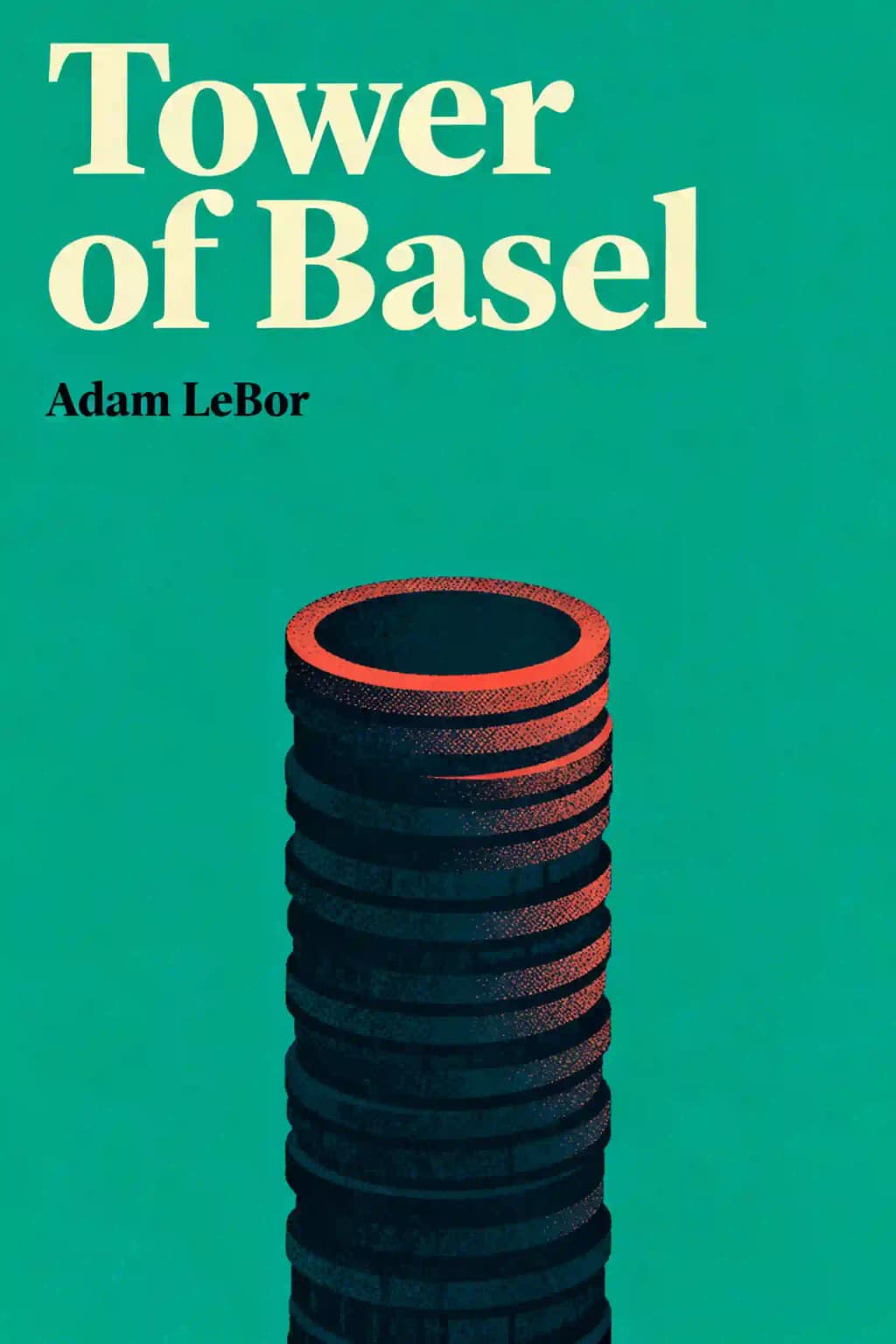
Tower of Basel by Adam LeBor is an investigative history of the Bank for International Settlements (BIS), the world's most secretive global financial institution. The book exposes the BIS's controversial role during World War II, when it accepted looted Nazi gold and facilitated transactions for the Reichsbank, while examining its continued influence over global monetary policy through closed-door meetings of central bank governors.
Adam LeBor is a British investigative journalist and author who worked as a foreign correspondent covering Hungary, central Europe, and the Balkans for The Times, The Independent, and The Economist. He has written nine non-fiction books, including Hitler's Secret Bankers, which was shortlisted for the Orwell Prize. LeBor specializes in exposing financial secrecy and European political affairs, with his work published in fourteen languages.
Tower of Basel is ideal for readers interested in global finance, central banking, economic history, and institutional power. Bankers, policymakers, economists, and investigative journalism enthusiasts will find value in LeBor's examination of financial secrecy. It's particularly relevant for those seeking to understand the hidden mechanisms behind international monetary policy and the accountability gaps in global financial institutions that shape economic outcomes.
Tower of Basel is worth reading for its groundbreaking research into an opaque institution, featuring exclusive interviews with Paul Volcker and Sir Mervyn King. However, critics note the book leans toward exposé rather than balanced history, with an emotional tone that some find borders on conspiratorial. It offers valuable insights into central banking secrecy but should be read alongside more neutral sources for complete perspective.
The Bank for International Settlements (BIS) is the central bankers' own bank, created in 1930 by the governors of the Bank of England and Reichsbank. Protected by international treaty, the BIS operates beyond any government's legal reach, with Swiss authorities having no jurisdiction over its premises or assets. With just 140 customers, it generated tax-free profits of $1.17 billion in 2011-2012 while coordinating global monetary policy.
Adam LeBor argues in Tower of Basel that the BIS is an opaque, elitist, and anti-democratic institution inappropriate for the 21st century. He criticizes its exemption from Swiss banking laws, lack of media access to confidential discussions, excessive profitability for a tax-exempt entity, and historical complicity with Nazi Germany. LeBor calls for reforms to increase transparency and accountability, though some reviewers find his conclusions harsh and unjustified.
Tower of Basel reveals that under American president Thomas McKittrick (1940-1946), the BIS remained open throughout World War II, accepting looted Nazi gold and conducting foreign exchange deals for the Reichsbank. LeBor argues the institution became a de facto German-controlled bank despite having non-German leadership, serving as a secret contact point between Allied and Axis powers to keep international finance channels open during wartime.
Tower of Basel differs significantly from Liaquat Ahamed's Lords of Finance, which offers a balanced history of modern central banking. While Ahamed provides scholarly analysis, LeBor writes from a more skeptical, investigative journalism perspective similar to his earlier work Hitler's Secret Bankers. Critics describe Tower of Basel as more exposé than historical review, with emotional undertones and focus on victimization that sets it apart from academic financial histories.
Tower of Basel profiles Thomas McKittrick (BIS president during WWII), Hjalmar Schacht (Reichsbank president), Montagu Norman (Bank of England governor), Allen Dulles (OSS director), Henry Morgenthau (Treasury Secretary), and Harry Dexter White. LeBor accuses McKittrick and Norman of actions bordering on treason for maintaining BIS operations that benefited Nazi Germany. The book uses these biographical narratives to illustrate broader institutional controversies.
Tower of Basel exposes how the BIS functions as a meeting ground where Federal Reserve, European Central Bank, and Bank of England officials coordinate policies largely shielded from public oversight. LeBor argues this arrangement reflects dominance by a transnational financial elite whose decisions profoundly affect global economies without democratic scrutiny. The book highlights the institution's role in developing Basel Committee banking standards and facilitating central bank cooperation.
Critics note Tower of Basel offers little new information about BIS wartime activities, as an independent academic review was published in 2005 by Cambridge University Press. The book's sensationalist title and emotional tone risk undermining scholarly credibility, with reviewers describing it as having "obvious bias." Some argue LeBor doesn't adequately explain the BIS's successful post-war evolution and valuable contributions to modern financial stability through data collection and research.
Tower of Basel identifies the Euro as a significant global contradiction—a transnational currency lacking transnational fiscal policy. Adam LeBor explains this represented a political compromise that overruled concerns from the Committee of Central Bankers at the BIS. His interviews with key bankers and use of primary sources provide insightful perspectives on European Community integration, though critics note there's limited new analysis compared to existing scholarship.
Erlebe das Buch durch die Stimme des Autors
Verwandle Wissen in fesselnde, beispielreiche Erkenntnisse
Erfasse Schlüsselideen blitzschnell für effektives Lernen
Genieße das Buch auf unterhaltsame und ansprechende Weise
The BIS was actually created to promote central bank cooperation free from political interference.
The BIS found itself "at the heart of the first experiment ever of a multilateral attempt at managing an international financial crisis."
Central banks and warfare had long been intertwined.
Schacht turned against the bank he helped create.
This chemical conglomerate was essentially a parallel state that would become an unprecedented synthesis of finance capital and mass murder.
Zerlegen Sie die Kernideen von Tower of Basel in leicht verständliche Punkte, um zu verstehen, wie innovative Teams kreieren, zusammenarbeiten und wachsen.
Erleben Sie Tower of Basel durch lebhafte Erzählungen, die Innovationslektionen in unvergessliche und anwendbare Momente verwandeln.
Fragen Sie alles, wählen Sie Ihren Lernstil und gestalten Sie Erkenntnisse, die wirklich zu Ihnen passen.

Von Columbia University Alumni in San Francisco entwickelt
"Instead of endless scrolling, I just hit play on BeFreed. It saves me so much time."
"I never knew where to start with nonfiction—BeFreed’s book lists turned into podcasts gave me a clear path."
"Perfect balance between learning and entertainment. Finished ‘Thinking, Fast and Slow’ on my commute this week."
"Crazy how much I learned while walking the dog. BeFreed = small habits → big gains."
"Reading used to feel like a chore. Now it’s just part of my lifestyle."
"Feels effortless compared to reading. I’ve finished 6 books this month already."
"BeFreed turned my guilty doomscrolling into something that feels productive and inspiring."
"BeFreed turned my commute into learning time. 20-min podcasts are perfect for finishing books I never had time for."
"BeFreed replaced my podcast queue. Imagine Spotify for books — that’s it. 🙌"
"It is great for me to learn something from the book without reading it."
"The themed book list podcasts help me connect ideas across authors—like a guided audio journey."
"Makes me feel smarter every time before going to work"
Von Columbia University Alumni in San Francisco entwickelt

Erhalten Sie die Tower of Basel-Zusammenfassung als kostenloses PDF oder EPUB. Drucken Sie es aus oder lesen Sie es jederzeit offline.
Imagine a circular tower in Basel, Switzerland, where eighteen unelected individuals meet every other month to make decisions that affect your daily life - from mortgage rates to job security. These central bankers control the global money supply and set interest rates that ripple through economies worldwide. Their meetings occur behind closed doors, their communications protected by diplomatic immunity, and their staff enjoy generous tax-free salaries. Welcome to the Bank for International Settlements (BIS) - arguably the world's most powerful and secretive financial institution. Founded in 1930 ostensibly to manage German war reparations, the BIS actually emerged as a sanctuary where central bankers could coordinate global finance away from political interference. Today, when these governors meet, they represent countries comprising four-fifths of global GDP - wielding more practical power than most elected officials on earth. Yet how many people even know this institution exists? What makes this story fascinating isn't just the concentration of power, but how this secretive club has survived - and thrived - through economic collapse, world war, and financial crises. The BIS has reinvented itself repeatedly, from managing Nazi gold to architecting the euro to designing the regulations that govern your bank account today.
In summer 1929, as the Great Depression loomed, Montagu Norman-the eccentric, manic-depressive governor of the Bank of England-envisioned a sanctuary where central bankers could coordinate global finance without political interference. The BIS was established to manage Germany's $29 billion war reparations over 58 years. Norman ensured the bank's founding statutes protected it from government oversight, creating an institution with unprecedented independence. When Nazi Germany appointed Hjalmar Schacht as Reichsbank president in 1933, he regained his BIS board seat. After Jewish vice president Carl Melchior was forced to resign, the bank expressed regret but took no action, citing neutrality. His replacement was Baron Kurt von Schroder-a Nazi-affiliated banker who had helped Hitler rise to power. Hermann Schmitz of IG Farben, which later ran a concentration camp at Auschwitz, subsequently joined the board. When Nazi Germany annexed Czechoslovakia's Sudetenland in 1938 and demanded Czech gold reserves from a BIS account, Norman authorized the transfer without hesitation, prioritizing the bank's "independence" over Britain's security interests, ultimately financing Hitler's war machine.
As war approached in 1939, the BIS appointed American Thomas McKittrick as president to maintain neutrality. Despite this claim, the BIS effectively functioned as a Reichsbank extension-accepting looted Nazi gold, recognizing Nazi annexations, and allowing Axis powers to control 67.4% of voting stock. McKittrick maintained friendship with Reichsbank vice president Emil Puhl even after America entered the war. Puhl himself called the BIS the Reichsbank's "only real foreign branch." Most disturbing were BIS transactions involving valuables stolen from concentration camp victims. Despite Treasury Secretary Morgenthau's efforts to dissolve the BIS at the 1944 Bretton Woods conference, the bank survived. In May 1948, the BIS secured immunity by returning 3.74 metric tons of looted gold to Belgium and the Netherlands. With American backing through the Marshall Plan, European integration accelerated, leading to the 1950 European Payments Union with the BIS as its agent-transforming from Nazi collaborator to architect of European integration in just five years.
By 1970, the BIS had evolved from controversial origins into a confident institution central to global finance, expanding membership beyond Europe. The bank built a modern headquarters-a striking circular tower with bronze-tinted windows and national flags-replacing its previously discreet location beside a chocolate shop. During the Cold War, the BIS served as neutral ground between Communist and capitalist worlds, with central bankers from behind the Iron Curtain becoming valuable intelligence sources. When Hungary faced financial crisis in 1982, BIS President Fritz Leutwiler arranged a crucial bridging loan that bolstered economic reformers, ultimately contributing to Hungary opening the Iron Curtain in 1989-a pivotal moment in Communism's collapse. By the 1990s, European monetary integration threatened the BIS's relevance. Under Andrew Crockett's leadership, the bank "went global," with the Federal Reserve finally joining in 1994, followed by central banks from China, India, Russia, Brazil, and Saudi Arabia by 1996.
Today's BIS wields enormous influence through global financial regulation. The Basel Committee dictates bank capital requirements worldwide, affecting everything from mortgages to business loans. The bank has become "the vampire squid of the regulatory world," spawning numerous committees that shape global financial governance. The BIS played a crucial role in creating the euro, with Alexandre Lamfalussy leading the European Central Bank's precursor. Launched in 1999, the euro represented decades of European integration, economically binding Germany to Europe while emphasizing price stability. Critics like Rupert Pennant-Rea called the euro "a monstrous creation" driven by Franco-German politics. The Eurozone suffered from two fundamental flaws: uniting economically diverse countries and lacking a credible transnational fiscal system. As Lamfalussy admitted, "if you have a common currency you have to have a common economic and fiscal policy from the beginning." The 2008 financial crisis only strengthened the BIS, with profits nearly doubling to $1.17 billion by 2012. Today, the bank hosts bimonthly meetings of central bankers controlling over four-fifths of global GDP.
The BIS tower stands as a modern Tower of Babel, housing those who believe they possess a mandate to manage the global economy. Despite today's transparency demands, this institution remains remarkably opaque-opening historical archives while concealing current operations, governors' meetings, and central bank transactions. In an era increasingly suspicious of unelected elites making decisions behind closed doors, the BIS faces growing criticism. To survive, it must reform through greater transparency, accountability, and responsibility: public press conferences, published attendance lists and discussion themes, and removal of its extraordinary legal immunities. Throughout history, the BIS has demonstrated remarkable adaptability, reinventing itself from the Nazi era through the euro's birth to today's regulatory committees. Amid public hostility toward bankers, it now emphasizes its role serving the common good. The fundamental question remains: should decisions affecting billions be made by unelected technocrats meeting in secret? The Tower of Basel symbolizes both financial cooperation and economic power beyond public scrutiny.
The BIS functions as a coordination center for global economic challenges. During the 2008 crisis, it provided a forum for central bankers to coordinate responses, despite its research department having warned of dangerous imbalances years earlier-warnings that growth-focused policymakers largely ignored. During the pandemic, the BIS facilitated unprecedented central bank cooperation to prevent economic collapse. Its research now addresses digital currencies, climate finance, and risks of prolonged low interest rates that will influence the global economy for decades. Critics note a democratic deficit in the BIS structure, where technocratic expertise outweighs political accountability. Defenders counter that central bank independence prevents short-term political interests from destabilizing the financial system. This tension between expertise and democracy will shape the BIS's future. The bank's evolution from its compromised wartime role to its current position atop global finance demonstrates how institutions can transform while maintaining their core purpose: providing central bankers a protected space largely shielded from democratic oversight.