Kapitel 1
What If Humans Vanished Tomorrow?
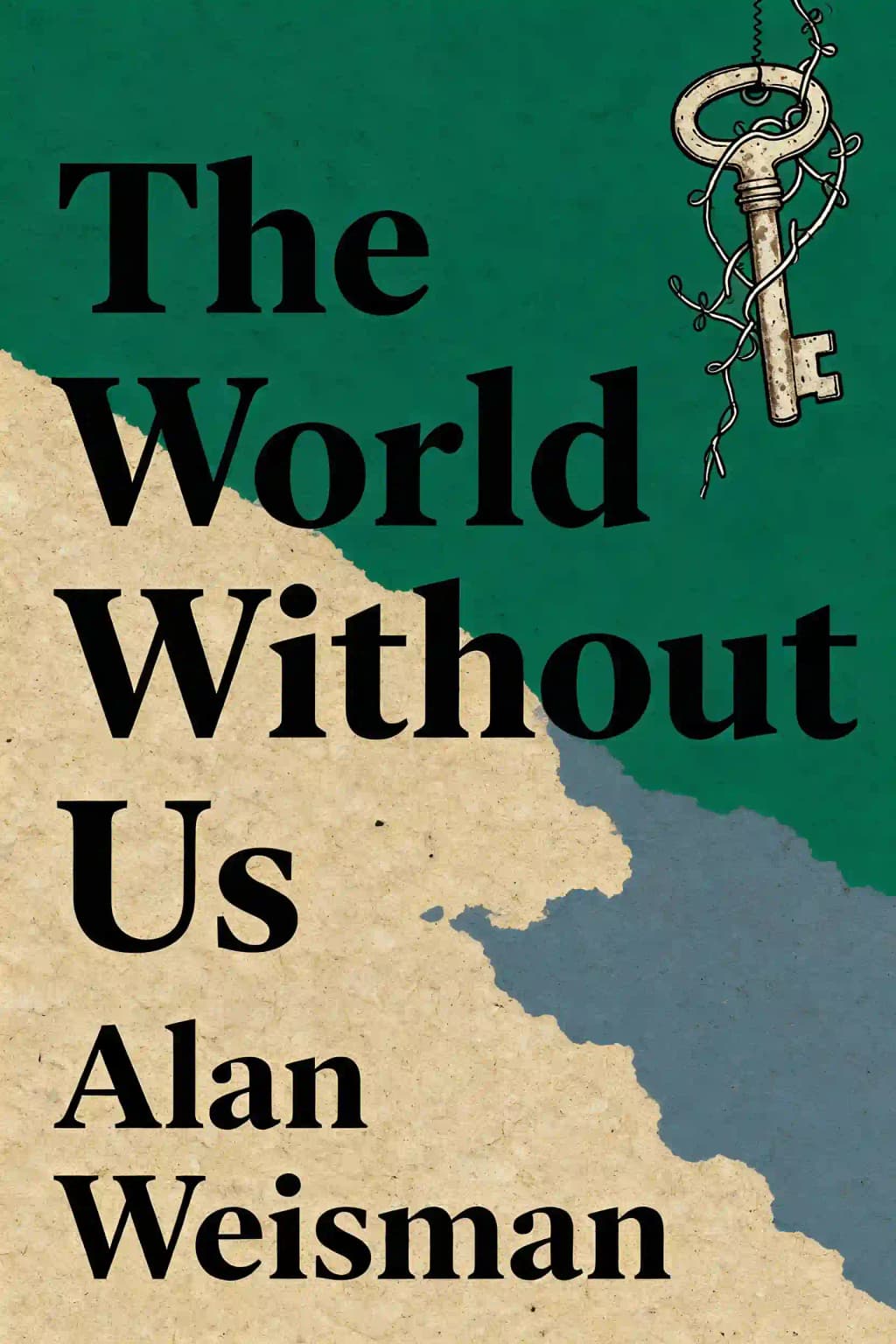
Imagine waking up to a world where every human has mysteriously disappeared overnight. Cities stand empty, power grids fail, and wild animals cautiously explore suburban streets. This thought experiment forms the fascinating premise of Alan Weisman's "The World Without Us," a book that became an unexpected cultural phenomenon upon its 2007 release. Selected as Time Magazine's #1 non-fiction book that year and translated into 34 languages, Weisman's exploration captivated readers across political spectrums-from environmentalists to industrialists-by removing humans from the equation while allowing us to witness what unfolds. Rather than a doom-laden ecological sermon, Weisman offers a strangely hopeful vision of Earth's resilience, examining both what we've irreparably changed and what might recover in our absence. The book's enduring appeal lies in its central question: without constant maintenance, how quickly would nature reclaim what we've built, and what permanent marks would remain of our civilization?
Kapitel 2
The Last Witnesses
One June morning in 2004, elderly Zapara tribeswoman Ana Maria Santi sat observing her intoxicated companions during a communal minga (work gathering) in the Ecuadorian Amazon. Her tribe, once 200,000 strong and spanning vast territories across the upper Amazon basin, had been devastated during the brutal rubber boom of the early 1900s when Henry Ford's automobile revolution created an insatiable demand for rubber that led to their enslavement and near-extinction. By 1999, only four fluent speakers of their ancient language remained alive, each carrying centuries of accumulated knowledge about the rainforest's medicinal plants, spiritual practices, and oral histories. When offered monkey meat during the gathering, Ana Maria refused with tears in her eyes, asking poignantly: "When we're down to eating our ancestors, what is left?"
This haunting question frames humanity's broader predicament in the modern age. Though we've managed to avoid nuclear annihilation, we've systematically damaged the planet's vital systems - depleting topsoil at alarming rates, contaminating freshwater aquifers, and driving countless species toward extinction. The question becomes particularly relevant when considering a thought experiment: What if humans suddenly vanished tomorrow? How would nature respond without our constant interventions and pressures? Could natural processes eventually restore an Eden-like state, break down our concrete cities, neutralize our toxic legacies? Would any of our monuments, technologies, or cultural artifacts endure the test of time?
The Biaowieza Puszcza, a ancient forest straddling the border between Poland and Belarus, offers compelling clues to these questions. This last remaining fragment of Europe's primeval lowland forest has miraculously survived seven centuries of monarchs, wars, and dictators, but now faces its greatest existential threat under modern democratic systems as forestry ministries promote "scientific management" - often a euphemism for harvesting irreplaceable mature hardwoods. The forest feels primally familiar to visitors, containing ten times more biodiversity than managed woodlands, with ancient oaks, lindens, and hornbeams creating a cathedral-like canopy. Forest ecologist Andrzej Bobiec has spent decades reading human history through its charcoal layers, strategic tree stands, and ancient burial sites, revealing a complex story of human-nature interaction spanning millennia.
Despite the political divisions between Poland and Belarus, the forest is actually expanding as rural populations abandon traditional farmland - a phenomenon occurring across much of Eastern Europe. Given 500 years without human interference, studies suggest a true primeval forest could return across the continent, though some species like the European bison may paradoxically require human intervention to remove barriers between isolated herds and maintain genetic diversity. This pattern of abandonment and natural reclamation would likely repeat worldwide if humans disappeared, with nature reclaiming developed areas at surprising speed - sometimes within decades rather than centuries. Urban areas would be colonized by pioneer species, followed by increasingly complex ecological successions, gradually erasing many traces of human civilization.
Kapitel 3
When Our Homes Become Habitats
Nature begins reclaiming our homes immediately after we're gone. The process starts with water infiltration through the roof-shingles separate around chimneys, water seeps beneath them onto plywood sheathing, and nails rust. As moisture penetrates, mold develops, secreting enzymes that break down cellulose and lignin. Without maintenance, structural integrity fails within decades.
Within 50-100 years, most houses collapse entirely as trusses fail, walls lean, and roofs cave in. Wildlife hastens the process, creating nest holes while weather degrades siding materials. Even "maintenance-free" materials like vinyl and aluminum eventually succumb.
After 500 years in temperate climates, forests reclaim suburbs, with only certain metal items-stainless steel cookware, aluminum parts-remaining recognizable. Desert dwellings fare differently, with metals corroding faster in salty soils while wood lasts longer. Only our most durable structures-those made from granite blocks rather than concrete-might persist for millennia.
The notion that nature could swallow something as colossal as a modern city seems inconceivable, yet the process would begin swiftly with an attack on the urban underbelly. In New York, where 13 million gallons of groundwater must be pumped daily from subway tunnels, the absence of human maintenance would prove catastrophic. Without electricity powering the 753 pumps that keep water at bay, subway tunnels would flood within 36 hours.
As water seeps beneath streets, soil erodes and pavement begins to crater. Within 20 years, water-soaked steel support columns corrode and buckle, causing thoroughfares to collapse and form rivers. The freeze-thaw cycle cracks asphalt and cement each spring, creating entry points for opportunistic plants. Chinese ailanthus trees-already notorious urban invaders-take root in tiny chinks and heave up sidewalks within five years.
Eric Sanderson's Mannahatta Project at the Wildlife Conservation Society reconstructs pre-urban Manhattan as it existed in 1609. Their work reveals an island crisscrossed by more than 40 brooks and streams, with hills that gave Manhattan its Lenni Lenape name. The modern sewer system closely follows these buried watercourses, though artificial drainage proves less efficient than nature's original design-a vulnerability that would hasten the city's dissolution in humanity's absence.
Kapitel 4
The Climate After Us
For over a billion years, ice sheets have advanced and retreated from the poles in regular cycles. Normally, New York would be due for another glacier soon-the last one departed 11,000 years ago, and interglacial periods typically last 12,000-28,000 years.
But our atmospheric alterations have changed this schedule. Atmospheric scientist Tyler Volk explains that even if humans vanished tomorrow, our carbon dioxide legacy would persist. The oceans would absorb much of the excess CO2 over about 1,000 years, but returning to pre-industrial levels requires the rock cycle-where carbonic acid weathers silicates into carbonates-which takes roughly 100,000 years.
During this recovery period, Earth's climate could follow several paths: a prolonged warm period with palmettos and armadillos replacing oaks and moose in New York; or paradoxically, if Greenland's melting disrupts ocean currents, a regional cooling bringing tundra to the East Coast. Either way, rising seas from melted ice caps could reduce Manhattan to just a few elevated outcroppings, with most buildings eventually succumbing to the waves.
Lake Tanganyika in East Africa, formed in the Great African Rift Valley 15 million years ago, provides an extraordinary climate archive through its sediment layers. These cores reveal how jungle gradually transformed to fire-tolerant miombo woodland as humans discovered burning could create grasslands to attract game. The sediments document the Iron Age's deforestation and agricultural development, preserving 100,000 years of pollen layers that could potentially yield 10 million years of Earth's climate history-spanning the entire timeline of human evolution.
East Africa's fossil sites reveal humanity's African genesis. At Olduvai Gorge, the Leakeys discovered 1.75-million-year-old hominid skulls and stone tools dating back 2 million years. Nearby, 3.5-million-year-old footprints preserved in volcanic ash pushed back our bipedal timeline. These sites confirm we're all Africans-our evolution beginning when we walked upright for hundreds of thousands of years before creating tools.
As ice ages cycled, our ancestors migrated beyond Africa, crossing the Bering land bridge from Siberia to Alaska through an ice-free corridor during the last ice age. With oceans 300 feet lower due to frozen water, humans picked their way around meltwater lakes to reach North America. Meanwhile, farming knowledge from the Middle East spread southward along the Nile and back to Africa, arriving during a time of climate-induced food scarcity.
Kapitel 5
The Animals That Vanished
Thomas Jefferson, mockingly called "Mr. Mammoth" by political opponents during his 1808 trade embargo crisis, was fascinated by giant fossil bones found at Kentucky's salt licks. As a passionate naturalist, he collected mammoth remains and even instructed Lewis and Clark to search for living specimens during their expedition. Jefferson rejected the concept of extinction, believing "no instance can be produced of nature having permitted any race of her animals to become extinct." Yet the mammoth bones weren't deeply fossilized, suggesting these creatures had disappeared relatively recently-raising questions about what had happened to them.
Paleoecologist Paul Martin's groundbreaking theory emerged from studying ancient sloth dung in Rampart Cave at the Grand Canyon. This discovery led Martin to develop his controversial "Blitzkrieg" theory: when humans arrived on new continents, they rapidly hunted megafauna to extinction. In North America alone, at least 70 genera of large mammals vanished within about 1,000 years of human arrival 13,325 years ago. These included ground sloths (some elephant-sized), mammoths, mastodons, horses, camels, and giant predators.
The strongest evidence supporting Martin's theory: ground sloths survived 5,000 years longer on Caribbean islands humans reached later, and mammoths survived on isolated Wrangel Island until just 4,000 years ago. New Zealand's massive flightless moa birds, weighing 600 pounds and standing taller than ostriches, survived until just before Columbus's time, vanishing shortly after human colonization.
In Africa, unlike other continents, humans and megafauna evolved together, creating a delicate balance that allowed large mammals to survive. This paradox-why Africa still has its famous big-game menagerie when humans decimated megafauna elsewhere-lies at the heart of understanding our species' impact on the natural world.
Africa remains a continent-sized museum of large mammals that survived human predation. The secret to African megafauna's survival was co-evolution-zebras developed confusing stripes, animals formed multi-species alliances combining different sensory strengths, and all developed wariness of human predators. This evolutionary dance created an equilibrium where both predator and prey survived, unlike the catastrophic impact when humans suddenly appeared in the Americas.
Kapitel 6
What Falls Apart, What Endures
In 1976, British electrical engineer Allan Cavinder received an unexpected call to repair the air conditioning at a hotel in Varosha, Cyprus-a resort abandoned during the 1974 war between Greek and Turkish Cypriots. Entering the ghost town, he found it eerily preserved: hotel registers still open to August 1974, keys at reception desks, coffee cups on tables. Yet nature was already reclaiming the space-three-foot Australian wattle trees sprouted from streets, creepers snaked across roads, and pigeons colonized hotel balconies.
By 1980, when Turkish journalist Metin Munir became the first reporter allowed inside, tiny cyclamen flowers had cracked concrete slabs, demonstrating how "soft is stronger than hard." Three decades later, Varosha remains abandoned-its buildings beyond salvage, bougainvillea consuming houses, and sea turtles nesting on beaches once crowded with tourists.
While ancient monuments like Istanbul's magnificent Hagia Sophia may endure for millennia due to their massive stone construction, modern buildings face swift destruction. Engineer Mete Sozen warns that Istanbul's explosive growth to 15 million inhabitants has created catastrophic vulnerability, with over one million multi-story concrete buildings of poor quality jammed into narrow streets. When the inevitable North Anatolian Fault earthquake strikes, at least 50,000 buildings will collapse.
In a post-human world, freeze-thaw cycles would gradually reduce earthquake rubble to soil. Wooden Ottoman mansions would burn without firefighters to intervene. Even mosque domes would eventually succumb as mortar deteriorates and stones fall, leaving only temple walls-still standing but buried, like those of 4,000-year-old Troy.
Underground structures would fare better. Istanbul's planned subway system, including a line beneath the Bosphorus connecting Europe and Asia, would likely survive intact long after the city above has crumbled. In Cappadocia, Turkey, humanity's underground legacy runs even deeper. Here, ancient peoples carved elaborate cave dwellings into hillsides and built vast underground cities like Derinkuyu, descending at least 18 stories and housing up to 30,000 people. These subterranean metropolises will outlast nearly all other human structures, preserving evidence of our existence long after we're gone.
Kapitel 7
Our Toxic Legacy
In Plymouth, England, marine biologist Richard Thompson studies the proliferation of plastic debris along coastlines. His research reveals that approximately 20 percent of beach sand now contains plastic particles, with at least 30 pellets per handful. These "nurdles"-raw materials of plastic production-travel great distances via ocean currents before being deposited on shores worldwide. Most troubling is that these particles, suspended in water, become available for consumption by marine organisms from lugworms to zooplankton, often with fatal consequences.
Plastics have natural counterparts that have existed for millions of years-polymers like spider silk, cellulose, lignin, and human collagen. The modern plastics era began when chemist Leo Baekeland created Bakelite by mixing phenol with formaldehyde. After World War II diverted most plastic to military purposes, a "torrent of products the world had never seen" entered consumer markets, transforming modern life.
Captain Charles Moore discovered the consequences in 1997 when sailing through the North Pacific Subtropical Gyre-a Texas-sized ocean span between Hawaii and California. Moore found himself crossing a sea covered with floating refuse-cups, bottle caps, fish netting, polystyrene packaging, plastic bags and countless other plastic debris. His research revealed that 80 percent of this mid-ocean flotsam originated on land, with calculations estimating 3 million tons of plastic in the gyre. Most shockingly, when he returned with trawling equipment, he found six times more plastic than plankton by weight on the ocean's surface.
The plastic debris in our oceans doesn't merely float harmlessly-it becomes a magnet for toxins. Tokyo University geochemist Hideshige Takada discovered that nurdles and other plastic fragments act as sponges for persistent poisons like DDT and PCBs. The concentration effect is staggering-plastic pellets eaten by birds concentrate poisons to levels one million times their normal occurrence in seawater.
Polymer expert Dr. Anthony Andrady delivers a sobering assessment: virtually every piece of plastic manufactured in the last 50 years-now exceeding 1 billion tons-still exists somewhere in the environment. While plastics can photodegrade when UV rays break their polymer chains, they degrade much slower in water where they're cooled and often shielded by algae. Even when they disintegrate into smaller pieces, their chemical nature remains unchanged for centuries or millennia.
Kapitel 8
The Nuclear Shadow
Nuclear power's deadly legacy would outlive us by centuries. If humans vanished tomorrow, we'd leave behind 30,000 intact nuclear warheads that wouldn't explode spontaneously but would eventually corrode, exposing their deadly contents. Weapons-grade plutonium-239, with a half-life of 24,110 years, would remain lethal long after bomb casings disintegrated. Even a millionth of a gram can cause lung cancer. It would take 250,000 years before plutonium's radiation levels merged with Earth's natural background radiation.
Nuclear power plants like Arizona's 3.8-billion-watt Palo Verde operate by using uranium fuel rods to heat water into steam that drives massive turbines. Each year, about 30 tons of spent fuel accumulates at Palo Verde alone, stored first in cooling pools and then in dry casks because there's nowhere else to put it. Globally, 441 nuclear plants produce nearly 13,000 tons of high-level waste annually.
Without human maintenance, cooling pond water would evaporate, exposing fuel rods to air. The zirconium cladding would ignite, causing radioactive fires to breach the relatively weak storage building roofs. Even if reactors were properly shut down before human disappearance, emergency generators would run out of diesel within days. Cooling water would eventually boil away, leading to core meltdowns. The resulting steam explosions and fires would release massive amounts of radiation that would persist for geological timeframes.
After Chernobyl's disaster, nature has shown surprising resilience in the 30-kilometer "Zone of Alienation." Despite radiation that has eaten holes in the hastily-built concrete sarcophagus, wildlife has returned-birds nest inside the structure itself, while forests have regrown with irregular branches and needle patterns. The contaminated area has become home to roe deer, wild boars, moose, lynx, and wolves. Even endangered black storks and eagles soar above the dead cooling towers.
Despite this apparent recovery, the radiation's effects remain devastating-Chernobyl's swallows show lower survival rates than migrants elsewhere, and studies reveal genetic mutations in local voles. Should the world's 441 nuclear plants be abandoned, their cooling ponds dry and cores melt, the radioactive clouds would be far more widespread and deadly than Chernobyl's fallout.
Kapitel 9
Earth's Future Symphony
If humans suddenly vanished, many wild species would hardly notice our absence, particularly those in remote habitats. Even endangered animals might celebrate our departure, as we often represent their greatest threat. The creatures who would genuinely miss us are those that evolved specifically to live on us-head and body lice, follicle mites, and approximately 200 bacteria species genetically customized to human bodies.
The domestic cat may be our most devastating legacy for birds. While purring on our furniture, Felis silvestris catus retains all its wild hunting instincts. When introduced to the Americas, these silent, tree-scaling predators encountered birds with no evolutionary defenses against them. Even well-fed cats hunt relentlessly, with rural Wisconsin's two million free-ranging cats alone killing between 7.8 and 219 million birds annually.
In a world without humans, what would become of birds? Of the more than 10,000 avian species that have coexisted with us, only about 130-barely more than 1 percent-have disappeared. Yet these losses include some spectacular extinctions: the 10-foot-tall moas of New Zealand, the famously trusting dodo of Mauritius, the penguin-like great auk, and Hawaii's leaf-eating moa-nalo ducks.
The most sobering avian extinction was the American passenger pigeon-once the most abundant bird on Earth. Its flocks spanned 300 miles, numbering in the billions and darkening skies for hours as they passed overhead. These beautiful dusky blue, rose-breasted birds were larger and more striking than common city pigeons, and unfortunately for them, reportedly delicious. Their story serves as a stark warning that what we consider limitless in nature rarely is.
Beyond physical artifacts, our electromagnetic transmissions may be our most enduring legacy. Since the 1890s when Tesla and Marconi pioneered radio, our signals have been expanding outward at light speed. Though weakening with distance, these waves theoretically continue forever. The first I Love Lucy episodes passed our nearest star in 1955 and will emerge from the top and bottom of our galaxy around AD 2450. As these signals travel billions of light-years, they'll be increasingly redshifted and compete with cosmic background radiation, but they remain theoretically detectable. "Whoever awaits our news at the edge of time will get an earful. They may not understand Lucy, but they will hear us laugh."
Kapitel 10
Nature's Resilience
Scientists from Scripps Institution of Oceanography journey to Kingman Reef to establish a baseline for healthy coral ecosystems untouched by humans. What they discover challenges conventional ecological wisdom-the food pyramid appears inverted, with large predators like sharks and red snappers constituting more biomass than their prey. The expedition follows a gradient of decreasing human population through the Line Islands, revealing how human presence correlates with declining reef health and predator populations.
At Kingman Reef, the expedition confirms a paradox: the abundance of predators actually drives faster reproduction among prey species. Like frequently mowed grass, heavily predated fish populations reproduce more rapidly. The reef's complex architecture provides hiding places for small fish to breed before becoming shark food. This efficient conversion of plant and algae nutrients through short-lived prey species results in apex predators accumulating most of the biomass-a stunning 85 percent of Kingman's total biomass consists of sharks, snappers, and other carnivores, inverting the traditional ecological pyramid.
At Palmyra Atoll, nature steadily reclaims human structures as concrete slabs crumble beneath nesting terns and a rusted radar antenna disappears among palms. Enric Sala believes that without human interference, these reefs could recover their prehistoric complexity within centuries. Despite global warming's threats, he envisions sea urchins, fish, and corals returning, creating oceans so teeming with predators that humans would fear entering them.
Nine hundred miles northwest of Palmyra lies Johnston Atoll, a marine Chernobyl where nuclear tests and chemical weapons incineration have left their mark. Despite this contamination, the coral appears relatively healthy, with angelfish displaying genetic mutations but life persisting. Like Chernobyl, Johnston demonstrates that nature can withstand our worst assaults, though our everyday lifestyle causes more pervasive damage. Without human interference, dams would eventually silt up, rivers would again nourish seas, and life would begin anew.
Weisman confronts the elephant in the room: human overpopulation. With global population increasing by 1 million every four days, he proposes a radical solution-limiting every woman to one child. According to calculations by demographer Sergei Scherbov, this would reduce our population to 5.5 billion by 2050 (instead of 9 billion), 3.43 billion by 2075, and 1.6 billion by 2100-levels last seen in the 19th century. At such numbers, we could maintain technological progress while controlling our environmental impact, resulting in a world growing "more wonderful" with "refreshed air" and "more birdsong" outside every window.
In a poetic conclusion, Weisman contemplates how our brain's electrical impulses, like radio waves, continue traveling through space-suggesting our thoughts might someday return to haunt "our beloved Earth" long after we're gone. Without us, Earth will abide and endure; without her, however, we could not even be.