Kapitel 1
When Witches Speak Truth to Power
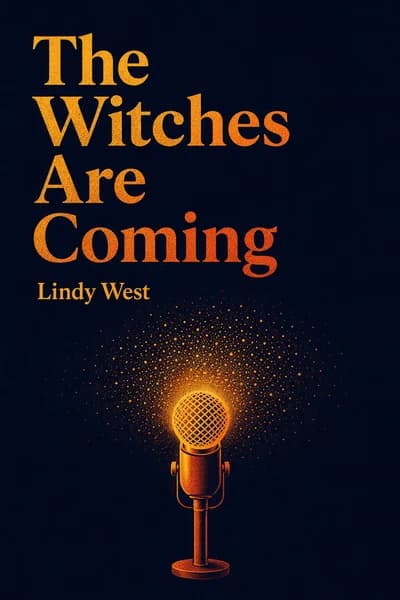
In a Chicago queer bar, a white man in his forties complains he's "NOT ALLOWED TO DANCE" because a woman rejected him. When advised he could dance without touching strangers, he asks for backup "if something goes wrong." This encounter perfectly captures our cultural moment - men confusing being asked to respect boundaries with being forbidden from basic human activities. When called out for wrongdoing, they claim to be victims of "witch hunts," a ridiculous comparison to historical witch trials where tens of thousands were tortured and executed. No one loves this deflection more than Donald Trump, who has tweeted "witch hunt" hundreds of times. But what if the witches really are coming - not with pitchforks and torches, but with truth and accountability? In her New York Times bestseller, Lindy West confronts our cultural myths with sharp humor and unflinching honesty, challenging us to examine who benefits when certain stories go unquestioned.
Kapitel 2
The Mythology of Male Mediocrity
I once set out to watch every major Adam Sandler movie to understand his cultural impact. After eight films and his 1993 comedy album, I realized something profound: there was never an Adam Sandler for girls. No one making blockbuster comedies about girls being gross and having fun.
From "Happy Gilmore" to "Little Nicky," Sandler's films follow a predictable formula: he plays a loser who's secretly THE BEST, talks in a funny voice, has anger issues that somehow benefit him, is secretly amazing at some sport or skill, urinates in public, behaves like a giant baby, and despite being deeply unappealing, attracts a beautiful woman. In "Big Daddy," he kidnaps a child and teaches him inappropriate behaviors while degrading Leslie Mann's character for working at Hooters to put herself through law school. In "That's My Boy," he plays a character who fathers a child with his middle school teacher - turning statutory rape into comedy.
These films normalize harmful ideas: women as prizes for male growth, women lusting after men who offer nothing, women shamed for their sexuality or punished for rejecting men. White men failing upward has become so normal it distorts our perception of quality. If Ellen Cleghorne had made something as terrible as "Little Nicky," would she have gotten to make seventy-seven more films? Or even one?
Yet Sandler was also a product of his time, reflecting those values while trying to make people laugh. The real problem isn't just the movies themselves but the emptiness around them - I don't begrudge straight white boys their abundance, I just wish the rest of us had had the same. When I saw Sandler host SNL years later, I unexpectedly cried watching the male cast members perform their Sandler impressions. They were simultaneously kids again and the men those kids dreamed of becoming. It was magical because Sandler was FOR THEM - in his worlds, comedy boys were king. Girls deserved more than just a reflected glow.
Kapitel 3
The Myth of Male Charm and Institutional Power
For as long as I can remember, I've been convinced a man would sneak into my house and murder me. When Netflix released their Ted Bundy documentary series in 2019, it was irritating watching everyone suddenly become Bundy experts. Some of us have had "List of serial killers by number of victims" bookmarked since 2006!
What strikes me most about Bundy isn't his supposed charisma but how little charisma he actually needed. Billy McFarland, the Fyre Festival con artist, is the most obvious bumbling dumbass ever birthed by the universe - yet good people were conned by him. Ted Bundy and Billy McFarland are both more charming than Donald Trump, who still pratfalled into becoming the most powerful man on earth.
America's bootstrap ethos conditions people to cheer deregulation and beg for the removal of consumer protections. We're literally asking to be conned. The past few decades have been a tug-of-war over the benefit of the doubt - Black Lives Matter demands white America adjust its assumptions about cops and criminals, while #MeToo demands we reexamine what credibility looks like. Institutional benefit of the doubt is monstrously powerful, turning lies into truth through incantation.
When Judge Edward Cowart sentenced Bundy to death, he still praised him: "You're a bright young man. You'd have made a good lawyer... I don't feel any animosity toward you." This isn't evidence of Bundy's charisma - it's evidence that men don't need charisma to succeed. I wonder how many of Bundy's victims would have made good lawyers. I wonder how many female lawyers Judge Cowart mentored.
Is there such a thing as a likable woman? Likability in a sexist, racist culture isn't objective - it's compulsory femininity, invisible labor, whiteness, smallness, sweetness. If someone is universally likable, I don't trust them. We will not play likability anymore - it's an endless runner game that keeps women from accruing real power. "Witch" is what we call a woman who demands the benefit of the doubt, who speaks truth, who punctures the con. A witch has power, and power in women isn't likable.
Kapitel 4
The Media That Shapes Us
Growing up, I didn't chafe at shallow representations of women on screen; I took notes. From makeover shows I learned I was ugly. From romantic comedies I learned stalking means he loves you. From Disney movies I learned if I made my waist small enough, a man might marry me. From "The Smurfs" I learned boys can have seventy-eight possible personalities and girls can have one: "high heels." From "The Breakfast Club" I learned rage is the selling point of an alluring bad boy, not the red flag of an abuser.
In "Revenge of the Nerds," the heroes install hidden cameras in women's bathrooms and commit sexual assault by deception. In "Weird Science," virgins just MADE A WOMAN. Remember Fat Monica? I need a separate therapist just for Fat Monica.
Two years after Weinstein's fall, Hollywood is in an unprecedented sociopolitical reckoning. To make that reckoning stick, we must examine how show business helped create this mess. No matter how many inspirational memes we create about equality, the culture that sells is still on-screen showing us how people are supposed to look and talk and fuck. I know what "The Bachelor" contestants look like. "The Biggest Loser" ran for seventeen seasons. Victoria's Secret won't feature trans or fat models because it's selling "a fantasy." Thin people would still do anything not to look like me.
What we need from Hollywood is about a hundred years of phase cancellation - not just neutrality or "nice," but new work that actively challenges old assumptions and offers radical models for how to conceive ourselves. We need artists and studios fighting for diversity because it's right.
Unseating powerful abusers is a start, but not an end unless we radically change the power structure and shared values. The solution? You do it. On my show "Shrill," we made choices about stories, characters, casting, writers, directors and crew. Whatever your sphere, you can make choices within it. Be a demon about diversity and never let anyone sleep.
Kapitel 5
The Complicated Relationship with Our Heroes
I've developed a minor ailment I'm not ashamed of but don't broadcast: I'm obsessed with "Guy's Grocery Games" and will watch as many consecutive episodes as the Food Network feeds me.
Guy Fieri does the same joke in every episode. When contestants are poised at the starting line awaiting his "Three, two, one, GO!" command, he tricks them with casual conversation. "You know, Three Dog Night is a great band. I saw them two years ago at Clearwater Casino. But they didn't play 'One (Is the Loneliest Number).' I had to go ask for my money back." As the contestants look confused, Fieri turns to the camera: "Not so quick, are they?" When they finally realize the countdown was hidden in his anecdote, they panic while Fieri luxuriates in his deception.
My favorite thing about Fieri is that he's objectively terrible at talking about food, saying only four things: "That's the real deal!" "You've got the salty from the pork, the sweet from the sauce, the crunchy from the lettuce!" "Killer!" and "This is Flavortown, baby." When he interacts with actual celebrity chefs, they show him kindness and encouragement rather than mockery. There's something endearing about his gaucherie - watching competent colleagues humor this saxophone of a man bungling around like a golden retriever is medicine during difficult times.
But if it's revealed Guy Fieri owns a puppy mill or did 9/11, he'll pass from my life like many before him. This is the slow work of progress.
Chip and Joanna Gaines of "Fixer Upper" fame are another comfort. Their formula is simple: live in Waco where mansions cost $74,000, knock down walls, cover everything in "shiplap," add a giant wall clock, hire a youth pastor/blacksmith to make custom art. Their charming banter and perfect relationship make them #goals.
But in 2016, BuzzFeed reported the Gaineses attended Antioch Community Church, whose pastor believes in conversion therapy for LGBTQ people - a cruel practice condemned by medical associations but still legal in 41 states. For the general public, the controversy didn't stick, but LGBTQ fans now have to think about it whenever they watch the show. People aren't binary; they're not good or bad. There's nothing wrong with asking for accountability from those we admire. Every person is, to varying degrees, a fixer upper.
Kapitel 6
The Wellness Industry's Class Problem
I traveled to Culver City for In Goop Health, Gwyneth Paltrow's inaugural "health and wellness expo" where women paid between $500-$1,500 to attend. Color-coded bracelets indicated whether you were a Lapis ($500), Amethyst ($1,000), or Clear Quartz ($1,500) Gooper, with more money buying more activities like foam roller workouts, "sound baths," or lunch with "GP" herself.
The venue featured wellness stations where Goop's "resident shaman" would tell you which crystal you needed, a tent for aura photography, an oxygen bar, and IV drips. Food came in tiny portions: vegan donuts, quinoa and lox in seaweed, unsalted bone broth. The Goop Marketplace sold face potions and the infamous $55 jade eggs that Goop suggested women carry in their vaginas.
In 2014, I tested Paltrow's diet book "It's All Good" for a week, spending $300 on three days' worth of groceries. The experience was a disaster: I nearly vomited from wet almonds (which Paltrow insists must be soaked to break down their difficult-to-digest enzyme coating), exploded soup in my blender, set chicken on fire, and made an avocado smoothie that "could give diarrhea an existential crisis" though Paltrow called it "beautiful."
Despite my mishaps, most recipes were actually delicious. But the diet required hours of daily chopping and cleaning, making it practical only for people with flexible schedules, disposable income, and household help - people with Clear Quartz bracelets.
The class implications of making wealth a prerequisite for "wellness" never came up at the expo. The women were having fun, connecting in the spontaneously intimate way women often do, just dressed in the language of magic and monetized wellness. I don't mock people who believe in crystals - it's not that different from organizing your life around Fitbits or bullet journaling, as long as you're not promising miracles or replacing vaccines with carnelian.
The event was shockingly white - I counted maybe ten people of color among hundreds of attendees. The panels avoided politics entirely, though you can't honestly address "wellness" without addressing poverty, racism, healthcare access, and reproductive rights - unless you're only talking about people who are already disproportionately well.
Kapitel 7
The Danger of False Equivalence
South Park is still on the air, though it premiered when I was a freshman in high school. Back then, it was considered so outrageous that my husband wasn't allowed to watch it growing up. In the 90s, South Park was seen as dangerously edgy content "BY BAD BOYS FOR BAD BOYS."
But now, creators Trey Parker and Matt Stone are middle-aged millionaire dads, yet we still treat South Park like the daring vanguard of counterculture. Their ideology hasn't perceptibly shifted in twenty-two seasons. For decades, they've positioned themselves as the only "Reasonable Men" who stand against both Right and Left, insisting both sides are equally stupid and worthy of mockery. They've created a neat trap: criticize the show, and you're just a moral scold, a "boring person." The only acceptable position is nihilistic detachment.
But both sides are not equally bad or stupid. This false equivalence has become extinction-level dangerous, especially regarding climate change. When Republicans are separating children from parents at the border and calling for a return to coal while we have perhaps thirty years before there's no more ice, smirking at liberals for being "social justice warriors" crosses from contrarianism into detached-from-reality psychopathy.
In 2018, the People for the American Way gave Parker and Stone a "Freedom Award." When accepting, they announced "We're republicans," causing nervous laughter from the liberal audience. But this wasn't news - they've been publicly identifying as Republicans since at least 2001. Their "South Park Republicanism" became a proto-alt-right movement of young white men who felt "bullied" by liberals and fought back with irreverence and vicious stereotyping.
The idea that "people on the far left and far right are the same exact person" is dangerous. While liberals are imperfect, Republicans literally want to strip healthcare, suppress wages, expand gun access, cage refugees, force unwanted births, roll back LGBTQ rights, and extract every last resource from our ecosystem until everything burns, starves or drowns. There is no cool version of conservatism - to conserve inherently means embracing stasis because the current system benefits certain people very well.
Kapitel 8
Abortion Stories as Radical Truth-telling
From the moment I considered turning my memoir Shrill into a TV show, I insisted on including an abortion in the pilot episode. I mentioned it repeatedly in every meeting, making it clear: "we're putting an abortion in the pilot, and we're doing it right." The resulting Hulu series features Annie Easton getting pregnant from casual sex and having an abortion simply because she doesn't want to be pregnant - a truth that "wanting an abortion is the same as needing an abortion."
The show depicts Annie receiving compassionate care at Planned Parenthood with her best friend beside her, feeling "relieved, grateful, and powerful" afterward. My real abortion was similar, except I went alone - something I might have done differently had I seen such representation on television. Annie's experience isn't universal - she's white, insured, and lives in a state without waiting periods or forced ultrasounds - but it represents countless underrepresented abortion stories like mine.
In 2015, while writing Shrill and amid national hysteria about Planned Parenthood "selling baby parts," my friend Amelia Bonow texted that she'd just posted about her abortion on Facebook. We'd recently discussed why so few friends knew about our abortions despite neither of us feeling ashamed. We realized abortion stigma was creating silence that anti-choice voices filled with lies.
When Amelia wrote "I have a good heart and having an abortion made me happy in a totally unqualified way," I shared it on Twitter with #ShoutYourAbortion. The hashtag exploded globally, with people sharing stories of freedom from shame, illegal abortions in religious countries, late-term procedures for nonviable pregnancies, and transgender experiences.
While anti-choice rhetoric remains monolithic and simplistic ("Life begins at conception," "Abortion is murder"), pro-choice messaging has struggled against this propaganda because most people who have abortions remain silent. We fall into defensive traps, arguing about extreme cases like child rape victims, when the fundamental truth is that abortion restrictions of any kind represent total disenfranchisement. We must stop treating such arguments as serious and instead flood the world with our real, complex abortion stories.
Kapitel 9
Online Radicalization and the Cost of Engagement
I've always played video games - from eight-bit Nintendo as a child to Dragon Age and Zelda as an adult - valuing them as escapes to closed, fixable universes where I can solve problems even when the real world feels overwhelming. Yet I've never called myself a "gamer," partly because I'm not especially skilled and partly because of the term's gatekeeping and baggage.
In 2014, Gamergate erupted when an angry man targeted his ex-girlfriend, a video game developer, claiming her success came not from talent but from "political correctness" and "fourth-wave feminism." This sparked a movement of men harassing women in gaming under the guise of "ethics in video games journalism." The movement became a gateway for radicalizing young men into more extreme ideologies.
Mike Cernovich exemplifies this trajectory - starting as a men's rights advocate who once targeted me with a bizarre weight-loss challenge video, he leveraged Gamergate to shepherd teenage boys toward white supremacy and fascism. By 2016, he was promoting Pizzagate conspiracy theories, and by 2017, he was photographed at the White House giving the alt-right "okay" sign - the same gesture later flashed by the New Zealand mosque shooter who murdered fifty Muslims.
I deactivated my Twitter account in 2017 because it felt like being in a nonconsensual BDSM relationship with the apocalypse. Twitter's platform enables Trump to spread lies, attack citizens, and undermine the press using the same troll playbook I've faced for years.
Despite years of harassment, those of us who complained were told we were too soft, while Twitter's leadership offered meaningless features instead of solutions. I discovered that internet trolls are often deeply unhappy people - a man who harassed me revealed in his YouTube videos that he was "unhappy with the way I look" and "not satisfied with myself as a man."
What actually stopped the harassment? Quitting Twitter. It works. Yet Twitter's leadership continues to drag their feet on addressing Nazis and white supremacy on their platform. I've lost a promotional platform, but gained peace. I don't wake up dreading what horrors accumulated overnight or waste hours blocking trolls. Sometimes it's okay to just let things go.
Kapitel 10
The Power of Women's Anger
I didn't call myself a feminist until I was nearly twenty because my world taught me feminists were ugly, angry, and ridiculous. I wanted male approval, not realizing that success and safety bestowed conditionally aren't really success and safety - they're domestication and implied violence. It took me two decades to become brave enough to be angry.
Women's anger is systematically weaponized against them. The men's rights movement was designed to provoke women's anger only to use it as evidence that women are "hysterical" and "hate men." They didn't fight for real men's issues but instead harassed women and advocated for horrific policies.
I wrote the statement that became infamous when a woman reading it was filmed, mocked, and turned into a meme for "feminist hysteria." This woman faced years of harassment, threats, and privacy violations - including being stalked by a liquor store employee who posted security footage of her online, leading to sexual assault threats.
Christine Blasey Ford's testimony against Brett Kavanaugh demonstrates this double standard perfectly. While she remained supernaturally poised and careful during her testimony about sexual assault, Kavanaugh was allowed to be openly angry and indignant. She lost despite her perfect composure; he won despite his rage. Ford now lives in hiding with security, while Kavanaugh sits on the Supreme Court.
Women are expected to absorb violence, discrimination, and subordination without complaint. When they do express anger, they're dismissed as irrational or emotional. But feminism itself is the collective manifestation of female anger - anger that men suppress for a reason.
Kapitel 11
Creating the Change We Need to See
In creating the TV adaptation of my memoir "Shrill," I made the show I needed when I was younger - stories featuring a fat character with a complex, dynamic life who has sex, has fun, and makes mistakes "that didn't involve cake pops." I promised to make a show where the fat protagonist never steps on a scale and sighs, and I delivered. Strangers regularly tell me how much it helped them.
However, visibility isn't justice. Despite my success breaking into Hollywood's beauty-obsessed infrastructure, real-world discrimination persists. I describe medical professionals dismissing my ankle injury (which turned out to be a bone spur) as a weight issue, the lack of clothing options for larger women, and how even for my own TV show about being fat, wardrobe had to custom-make almost all the clothes because nothing suitable was available.
When promoting Shrill at the Television Critics of America event, I was struck by how journalists fixated almost exclusively on Elizabeth Banks' appearance. Multiple reporters asked variations of "Elizabeth, you're gorgeous! Why would you be interested in this project?" - reducing the show to a simplistic conversation about body size rather than its artistic and political merits. Even after Banks attempted to redirect conversation to her directorial ambitions and feminist storytelling, the questions continued about her physical appearance.
Despite the #MeToo movement and some progress, fundamental cultural attitudes remain deeply entrenched. A few powerful men losing jobs and a few women gaining power doesn't change how people think on a large scale. "The hardest truth to swallow isn't that this cultural moment-the reckoning, the witches are coming, the last straw-is not a finish line but that there may be no finish line at all. Maybe we will have to fight forever."
Kapitel 12
Hope in the Face of Climate Crisis
Climate change has transformed my beloved Pacific Northwest, with summer wildfires bringing smoke that chokes the city and obscures landmarks. I recall the first summer when all mountain snow melted, now an annual occurrence, and weather forecasts reading "89 degrees, smoke." The smoke-filled air creates a claustrophobic preview of what's coming if climate change continues unchecked.
Though daily life continues with mundane normalcy for many Americans, we're "well past the window of procrastination." Human-made climate change can be unmade by humans, but requires more than individual actions like composting or banning straws. We need to "remember what a society is for" and recognize our collective duty to prevent suffering.
I describe my personal grief about climate change, recounting sobbing into my husband's back in "absolute true fucking grieving terror" after reading a post suggesting we've missed the window to prevent climate collapse. I rail against politicians who mock climate concerns while bragging about increased oil production. Despite my despair, I rally: "Do not despair. Despair is the death of action." The world is "beautiful and good and worth saving" and we must fight through daily civic engagement, calling representatives, marching, and voting for leaders who will protect the planet.
The concept of a "liberal elite" evolved from leftist critiques of Soviet bureaucrats into a right-wing propaganda tool. This strategy serves to stigmatize the very concept of care itself - for the environment, for vulnerable communities, for the future - as weakness, enabling the powerful to strip away rights and protections while citizens "weep for the guns."
Despite the overwhelming noise of the Trump era, we've finally named problems long kept in shadow. As the 2020 campaign begins, I remember my husband calling the 2016 election "part of the Civil War." Those who believe straight white men have a mandate to burn the rest of us as fuel never truly conceded that war. But I live in the America that won-with art, empathy, free press, and fierce protest. We've won this war before and will win again. The witches are coming, not for your life but for your lies, your legacy, and our future.