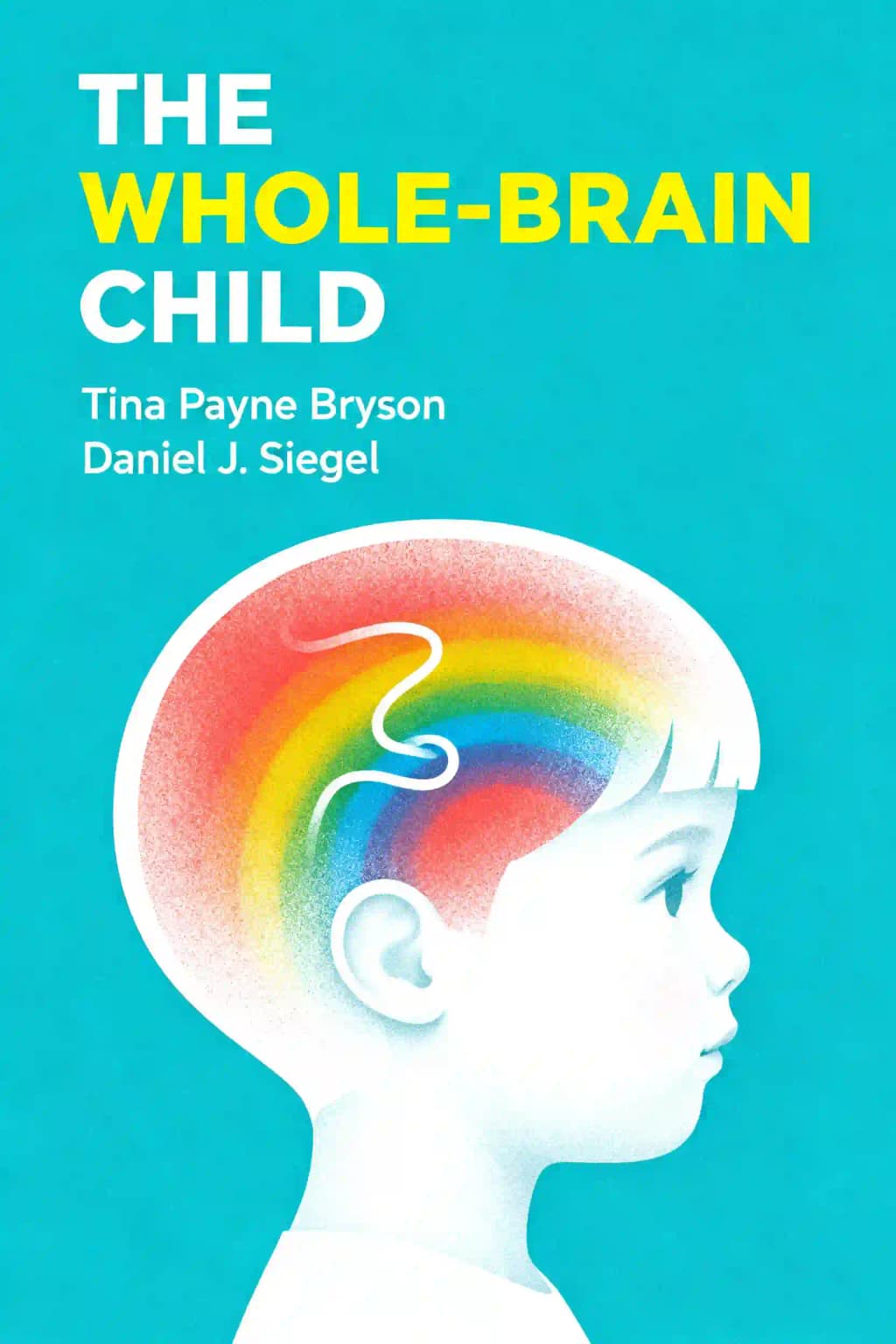
Revolutionize your parenting with "The Whole-Brain Child," the bestseller translating complex neuroscience into 12 practical strategies. With 4,000+ glowing reviews and endorsed by parenting expert Dr. Laura Markham, discover why "Connect and Redirect" is transforming how we nurture resilient, emotionally balanced children.
Tina Payne Bryson, Ph.D., and Daniel J. Siegel, M.D., co-authors of the New York Times bestseller The Whole-Brain Child, are renowned experts in child development and neuropsychiatry. Bryson, a pediatric psychotherapist and founder of the Center for Connection, combines clinical expertise with practical parenting strategies.
Siegel, a clinical professor of psychiatry at UCLA and executive director of the Mindsight Institute, bridges neuroscience with everyday parenting challenges. Their collaborative work explores brain-based approaches to nurturing emotional resilience, conflict resolution, and healthy cognitive development in children.
The duo’s partnership extends to other influential parenting guides like No-Drama Discipline and The Yes Brain, which expand on their integrative strategies for fostering emotional intelligence. Siegel’s groundbreaking Mindsight and Bryson’s Bottom Line for Baby further cement their authority in developmental psychology.
With translations in over 40 languages and global recognition from educators and mental health professionals, The Whole-Brain Child has sold more than 3 million copies worldwide, establishing Siegel and Bryson as leading voices in science-backed parenting.
The Whole-Brain Child explains how neuroscience can inform parenting strategies to foster children’s emotional and cognitive development. It introduces 12 actionable techniques to help kids integrate brain functions (like logic and emotion) during conflicts, tantrums, or everyday interactions. The book emphasizes connecting with children through play, storytelling, and empathy to build resilience and self-awareness.
Parents, educators, and caregivers of children aged 0–12 will benefit most, though strategies can adapt for teens and adults. It’s ideal for those seeking science-backed methods to handle meltdowns, improve communication, and nurture emotional intelligence. Teachers also use its insights for classroom management and conflict resolution.
Yes—it blends cutting-edge neuroscience with practical tools, making complex concepts accessible. Parents praise its actionable advice for calming tantrums, improving cooperation, and strengthening parent-child bonds. Over 1 million copies sold and its status as a New York Times bestseller reflect its impact.
The “upstairs brain” (prefrontal cortex) handles logic, decision-making, and emotional regulation, while the “downstairs brain” (primitive regions) governs survival instincts like fight-or-flight. When melted down, children operate from the “downstairs brain,” requiring calming techniques before problem-solving. Integration of both regions promotes resilience.
It shifts from punishment to integration: redirecting outbursts by addressing underlying emotions (right brain) before logic (left brain). For example, validating feelings (“You’re upset”) before discussing consequences. This builds neural pathways for self-regulation and empathy.
Yes. Strategies like “name it to tame it” encourage labeling emotions to reduce tension. The book also teaches parents to model conflict resolution and guide kids in repairing relationships, fostering empathy and problem-solving skills.
Some note its examples reflect Western cultural norms, potentially limiting relevance for non-Western families. Others caution that applying strategies requires consistency, which busy parents may find challenging. However, its core principles are widely praised as universal.
Unlike behavior-focused guides (e.g., 1-2-3 Magic), it prioritizes brain integration and emotional connection. It complements No-Drama Discipline (by the same authors) but is more neuroscience-focused. Montessori educators also endorse its child-centered approach.
Toddlers to preteens (0–12) gain the most, but teens can adapt techniques like “sifting through memories” to process experiences. The book’s metaphors (e.g., “Name it to tame it”) work for all ages.
It debunks myths, explaining memories are reconstructed, not stored intact. Parents learn to help kids reframe traumatic memories through storytelling, reducing emotional charge and promoting resilience.
Its neuroscience foundations remain valid, and its focus on emotional intelligence aligns with modern education and mental health priorities. Updated research continues to support its integrative approach to child development.
Key strategies include:
Erlebe das Buch durch die Stimme des Autors
Verwandle Wissen in fesselnde, beispielreiche Erkenntnisse
Erfasse Schlüsselideen blitzschnell für effektives Lernen
Genieße das Buch auf unterhaltsame und ansprechende Weise
What if those challenging moments weren't just obstacles to endure but opportunities to help your children thrive?
Achievement-obsessed parenting focuses instead on nurturing children's natural resilience.
Integration is the foundation of emotional health and the key concept for understanding how to help children thrive.
The brain's plasticity means it's constantly being rewired through experience.
Rather than seeing tantrums as manipulation requiring punishment, we can recognize when a child's upstairs brain has been hijacked.
Zerlegen Sie die Kernideen von The Whole-Brain Child in leicht verständliche Punkte, um zu verstehen, wie innovative Teams kreieren, zusammenarbeiten und wachsen.
Erleben Sie The Whole-Brain Child durch lebhafte Erzählungen, die Innovationslektionen in unvergessliche und anwendbare Momente verwandeln.
Fragen Sie alles, wählen Sie Ihren Lernstil und gestalten Sie Erkenntnisse, die wirklich zu Ihnen passen.

Von Columbia University Alumni in San Francisco entwickelt
"Instead of endless scrolling, I just hit play on BeFreed. It saves me so much time."
"I never knew where to start with nonfiction—BeFreed’s book lists turned into podcasts gave me a clear path."
"Perfect balance between learning and entertainment. Finished ‘Thinking, Fast and Slow’ on my commute this week."
"Crazy how much I learned while walking the dog. BeFreed = small habits → big gains."
"Reading used to feel like a chore. Now it’s just part of my lifestyle."
"Feels effortless compared to reading. I’ve finished 6 books this month already."
"BeFreed turned my guilty doomscrolling into something that feels productive and inspiring."
"BeFreed turned my commute into learning time. 20-min podcasts are perfect for finishing books I never had time for."
"BeFreed replaced my podcast queue. Imagine Spotify for books — that’s it. 🙌"
"It is great for me to learn something from the book without reading it."
"The themed book list podcasts help me connect ideas across authors—like a guided audio journey."
"Makes me feel smarter every time before going to work"
Von Columbia University Alumni in San Francisco entwickelt

Erhalten Sie die The Whole-Brain Child-Zusammenfassung als kostenloses PDF oder EPUB. Drucken Sie es aus oder lesen Sie es jederzeit offline.
Ever found yourself counting minutes until bedtime while your children bicker over the last cookie? What if these challenging moments weren't just survival situations but opportunities to help your children thrive? Since 2011, "The Whole-Brain Child" has transformed millions of families worldwide by offering a refreshing alternative to achievement-obsessed parenting. Instead of focusing solely on academic success or behavioral compliance, this approach nurtures children's developing minds by working with - rather than against - their brain's natural development. By understanding how children's brains actually function, we can turn everyday challenges into opportunities that build resilience, emotional intelligence, and authentic connection.
Think of your child's brain as a two-story house. The "downstairs brain" includes primitive structures handling basic functions, instincts, and strong emotions - fully developed at birth. The "upstairs brain" manages decision-making, emotional control, empathy, and morality but remains under construction until the mid-twenties. This explains why a six-year-old understands hitting is wrong yet still lashes out when frustrated. When a three-year-old melts down over missing popsicles, their amygdala floods with stress hormones, making rational thought impossible. Mental health resembles staying in a "river of well-being" - when in this flow, we understand ourselves and others, respond flexibly, and feel at peace. We can veer toward chaos (feeling overwhelmed) or rigidity (becoming inflexible). Integration means connecting different brain parts to work as a coordinated whole. Without it, children become overwhelmed, leading to meltdowns or withdrawal. The brain's "plasticity" means it constantly rewires through experience, with parents shaping this development through daily interactions. When two-year-old Marco experienced a car accident where his babysitter had a seizure, his mother helped him process the trauma by letting him repeatedly tell the story. Through validation, drawing, and play, she helped him express his feelings until the frightening experience became just another life event rather than trauma.
Our brain's hemispheres have distinct functions - the left prioritizes order and logic while the right processes emotions and holistic perspectives. Children start right-hemisphere dominant, experiencing life without words for their feelings. The persistent "Why?" questions of toddlers indicate left brain development. Healthy functioning requires hemispheric integration. Operating primarily from one side creates imbalance: the right brain alone creates an "emotional flood" where feelings overwhelm logic, while the left brain alone produces an "emotional desert" where emotions are ignored. When children become upset, logical responses often fail. The "connect and redirect" approach works better: first connect emotionally (right brain), then engage logically (left brain). When Tina's seven-year-old had an irrational outburst, she avoided logical defense and instead held him close, acknowledging his feelings. Only after emotional connection did she introduce logical redirection. This approach succeeds because during emotional flooding, logic won't register until emotional needs are addressed. This isn't permissiveness - boundaries remain essential, but discipline becomes more effective once both hemispheres are engaged.
Storytelling helps children process difficult events by engaging both brain hemispheres - the right processes emotions and memories, while the left makes sense of feelings through words and logic. Simply naming emotions calms the brain's emotional circuitry. This is why Marco's mother helped him tell the story of his frightening experience. Through repeated narration, his brain integrated emotional experience with logical understanding, transforming a potentially traumatic event into a manageable memory. Memory works through associations rather than like a file cabinet. Each retrieval alters the memory, and our state of mind during encoding and recall affects how we remember events, explaining why siblings often disagree about shared experiences. By helping children transform implicit memories (unconscious emotional reactions) into explicit memories (conscious recollections), parents enable them to understand experiences, control responses, and become authors of their own life stories - a crucial integration process for healing and growth.
The upstairs brain develops like a muscle-strengthening with use and weakening when ignored. Parents should provide opportunities for children to exercise these functions through daily interactions. For sound decision-making, let children make age-appropriate choices. Simple options for young children ("blue shoes or white shoes?") can progress to more complex decisions for older kids, like managing allowance or organizing homework. When disciplining, consider which part of their brain you're addressing. Tina shares how she handled her defiant four-year-old at a restaurant: instead of threats that would trigger his reptilian brain, she connected with his emotions and encouraged problem-solving by having him negotiate with his father about finishing his meal before dessert. Children need to understand that emotions are temporary states, not permanent traits-like weather patterns that eventually pass. The wheel of awareness model pictures the mind as a bicycle wheel where the rim represents everything we can pay attention to, while the hub is our awareness center. This helped eleven-year-old Josh, a perfectionist struggling after his father's abandonment. By recognizing his anxious thoughts were just points on the rim, not his entire identity, Josh could return to his hub and focus on other aspects of himself. Children who aren't working from an integrated wheel of awareness become "stuck on the rim," confusing temporary feelings with permanent identity. Instead of saying "I feel sad," they say "I am sad," turning a temporary state into a defining trait.
Our brains are fundamentally social organs, designed for connection. Mirror neurons function like "sponge neurons" that absorb others' internal states, enabling empathy. Children's early relationships with caregivers establish the foundation for all future connections, forming mental models about relationships. While children are born with connection-ready brains, relationship skills must be learned through practice. "Playful parenting" prepares children for healthy relationships by creating positive associations. When families engage in activities children enjoy, it triggers dopamine - the brain's reward chemical - strengthening bonds and teaching that relationships are fulfilling. We can't shield children from conflict, but we can teach skills to manage disagreements: seeing others' perspectives, listening to what's unsaid, and making repairs after conflicts. When parents transform conflicts into teaching opportunities rather than punishment, children learn to maintain connection even during disagreements.
What most powerfully influences the parent-child connection isn't parenting books but how well parents have made sense of their own childhood experiences. By developing a coherent life narrative, parents can break cycles of pain rather than passing them down. Even good parents have "downstairs moments" when they lose control. These parenting crises offer opportunities to model self-regulation. When losing control: do no harm, briefly step away, use physical movement to regain balance, and quickly repair by reconnecting with your child. Whole-brain parenting transforms daily challenges into opportunities for connection. By encouraging integration and developing children's upstairs brain, we prepare them for future relationships. This impact extends to future generations - by raising whole-brain children, parents create a legacy of joy and well-being. Remember: perfection isn't the goal. Each interaction offers an opportunity to strengthen your child's developing brain and deepen your connection. Our most challenging moments often hold the greatest potential for helping children grow into resilient, emotionally intelligent humans.