Kapitel 1
Disruption as the New Normal: Thriving in an Era of Accelerating Change
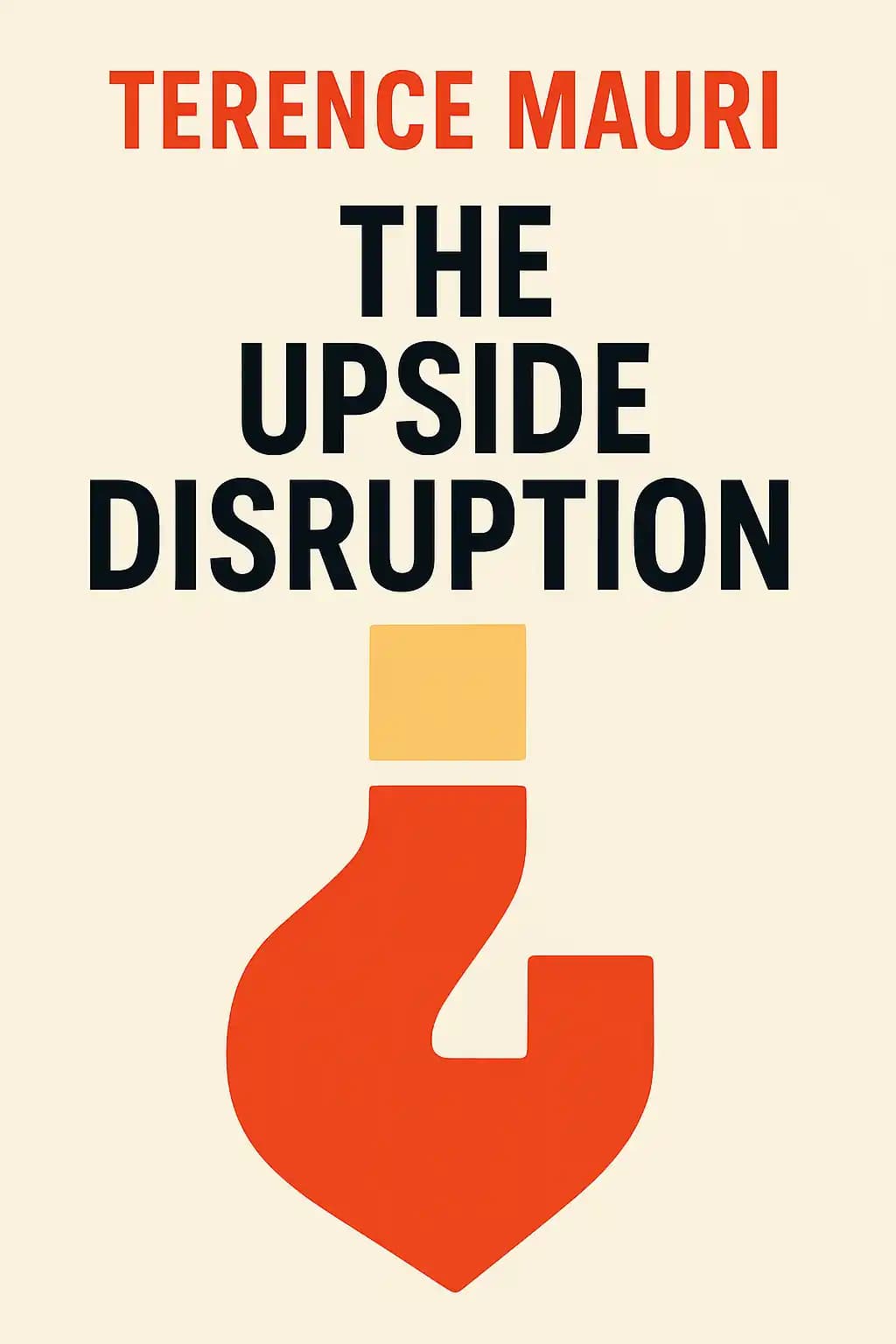
What if the greatest risk to your organization isn't technological disruption, but rather a lack of courage to evolve? This provocative question lies at the heart of Terence Mauri's "The Upside of Disruption," a book that has become required reading for forward-thinking executives worldwide. Since its publication, the book has influenced leadership strategies at organizations from Google to Pfizer, with its DARE framework (Data, Agility, Risk, Evolution) offering a practical roadmap for navigating uncertainty. Mauri's insights come at a critical moment-when 93% of leaders expect AI disruption but only 27% have capabilities to respond, and 81% feel overwhelmed by business disruption. What makes this work particularly compelling is how it reframes disruption not as something that happens to organizations, but as an opportunity that can be harnessed by those with the right mindset.
Kapitel 2
The Wake-Up Call: Leadership in an Era of Perpetual Beta
Einstein once said, "You can't use an old map to explore a new world." This profound observation perfectly captures our current leadership challenge. We're experiencing disruption everywhere and all at once, yet many leaders remain trapped in outdated mindsets. The statistics are alarming: 81% of leaders feel overwhelmed by business disruption, 77% believe their organizations suffer from talent-crushing bureaucracy, and six in ten employees worldwide are disengaged. These numbers reflect a growing crisis in leadership effectiveness, with studies showing that traditional command-and-control approaches are becoming increasingly ineffective in motivating modern workforces.
Today's leadership landscape bears little resemblance to the more predictable world of just a decade ago. The convergence of transformative technologies-blockchain, energy storage, AI, robotics, and DNA sequencing-has fundamentally altered the nature of competition, work, and leadership. This isn't merely incremental change; it's a paradigm shift requiring entirely new approaches. For instance, AI alone is projected to automate 30% of current work activities by 2030, while simultaneously creating millions of new roles that don't yet exist.
Consider how industry boundaries are blurring: your next competitor might emerge from an adjacent sector you've never considered. The "MAANMA" companies (Microsoft, Apple, Amazon, NVIDIA, Meta, Alphabet) command $8 trillion in market value, while Europe has its own "GRANOLAS" powerhouses (Glaxo, Roche, ASML, Nestle, Novartis, Novo Nordisk, L'Oreal, LVMH, AstraZeneca, SAP, and Sanofi). Meanwhile, talent scarcity presents a critical challenge, with 90% of workers needing reskilling by 2030 to avoid $15 trillion in lost GDP. Companies like Google and Amazon are already investing billions in internal upskilling programs, recognizing that talent development is now a strategic imperative.
What separates organizations that thrive from those that merely survive is their ability to find opportunity in disruption. History shows that crises often birth innovation-many of today's $100 billion companies (Square, Airbnb, Uber) emerged during the 2008-2009 financial crisis, while UPS, Volvo, and HP were founded during the Great Depression. More recent examples include Zoom, which saw explosive growth during the COVID-19 pandemic, and Discord, which evolved from a gaming chat platform to a widespread communication tool. The question isn't whether disruption will happen, but whether you'll harness it as a tailwind for opportunity or dismiss it as a headwind to be avoided.
The path forward requires what Mauri calls "future-readiness"-the ability to anticipate and adapt to the unthinkable. This means questioning billion-dollar beliefs, identifying what's enduring versus eroding, challenging untested assumptions, and developing collective unlearning strategies to eliminate outdated "always-done ways" that prevent adaptation to accelerating change. Leading companies like Microsoft have demonstrated this by successfully pivoting from traditional software sales to cloud-based services, while Netflix transformed from a DVD-by-mail service to a streaming giant and content creator. These examples show how future-ready organizations continuously reinvent themselves while maintaining their core purpose and values.
Kapitel 3
Leading with AI: The Human-Machine Partnership
"Software is eating the world, but AI is going to eat software," says NVIDIA CEO Jensen Huang. We've entered an "Age of Wonder" where AI transforms everything about leadership, work, creation, and competition. Unlike previous tools, AI can create new things and make decisions independently. The productivity curve from railroads to AI is now "tilted straight up," with AI offering not just hyper-efficiency but providing employees with "human superpowers."
This creates a new leadership logic where algorithms function as a labor force in a winner-take-all environment. AI can radically lower organizational costs while augmenting human capabilities, potentially automating 30% of work hours by 2030 and freeing people from low-value tasks to focus on "Deep Work" rather than "Shallow Work."
Bill Gates considers AI "as revolutionary as mobile phones and the Internet"-a code red for accelerated reinvention. This transformational megatrend delivers breakthrough discoveries across domains. Consider Insilico Medicine, an AI-first biotech company reducing drug discovery costs by 25-50% and cutting development time from decades to years.
This "Cambrian Explosion" of AI requires "frontier leaders" who can adapt, improvise, and operationalize AI while managing its risks. Companies sit on goldmines of diverse data that AI can transform from spreadsheet analysis to self-service analytics, reducing decision-making time dramatically. Meanwhile, text-to-video generators like OpenAI's Sora could be the next Hollywood disruptor, forcing leaders to abandon business-as-usual thinking.
The "Amazonification" of the global economy is becoming the norm, rapidly shrinking company, product, and job lifespans. Leaders must now compete on Amazon-inspired principles that transform fundamental business concepts: economies of scale become economies of learning; supply chains evolve into AI-driven supply brains; vertical power structures shift to horizontal trust; growth-at-any-cost mentality yields to humanity and ecology; fragmented control transforms to networked resilience; and cultures of conformity give way to cultures of curiosity.
Yet the greatest threat isn't AI disruption itself but what Peter Drucker called "acting with yesterday's logic"-becoming prisoners of past success models. Leaders must embrace Amara's Law: we overestimate technology's short-term impact while underestimating its long-term consequences.
The AI-Intelligence Illusion reveals our tendency to place blind faith in technology without understanding its human impact. At Jumbo supermarkets, "chat checkouts" with human cashiers have become their most profitable lanes despite automation trends, addressing a growing loneliness epidemic affecting 300 million friendless people worldwide. This counterintuitive success demonstrates the difference between "warm tech" (humanity-first, trust-building) and "cold tech" (machine-first, trust-eroding).
In our AI-driven world, attention has become our scarcest resource. To reclaim attention, leaders should focus on velocity (direction plus speed) rather than speed alone; fight complexity with bold simplicity; implement meeting-free days and a strategic "no"; and fortify "triple attention"-inner (reflection and intuition), other (human connection), and outer (trend awareness).
Kapitel 4
The Power of Unlearning: Breaking Free from Outdated Patterns
In a rapidly changing world, unlearning may be the highest form of learning. Great leaders not only learn from mistakes but also unlearn outdated approaches. Unlearning requires humility to recognize bad habits, vulnerability to seek help, and the capacity to reflect, rethink, and renew. It's the ultimate insurance against "zombie leadership" and what academic Cory Doctorow calls "enshittification"-the slow decay in everything we do.
Alvin Toffler predicted that the illiterate of the 21st century would be those who cannot learn, unlearn, and relearn. In leadership, adaptability is more valuable than accumulated knowledge. Neuroplasticity research shows our brains constantly create new connections while discarding others-much like effective leadership must adapt to new contexts.
The "Half-Life of Everything" is accelerating: skills last 5 years (technical skills just 2.5), competitive advantage less than 18 months, CEO tenures shrinking by 20%, and medical knowledge doubling every 24 months. As organizational speed increases, so must unlearning. Leaders must shed Industrial Age thinking and embrace Intelligence Age approaches that prioritize learning facilitation, curiosity cultures, trust, and collective intelligence over traditional command-and-control models.
Despite agility being a top strategic priority for most organizations, only 18% describe themselves as having agile-wide behaviors. The agility paradox requires unlearning to push businesses beyond boundaries and turn risk into reward. Without unlearning, leaders remain trapped in endless meetings, conflicting priorities, and emails that create little value. "Best practices" become "broken practices," and KPIs outlive their usefulness, while cultures reward conformity over courage.
Research reveals the staggering cost of bureaucratic inefficiency: one-third of leaders waste 700 hours annually (33.3% of their working time) on bureaucratic busywork, half waste time on manual processes that could be automated, and half agree bureaucracy taxes speed, agility, and talent development. With $41 trillion of enterprise value at risk from disruption and $17 trillion wasted yearly on excess bureaucracy, 93% of leaders recognize bureaucracy as a significant barrier to growth.
NVIDIA CEO Jensen Huang's advice to "grow a tolerance for failure" highlights how we often miss failure's upside. Research shows prior failure is "the essential prerequisite for success," yet we're conditioned to avoid it. Sara Blakely of Spanx shares how her father encouraged failure at the dinner table, redefining it as "not trying" rather than "not achieving." Organizations that thrive don't just react to crises but use them as platforms to become wiser and more agile, turning barriers into opportunities through post-mortems that build resilience rather than assign blame.
The chapter reframes FAIL as "From Action, I Learn," highlighting how productive failures are hypothesis-driven experiments that reduce uncertainty through new insights. The discovery of graphene exemplifies this-when scientists Andre Geim and Kostya Novoselov observed graphite flakes on sticky tape during a "Friday night experiment," their apparent failure led to isolating graphene for the first time, revolutionizing materials science.
Kapitel 5
The Courage Advantage: Bold Leadership in Uncertain Times
The greatest risk to organizational vitality isn't technological disruption but rather "a lack of courage to evolve." Research from Hack Future Lab reveals "lack of boldness" as the primary barrier to long-term growth, with employees ranking courage deficiency among their top three organizational challenges.
Data shows courageous leaders in fast-moving organizations achieve 2.4 times higher operational resilience, 2.2 times higher growth, and 3.7 times higher innovation compared to cautious peers. The author defines courage not as recklessness but as "proactive resilience"-making intelligent risks and tough decisions amid volatility.
Microsoft serves as a case study, having transformed from trailing in AI to achieving revenue per employee 1.8 times that of Salesforce through anticipatory leadership and bold moves. Despite such success stories, fewer than 20% of companies operate with similar courage.
The courage dividend represents the substantial organizational benefits from cultivating bold leadership in an era of perpetual upheaval. Courage leaps require replacing fear with action and doubt with conviction as decision cycles accelerate dramatically. Organizations showing courage create a leadership edge-they act more quickly, mobilize resources better, win new customers faster, and demonstrate greater resilience.
John Deere exemplifies this courage calling, evolving from its 1837 steel plow origins to become a $100+ billion agriculture technology leader by avoiding the "success paradox" where past achievements become future liabilities. While traditional industries representing 75% of global GDP remain untransformed by technology, Deere boldly moved into autonomous tractors, carbon capture, robots, and drones-even exploring "robot-bee" pollination technology-demonstrating how legacy can become a platform for future reinvention.
Leaders who adopt willful contrarianism-taking positions counter to conventional business wisdom-are more likely to see the future first and develop a courage edge. This mindset combats the "curse of sameness" where companies believe they're unique while actually mirroring industry peers.
Patagonia exemplifies willful contrarianism in its DNA. Founded by rock climber Yvon Chouinard, the company has allocated 1% of sales to environmental causes since the 1980s. Rejecting Milton Friedman's shareholder primacy model, Chouinard made Earth the company's only shareholder, transferring ownership to the Patagonia Purpose Trust and Holdfast Collective to channel profits to environmental causes.
A leader's mindset profoundly impacts their choices, especially in separating genuine risks from noise. The most courageous leadership action is acknowledging vulnerability-being brave enough to "know that you don't know everything." Clayton Christensen embodied this with a wooden sign on his office door reading "Anomalies Welcome." This invitation to embrace challenges and upend assumptions symbolized his openness to weak signals that don't fit existing patterns but offer glimpses of future possibilities.
Kapitel 6
Trust: The Ultimate Leadership Currency
Trust forms the ultimate currency for navigating our future, serving as the bedrock of effective leadership and organizational success. Without trust, leadership breaks down, companies fail, and cultures decay. We face record levels of distrust globally, with businesses leading on trust but still scoring below 60%, while media is actively distrusted according to Edelman's trust barometer. This crisis of trust extends across sectors, from government institutions to social media platforms, affecting how people engage with organizations and their leaders.
Trust is on the ballot in today's organizations, with alarming statistics that reveal deep-seated challenges: 73% of employees worry AI could take their jobs in five years, 54% agree trust isn't a core "living" value in their organizations, 53% haven't received feedback in three months, only 36% trust leadership to do the right thing, and 28% would trust a stranger more than their boss. These numbers reflect a fundamental breakdown in workplace relationships and highlight the urgent need for trust-building initiatives.
Within every organization, leaders must ask, "How do we get the best from our people?" Trust emerges as the definitive answer, functioning as both a leap of faith into the unknown and the cornerstone of high-performing leadership. When trust outcomes are high, cost and time decrease while speed increases; when trust is low, the opposite occurs, creating organizational friction and inefficiency. Research shows a strong correlation between trust and smart risk-taking-when people feel trusted, they're more inclined to take courageous leaps into uncertain futures, innovate, and contribute their best ideas.
Trust serves four crucial functions in modern organizations: as a clarifier (cutting through misalignment and fear by fostering transparent communication), a simplifier (reducing complexity when messages travel faster in high-trust environments, enabling quick decision-making), an energizer (combating the "meta-anxiety" and burnout affecting two-thirds of employees by creating psychological safety), and enabling a "no" strategy (providing focus on what truly matters, exemplified by CVS foregoing $2 billion in tobacco sales to align with its health mission).
Who can you trust in today's complex business landscape? An exchange of trust defines every leadership interaction, yet trust has never been more tested. Leadership faces its moment of truth amid fake news, ethical fading, data breaches, and digital skulduggery. More companies operate at the ethical edge pursuing profits, with trust under intense scrutiny by regulators, media, talent, and customers. Examples of trust violations, from data privacy breaches to environmental misconduct, regularly make headlines and erode stakeholder confidence.
The Economist's analysis revealed that firms involved in major scandals were worth 30% less than they would have been otherwise, demonstrating the tangible financial impact of broken trust. With global digital transformation spending projected to reach $5.9 trillion by 2025, billions are wasted annually on failed transformations due to lack of trust, highlighting the critical role of trust in successful organizational change.
Hack Future Lab's research discovered that when leaders activate a Trust Mindset, employees feel empowered to co-create the future and are three times more likely to see resilience as an organizational strength. The Trust Mindset strengthens three critical dimensions: Who we are (identity - fostering authentic leadership and cultural alignment), How we work (agility - enabling rapid adaptation and innovation), and How we grow (scalability - supporting sustainable expansion and development). Organizations that successfully harness these dimensions are 2.1X more likely to outperform industry peers, 4.7X more likely to be great workplaces, and 5.6X more likely to be innovative, demonstrating the profound impact of trust on organizational success.
Kapitel 7
Beyond is Where We Begin: Finding Your Upside in Disruption
Jesse Armstrong, creator of HBO's Succession, offers valuable lessons about embracing the unknown despite obstacles and the urge to give up. His journey illustrates how driving ourselves outside comfort zones is essential for finding the upside in disruption.
Leaders must embrace disruption's upside to avoid zombie leadership and the curse of sameness. Rethinking serves as proactive resilience, anticipating volatility as a tailwind for learning and growth. Everything in the leadership value chain must be reconsidered: culture, talent, strategy, and execution.
Research shows a "resilience dividend" for those with sharpened future readiness-they're 1.8x more likely to outperform peers and 3.4x less likely to burn out in crisis. Leaders should ask themselves what "success headlines" they want to achieve, using future milestones to determine goals and necessary changes.
Co-intelligence means learning to work alongside AI, yet we face a profound paradox: technology changes rapidly while humans evolve slowly. Leaders are trapped in a widening wisdom gap as runaway AI outstrips our Paleolithic brains' capacity to process complexity. While data processing power has increased a trillion-fold since the 1950s, human cognition remains relatively unchanged.
This creates a critical distinction: data is information bits, knowledge connects those bits, but wisdom transforms data into unexpected insights. As AI brings the cost of generating content to zero, leaders must navigate the rise of "botshit" alongside traditional organizational challenges.
Behavioral scientist Rory Sutherland observed that "the next revolution is not technological; it's psychological." Overthinking creates risk aversion and organizational bottlenecks, with future anxiety-particularly around AI's impact on jobs-becoming a significant challenge.
Waiting for certainty is risky in an era of acceleration. Leaders can't navigate technological disruption without sharpening courage skills: being proactive, pro-change, pro-growth, and pro-resilience. Research shows 66% of employees consider their organizations conformist, yet companies like Nike thrive through bold moves in digital innovation, sustainability, and branding while staying true to core values.
The rubber band effect occurs when leaders attend conferences, get inspired by new thinking, but then snap back to old ways upon returning home. Despite good intentions and bold commitments, nothing changes as they relapse into familiar patterns. To overcome this, leaders must break the bias for deja vu conversations and zombie ideas by adopting against-the-grain approaches and disrupting from within.
In today's paradigm-shifting world suspended between past certainties and future possibilities, we need frontier leadership-characterized by improvisation, adaptation, and the courage to rethink and unlearn. Traditional leadership has been hierarchy-led (control, power, rules) rather than frontier-led (trust, care, co-creation).
Research shows that end-of-life regrets typically center on inaction rather than action, with lack of boldness among leaders' top regrets. A story of a 100-year-old woman who pursued her mathematics degree at 83, completed a master's at 89, and did a parachute jump at 100 illustrates how embracing the upside of disruption can lead to remarkable achievements at any age.
Kapitel 8
The DARE Framework: Your Path to Future-Ready Leadership
The DARE Leadership framework provides a comprehensive, structured approach for navigating disruption through four essential dimensions: Data, Agility, Risk, and Evolution. This practical tool helps leaders identify strengths and gaps in their readiness for an increasingly volatile future, offering specific metrics and actionable strategies for improvement.
The Data dimension focuses on how leaders harness AI and information to drive decision-making in an increasingly digital world. It evaluates whether organizations are using AI as a co-pilot rather than autopilot, balancing technological advancement with human wisdom. Leaders who excel in this dimension create cultures where AI augments human capabilities rather than replacing them, turning data into actionable insights that drive competitive advantage. For example, successful organizations might use AI to analyze customer behavior patterns while relying on human insight to interpret the emotional and contextual nuances that influence buying decisions. They implement robust data governance frameworks and invest in developing their team's data literacy skills.
The Agility dimension measures a leader's capacity to unlearn outdated approaches and embrace new possibilities with speed and precision. Organizations scoring high here demonstrate the ability to pivot quickly, eliminate bureaucratic drag, and learn from both successes and failures. They create cultures where experimentation is encouraged and where "best practices" don't become "broken practices" that inhibit innovation and adaptation. This might involve implementing rapid prototyping processes, maintaining flexible organizational structures, and establishing quick feedback loops that allow for fast iteration and improvement. Companies like Amazon and Netflix exemplify this dimension by constantly experimenting with new services and business models.
The Risk dimension assesses a leader's courage advantage-their ability to make bold decisions amid uncertainty while maintaining organizational stability. High performers in this category demonstrate willful contrarianism, challenging industry assumptions and pursuing opportunities others miss. They balance prudent risk management with the boldness required to seize emerging opportunities, avoiding both recklessness and excessive caution. This includes developing sophisticated risk assessment frameworks, maintaining strong financial buffers, and creating diverse revenue streams while still being willing to make calculated bets on innovative initiatives.
The Evolution dimension evaluates a leader's ability to build trust and foster sustainable growth in an organization. Leaders who excel here make trust their #1 value, radiating purpose and empowering others through transparent communication and consistent behavior. They create environments where people feel safe to innovate, speak up, and contribute their best work. This includes implementing regular feedback mechanisms, investing in employee development programs, and creating clear career progression pathways. This foundation of trust enables sustainable organizational development even in the most turbulent times.
The DARE framework isn't just theoretical-it's a practical tool for developing the mindsets and behaviors required in today's rapidly changing landscape. By identifying areas scoring 3 or below on the assessment scale, leaders can prioritize specific development areas to strengthen their future readiness. The framework includes detailed assessment tools, development resources, and action planning templates that help leaders move from insight to implementation.
What makes this approach particularly powerful is its holistic nature and practical applicability. While many organizations focus exclusively on technological transformation, the DARE framework recognizes that true future readiness requires equal attention to human factors like trust, courage, and adaptability. In a world where disruption is the norm, these human capabilities may ultimately prove more valuable than any technological advantage. The framework helps leaders develop both the hard and soft skills needed for success in an increasingly complex business environment.