Kapitel 1
Ancient Rome's Most Notorious Rulers: Power, Madness, and Legacy
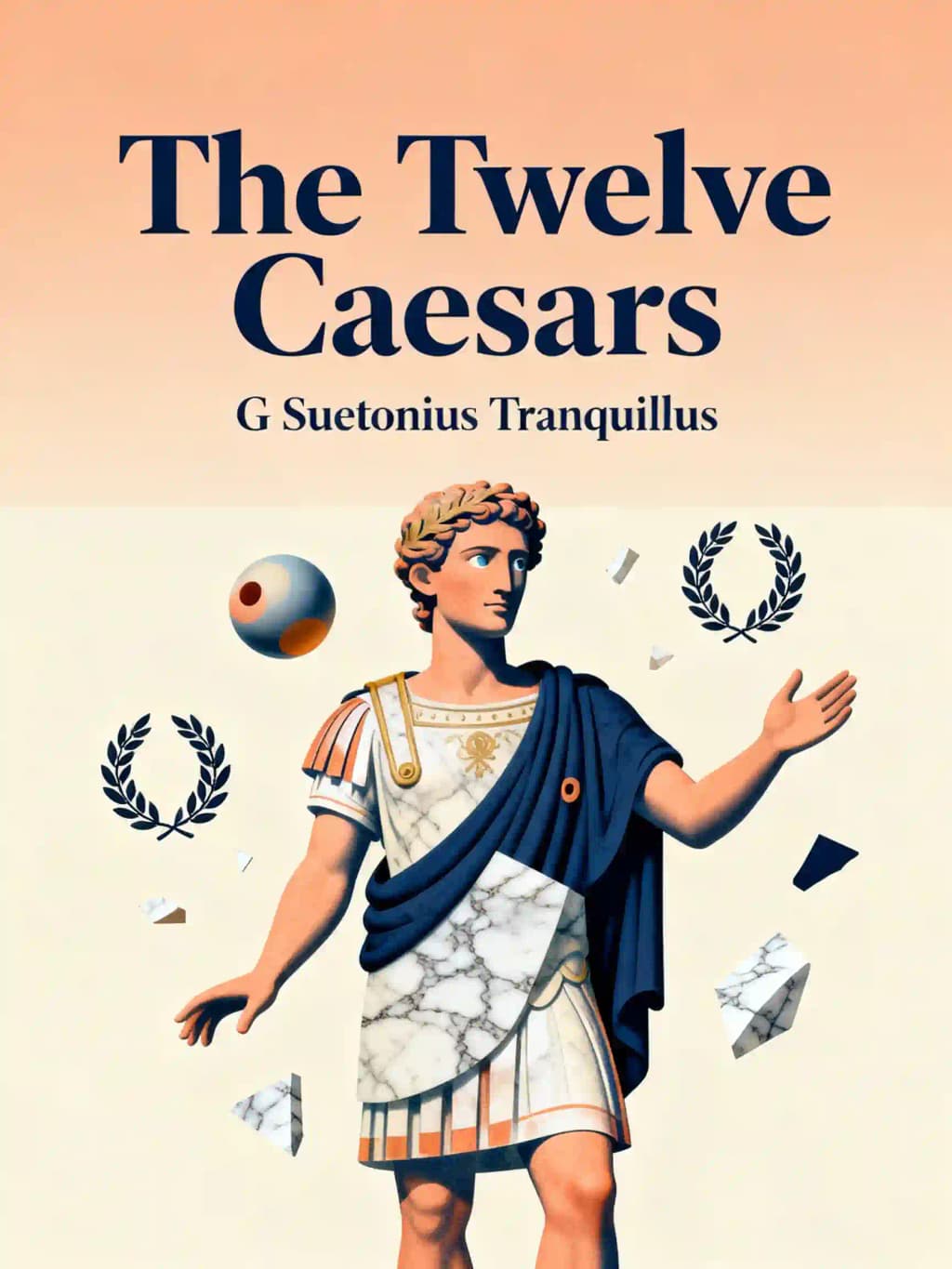
When Julius Caesar crossed the Rubicon in 49 BCE, he did more than defy the Roman Senate-he transformed Western civilization forever. Standing at the river's edge, Caesar reportedly uttered the famous words "alea iacta est" ("the die is cast") before leading his troops across this forbidden boundary. This singular moment marked the death of the Roman Republic and the birth of an imperial system that would shape European politics, law, and culture for millennia to come. Suetonius' "The Twelve Caesars" offers us the most intimate, scandalous, and revealing portrait of these larger-than-life figures who wielded unprecedented power-often with disastrous consequences. From Augustus' masterful political maneuvering to Nero's artistic pretensions and Caligula's shocking depravities, these rulers continue to fascinate us precisely because they reveal the timeless human dramas of ambition, corruption, and the intoxicating effects of absolute power.
Kapitel 2
The First Caesar: Ambition, Brilliance, and Betrayal
Julius Caesar embodied the perfect storm of political genius, military prowess, and personal charisma that would forever change Rome. Born into the ancient but impoverished Julian clan that claimed divine descent from Venus, Caesar's early life was marked by narrow escapes and bold gambles. When the dictator Sulla ordered the young Caesar to divorce his wife Cornelia (daughter of Sulla's enemy Cinna), Caesar defiantly refused-a decision that nearly cost him his life. Stripped of his priesthood and inheritance, he fled Rome while suffering from malaria, hiding from Sulla's assassins until his powerful relatives secured a pardon.
This early brush with death seemed to instill in Caesar a lifelong urgency to achieve greatness. His military campaigns in Gaul were masterpieces of both warfare and propaganda, as he meticulously documented his conquests in commentaries written with what Cicero called "naked, straightforward beauty." In nine years, he conquered all of Gaul, built the first Roman bridge across the Rhine, and twice invaded the previously unknown Britain. These achievements made him wildly popular with common Romans but increasingly threatening to the Senate.
Caesar's personal habits revealed a complex man of contradictions. Though he suffered from epilepsy (the "falling sickness"), he pushed himself to extraordinary physical feats-swimming across rivers with one hand held above water to keep his papers dry, or traveling incredible distances at speeds that left his messengers behind. His sexual appetites were equally legendary. As his troops marched in his Gallic triumph, they sang ribald verses about "Caesar, who conquered the Gauls, while Nicomedes conquered Caesar"-referring to his alleged affair with the king of Bithynia. His numerous affairs with prominent Roman women earned him the nickname "every woman's husband and every man's wife."
What made Caesar truly dangerous to the Republic was his extraordinary connection with ordinary soldiers. Unlike most aristocratic commanders, he addressed his troops as "comrades" rather than "soldiers," knew many by name, and inspired fanatical loyalty. After his famous crossing of the Rubicon, he marched on Rome with just a single legion, yet his opponents fled before him. During the subsequent civil war, he displayed both tactical brilliance and calculated clemency, often pardoning defeated enemies-a policy that, ironically, allowed many of his future assassins to live.
Caesar's assassination on the Ides of March in 44 BCE came after he had accumulated unprecedented honors. The Senate had named him dictator perpetuo (dictator for life), placed his image on coins (the first living Roman so honored), and granted him powers that effectively ended the Republic in all but name. When conspirators led by Brutus and Cassius stabbed him 23 times at the foot of Pompey's statue, Caesar reportedly gasped "You too, my child?" upon seeing Brutus among his attackers. In death as in life, Caesar's timing was impeccable-by dying at the height of his power, he became a martyr whose legacy would be championed by his adopted son Octavian, the future Augustus.
Kapitel 3
Augustus: The Master Architect of Imperial Rome
If Julius Caesar created the opportunity for one-man rule in Rome, it was his grand-nephew and adopted son Augustus who transformed this opportunity into a lasting system. Born Gaius Octavius in 63 BCE, the man history knows as Augustus seemed an unlikely successor to Caesar's mantle. Physically frail and only eighteen when Caesar was assassinated, he nonetheless outmaneuvered more experienced rivals through a combination of political cunning, patience, and ruthless determination.
The young Octavian's first masterstroke was claiming Caesar's name and inheritance, instantly gaining the loyalty of Caesar's veterans. When Mark Antony underestimated him as "a boy who owes everything to a name," Octavian proved his mettle by raising his own army. After defeating Antony and Lepidus in the civil wars, he systematically dismantled the Republic while maintaining its outward forms-a political sleight of hand that allowed Romans to believe their ancient liberties remained intact.
Augustus' genius lay in his understanding that power needed to be clothed in legitimacy. He refused titles like "king" or "dictator," preferring instead to be called princeps (first citizen). While holding no formal office beyond consul, he accumulated various powers through separate grants from the Senate. As he famously declared: "I found Rome built of bricks; I leave it clothed in marble." This was no idle boast-Augustus transformed the city with magnificent new buildings, established a professional fire brigade and police force, and created a reliable grain supply that prevented urban unrest.
His private life presented a carefully cultivated image of old-fashioned Roman virtue. He lived modestly in a small house on the Palatine Hill, wore simple clothes often woven by female relatives, and passed laws promoting marriage and childbearing. Yet this moral exemplar was not above using his daughter Julia and granddaughter Agrippina as political pawns, marrying them to secure alliances. When Julia's promiscuity became a public scandal, Augustus exiled her to a barren island, grimly declaring he would rather have "no daughters at all than one like her."
Perhaps Augustus' greatest achievement was creating a system that could survive his death. By gradually elevating his stepson Tiberius to positions of authority, he ensured a smooth transition of power-something Caesar had failed to arrange. When Augustus died in 14 CE at age 76, he had ruled for 41 years and established what would become the template for imperial governance for centuries. His final words reportedly asked, "Have I played my part well in the comedy of life?" History's answer has been a resounding yes.
Kapitel 4
Tiberius: The Reluctant Emperor's Descent into Darkness
Few rulers illustrate the corrupting influence of power more dramatically than Tiberius, Augustus' successor. Born into the aristocratic Claudian family, Tiberius was a brilliant military commander who secured Rome's northern frontiers through skillful campaigns in Germany and Pannonia. Yet his path to the throne was marked by personal humiliation and resentment. Forced by Augustus to divorce his beloved wife Vipsania and marry the emperor's daughter Julia (whom he despised), Tiberius later retreated to Rhodes for seven years in self-imposed exile.
When he finally became emperor at 55, Tiberius initially showed promise. He rejected excessive honors, referred important matters to the Senate, and displayed financial restraint that filled the treasury. "A good shepherd," he declared, "shears his sheep but does not flay them." Yet beneath this reasonable exterior lurked deep psychological damage. His childhood teacher Theodorus had called him "mud kneaded with blood," and time would prove this assessment tragically accurate.
As Tiberius aged, his natural suspicion and resentment intensified. The death of his son Drusus in 23 CE marked a turning point, after which he increasingly relied on the ambitious praetorian prefect Sejanus. When Tiberius retreated permanently to the island of Capri in 26 CE, Sejanus effectively ruled Rome, eliminating opponents through treason trials. Even after discovering Sejanus' betrayal and ordering his execution, Tiberius remained on Capri, where according to Suetonius he indulged in increasingly depraved sexual practices with young "spintriae" (sexual performers).
The island retreat became a place of terror, where Tiberius tortured victims and had them thrown from cliffs into the sea. When prisoners begged for death, he would cruelly respond, "I have not yet become your friend"-implying that death would be a favor he wasn't ready to grant. By the time of his death in 37 CE, Romans had come to hate him so thoroughly that crowds shouted "To the Tiber with Tiberius!"-the traditional fate of executed criminals.
Tiberius' reign reveals how even capable men can be corrupted by unlimited power combined with personal bitterness. His legacy was a system of informers, treason trials, and paranoia that would poison Roman political life for generations. As Tacitus wrote, he was a man who "covered his cruelty with cunning delay," making his eventual vengeance all the more terrible for its calculated patience.
Kapitel 5
Caligula: The Emperor Who Became a Monster
If Tiberius' reign ended in darkness, his successor Caligula's began with extraordinary promise before descending into madness. Born Gaius Julius Caesar Germanicus in 12 CE, he earned the nickname "Caligula" ("Little Boot") as a child living among his father's troops, where he wore miniature soldier's boots. When he became emperor at 24 following Tiberius' death, Rome erupted in celebration. The son of the beloved general Germanicus, young Caligula seemed to represent a fresh start after Tiberius' gloomy reign.
The first six months of Caligula's rule seemed to confirm these hopes. He recalled exiles, abolished the treason trials, published government accounts, and distributed generous bonuses to the military and public. He showed filial piety by personally retrieving his mother's and brother's remains from exile islands where they had died under Tiberius. Suetonius marks this period with the stark transition: "So much for Caligula the Emperor; the rest of this history must needs deal with Caligula the Monster."
What caused this transformation remains debated. Some ancient sources blamed a serious illness that left him mentally impaired; others suggested he had always been cruel but initially concealed his true nature. Whatever the cause, Caligula's behavior became increasingly erratic and tyrannical. He claimed divine status, replacing the heads of statues of gods with his own likeness and building a temple to himself. He allegedly planned to appoint his favorite horse Incitatus as consul, though this may be a satirical exaggeration.
Caligula's cruelty knew no bounds. He forced parents to attend their sons' executions and made a habit of ordering torture during meals. When food supplies ran short, he converted grain ships to transport sand for his amphitheater. He sexually violated both men and women of noble families, boasting that he could do anything to anyone. His financial extravagance was equally extreme-he depleted the treasury of 2,700 million sesterces left by Tiberius in just one year, forcing him to resort to extortion and false accusations to raise funds.
Perhaps most disturbing was Caligula's casual attitude toward human life. When told meat for the wild beasts used in arena games was expensive, he ordered criminals fed to them regardless of their crimes. He famously lamented that the Roman people did not have "a single neck" he could cut, and expressed disappointment that his reign lacked major disasters like those that had occurred under Augustus and Tiberius.
After less than four years of increasingly unhinged rule, Caligula was assassinated by officers of his own Praetorian Guard in January 41 CE. His wife and infant daughter were also killed, effectively extinguishing his bloodline. The Senate briefly considered restoring the Republic, but the Praetorian Guard had already found an unlikely successor hiding behind a palace curtain-Caligula's uncle Claudius.
Kapitel 6
Claudius: The Unlikely Emperor Who Surprised Rome
Perhaps the most improbable of all Roman emperors, Claudius had been dismissed by his own family as an embarrassment due to his physical disabilities and apparent slowness. Born with what modern scholars believe may have been cerebral palsy, he walked with a limp, drooled when excited, and spoke with a stammer. His own mother Antonia called him "a monster of a man, not finished but merely begun by Dame Nature." Augustus and Tiberius kept him from public office, though privately he developed considerable scholarly expertise in history and Etruscan studies.
When the Praetorian Guard discovered the 50-year-old Claudius hiding behind a curtain after Caligula's assassination, they acclaimed him emperor-partly because he was the last adult male of the imperial family, but also because they expected him to be easily controlled. They were mistaken. Despite his physical limitations, Claudius proved to be an effective administrator who expanded the empire and implemented important reforms.
His most significant military achievement was the conquest of Britain in 43 CE, the first major expansion of Roman territory since Augustus. Though he spent only sixteen days with the army there, he celebrated a magnificent triumph in Rome and added "Britannicus" to his son's name. He also annexed Mauretania, Lycia, and Thrace, and established the new provinces of Noricum and Pamphylia.
Domestically, Claudius was a tireless administrator who personally heard legal cases and implemented practical reforms. He built a new harbor at Ostia to improve Rome's grain supply, constructed aqueducts, and drained the Fucine Lake-a massive engineering project employing 30,000 men for eleven years. He expanded citizenship rights to provincials and admitted Gauls to the Senate, declaring in a preserved speech that Rome's greatness came from incorporating worthy foreigners.
Yet Claudius' personal life undermined his public achievements. His third wife Messalina notoriously competed with a prostitute to see who could service more men in a single night, then scandalously "married" her lover Silius while still Claudius' wife. After her execution, Claudius made the fateful decision to marry his niece Agrippina the Younger, who manipulated him into adopting her son Nero as his heir over his own son Britannicus.
Claudius died in 54 CE after eating poisoned mushrooms, almost certainly administered by Agrippina. Suetonius reports that when the emperor began to recover from the initial dose, Agrippina had the imperial physician Xenophon apply a poisoned feather to his throat under the pretense of helping him vomit. His death cleared the path for the seventeen-year-old Nero to become emperor, bringing the Julio-Claudian dynasty to its catastrophic conclusion.
Kapitel 7
Nero: The Artist-Emperor Who Fiddled While Rome Burned
Few historical figures have achieved Nero's level of infamy. Born Lucius Domitius Ahenobarbus in 37 CE, he became emperor at sixteen after his mother Agrippina poisoned his stepfather Claudius. Initially guided by the philosopher Seneca and the praetorian prefect Burrus, the young emperor showed promise. He reduced taxes, gave monetary gifts to the people, and displayed clemency toward opponents. This "golden quinquennium" (five-year period) led the philosopher Seneca to write a treatise on clemency dedicated to Nero.
But as Nero matured, his artistic pretensions and megalomania grew unchecked. He considered himself a gifted poet, charioteer, and above all, a divine singer and lyre player. He established the Neronia, games modeled on Greek competitions where he personally performed, and later toured Greece giving musical performances where guards prevented audience members from leaving. When he sang, specially organized groups called the Augustiani would applaud with specific rhythmic patterns, while soldiers punished those who showed insufficient enthusiasm.
Nero's artistic ambitions were matched by his cruelty. He had his mother Agrippina murdered after multiple attempts, including an elaborate collapsible boat designed to drown her. When she survived the shipwreck and swam to shore, he dispatched assassins to finish the job. He later killed his first wife Octavia and his second wife Poppaea Sabina, the latter by allegedly kicking her in the stomach while she was pregnant.
The great fire of Rome in 64 CE cemented Nero's reputation for callousness. Though Suetonius reports he watched the conflagration from a tower while singing about the destruction of Troy in stage costume, modern historians doubt he deliberately started the fire. However, he did use the disaster to seize land for his enormous Golden House, a palace complex so vast that it contained a 120-foot statue of himself, artificial lakes, and vast colonnaded grounds. When he first entered the completed palace, he reportedly remarked, "Good, now I can begin to live like a human being."
To deflect blame for the fire, Nero targeted the small Christian community in Rome, having them covered in animal skins and torn apart by dogs, or used as human torches in his gardens. This first imperial persecution of Christians would be remembered for centuries in Christian tradition.
As provincial revolts spread in 68 CE, the Senate finally found the courage to declare Nero a public enemy. Abandoned by his guards and facing execution, he fled to a freedman's villa outside Rome. Before committing suicide with the help of a secretary, he famously lamented, "What an artist dies in me!" He was the last emperor of the Julio-Claudian dynasty, and his death triggered a year of civil war known as the Year of the Four Emperors.
Kapitel 8
The Flavian Dynasty: Stability After Chaos
The Year of the Four Emperors (68-69 CE) saw Rome torn apart by civil war as Galba, Otho, and Vitellius briefly claimed the throne before meeting violent ends. From this chaos emerged Vespasian, a career military man from a modest background who established the Flavian dynasty.
Unlike his aristocratic predecessors, Vespasian was known for his unpretentious manner and practical approach to governance. Born to a tax collector and moneylender, he rose through military service rather than family connections. When his troops proclaimed him emperor while he was commanding the Jewish War, he moved cautiously, securing Egypt and its vital grain supply before marching on Rome.
As emperor, Vespasian faced the enormous task of restoring stability after Nero's extravagance and the subsequent civil wars. He balanced the budget through new taxes (including his famous tax on public urinals, prompting the saying "money doesn't stink"), reformed the army, and embarked on sensible building projects. His most famous construction was the Flavian Amphitheater, later known as the Colosseum, built on land Nero had seized for his Golden House-a symbolic reclamation of space for public use.
Vespasian maintained his down-to-earth humor throughout his reign. When criticized for the urinal tax, he held a gold coin under a critic's nose and asked if it smelled bad. As he lay dying in 79 CE, he reportedly joked, "Dear me, I think I'm becoming a god"-mocking the practice of imperial deification.
His elder son Titus succeeded him smoothly, having already served as his father's virtual co-ruler. Despite earlier concerns about Titus' character-he had scandalized Rome with his affair with the Jewish princess Berenice-he proved an exemplary emperor. During his brief two-year reign, he responded generously to major disasters including the eruption of Mount Vesuvius (which destroyed Pompeii and Herculaneum) and a fire in Rome. His early death in 81 CE prompted genuine public mourning.
The Flavian dynasty ended with Domitian, Vespasian's younger son, who ruled for fifteen years (81-96 CE). Initially a capable administrator who strengthened frontier defenses, Domitian gradually became paranoid and autocratic. He insisted on being addressed as "Lord and God" and executed senators on the slightest suspicion. His assassination in 96 CE by a palace conspiracy brought the Flavian dynasty to an end, but the stability they had established allowed for the peaceful succession of Nerva and the beginning of the "Five Good Emperors" period.
Kapitel 9
Legacy of the Caesars: Power and Its Corruptions
Suetonius' "The Twelve Caesars" offers more than just scandalous anecdotes about Rome's rulers-it provides profound insights into the nature of power itself. Through these twelve biographies, patterns emerge that remain relevant to understanding leadership and governance in any era.
Perhaps the most striking lesson is how absolute power transforms individuals. Augustus, who came to power through brutal proscriptions and civil war, gradually evolved into a model of restraint and wisdom. Conversely, Tiberius began his reign with genuine moderation before deteriorating into a paranoid tyrant. Caligula and Nero, who both started with promising reforms, became increasingly unhinged as their reigns progressed. The pattern suggests that unchecked power doesn't merely corrupt-it magnifies existing character traits, whether virtuous or vicious.
The Caesars also demonstrate the crucial importance of succession planning in autocratic systems. Augustus carefully groomed Tiberius as his successor, ensuring a smooth transition. By contrast, Caligula's sudden assassination without a designated heir created a dangerous power vacuum. The Year of the Four Emperors following Nero's suicide demonstrated how quickly civil order could collapse without clear succession rules.
Suetonius' accounts reveal the tension between personal character and institutional constraints. The best emperors-Augustus and Vespasian-recognized the need to maintain institutional forms even while holding absolute power. The worst-Caligula and Nero-treated Rome as their personal playground, ignoring traditional limits on their behavior. This suggests that even in autocratic systems, respecting institutional boundaries helps preserve stability.
Finally, these biographies highlight the psychological toll of absolute power. Nearly all the Caesars became increasingly isolated, paranoid, and disconnected from reality over time. Without honest feedback or meaningful constraints, their decision-making deteriorated. Even the capable Tiberius eventually retreated to Capri, governing at a distance through intermediaries.
The enduring fascination with the Twelve Caesars stems not just from their extravagant vices or remarkable achievements, but from how they embody timeless questions about power, leadership, and human nature. When we read about Caligula making his horse a consul or Nero performing on stage while Rome burns, we're seeing more than just the eccentricities of ancient rulers-we're witnessing the fundamental challenges of governance that continue to shape our world today.
In an age of strongman leaders and debates about democratic backsliding, Suetonius' portraits of the Caesars remain disturbingly relevant. They remind us that the institutions constraining power are fragile, that personality can override policy, and that even the most promising leaders can be corrupted by the intoxication of absolute authority. Two thousand years after these emperors ruled, their stories continue to serve as cautionary tales about the dangers of unchecked power and the thin line between civilization and tyranny.