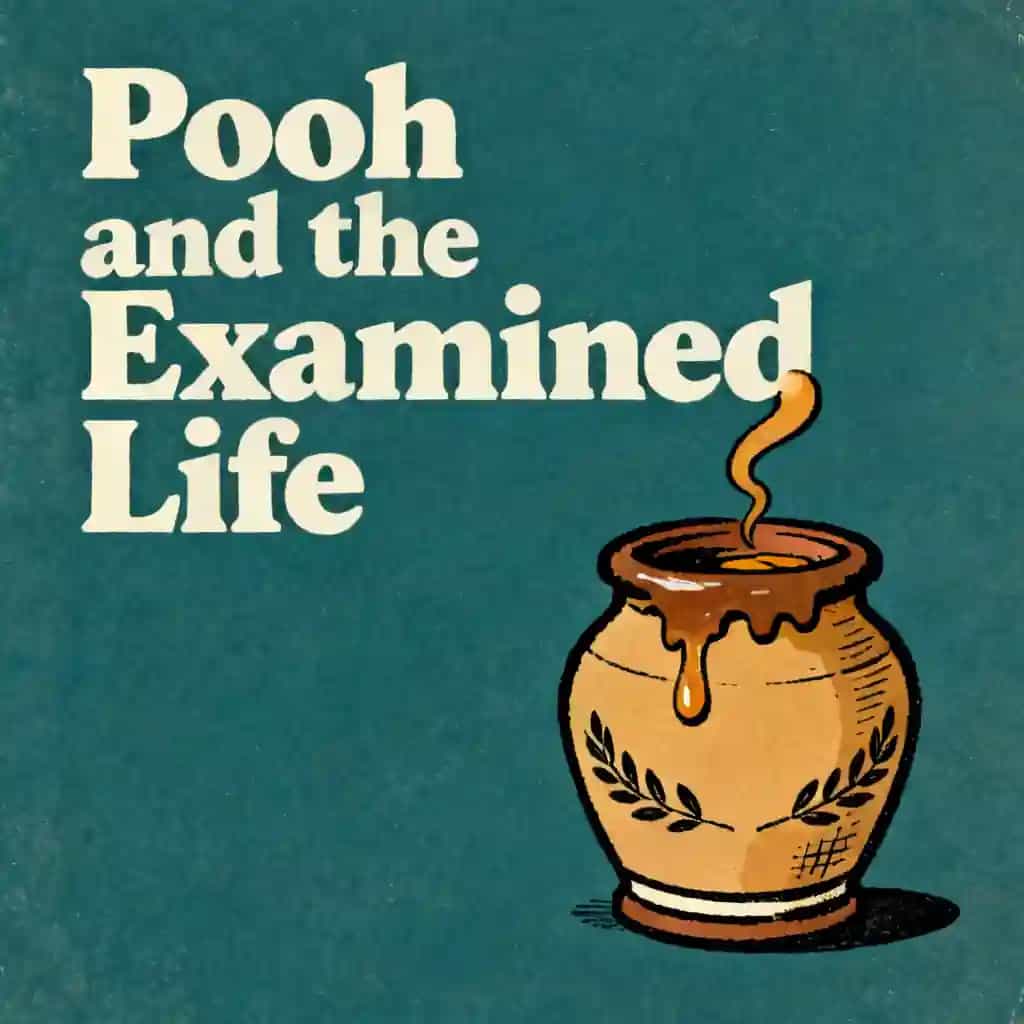
Discover how Winnie-the-Pooh explains Taoism in this international bestseller that spent 49 weeks on the NYT list. Readers claim it "changed my life," blending Eastern wisdom with Western whimsy. What makes this children's bear a philosophical genius?
Benjamin Hoff, born in 1946, is the bestselling American author of The Tao of Pooh, a work renowned for translating Taoist philosophy into accessible Western contexts through the use of A.A. Milne’s beloved characters.
Blending Eastern wisdom with whimsical storytelling, Hoff's 1982 book popularized Taoist principles such as simplicity and harmony with nature. This achievement established him as a unique voice in the realm of spiritual self-help literature.
A graduate of The Evergreen State College with a degree in Asian Art, Hoff brings decades of study in Japanese tea ceremonies, tai chi, and qigong to his exploration of Taoism. His follow-up, The Te of Piglet (1992), further examines virtue through Milne’s characters, while The Singing Creek Where the Willows Grow (1986), a biographical work on naturalist Opal Whiteley, earned the American Book Award.
Before his writing career, Hoff worked as a musician, investigative journalist, and antiques restorer, experiences that inform his interdisciplinary approach to writing. The Tao of Pooh remains a cultural touchstone, having sold over a million copies worldwide and inspiring adaptations across various media formats.
The Tao of Pooh by Benjamin Hoff uses A.A. Milne’s Winnie-the-Pooh characters to explain Taoist philosophy. It illustrates principles like living simply, embracing the present, and finding joy in the natural flow of life. Pooh’s “Uncarved Block” symbolizes the beauty of innate simplicity, while stories like Eeyore’s lost tail demonstrate the value of an “Empty Mind” over intellectual overcomplication.
This book suits readers interested in Eastern philosophy, mindfulness, or personal growth, as well as fans of Winnie-the-Pooh seeking deeper meaning. Hoff’s playful analogies make Taoism accessible to those new to spirituality, while his insights resonate with self-help enthusiasts looking for practical wisdom.
Benjamin Hoff (b. 1946) is an American author and Taoist practitioner best known for The Tao of Pooh and The Te of Piglet. A trained Asian art scholar, he blends philosophy with storytelling. His work The Singing Creek Where the Willows Grow won a 1988 American Book Award. Hoff resigned from publishing in 2006, criticizing the industry’s commercialization.
Yes—it’s a timeless primer on Taoism that balances depth with whimsy. Readers praise its ability to distill complex ideas (like Wu Wei, or effortless action) through Pooh’s adventures. Over 40 years since publication, it remains a popular intro to mindfulness and simplicity.
The “Uncarved Block” represents the natural state of being—untouched by overthinking or societal conditioning. Pooh embodies this concept, finding joy in simplicity. As Hoff notes, “When you discard arrogance and complexity… Life is Fun”.
Hoff uses Pooh’s stories to illustrate core ideas:
Hoff argues that society’s obsession with complexity and productivity creates stress. Through Owl’s pompousness and Rabbit’s busyness, he contrasts Taoist harmony with modern “Knowledge” and “Cleverness,” advocating instead for childlike curiosity.
Some scholars argue it oversimplifies Taoism or leans too heavily on Western interpretations. Others praise its accessibility but note it lacks rigorous philosophical depth, focusing instead on allegorical storytelling.
While Tao of Pooh focuses on foundational Taoism, The Te of Piglet (1992) explores virtue (Te) through Piglet’s humility and courage. Both use Milne’s characters but address different aspects of Taoist philosophy.
Yes—its emphasis on living in the moment, accepting change, and reducing overthinking aligns with mindfulness practices. Hoff’s advice to “work with circumstances instead of against them” offers a framework for managing stress.
Erlebe das Buch durch die Stimme des Autors
Verwandle Wissen in fesselnde, beispielreiche Erkenntnisse
Erfasse Schlüsselideen blitzschnell für effektives Lernen
Genieße das Buch auf unterhaltsame und ansprechende Weise
Things are as they are. Looking out over the world, there is no right way and wrong way to do things.
The main problem with this great obsession for saving time is very simple: you can't save time. You can only spend it. But you can spend it wisely or foolishly.
A clever mind is not a heart.
Life is fundamentally sweet when we work with its natural flow rather than against it.
Life is Fun.
Zerlegen Sie die Kernideen von The Tao of Pooh in leicht verständliche Punkte, um zu verstehen, wie innovative Teams kreieren, zusammenarbeiten und wachsen.
Destillieren Sie The Tao of Pooh in schnelle Gedächtnisstützen, die die Schlüsselprinzipien von Offenheit, Teamarbeit und kreativer Resilienz hervorheben.

Erleben Sie The Tao of Pooh durch lebhafte Erzählungen, die Innovationslektionen in unvergessliche und anwendbare Momente verwandeln.
Fragen Sie alles, wählen Sie die Stimme und erschaffen Sie gemeinsam Erkenntnisse, die wirklich bei Ihnen ankommen.

Von Columbia University Alumni in San Francisco entwickelt
"Instead of endless scrolling, I just hit play on BeFreed. It saves me so much time."
"I never knew where to start with nonfiction—BeFreed’s book lists turned into podcasts gave me a clear path."
"Perfect balance between learning and entertainment. Finished ‘Thinking, Fast and Slow’ on my commute this week."
"Crazy how much I learned while walking the dog. BeFreed = small habits → big gains."
"Reading used to feel like a chore. Now it’s just part of my lifestyle."
"Feels effortless compared to reading. I’ve finished 6 books this month already."
"BeFreed turned my guilty doomscrolling into something that feels productive and inspiring."
"BeFreed turned my commute into learning time. 20-min podcasts are perfect for finishing books I never had time for."
"BeFreed replaced my podcast queue. Imagine Spotify for books — that’s it. 🙌"
"It is great for me to learn something from the book without reading it."
"The themed book list podcasts help me connect ideas across authors—like a guided audio journey."
"Makes me feel smarter every time before going to work"
Von Columbia University Alumni in San Francisco entwickelt

Erhalten Sie die The Tao of Pooh-Zusammenfassung als kostenloses PDF oder EPUB. Drucken Sie es aus oder lesen Sie es jederzeit offline.
What if the secret to contentment wasn't hidden in ancient scrolls or academic treatises, but sitting right there in the Hundred Acre Wood with a pot of honey? Three million readers discovered this unlikely truth when a relatively unknown writer named Benjamin Hoff paired Winnie-the-Pooh with Taoist philosophy in 1982. The book landed on college reading lists, corporate training agendas, and bedside tables from Hollywood to Main Street. Its power lies in a radical premise: that wisdom doesn't require intellectual gymnastics or spiritual marathons. Sometimes the bear of very little brain understands more than the rest of us combined. What Pooh grasps intuitively-and what ancient Taoists spent lifetimes articulating-is that fighting against life's current exhausts us, while floating with it carries us exactly where we need to go. Picture three ancient philosophers standing around a vat of vinegar, each taking a taste. Confucius puckers at the sourness, seeing life as fallen from heaven's perfect order, fixable only through rigid rules and social hierarchy. Buddha grimaces at the bitterness, recognizing existence itself as suffering that can only be transcended through detachment from worldly desire. But Lao-tse, founder of Taoism, smiles. The vinegar tastes sweet to him-not because he's delusional, but because he accepts reality as it is rather than mourning what it isn't or escaping what it contains. This fundamental difference shapes everything. Where Confucius imposes structure and Buddha seeks transcendence, Taoism embraces what it calls "the dust of the world." The Tao-meaning "the Way"-represents the natural current underlying all existence, like water finding its path downhill without effort or strategy.