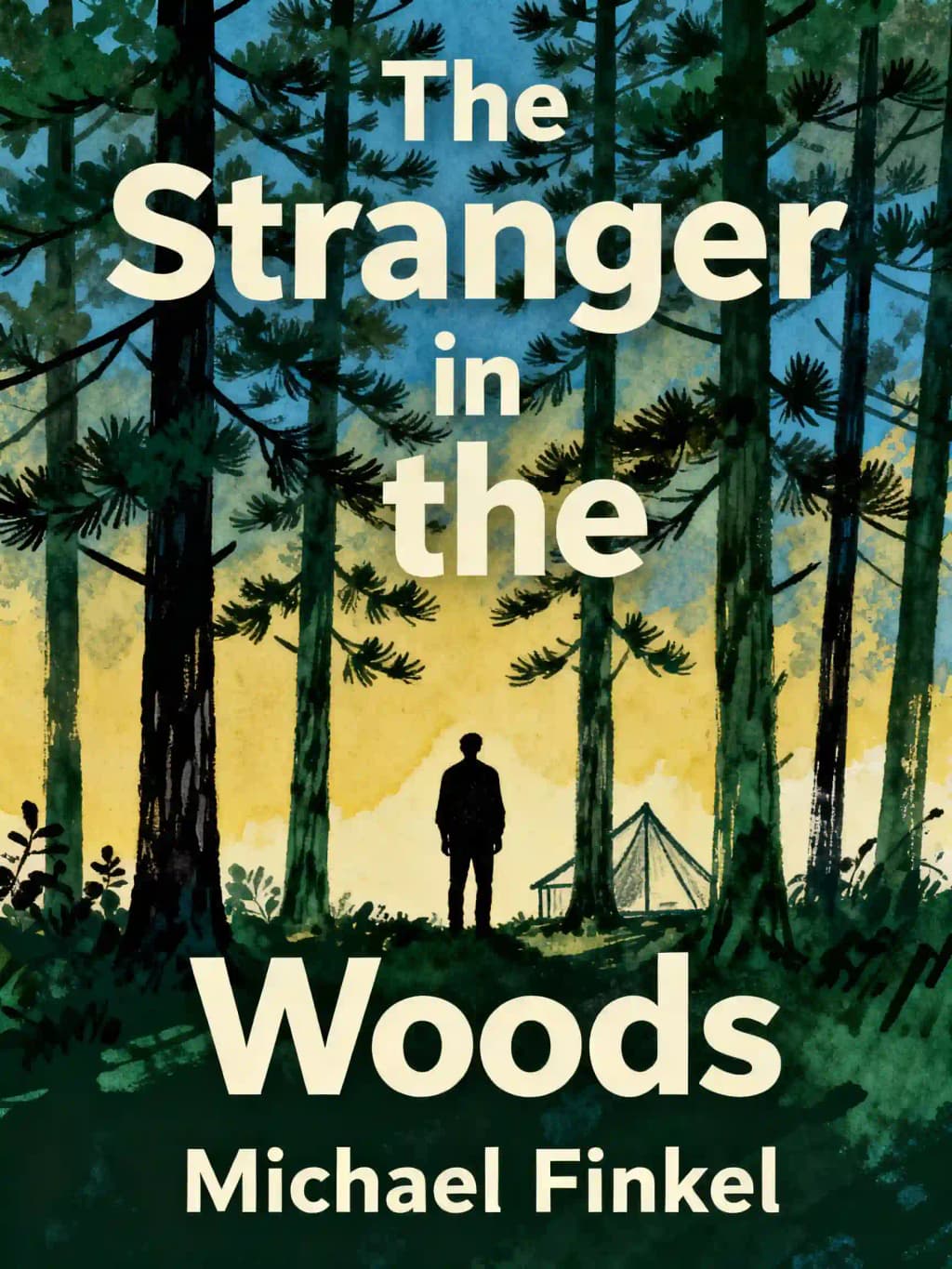
Kapitel 1
Into the Woods: One Man's Extraordinary Retreat from Society
In 2013, a story emerged that captivated the world: a man had lived completely alone in the Maine woods for 27 years, surviving brutal winters without ever lighting a fire. Christopher Knight, dubbed "the North Pond Hermit," became an overnight sensation after his arrest for over 1,000 break-ins at nearby vacation cabins. The story struck a nerve in our hyper-connected age, inspiring songs, artwork, and even marriage proposals from strangers. Stephen King called it "a meditation on solitude, wildness and survival," while The New York Times compared Knight to literary recluses like Boo Radley. Michael Finkel's "The Stranger in the Woods" delves beyond the headlines to explore the profound philosophical questions raised by Knight's extraordinary exile: What drives someone to abandon society completely? How does extreme isolation transform the human mind? And in our relentlessly social world, might there be wisdom in Knight's radical retreat?
Kapitel 2
The Midnight Thief: A Hermit's Survival Strategy
The hermit moved at midnight through a tangled forest of skinny trees and giant boulders, his footsteps carefully placed on patches of moss and stone to avoid leaving traces. He navigated with the precision of a master woodsman, having memorized every root, hollow, and fallen branch along his countless midnight paths. For Christopher Knight, this was a routine he had perfected over 27 years of living alone in the Maine woods, where survival depended on stealth, patience, and meticulous planning. The darkness became his ally, and the forest his accomplice.
Knight's thousand-plus break-ins required extraordinary precision and discipline. From the forest edge, he would spend days studying cabin owners' patterns - noting when lights went on and off, tracking vehicle movements, and identifying the rhythm of seasonal occupancy. He preferred raiding during rainy nights midweek, particularly during light drizzles that masked sound while providing enough visibility to move. Weekends were strictly avoided, as were holidays and hunting seasons when human activity peaked. Before each break-in, he'd station himself in shadow for hours, sometimes up to eight, ensuring no one was present. His heart would race with each approach, yet his movements remained controlled as he selected only essential items - specific brands of food that wouldn't spoil, Coleman propane tanks, long-lasting batteries, and carefully chosen books that would provide mental sustenance in his solitude.
The peculiarity of Knight's thefts lay in their selective nature. Valuable electronics, jewelry, and cash were left untouched, even when easily accessible. His break-ins were surgical operations - windows were carefully pried open, locks picked with homemade tools, and any damage meticulously repaired before departure. Some victims reported surreal details: door hinges removed and perfectly replaced, screen windows cut with surgical precision, and heavy mattresses somehow extracted through impossibly small openings without disturbing surrounding furniture. He developed techniques for breaking window locks that left such minimal trace that many victims initially believed they had simply forgotten to secure their homes.
The hermit evolved into powerful local folklore, inspiring both fear and fascination. Families invested in elaborate "hermit-proofing" measures, installing motion sensors and reinforced locks. Some residents, intrigued by their mysterious visitor, left care packages with notes requesting communication or hung bags of books and supplies on their doorknobs, but Knight maintained his code of absolute isolation, never acknowledging these offerings. His patterns became well-known yet impossible to catch - he would emerge before Memorial Day, disappear after Labor Day, and always strike on rainy nights. He developed rules: never breaking into full-time residences, avoiding opened food containers, and taking only what could be carried in one trip.
Despite numerous police investigations, motion-activated cameras, and organized community stakeouts, Knight's masterful woodcraft and iron discipline kept him ghostlike for decades. Each carefully executed raid provided approximately two weeks of supplies, bringing him what he later described as his only moments of excitement in an otherwise monotonous existence. When finally apprehended in 2013 at the Pine Tree Camp, Knight immediately confessed to his crimes with remarkable candor. He expressed deep shame about his thefts, acknowledging that "everything is stolen... The only thing I can honestly say is mine are my eyeglasses." His capture revealed a man who had developed an extraordinary system of survival, albeit one built on thousands of small crimes that haunted the community for nearly three decades.
Kapitel 3
The Hidden Kingdom: Creating an Invisible Home
Knight's campsite wasn't deep in Maine's vast wilderness but surprisingly close to civilization. Despite being surrounded by towns, roads, and houses - just a three-minute walk from the nearest cabin - he remained hidden for decades through extraordinary camouflage skills and location selection. His camp lay within earshot of summer vacationers, yet remained undetected for 27 years, a testament to his masterful understanding of human behavior and perception.
He had created a masterpiece of concealment - a living room-sized clearing completely invisible from just steps away, protected by natural boulder formations and dense hemlock thickets. The site utilized existing landscape features brilliantly - granite outcroppings created natural walls while old-growth hemlocks provided both cover and windbreak. Tree branches linked overhead in a natural canopy, masking his site from aerial view and keeping him in perpetual shade. The perfectly flat ground on a slight rise provided just enough breeze to deter mosquitoes without causing winter windchill, while natural drainage prevented flooding during heavy rains.
The site's entrance was a marvel of natural camouflage - accessible only through a narrow gap between two massive rocks that created an optical illusion of being a single boulder. This natural doorway was so well concealed that even from three feet away, it appeared to be solid rock. Even experienced game warden Sergeant Hughes, with decades of tracking experience, admitted they likely would never have found it without Knight showing them. The entrance's positioning also allowed Knight to slip in and out without creating visible trails.
Knight had engineered an elaborate A-frame structure using overlapping tarps and garbage bags, carefully arranged to shed water while remaining invisible against the forest backdrop. His camp was a model of efficient design, including a fully functional kitchen with a Coleman stove, organized storage areas, and a bedroom featuring a real mattress and bed frame inside a waterproof tent. His ingenious rainwater collection system utilized carefully positioned tarps and plastic containers, while his washing area and bathroom were designed to leave minimal environmental impact. He stored supplies by wrapping ropes around tree trunks, creating an innovative vertical storage solution - some items had been there so long the trees had grown around them, incorporating them into the forest itself.
His attention to detail in camouflage was obsessive and brilliant. Knight meticulously disguised anything that might reflect light or appear unnatural - spray-painting coolers in forest colors, painting clothespins green, and even covering shiny surfaces with mud and moss. Despite living rough, he maintained an impressively organized and comfortable living space, with designated areas for different activities and careful systems for everything from food storage to waste disposal.
Maine's unique landscape proved perfect for Knight's chosen lifestyle. The state's unusually dense forests, moderate population density, and cultural tradition of respecting privacy and property boundaries created ideal conditions for long-term concealment. Sergeant Hughes, renowned for his tracking abilities, described Knight's movement through the forest with a mixture of professional respect and amazement - every step precisely placed, never breaking a twig or leaving a discernible track, moving "like a cat" in what appeared to be an almost meditative state of awareness. This ghostlike ability to traverse the forest without leaving traces became legendary among local law enforcement.
Kapitel 4
The Making of a Hermit: From Ordinary Life to Extraordinary Exile
Christopher Knight grew up in rural Albion, Maine, in a family that valued self-sufficiency, privacy, and Yankee ingenuity. The fifth of six children, Chris was raised in a modest farmhouse on sixty wooded acres where the Knight children performed old-school chores - splitting logs, picking berries, and tending the family's two-acre garden. Under their father Sheldon's guidance, they learned to fix and build anything they needed.
The Knights were intellectually curious but socially reserved, described by neighbors as "keep-to-themselves people." They valued education and practical skills over social connections. Chris described his family as "not touchy-feely" with few overt expressions of love, relying instead on "unspoken understandings."
Though described by classmates as "quiet," "shy," and "wicked smart," Chris participated in normal activities, even going skydiving once with his brother. After high school, he took a nine-month electronics course and briefly worked installing alarm systems in Massachusetts before suddenly quitting.
Without telling anyone, he embarked on a solitary road trip to Florida and back. During this journey, something crystallized within him - a lifetime of comfort with solitude transformed into resolve. Driving past his family home one last time without stopping, he headed "up and up and up" until reaching remote Moosehead Lake. He drove until nearly out of gas, taking increasingly smaller roads into the wilderness. Finally, he parked his car, left the keys on the console, and with only basic camping supplies but no compass or map, stepped into the trees and walked away.
Why would a twenty-year-old with a job, car, and intelligence abandon society? Knight claimed he didn't fully know himself - there was no childhood trauma, abuse, alcoholism, or other specific cause he could name. Unlike Thoreau, whom Knight dismissed as "a dilettante" who socialized frequently and wrote books, Knight was what he called a "true hermit" - someone who turned their back completely on society. "I can't explain my actions," he said. "I had no plans when I left, I wasn't thinking of anything. I just did it."
Kapitel 5
Surviving the Wilderness: The Physical Challenges of Hermit Life
Knight's only plan was to get lost - not just to society but literally lost in the woods. Carrying minimal supplies and leaving his keys in the car, he felt instinctually pulled southward "like a homing pigeon" toward his home territory. He traversed Maine's north-south valleys, keeping mainly to ridges and occasionally crossing swamps.
His major challenge was food - he carried neither gun nor fishing rod, and Maine's wilderness offers little natural foraging. After going hungry for days, he reluctantly began taking from gardens he passed, overcoming his rigid moral upbringing. Eventually, Knight reached familiar territory about thirty miles from his childhood home, finding two lakes surrounded by cabins with gardens that offered easy food sources.
Though living in dirt, Knight remained remarkably clean and healthy. Without human contact, he avoided the germs that typically spread through social interaction. He memorized the locations of poison ivy patches so thoroughly he could avoid them even in darkness and never suffered from Lyme disease despite its prevalence in Maine.
Knight cultivated a strategic relationship with worry, using it as motivation for planning while not allowing it to overwhelm him. After each theft, he'd organize his food by spoilage rate, eating ground beef before Twinkies, and making biscuits from flour and shortening when supplies ran low. Despite brushing regularly, his teeth began rotting without dental care, his only significant health issue during decades in the woods.
Winter presented the greatest challenge to survival. As cabins closed for the season, Knight intensified his all-night raids - "Harvest time. A very ancient instinct." First goal: gaining weight through sugar and alcohol. He stockpiled nonperishable food, warm clothes, sleeping bags, and crucially, propane tanks for melting snow into drinking water. Once snow fell, he remained in camp until spring thaw to avoid leaving tracks.
During the coldest months, he'd sleep at 7:30 p.m. and arise at 2 a.m. to prevent freezing in his sleeping bag. He'd immediately light his stove, melt snow, and pace his camp to circulate blood. Despite locals' skepticism that anyone could survive Maine winters without fire, Knight endured temperatures dropping to negative twenty and below - "That's when you do have religion."
Kapitel 6
The Philosophy of Solitude: Finding Meaning in Isolation
"I spent most of my free time doing nothing," Knight explained. "Sitting on my bucket or lawn chair in quiet contemplation - not chanting or assuming lotus position, just daydreaming and thinking." The concept of boredom remained foreign to him; he never experienced it once. Ancient Chinese hermits understood the value of wu wei, "non-doing," something largely absent from today's world.
From his clearing, Knight heard more than saw, his hearing growing exceptionally sharp over the years. Each season brought its distinctive sounds: spring's wild turkeys and chirping frogs, summer's songbirds and powerboats, autumn's drumming grouse and deer "walking on cornflakes," winter's ice cracks like bowling balls rolling down alleys.
Though he saw deer, occasional moose, once a mountain lion's hindquarters, and bold mice that would crawl on his boots, he never considered keeping a pet - he couldn't risk competing with it for food. His closest companion was perhaps a shelf mushroom that grew from a hemlock in his camp, expanding over decades from watch-face to dinner-plate size.
Knight had no need for a Bible, though he'd read it completely. Coming from Protestant stock but never attending church as a child, he developed no formal religious practice. Instead, he practiced Stoicism - the Greek philosophy emphasizing self-control, harmony with nature, and enduring hardship without complaint. "There was no one to complain to in the woods, so I did not complain."
In the absence of a deity, Knight venerated Socrates, who advocated for a simple life, walking barefoot and eating poor-quality meats. Socrates taught that freedom comes not from fulfilling desires but eliminating them. Knight maintained dispassionate equanimity through life-threatening challenges, never praying except during extreme cold.
Time lost meaning for Knight in the forest - "Years were meaningless. I measured time by the season and moon." The boundary between himself and the forest dissolved; isolation became communion. "My desires dropped away. I didn't long for anything. I didn't even have a name. To put it romantically, I was completely free."
This dissolution of self echoes what countless solitary seekers have described throughout history - from Christian ascetics to Buddhist monks, transcendentalists to shamans. Emerson called it becoming "a transparent eyeball," Byron "the feeling infinite." Knight existed in "the perpetual now," without past or future. "You're just there," Knight said. "You are."
Kapitel 7
The Paradox of Isolation: Suffering and Transcendence
While poets and mystics throughout history have celebrated solitude, most people find forced isolation unbearable - it remains one of humanity's oldest and most devastating punishments. Solitary confinement persists as the worst nonlethal punishment in the American penal system, with prisoners describing it as "a continuous silent screaming" that can trigger severe psychological breakdown after just ten days. Studies show that 94% of inmates experience significant mental health issues within days. The United Nations has formally declared isolation beyond fifteen days to be cruel and inhuman punishment, citing extensive research on its destructive psychological effects.
Evolutionary biologists and neuroscientists have demonstrated that humans evolved and thrived through cooperation, with our brains fundamentally wired for social connection - social pain activates the same neural circuitry as physical pain in the anterior cingulate cortex. Contemporary research reveals that prolonged isolation can damage brains as severely as physical trauma, while unwanted loneliness increases risks of numerous illnesses including heart disease, depression, and dementia, leading to mortality rates comparable to smoking fifteen cigarettes daily.
Knight, however, presented a fascinating contradiction to these patterns. He actively craved solitary confinement during his brief jail stay, considering it a welcome relief rather than punishment. His experience dramatically highlights the paradoxical nature of isolation - while some individuals find spiritual transcendence and mental clarity in solitude, others descend into psychological deterioration. Knight seemed to embody both extremes simultaneously, willingly enduring winter's brutal physical suffering to experience the pristine stillness he desperately craved.
His most cherished experiences came precariously close to his most horrific - the perfect silence of the frozen forest in deepest winter, broken only by the distinctive call of chickadees announcing winter's end, what he poetically described as "the sound of months of mute suffering coming to a close, the sound of survival." These moments of transcendent beauty were inseparable from the extreme deprivation that made them possible.
The label "crazy" particularly bothered Knight, who saw himself firmly in the Stoic philosophical tradition as clearheaded and rational. Everything he did in the woods, from his careful camp arrangement to his precise timing of burglaries, had a carefully considered reason. He suggested that perhaps he was among the few truly sane people left in an insane world. "How is spending life in a cubicle staring at a computer for money considered acceptable, while relaxing in the woods is disturbed?" he questioned. "Cutting trees is considered enterprising; observing them is deemed indolent. I lived for a living."
Though Knight wasn't consciously positioning himself as a critic of society, he'd observed enough from his hidden perch to be deeply repulsed by modern consumerism and environmental destruction, seeing humanity hypnotized by what he called "candy-colored fluff" on billions of screens. As Carl Jung noted, only introverts truly see "the unfathomable stupidity of man." Friedrich Nietzsche expressed similar sentiments, writing "Wherever is the crowd is a common denominator of stench." Knight's existence raised a provocative question - perhaps the real mystery isn't why someone would choose to leave society, but why anyone would willingly choose to stay within its confines.
Kapitel 8
Return to Society: The Hermit Captured
Knight grew older and his body began to fail him. His eyesight deteriorated, making everything beyond arm's length a blur. Though he tried on glasses during break-ins, he never found a better prescription. His aging body healed more slowly from the inevitable bruises of outdoor living. His teeth constantly hurt.
Thieving grew harder as cabin owners upgraded locks and installed security systems. Despite his caution, he had rare encounters - once frightening a young man during a break-in, and another time meeting three generations of ice fishermen who, upon the grandfather's insistence, swore an oath to keep his existence secret.
Just two months after the ice fishermen encounter, with food supplies depleted, Knight was caught during a midnight raid at Pine Tree Camp - "the circle was closing in." After his arrest, Christopher Knight was jailed in Augusta, sleeping indoors for the first time in nearly ten thousand nights.
His story sparked an astonishing public reaction - offers of marriage, free land, housing, and cash donations. Two men arrived with $5,000 for his bail (later raised to $250,000). Musicians recorded five different songs about him, a deli created "The Hermit" sandwich with "locally stolen ingredients," and a Dutch artist exhibited hermit-inspired paintings in Germany.
The cabin owners of North Pond were divided in their reactions. Many respected Knight for following his strange calling and staying true to himself. Some offered land or suggested fundraisers so he wouldn't need to steal. Others, however, felt violated - not by the items stolen but by their lost peace of mind. Debbie Baker's young sons had nightmares, Martha Patterson lost her "piece of heaven," and Mary Hinkley despised Knight after dozens of break-ins.
After seven months in jail, Knight appeared in court. Justice Nancy Mills announced a solution: Knight would plead guilty to thirteen counts of burglary and theft and enter the Co-Occurring Disorders and Veterans Court program instead of prison. His sentence included seven months jail time (nearly completed), mandatory counseling, weekly court appearances, and a $2,000 fine to be distributed to victims. He had to live with his mother, find employment or education, perform community service, and abstain from alcohol.
Kapitel 9
The Unresolved Question: Can a Hermit Ever Truly Return?
Chris's brother Daniel provided him with a job dismantling old automobile and tractor engines in a shed on the family property - unpaid work in exchange for room and board that fulfilled his employment requirement without social interaction. Every Monday, a family member drove him to his courthouse meetings, which he never missed.
Seven months after his release, Knight confessed to author Michael Finkel, "I'm not doing very well." He explained that people misconstrued him as arrogant, and he felt like he was "in high school all over again." At nearly fifty years old, after sacrificing everything for complete autonomy, he was now unable to make simple decisions for himself. Everyone spoke to him like a child, offering platitudes he'd grown tired of hearing.
In a moment of vulnerability, he asked if he was crazy and revealed his plan to commit suicide by hypothermia in late November, walking into the woods underdressed to "be with the Lady of the Woods." As he said "I miss the woods," tears streamed down both his and the author's faces.
Months later, Knight graduated from the Co-Occurring Disorders and Veterans Court with "flawless" performance. In court, the author noticed a change in him - the once defiant man now seemed compliant, as if he'd surrendered to society's demands.
When the author visited Knight's former camp, he found the Department of Environmental Protection had cleared the remaining trash, leaving little evidence anyone had lived there. In a final letter, Knight included a small drawing of a flower - an optimistic sign suggesting he was adapting to his new life.
Still, one wonders what would have happened if he'd never been caught, if he'd stayed in the woods forever as he planned, eventually becoming one with the forest he loved. Knight's extraordinary journey forces us to question our assumptions about human nature, society, and the meaning of a well-lived life. In our hyper-connected world of constant stimulation and social media, perhaps there's wisdom in Knight's radical retreat - a reminder that sometimes the most profound insights come not from engagement with the world, but from stepping away from it.