Kapitel 1
America's Enduring Soul: Hope Versus Fear in a Nation's Journey
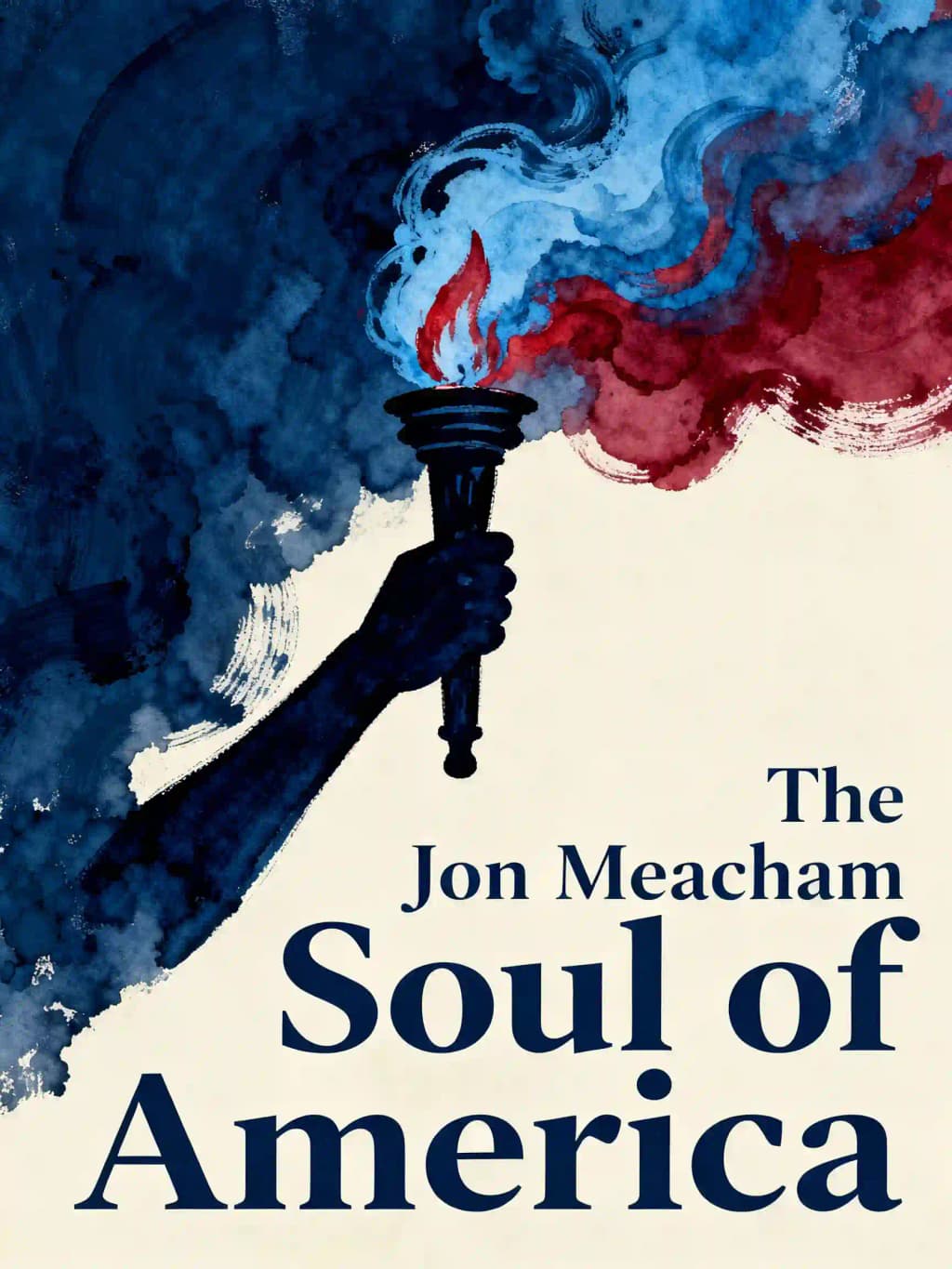
When Jon Meacham's "The Soul of America" was published in 2018, it quickly became a cultural phenomenon. Oprah Winfrey named it one of her essential reads, and Barack Obama included it on his summer reading list. The book's timing couldn't have been more prescient-arriving during a period of intense national division, it offered a historical perspective that both acknowledged America's darkest moments and celebrated its capacity for moral renewal. Drawing on his deep historical knowledge and narrative gifts, Meacham reminds us that we've survived periods of fear, hatred, and despair before. His central argument-that hope rather than fear has prevailed throughout American history-resonates across political lines because it speaks to our collective desire to believe in national progress, even when evidence suggests otherwise.
Kapitel 2
The Eternal Struggle Between Our Better Angels and Worst Impulses
America was founded on twin pursuits: religion and wealth. The 1606 First Charter of Virginia devoted just 98 words to spreading Christianity while the remaining 3,707 focused on acquiring land, resources, and minerals. Religious dissenters sought freedom of worship, with Puritan John Winthrop envisioning a "City upon a hill" in 1630. Yet fundamental contradictions emerged early-while white settlers built and dreamed, African slaves were brought to Virginia in 1619, and Native Americans were systematically removed.
This contradiction between our highest ideals and darkest practices has defined American history from the beginning. The presidency itself emerged as an uncertain experiment at the 1787 Constitutional Convention, with delegates like Madison unsure how to structure executive power. The framers ultimately left the office's precise nature ambiguous, largely because they assumed George Washington would be the first to hold it. The presidency was thus an act of faith in human character and the future.
Hamilton defended the executive branch in The Federalist, arguing that "Energy in the Executive is a leading character in the definition of good government" essential to securing liberty against "ambition, faction, and anarchy." Yet he also acknowledged human limitations. Washington established crucial precedents, understanding his actions would shape the office. When Pennsylvania farmers rebelled against a whiskey tax, Washington showed strength, believing it was his duty to ensure laws were faithfully executed. Even Jefferson, after serving eight years as president, came to believe the chief magistrate must unite "the confidence of the whole people" to channel national energy effectively.
Our most consequential presidents expanded this vision. Andrew Jackson transformed American governance by making it more responsive to popular will, proving that a leader who could inspire the masses could change the world. Jackson was a mass of contradictions-a champion of poor whites yet an unrepentant slaveholder, a sentimental man who adopted an Indian orphan yet drove tribes from their lands. His passion for "the humble members of society" opened doors of opportunity for men like himself. Though he thundered against his opponents, Jackson was a skilled compromiser who believed in the union with all his heart, calling America "one great family."
Kapitel 3
Lincoln and the Moral Dimension of Leadership
Abraham Lincoln expanded executive power during the Civil War through actions from summoning militia to emancipating slaves. At Gettysburg, he invested the war with transcendent meaning about democracy and equality. His second inaugural called for binding up the nation's wounds "with malice toward none, with charity for all." Frederick Douglass, who had pressed Lincoln on equal treatment of black soldiers, called the speech "a sacred effort." Years later, Douglass offered a nuanced assessment of Lincoln as "preeminently the white man's President" who nevertheless became "the man of our redemption." Lincoln understood the American people better than they knew themselves, balancing the twin imperatives of saving the Union and ending slavery.
Theodore Roosevelt championed the presidency as a "bully pulpit" and governed with the common American in mind-the Civil War veteran who "had worked hard," been a good husband and father, and wanted justice. TR believed firmly in presidential power, declaring it was "not only his right but his duty to do anything that the needs of the Nation demanded" unless forbidden by Constitution or law. He saw himself as president in the mold of Jackson and Lincoln, not the ineffectual James Buchanan.
Before becoming president, Woodrow Wilson observed that while American government was designed as a Newtonian system of balanced forces, in practice it functioned as a Darwinian organism that adapted to its environment. "Government is not a machine, but a living thing," he wrote, noting the Constitution's elasticity allowed for "play of life and circumstance." Wilson believed the president could be powerful by representing "the whole people" rather than special interests.
Franklin Roosevelt exemplified the importance of presidential temperament. Justice Oliver Wendell Holmes famously described FDR's cousin Theodore as having "a second-class intellect, but a first-class temperament!" Despite his ego-once calling himself and Orson Welles "the two best actors in America"-FDR possessed crucial self-knowledge and compassion. He understood the delicate balance of leadership, noting that "public psychology cannot be attuned for long periods to a constant repetition of the highest note in the scale." Eisenhower similarly emphasized that leadership wasn't "hitting people over the head" but rather "persuasion-and conciliation-and education-and patience."
Kapitel 4
The Long Shadow of the Civil War
On Palm Sunday, April 9, 1865, Robert E. Lee surrendered to Ulysses S. Grant at Appomattox Court House in Virginia. As the generals parted, they exchanged respectful salutes, but this comity augured little about what was to come. The clash of arms was over, but the battle between justice and injustice remained unresolved.
Appomattox proved as much a beginning as an end. Grant as president fought against the Ku Klux Klan, but was bracketed by Andrew Johnson, who obstructed equality, and Rutherford Hayes, who removed federal troops from the South in 1877, effectively ending Reconstruction. For many white Southerners, a new order with black equality was disorienting and had to be fought ferociously. In the creed of the "Lost Cause," they insisted the war had been about states' rights, not slavery.
The Confederate defeat was immense-between one-fifth and one-third of Southern troops died, with countless more injured. Mississippi spent 20% of its 1866 budget on wooden limbs. To justify such staggering losses, Southerners looked both backward and forward, rewriting history while plotting a new strategy.
The pre-war years had been marked by madness-Representative Preston Brooks nearly killed Senator Charles Sumner with a cane on the Senate floor, and Virginia executed John Brown when he might have been committed to a mental institution. As Robert Penn Warren noted, "a crazy man is a large-scale menace only in a crazy society."
Though the war had fundamentally been about slavery and freedom-what William Seward called the "irrepressible conflict"-Southerners afterward sought to diminish slavery's role. Jefferson Davis claimed in his memoirs that "African servitude was in no wise the cause of the conflict, but only an incident." This revisionism contradicted what Confederate leaders had said during secession, like Alexander Stephens' "Cornerstone Speech" declaring the Confederacy's foundation rested "upon the great truth that the negro is not equal to the white man."
The Civil War's moral clarity was less absolute than we imagine. As C. Vann Woodward noted, "The Union fought the Civil War on borrowed moral capital." Emancipation didn't necessarily mean equality-Lincoln himself told a delegation of blacks in 1862: "But even when you cease to be slaves, you are yet far removed from being placed on an equality with the white race." He even suggested colonization to Africa as a solution.
The Southern strategy was articulated by Confederate journalist Edward Alfred Pollard in "The Lost Cause" (1866). Pollard declared that while the South had surrendered slavery and secession, a new "war of ideas" was underway. "The war has left the South its own memories, its own heroes, its own tears, its own dead," he wrote, under which "sons will grow to manhood, and lessons sink deep." In his 1868 follow-up "The Lost Cause Regained," Pollard argued that white supremacy was the "true cause" and "true hope of the South," likening Southerners' suffering to Christ's, saying the South "must wear the crown of thorns before she can assume that of victory."
Kapitel 5
The Rise and Fall of Extremism in American Life
The Ku Klux Klan emerged as a violent enforcement arm of the Lost Cause. Founded in spring 1866 in Pulaski, Tennessee by six former Confederates, the Klan's name derived from kuklos, the Greek word for circle. What began with elaborate costumes and midnight horseback rides quickly evolved into organized terror against African Americans.
Southern accounts romanticized the Klan's origins as mere boredom-induced mischief, with one founder allegedly suggesting, "Boys, let's start something to break the monotony and cheer up our mothers and girls." Claude Bowers' 1929 book "The Tragic Era" celebrated how the white-sheeted riders frightened "superstitious" freedmen back to work, noting approvingly that whites observed "an improvement among them, with more industry and less petty pilfering."
By spring 1867, the Klan reorganized at Nashville's Maxwell House hotel with a detailed hierarchical charter. Nathan Bedford Forrest, the legendary Confederate cavalry commander whom Sherman had said must die before Tennessee could know peace, was elected "Grand Wizard of the Invisible Empire." The Klan's night riders spread throughout the South, systematically terrorizing freed blacks who were voting and holding office, effectively undermining Reconstruction authorities.
Andrew Johnson proved a disastrous successor to Lincoln, betraying Republican principles and serving primarily white Southern interests. Yet his presidency demonstrates that even an obstinate executive can be checked by organized public sentiment through Congress. While Lincoln had used presidential power for progress, Johnson wielded it to resist change.
Despite Johnson's opposition, Congress passed landmark legislation over his vetoes, including the Civil Rights Act of 1866 and Reconstruction Acts of 1867 that created military districts in the South and guaranteed black male suffrage. Johnson also unsuccessfully opposed the Fourteenth Amendment, which granted citizenship to former slaves and established the revolutionary principle of birthright citizenship and equal protection.
Kapitel 6
Theodore Roosevelt and the Progressive Era
Born in New York City in 1858 to a prominent family, Theodore Roosevelt was a sickly child plagued by terrible asthma. Finding solace in adventure stories and poetry, the young "Teedie" fought through his illnesses with remarkable determination. "There were all kinds of things of which I was afraid at first," he recalled, "but by acting as if I was not afraid I gradually ceased to be afraid."
Roosevelt's boundless energy became legendary. An English visitor remarked that the two most wonderful things he'd seen in America were "Niagara Falls and the President of the United States, both great wonders of nature!" His daughter Alice noted that her father always wanted to be "the bride at every wedding, and the corpse at every funeral." Journalist Ida Tarbell thought the president might literally explode with energy at a White House musicale.
In his famous "Citizenship in a Republic" speech at the Sorbonne in 1910, TR celebrated the "man in the arena, whose face is marred by dust and sweat and blood," arguing that glory belongs not to critics but to those who strive valiantly despite errors and shortcomings.
Born to privilege, Roosevelt adopted progressive passions, targeting "malefactors of great wealth" and arguing for workers' rights to "a living wage, to reasonable hours of labor, to decent working and living conditions." He believed progress came not from "the crowding out of the lower classes by the upper, but on the contrary from the steady rise of the lower classes to the level of the upper."
Roosevelt's era simultaneously embraced progressive reform and troubling notions of racial superiority. While movements for economic justice and workplace improvements gained momentum, so did eugenics and quasi-Darwinian theories about white hegemony. Herbert Spencer's "survival of the fittest" concept fueled a sense of Anglo-Saxon destiny, celebrated in works like John Fiske's "Manifest Destiny of the English Race" and Rudyard Kipling's "The White Man's Burden," which Roosevelt shared with Henry Cabot Lodge as "rather poor poetry, but good sense from the expansionist viewpoint."
While Roosevelt shared contemporary views of Anglo-Saxon imperialism, he distinguished himself through his partial rejection of nativism. He expanded the mainstream understanding of "Americanism" by declaring it "a question of spirit, conviction, and purpose, not of creed or birthplace." He condemned politicians who pandered to ethnic voting blocs and voters who rejected candidates based on their birthplace, insisting that immigrants who "really become American" deserved equal footing with native-born citizens.
Kapitel 7
The Triumph of Women's Suffrage and the Darkness of Reaction
In September 1918, President Woodrow Wilson personally typed and delivered a speech urging the Senate to approve the Nineteenth Amendment granting women voting rights. Though initially reluctant to support suffrage, Wilson had evolved, telling senators that in this global war for democracy, the world was "looking to the great, powerful, famous Democracy of the West" for leadership. He argued women's participation was essential: "Without their counsellings, we shall be only half wise."
Wilson had witnessed the movement's determination firsthand. When arriving for his 1913 inauguration, he found Washington's streets empty of well-wishers who were instead watching a massive suffrage parade. That demonstration turned chaotic when angry men harassed the marchers, forcing cavalry troops to restore order. Despite this show of popular support, Wilson initially rebuffed suffrage leader Alice Paul in a White House meeting, dismissing the movement that had already been fighting for seven decades since the 1848 Seneca Falls convention.
Alice Paul established herself across from the White House and launched a persistent protest campaign at Wilson's doorstep. Born to a Quaker family in New Jersey, Paul had been radicalized by the militant British suffrage movement under Emmeline Pankhurst from 1907-1910, where she learned confrontational tactics including hunger strikes that led to force-feedings when arrested. These gruesome procedures-tubes carrying milk and mush forced through protestors' nostrils-generated moral outrage that advanced the cause.
The women's rights movement predated America itself. In 1776, Abigail Adams famously urged her husband John to "Remember the Ladies" when creating new laws, warning that women would "foment a Rebellion" if denied representation. By 1848, the Seneca Falls convention, organized by Elizabeth Cady Stanton and Lucretia Mott, issued their "Declaration of Sentiments" proclaiming "all men and women are created equal." Susan B. Anthony later reinforced this principle after illegally voting in 1873, declaring that "we, the whole people" formed the Union to secure liberty for everyone, "women as well as men."
The suffrage movement reached its climax during Wilson's presidency through Alice Paul's relentless pressure tactics. "Silent sentinels" stood daily outside the White House, and when arrested for "interfering with traffic," they employed hunger strikes leading to force-feedings. During Wilson's 1916 State of the Union, suffragists unfurled a banner asking "MR. WILSON, WHAT ARE YOU DOING FOR WOMEN'S SUFFRAGE?" This represented the first organized use of passive resistance and civil disobedience directly confronting presidential authority in American history.
Their persistence succeeded when Wilson endorsed the Nineteenth Amendment, ratified August 18, 1920. Wilson later wrote to suffrage leader Carrie Chapman Catt that he considered the amendment's ratification "one of the greatest honors" of his life. Catt herself reflected that beyond victory, the movement's greatest achievement was the discipline it gave participants in establishing "a new and good thing in the world."
Kapitel 8
The Great Depression and the Test of American Democracy
The Great Depression presented an existential challenge to American democracy. By 1932-33, the crisis had eroded trust in basic institutions, with unemployment reaching nearly 20% and widespread fear that America might abandon democracy for totalitarianism or communism. Franklin Roosevelt identified Huey Long and Douglas MacArthur as potentially the two most dangerous men in America-one who might orchestrate a coup from the populist left, the other from the right. The nation was so desperate that the loudest cheers during FDR's inaugural came when he suggested assuming extended wartime powers.
In February 1933, Roosevelt narrowly escaped assassination when Giuseppe Zangara opened fire in Miami, wounding Chicago's mayor instead. This attack further destabilized an already fragile nation. Economic conditions were so dire that John Maynard Keynes compared the Depression to the Dark Ages. The unemployed suffered not just poverty but profound guilt, with one jobless man telling a reporter, "Sometimes I feel like a murderer. What's wrong with me, that I can't protect my children?"
While Huey Long advocated for radical wealth redistribution to save capitalism, warning "the country has been going toward communism" as wealth concentrated in few hands, Franklin Roosevelt emerged as the nation's unlikely savior. In his 1932 Senate speech "The Doom of America's Dream," Long argued that both parties had failed America and that only radical change could restore the nation to its people. He lamented the vanishing middle class: "Where is the corner groceryman? He is gone or going."
Roosevelt navigated the political extremes with remarkable balance, telling an aide who feared failure, "If I fail, I shall be the last one." Just as he physically balanced himself with braces and canes, he politically maneuvered through the decade's storms, maintaining composure while never showing "exhaustion, boredom, or irritation." He defined his approach as a liberal middle path: "The radical says: 'Cut it down.' The conservative says: 'Don't touch it.' The liberal compromises: 'Let's prune, so that we lose neither the old trunk nor the new branches.'" He embraced experimentation, saying, "It is common sense to take a method and try it: If it fails, admit it frankly and try another. But above all, try something."
Kapitel 9
The McCarthy Era and America's Reckoning with Fear
Senator Joseph McCarthy exploited Americans' fears of Communism with sensationalism rather than substance. Unlike traditional politicians, McCarthy mastered false charges, conspiracy theories, and calculated disrespect for established figures while keeping himself center stage. His accusations about Communist infiltration in government were constantly shifting and imprecise-his famous "list" of alleged Communists in the State Department changed from 205 to 57.
McCarthy was an opportunist without deep ideological convictions. As his lawyer Roy Cohn noted, McCarthy "bought Communism" like a new car, recognizing its political opportunities. When confronted by Wisconsin journalists about his lack of evidence, McCarthy crudely admitted he had "a pailful of shit" to use where it would benefit him most.
Thoughtful leaders recognized the danger. Eleanor Roosevelt said McCarthy's methods "look like Hitler's," Truman compared McCarthyism to Hitlerism, and even Winston Churchill defended Anglo-American traditions against McCarthy's tactics. Truman bluntly told reporters in 1950 that "the greatest asset that the Kremlin has is Senator McCarthy," noting that his loyalty program had found "an infinitesimal part of 1 percent" of government employees to be disloyal.
McCarthy's influence was profound both domestically and internationally. Richard Rovere of The New Yorker noted he was "the first American ever to be actively hated and feared by foreigners in large numbers." Even in Japan, Eleanor Roosevelt faced questions about McCarthyism from bewildered businessmen unable to comprehend such behavior in a democratic nation.
On March 9, 1954, Edward R. Murrow's See It Now broadcast a devastating episode on McCarthy using the senator's own words against him. Murrow concluded with a powerful statement: "We must not confuse dissent with disloyalty... We will not walk in fear, one of another." He placed responsibility not just on McCarthy but on Americans themselves: "He didn't create this situation of fear; he merely exploited it."
The Army-McCarthy hearings that followed exposed McCarthy's bullying tactics to television audiences. The iconic moment came when Army counsel Joseph Welch, responding to McCarthy's attack on a young lawyer, asked: "Have you no sense of decency, sir, at long last? Have you left no sense of decency?"
Kapitel 10
Lyndon Johnson and the Civil Rights Revolution
Lyndon Johnson, thrust into the presidency by Kennedy's assassination on November 22, 1963, was determined to act decisively despite the tragedy. "I can't sit still," he told Speaker McCormack, "I've got to keep the government going." Even as the nation reeled from Dallas, Johnson was already thinking beyond the crisis, declaring his intention to pass Kennedy's civil rights bill without compromise: "I'm going to fix it so everyone can vote, so everyone can get all the education they can get."
The moment was fraught with racial tension. Governor George Wallace had tried blocking integration at the University of Alabama; Medgar Evers had been assassinated; King had led the March on Washington; and four little girls had been killed in the Birmingham church bombing. Martin Luther King Jr. worried about America's "ten-day" attention span on civil rights issues.
As a Southern Democrat in a party divided between Northern liberals and Southern segregationists, Johnson faced tremendous political risk. When advised to delay civil rights legislation until after the 1964 election, Johnson dismissed such counsel with his penetrating question: "Well, what the hell is the presidency for?"
Johnson had hardly been a progressive earlier in his career. As a Texan with consuming ambition, he had generally appeased segregationist constituents. While he declined to sign the 1956 Southern Manifesto opposing school integration (along with Tennessee senators Albert Gore Sr. and Estes Kefauver), he had also weakened civil rights bills in the Senate, though he would later point out that at least they passed in some form.
His commitment to civil rights after Dallas represents one of the great transformations in presidential history, comparable to Lincoln's evolution from tolerating slavery to emancipation. "I've never felt freer in my life," Johnson remarked in January 1964. Now representing the whole country rather than just a southern state, he could "do what the whole country thinks is right." His story demonstrates the difference a singular president can make when circumstances align with steady, brave protest voices.
Kapitel 11
The First Duty of an American Citizen
Political engagement is our first duty as citizens. Theodore Roosevelt declared that Americans must work in politics practically while upholding "the highest principles of honor and justice." Those who avoid politics disarm themselves in the great contests of the soul, missing what Holmes called the "passion and action" of the age. Politicians will inevitably disappoint but also occasionally inspire. We need not become candidates, but must pay attention, express opinions, and vote-foundational obligations of citizenship. Our beliefs create obligations to make them known and act upon them. Politicians typically mirror public sentiment rather than mold it, making public opinion the true power in America. As Jefferson noted, "the spirit of resistance to government" should always remain alive, for skepticism about authority is embedded in our revolutionary character.
Politics works best when we resist tribal inclinations. Jane Addams warned that limiting our interactions to those we already respect "tremendously circumscribe our range of life" and limits our ethics. Eleanor Roosevelt offered practical advice: attend meetings of both your party and the opposition to understand what people are thinking and remain flexible. She would likely advise against letting any single cable network or Twitter feed dictate your thoughts. Harry Truman, though "fiercely partisan," believed America would lose something vital if conservatives and liberals segregated into separate, irreconcilable camps.
Facts remain stubborn things, as John Adams noted, yet too many Americans choose perspectives based on loyalty to leaders rather than grounding in reality. Truman believed that while dictators rely on repeated lies, truth told often enough will ultimately prevail. Reflexively opposing ideas without weighing their merits surrenders our intellectual capacity to shape public life. Reform requires patience and consideration-even of opposing viewpoints.
Jefferson believed an informed citizenry could be trusted with self-government and would correct course when things went wrong. Being truly informed means recognizing that rarely does any single group monopolize wisdom or virtue. Presidents are neither mythic figures nor villains but humans with strengths and weaknesses. Kennedy once remarked that no one should grade a president who hasn't sat in his chair and understood why decisions were made. Yet as Theodore Roosevelt insisted, blind support for a president "is not only unpatriotic and servile, but morally treasonable." A free press remains essential-Kennedy himself acknowledged that despite its "abrasive quality," we "could not do the job at all in a free society without a very, very active press."
Historical perspective provides orientation in troubled times. Daniel Webster compared this to a mariner using "the earliest glance of the sun" after a storm to determine his position. Understanding our past helps us navigate present challenges.
Lincoln, who gave us the image of our better angels, deserves the final word. In summer 1864, addressing the 166th Ohio Regiment who had defended Washington against Confederate forces, Lincoln explained why the struggle must continue: so each citizen might have "an open field, and a fair chance" with "equal privileges in the race of life." The nation, he concluded, "is worth fighting for, to secure such an inestimable jewel." Despite our darker impulses and imperfections, the American experiment remains worthy of our defense-there is no struggle more important than serving those better angels who are "always ready for battle."