Kapitel 1
The Soundtrack of a Nation: How Music Shaped American Identity
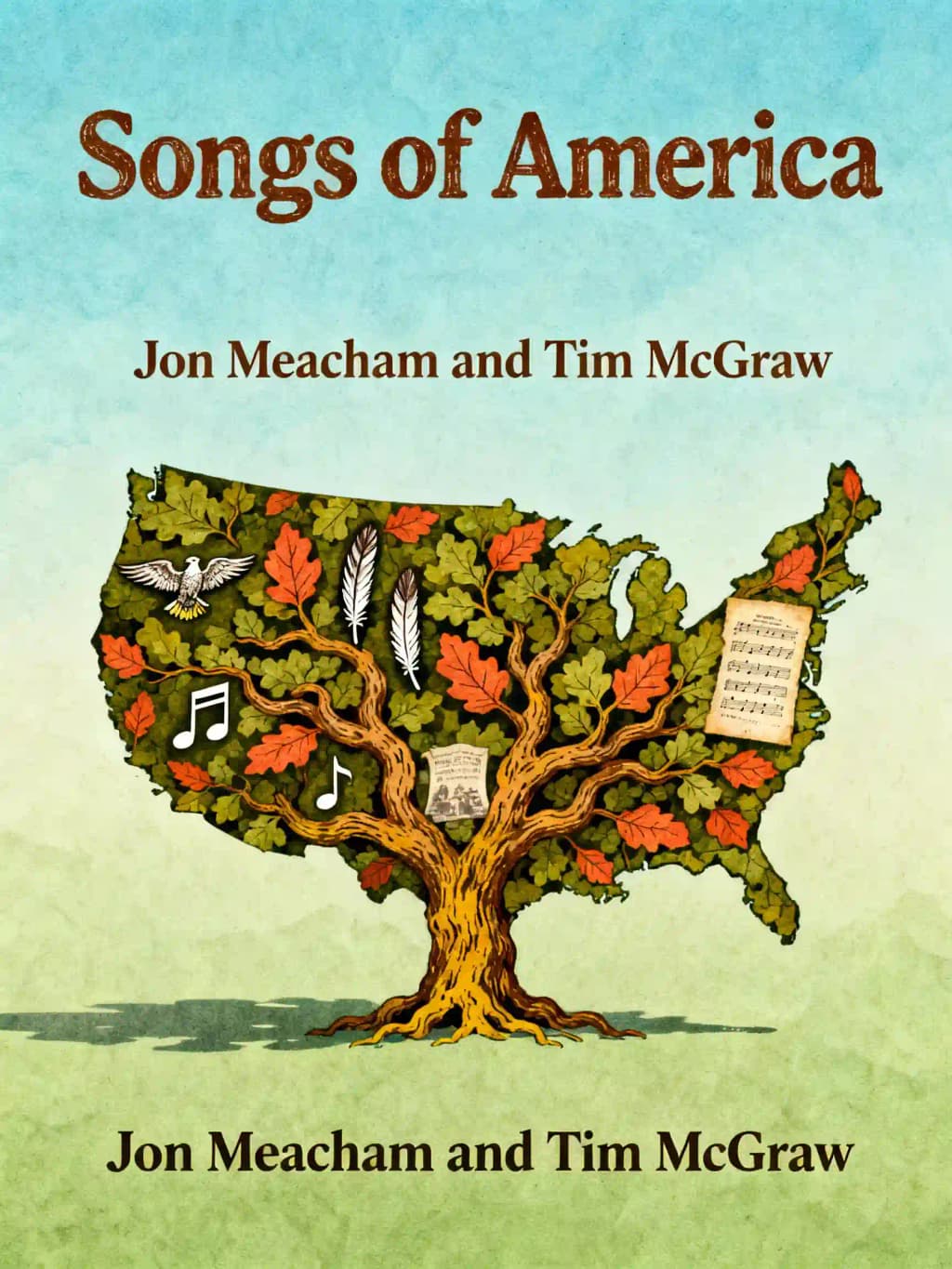
In the heart of the American story lies a melody-or rather, a complex symphony of melodies. Jon Meacham and Tim McGraw's "Songs of America" has become a cultural phenomenon, praised by figures from Oprah Winfrey to historian Doris Kearns Goodwin as an essential exploration of how music has both reflected and shaped the American experience. The book's unique approach-combining Meacham's historical expertise with McGraw's musical insights-creates a powerful narrative that has resonated with readers across political divides. As Barack Obama noted in his summer reading list recommendation: "This book reminds us how music has always been a powerful force in understanding who we are as Americans." Indeed, the work has sparked conversations in university courses, book clubs, and even inspired a companion concert tour that sold out venues nationwide. Through patriotic anthems, protest songs, and everything in between, Meacham and McGraw reveal how America's soundtrack contains both our highest aspirations and our painful contradictions.
Kapitel 2
The Sensations of Freedom: Music in Revolutionary America
When British officials seized John Hancock's sloop Liberty in Boston Harbor in June 1768, they couldn't have known they were setting in motion events that would inspire America's first patriotic song. The seizure, enforcing the hated Townshend Acts, sparked violent resistance as colonists pursued customs collector Joseph Harrison through Boston's streets, pelting him with stones. This "Great Riot" moved Pennsylvania lawyer John Dickinson to action. Already known for his influential "Letters from a Farmer in Pennsylvania," Dickinson composed "The Liberty Song" set to a popular British naval tune.
With stirring lines like "By uniting we stand, by dividing we fall" and "To die we can bear-but to serve we disdain," Dickinson's song spread rapidly through the colonies. The irony wasn't lost on Americans-they were using British music to express their growing resistance to British rule. Through "boisterous choral singing," colonists experienced a sense of unity that John Adams called "cultivating the sensations of freedom."
Music quickly became a battlefield in the emerging conflict. British forces under Lord Percy tauntingly played "Yankee Doodle" before the battles at Lexington and Concord in April 1775, not realizing Americans would eventually embrace the tune as their own. As reconciliation hopes faded with King George III's "Proclamation for Suppressing Rebellion," Thomas Paine's "Common Sense" galvanized public opinion toward independence. By July 1776, the Declaration of Independence established America's founding ideal that "all men are created equal"-an aspiration not fully realized but worth pursuing.
The constitutional framework drafted in 1787 carried forward this promise, designed to check human passions and balance our failings. As Madison noted in The Federalist Papers, "If men were angels, no government would be necessary." Americans never lacked self-regard, seeing themselves as "a city upon a hill" in John Winthrop's words-an image later invoked by Kennedy and modified by Reagan as a "shining city upon a hill."
Yet despite its lofty founding ideals, the new republic subjugated women, enslaved African Americans, and persecuted indigenous peoples. The struggle to apply Jefferson's words to all rather than some began early. Abigail Adams urged her husband to "Remember the Ladies" while Phillis Wheatley, an African-born enslaved woman, became one of early America's most important literary voices, celebrated by Washington himself for her sublime prophetic verse about "Freedom" descending with "every Grace."
From its founding, the republic was torn by partisan strife between Federalists and Republicans. Washington warned against "the baneful effects of the spirit of party," calling it "truly their worst enemy." The 1798 war fever that produced the Alien and Sedition Acts exemplified this division, with both sides expressing their politics through song. Federalists promoted "Adams and Liberty" while Jeffersonians countered with "Jefferson and Liberty" after his 1800 victory.
In April 1798, amid this intense partisan conflict, Philadelphia lawyer Joseph Hopkinson composed "Hail Columbia" at the request of actor-singer Gilbert Fox, who needed a patriotic song to boost ticket sales. Set to "The President's March," the ballad featured the unifying chorus: "Firm, united let us be/Rallying round our liberty/As a band of brothers joined/Peace and safety we shall find." Initially known as "The Favorite New Federal Song," it was considered by many to be the national anthem for years before Congress officially elevated "The Star-Spangled Banner" in 1931.
Kapitel 3
The Banner Yet Waves: Music in the Early Republic
The War of 1812 became a pivotal moment in American history-a struggle to ratify the American Revolution and establish national identity. The conflict began over British impressment of American sailors and concerns about British alliances with Indian tribes, but ultimately became about reaffirming independence. Many historians view it as the true conclusion to the Revolutionary period, which didn't fully end until the Treaty of Ghent and Battle of New Orleans in 1815.
When the British attacked Fort McHenry in Baltimore Harbor on September 13-14, 1814, Francis Scott Key watched anxiously from a sloop as the bombardment lasted twenty-five hours. The British flotilla was formidable, including frigates and "bomb vessels" with names like Meteor, Devastation, and Terror. Despite firing 1,500-1,800 shells at the fort, only four Americans were killed. At dawn, Key peered through the mists to see if the garrison had held. When he saw the flag still flying, he scribbled verses on the back of a letter that would become "The Star-Spangled Banner."
In 1831, twenty-four-year-old seminary student Samuel Francis Smith penned "America" (known as "My Country 'Tis of Thee") in just half an hour after reading German patriotic hymns. With impudent brilliance, he set his American lyrics to the tune of "God Save the King," the British national anthem. The song's power derived from what Bernice Johnson Reagon would later call "the communal expression of 'I'"-the personal ownership each singer feels toward their native land.
The hymn proved remarkably versatile and enduring. Abolitionists rewrote it to highlight slavery's contradictions with American ideals. Freed slaves sang it first when emancipation came in 1863. Colonel Roosevelt's dying Rough Riders made it their final utterance in Cuba. Martin Luther King Jr. invoked it at the March on Washington. Through these diverse uses, Smith's creation became a beacon through which Americans could express not just what the nation was, but what it could become.
While Americans celebrated their ideals in song, foreign observers noted the nation's profound contradictions. Harriet Martineau saw America as "a great embryo poet" capable of magnificent dreams, while Frances Trollope bluntly observed Americans "with one hand hoisting the cap of liberty, and with the other flogging their slaves" while driving Native Americans from their lands despite solemn treaties.
The treatment of Native Americans revealed America's broken promises. Despite moral appeals from figures like Jeremiah Evarts and Catharine Beecher Stowe against removal policies, white power prevailed. John Rollin Ridge, a Cherokee child forced onto the Trail of Tears, described himself as "a stranger in a strange land"-echoing the biblical lament of exiled Israelites. Native American songs like the Choctaw's "Long Sought Home" expressed spiritual connection to land and hope for divine mercy amid displacement.
Kapitel 4
Battle Cries and Freedom Songs: Civil War and Emancipation
As the Civil War approached, two starkly divergent visions of America emerged. While Frederick Douglass spoke of reason and Enlightenment ideals spreading globally to end slavery, Confederate Vice President Alexander H. Stephens offered a radically different perspective, declaring that the Confederacy's cornerstone rested "upon the great truth that the negro is not equal to the white man; that slavery subordination to the superior race is his natural and normal condition."
These opposing worldviews-Douglass's vision of universal freedom versus Stephens's defense of permanent racial subordination-framed what Lincoln called "the fiery trial" that would claim three-quarters of a million lives. The fundamental question required resolution: could America remain the "land of the Slave," or would it truly become "the land of the free"?
While Lincoln's prose during the Civil War achieved remarkable eloquence, song became equally vital to expressing America's wartime experience. Music "rang out from parlor pianos in homes across the country; it thundered from crowds of civilians at political rallies; it beat the steady rhythms of soldier life; and it declared the newfound freedom of African-Americans," as scholar Christian McWhirter observed.
Lincoln's journey toward emancipation revealed the complexities behind the Union's musical certainty. Though he later claimed, "I am naturally anti-slavery. If slavery is not wrong, nothing is wrong," his path was complicated by prevailing white prejudices and political realities. By summer 1862, however, military necessity aligned with moral imperative. After the Union victory at Antietam that September, Lincoln told his cabinet he had struck a bargain with God: if Union forces prevailed in Maryland, he would move on emancipation.
Lincoln's emancipation decision coincided with Julia Ward Howe's "Battle Hymn of the Republic" gaining popularity. After visiting the Army of the Potomac in Virginia, Howe awoke in her Washington hotel room and composed new verses to the familiar tune of "John Brown's Body." Her poem elevated the Union cause to divine purpose: "Mine eyes have seen the glory of the coming of the Lord..." First published in The Atlantic Monthly in February 1862, the song captivated Lincoln, who once exclaimed "Sing it again!" after hearing it performed.
Ironically, the Confederate anthem "I Wish I Was in Dixie's Land" originated in New York as part of a minstrel show. Daniel Decatur Emmett, an Ohio native performing with Bryant's Minstrels, hastily composed "Dixie" in March 1859. The song was written for blackface performers-whites pretending to be blacks nostalgically longing for the South. Despite this origin, the tune became popular across both North and South, with even Lincoln admiring it.
As Union forces advanced, enslaved people created their own musical responses. When William T. Sherman marched through Georgia and the Carolinas, one South Carolina enslaved community sang Henry Clay Work's minstrel song when their master fled: "White folks, have you seen old master/Up the road, with his moustache on?/He pick up his hat and he leave real sudden/And I believe he's up and gone." The song celebrated their master's cowardice and anticipated freedom's arrival.
Kapitel 5
Marching Forward: Music in the Progressive Era
In October 1915, over twenty-five thousand suffragists marched up Fifth Avenue in New York to the cheers of a quarter-million spectators. Thirty bands played marching tunes as fifteen thousand yellow banners filled the streets. This movement, with roots stretching back to Abigail Adams's admonition to "Remember the Ladies," would culminate in the passage of the Nineteenth Amendment in time for the 1920 presidential election.
Many women who had fought for abolition, including Julia Ward Howe, turned their attention to suffrage. Howe wrote that discovering "true womanhood" was like "the addition of a new continent to the map of the world." The movement had its own anthems, like "Give the Ballot to the Mothers," sung to the tune of "Marching Through Georgia," with lyrics celebrating "Equal Rights" and "Giving the ballot to the mothers."
While women marched for suffrage, African Americans continued their fight against racial injustice. Despite Appomattox being a beginning rather than an ending, white Southerners secured legalized segregation, with Edward Alfred Pollard arguing for the "Lost Cause" of white supremacy. Against these terrible odds, reformers persisted. In 1905, W.E.B. Du Bois led the Niagara Movement, declaring, "We will not be satisfied to take one jot or tittle less than our full manhood rights."
During this period, James Weldon Johnson wrote the lyrics to "Lift Every Voice and Sing," with music composed by his brother J. Rosamond Johnson. Created for a Lincoln's Birthday celebration in Jacksonville, Florida in 1900, the song was performed by five hundred schoolchildren. Though the Johnson brothers soon moved to New York, the song spread organically as those children became teachers and taught it to others. Within twenty years, it was being sung throughout the South and beyond, becoming known as the "Negro National Hymn."
The song's success grew naturally, with Johnson noting he often found copies pasted in hymnals and songbooks. By 1919, the NAACP had made it their official hymn. Johnson viewed the song as compatible with other patriotic songs, noting it was "fully as patriotic" as "The Star-Spangled Banner" or "America." The song expressed tempered hope-acknowledging progress from the past while praying for a better future, maintaining faith in America as a "native land" deserving allegiance.
On May 1, 1940, as Europe faced Hitler's advancing forces, President Franklin D. Roosevelt presented the Congressional Gold Medal to George M. Cohan for his patriotic songs from World War I. Cohan's works had unified the country during 1917-18 and resonated again as a new global conflict loomed. His song "Over There" embodied American resolve and sense of duty with lines like "show your grit, do your bit" and "Make your Mother proud of you."
Not all songs of the World War I era were rallying cries. Some expressed opposition to the conflict, like the 1915 song "I Didn't Raise My Boy to Be a Soldier," marketed as "A Mother's Plea for Peace." Its lyrics questioned the morality of sending young men to "shoot some other mother's darling boy" and suggested that if all mothers refused to send their sons to war, conflict would end.
Kapitel 6
Through Depression and War: Music of the Roosevelt Era
The song "Happy Days Are Here Again" became inseparable from Franklin Roosevelt in the political imagination of Americans. Written by Jack Yellin with music by Milton Ager before the 1929 stock market crash for an MGM movie, the song entered politics at the 1932 Democratic National Convention in Chicago. Though initially planning to use "Anchors Aweigh," Roosevelt advisor Louis Howe switched to "Happy Days" after hearing his secretary sing it-a fitting choice, as insistent optimism was one of FDR's greatest gifts to a nation consumed by the Great Depression.
Roosevelt's show of confidence required immense effort, as no one-including the president-truly knew if prosperity would return. The popular song "Brother, Can You Spare a Dime?" (successfully recorded by Bing Crosby in 1932) captured the grim reality facing countless Americans. Its narrator-an unemployed veteran who had played by the rules but now stood in bread lines-represented innumerable shattered lives.
In 1938, as Europe drifted toward chaos, Irving Berlin revived his 1918 song "God Bless America," which Kate Smith performed on CBS radio on Armistice Day 1938. The song's references to "storm clouds" gathering "far across the sea" resonated with listeners fearing Hitler. Woody Guthrie, however, heard something else in Berlin's verses-a triumphalism that portrayed America simplistically-and wrote "This Land Is Your Land" in response.
One of the most powerful moments in this era came when Marian Anderson performed at the Lincoln Memorial on Easter Sunday, April 9, 1939, after being denied the use of Constitution Hall by the Daughters of the American Revolution. Before 75,000 people, Anderson performed "Ave Maria," "Gospel Train," and "Nobody Knows the Trouble I've Seen." The image of an African American woman standing before Lincoln's statue singing of "sweet land of liberty" was profoundly moving. Mary McLeod Bethune wrote, "Through the Marian Anderson protest concert we made our triumphant entry into the democratic spirit of American life."
By January 1939, Roosevelt had concluded there was "a policy of world domination between Germany, Italy, and Japan." When Hitler and Stalin signed their nonaggression pact in August, Hitler invaded Poland on September 1, 1939. Roosevelt was awakened at 3 a.m. with the news, responding, "Well, Bill, it's come at last. God help us all."
Sacred music cemented the Anglo-American alliance when Roosevelt and Churchill met secretly at Placentia Bay in August 1941. During a Sunday service aboard HMS Prince of Wales, Churchill deliberately chose "grand hymns" to create a shared sense of mission. Together they sang "O God, our help in ages past," "Onward, Christian soldiers," and "Eternal Father, strong to save." Roosevelt later told his son, "If nothing else had happened while we were here, that would have cemented us."
The most powerful wartime songs were those that moved the troops themselves-songs of longing, loss, love and hope like "We'll Meet Again" and "You'll Never Know." Glenn Miller, despite being in his late thirties, lobbied to join the military and was commissioned in the Army Air Force, aiming to "put a little more spring into the feet of our marching men and a little more joy into their hearts."
Roosevelt's death on April 12, 1945, marked the end of an era. The New York Times lamented the loss of his "fresh and spontaneous interest" in "the troubles and the hardships and the disappointments and the hopes of little men and humble people." Perhaps most poignantly, Woody Guthrie addressed Eleanor Roosevelt directly: "Dear Mrs. Roosevelt, don't hang your head and cry; His mortal clay is laid away, but his good work fills the sky; This world was lucky to see him born."
Kapitel 7
We Shall Overcome: Music of the Civil Rights Era
Throughout the civil rights struggle, music powered the movement. SNCC field secretary Phyllis Martin explained how singing helped overcome fear: "When the singing started, I forgot all that. I felt good within myself." John Lewis believed that "if it hadn't been for music, the civil rights movement would have been like a bird without wings."
The music's power crossed racial lines. In Albany, Georgia, in December 1961, even jail guards were caught "singing and humming songs along with the prisoners" as activists sang "We Shall Overcome." Martin Luther King Jr. understood music's central role, telling the Times, "We all share the same songs. They give the people new courage and a sense of unity. I think they keep alive a faith, a radiant hope, in the future, particularly in our most trying hours."
"We Shall Overcome" emerged as the movement's anthem, with King noting in a 1965 Playboy interview that "In a sense, songs are the soul of a movement." The song's history is complex, with at least seven antecedents including an 18th-century Italian hymn, "No More Auction Block," Charles Tindley's 1900 hymn "I'll Overcome Someday," and labor movement songs. John Lewis recalled the song's power: "It made us feel we could face almost anything-the storms of the movement, the storms of life itself."
The civil rights movement inspired artists across America. Northern voices like Bob Dylan offered support to Southern activists, with songs like "Blowin' in the Wind" joining "We Shall Overcome" in the movement's repertoire. Dylan's work particularly inspired Sam Cooke to write "A Change Is Gonna Come" in 1964. Other artists employed "masking"-conveying political messages in seemingly innocuous terms. Chuck Berry's "Promised Land" described the Freedom Rides' route without explicit political language, making it radio-friendly.
The March on Washington for Jobs and Freedom in August 1963 showcased the powerful convergence of music and civil rights activism. Joan Baez performed "We Shall Overcome" and "Oh Freedom" as one of fourteen official performers. Peter, Paul and Mary performed "If I Had a Hammer" and Dylan's "Blowin' in the Wind," which had become a massive hit. Mahalia Jackson delivered powerful renditions of "I Been 'Buked and I Been Scorned" and "How I Got Over."
The hopeful spirit of the March on Washington was shattered just weeks later when a bomb planted by Ku Klux Klansmen exploded at Birmingham's 16th Street Baptist Church, killing four young girls. The news reached musician Nina Simone in her Mount Vernon, New York apartment. "It was more than I could take," she recalled, "and I sat struck dumb in my den like St. Paul on the road to Damascus." In her fury, she initially tried to assemble a homemade gun before her husband reminded her: "Nina, you don't know anything about killing. The only thing you've got is music." Within an hour, Simone composed "Mississippi Goddam," her first civil rights song.
The power of "We Shall Overcome" would reach its pinnacle when President Lyndon Johnson, responding to the "Bloody Sunday" attack on marchers in Selma in March 1965, addressed Congress and 70 million Americans. After invoking America's founding principles and the struggle for voting rights, Johnson concluded by adopting the movement's anthem: "And we shall overcome." As King watched from Selma, he wept to hear a president embrace the movement's mantra.
On the evening of April 3, 1968, Martin Luther King Jr. delivered what would be his final speech at the Mason Temple in Memphis. His words took on a prophetic tone: "Well, I don't know what will happen now. We've got some difficult days ahead. But it really doesn't matter with me now. Because I've been to the mountaintop." The next day, April 4, King was preparing a sermon titled "Why America May Go to Hell" when he stepped onto the balcony of the Lorraine Motel. There, a rifle shot ended his life, but not his legacy or the movement he led.
Kapitel 8
Divided Harmonies: Music in a Polarized Nation
As the Watergate scandal engulfed his presidency, Richard Nixon sought refuge among friendly audiences. In March 1974, he traveled to Nashville for the opening of the new Grand Ole Opry venue, hoping to rally support from Middle America. On stage, Nixon praised country music for coming "from the heart of America" and embodying traditional values of family, religion, and patriotism. He closed by playing "God Bless America" on the piano, attempting to shift focus from Watergate to themes of national pride.
The episode illustrated America's deep divisions during the Vietnam and Watergate years. The country was split by region, class, party, and religion-a struggle between the countercultural "Age of Aquarius" and the traditional values represented by fictional character Archie Bunker. While anti-war music like John Lennon's "Give Peace a Chance" dominates cultural memory, understanding this era requires appreciating the tensions between divergent visions of America.
Merle Haggard's "Okie from Muskogee" became a defining anthem for traditional America during the Vietnam era, topping the country charts just six weeks after its release. In contrast, "Aquarius/Let the Sunshine In," performed by the 5th Dimension, represented the counterculture's spirit. These songs weren't merely protest music but represented a fundamental generational shift in American values-one embracing traditional patriotism, the other celebrating cultural transformation.
The Vietnam War's inequities sparked powerful musical responses. Creedence Clearwater Revival's "Fortunate Son" confronted the privilege that allowed wealthy Americans to avoid military service, with John Fogerty later describing it as "a confrontation between me and Richard Nixon." For soldiers in Vietnam, the Animals' "We Gotta Get Out of This Place" became the unofficial anthem, its desperate refrain capturing their longing for home.
Johnny Cash embodied America's ambivalence about Vietnam-neither hawk nor dove. Though he toured with the USO, he privately questioned whether soldiers were "dying for a cause that isn't just." His song "Ragged Old Flag" (1974) captured this complexity, defending patriotic symbols while acknowledging national flaws: "She's been burned, dishonored, denied, and refused...And the government for which she stands/Has been scandalized throughout the land."
Elvis Presley's rise from poverty to stardom mirrored America's journey-prosperous in the fifties, troubled in the sixties, and breaking down in the seventies. His story was quintessentially American-a poor boy rising to riches on talent alone. As America struggled through Vietnam and Watergate, Presley too was torn between patriotism and self-indulgence. His bizarre 1970 meeting with Nixon, where he rambled about moral degeneration and offered to become a secret federal agent, reflected the mindset of many white Americans who didn't protest or challenge authority.
Kapitel 9
From Reagan to Obama: Music in Contemporary America
In summer 1984, conservative columnist George F. Will attended-and surprisingly enjoyed-a Bruce Springsteen concert in Washington. Will interpreted Springsteen through a conservative lens as embodying free market virtues, missing the complexity of Springsteen's lyrics about working-class anxiety. When Reagan's 1984 reelection campaign attempted to appropriate "Born in the U.S.A." as a patriotic anthem, Springsteen pushed back, explaining that his song was actually a protest about America splitting into "two different Americas" where promises were being broken.
Lee Greenwood's "God Bless the U.S.A." became the conservative counterpart to Springsteen's "Born in the U.S.A." After toiling for decades as a Las Vegas lounge singer, Greenwood wrote the song in response to the Soviet downing of a Korean passenger jet in 1983. The Reagan campaign discovered it and licensed it for a dollar, making it the anthem of the 1984 reelection campaign. Unlike Springsteen's ambivalent anthem, Greenwood's song offered unapologetic optimism about America as a land of second chances and opportunity.
While Greenwood and Reagan shared an optimistic view of America, groups like Run-DMC offered a counternarrative. Hip-hop's commercial and cultural rise coincided with Reagan's presidency, with Chuck D calling rap music "the CNN of black America." Artists like Jay Z, Snoop Dogg, and Tupac Shakur built cultural bridges by compelling white America to cross over to them rather than vice versa.
On September 11, 2001, America entered a new era when terrorists attacked the World Trade Center and Pentagon. In his Grammy Award-winning album The Rising, released ten months after 9/11, Bruce Springsteen created what amounted to a modern hymnal that helped Americans express what they couldn't put into words. "Into the Fire," an ode to the more than 300 firefighters lost, transformed grief into hope. "My City of Ruins," though written before 9/11, became an anthem of resilience.
In 2003, the Dixie Chicks faced massive backlash after Natalie Maines criticized President Bush during a London concert. Country music columnist Chet Flippo explained the audience's reaction: "That audience is tolerant of artists' mistakes and foibles: drunkenness, drug use, adultery, no-shows and any amount of indulgent behavior. What that audience will not tolerate is an artist turning on that audience." Though they found success with their defiant 2006 single "Not Ready to Make Nice" and won Grammy awards, country music never welcomed them back-a stark illustration of America's growing political polarization.
Brooks & Dunn's patriotic anthem "Only in America" transcended partisan politics, being embraced by both Republican and Democratic administrations. Written by Kix Brooks and friends in 1999 after "a good long day in the woods" discussing their love for America, the song was first performed at George W. Bush's 2001 pre-inaugural celebration and used in his 2004 campaign. Remarkably, the same song later played as Barack Obama accepted the Democratic nomination in 2008. As Brooks noted, "It was never meant to be political; it was patriotic, not partisan."
Kapitel 10
Lift Every Voice: The Unfinished Song of America
The Johnson White House Festival of the Arts in June 1965 showcased America's artistic brilliance with works by masters like Pollock, Johns, and Hopper alongside performances celebrating American theater and film. Yet even this celebration of culture couldn't escape the nation's political divisions, as some artists protested Vietnam policies. President Johnson addressed this tension directly: "Your art is not a political weapon. Yet much of what you do is profoundly political."
This historical episode reflects our current national predicament-deeply divided yet still capable of finding common ground through art. While nativism, xenophobia and political fear have always shaped America, music possesses a unique capacity to "create a collective experience by firing our individual imaginations" and potentially open minds to competing viewpoints in ways that foster conversation rather than confrontation.
America's history can be traced through opposing musical expressions, from "The Liberty Song" versus "The Rebels" to "Born in the U.S.A." versus "God Bless the U.S.A." By hearing and feeling how others experience America, we become better equipped to work toward a more perfect union. As Johnson told the gathered artists, "The search itself enlarges America in heart, in spirit, in purpose, and in grandeur." For the unfinished song of America, "let us lift every voice, and sing."
From the earliest days of the republic, when John Dickinson's "Liberty Song" helped forge a sense of American identity, to the present day, when diverse musical traditions continue to both celebrate and challenge the nation, music has been central to our understanding of what it means to be American. Through war and peace, prosperity and hardship, music has provided the soundtrack to our collective journey.
The songs we sing reveal who we are-our hopes and fears, our triumphs and failures. They remind us that patriotism isn't blind devotion but active engagement with the nation's ideals and realities. As we continue to write America's unfinished symphony, we would do well to remember that the most beautiful music often emerges from the harmonious blending of different voices, each contributing its unique tone to create something greater than any could achieve alone.