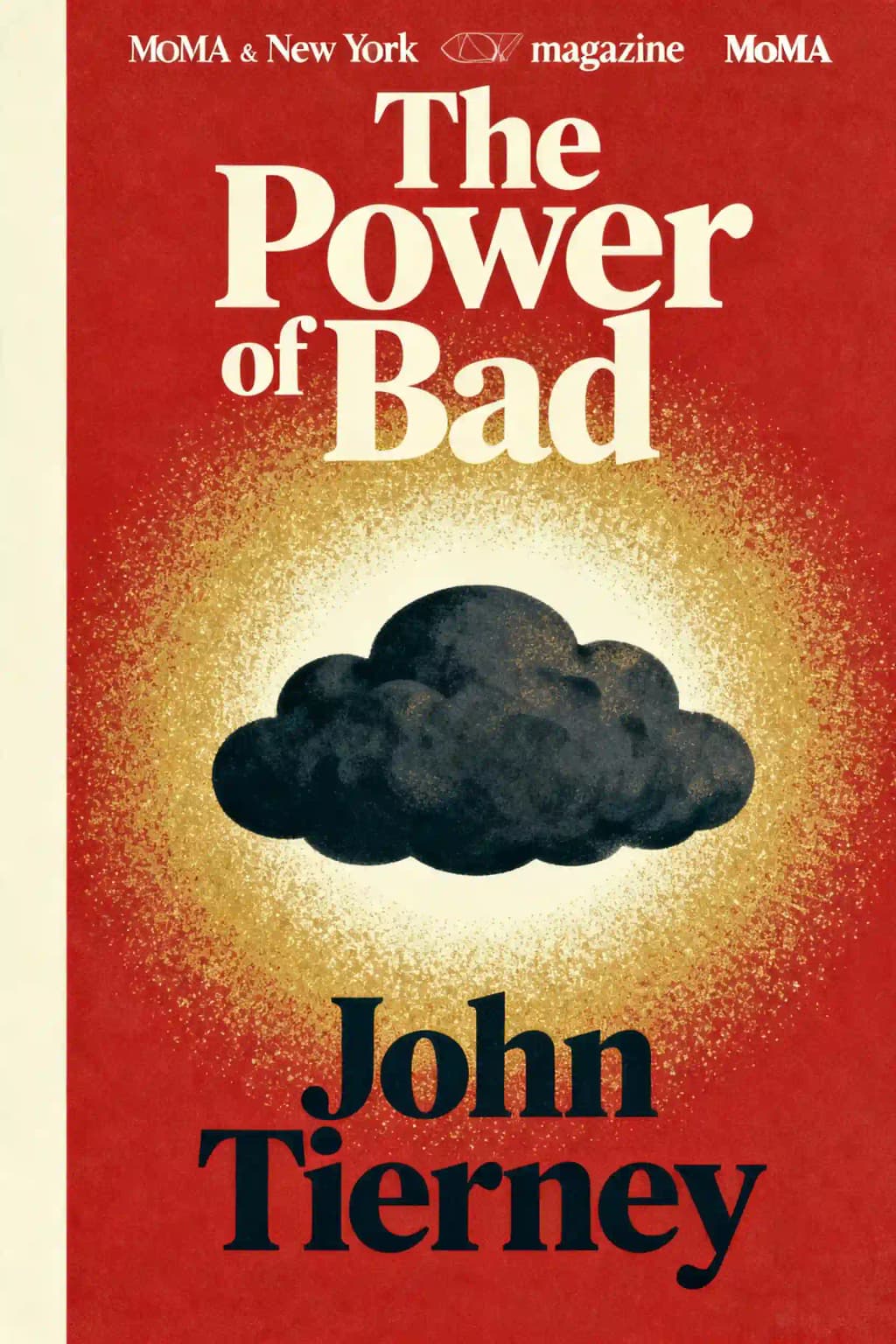
Discover why negativity impacts you five times more than positivity. "The Power of Bad" reveals the hidden force shaping your relationships, career, and happiness - what Harvard's Daniel Gilbert calls "just damn good!" Learn to neutralize negativity's grip and reclaim control.
John Marion Tierney, co-author of The Power of Bad: How the Negativity Effect Rules Us and How We Can Rule It, is a New York Times-bestselling science journalist and behavioral psychology commentator. A senior fellow at the Manhattan Institute and contributing editor to City Journal, Tierney combines over two decades of investigative reporting at the New York Times with research-backed analysis to explore societal biases and decision-making patterns. His work on urban politics, economics, and culture—including his award-winning “The Big City” column—laid the groundwork for his focus on cognitive science and human behavior.
Tierney’s expertise in debunking cultural myths through empirical evidence shines in The Power of Bad, which examines humanity’s evolutionary predisposition to negativity. His collaboration with psychologist Roy F. Baumeister builds on their earlier bestseller, Willpower: Rediscovering the Greatest Human Strength, a global phenomenon translated into 20 languages. A frequent speaker on media platforms like NPR and TEDx, Tierney bridges academic research and public discourse. The Power of Bad has been praised for its actionable insights into overcoming cognitive traps, cementing Tierney’s reputation as a leading voice in science-based self-improvement.
The Power of Bad explores the "negativity effect," a psychological phenomenon where negative experiences disproportionately impact thoughts and behaviors compared to positive ones. Co-authored by John Tierney and Roy Baumeister, the book examines how this bias affects relationships, workplace dynamics, and decision-making while offering strategies to mitigate its influence through practices like maintaining a 4:1 positivity ratio.
This book suits psychology enthusiasts, professionals managing team dynamics, and anyone seeking to improve personal relationships. Its insights into overcoming negativity bias are particularly valuable for leaders aiming to foster workplace resilience or individuals navigating high-stress environments.
Yes—critics praise its actionable strategies for countering negativity, such as the "no-asshole rule" for team productivity and the "peak-end rule" for shaping positive memories. Kirkus Reviews highlights its blend of scientific rigor and practical advice, making it a valuable resource for understanding emotional resilience.
The negativity effect describes humans’ evolutionary tendency to prioritize threats over rewards. For example, criticism lingers longer than praise, and bad news dominates media. The book argues this bias skews judgment but can be managed through mindfulness and intentional positivity.
This rule emphasizes removing toxic individuals from teams, as one negative member disproportionately lowers morale and productivity. The authors argue that avoiding "bad apples" is more critical than adding star performers, as negativity spreads faster than positivity.
To counteract negativity bias, the authors recommend a 4:1 ratio of positive to negative interactions in relationships. Research shows this balance strengthens partnerships and workplace cohesion, ensuring positives outweigh the lasting impact of negatives.
The book advises ending conflicts on a positive note (peak-end rule), filtering out toxic influences, and delivering constructive criticism sandwiched between praise. These tactics reduce resentment and foster collaboration, aligning with studies on team performance.
Unlike Atomic Habits (focused on incremental change), The Power of Bad specifically addresses overcoming innate negativity bias. It complements Thinking, Fast and Slow by offering targeted strategies to rewire automatic responses to adverse events.
Some reviewers note its narrow focus on negativity might oversimplify complex emotional experiences. Others argue that solutions like the "low-bad diet" lack scalability in large organizations, though most praise its evidence-based framework.
Tierney’s award-winning science journalism and collaboration with psychologist Roy Baumeister lend credibility. His ability to distill research into accessible narratives helps readers apply concepts like negativity detoxing to daily life.
Yes—the book advises couples to prioritize conflict resolution with positive endings and avoid "negative sentiment override," where minor irritations cloud overall perceptions. Practicing gratitude and maintaining the 4:1 positivity ratio are key takeaways.
Erlebe das Buch durch die Stimme des Autors
Verwandle Wissen in fesselnde, beispielreiche Erkenntnisse
Erfasse Schlüsselideen blitzschnell für effektives Lernen
Genieße das Buch auf unterhaltsame und ansprechende Weise
Safety addiction may be the most costly and least recognized addiction in modern society.
Negativity is a tough disease to shake-and it's highly contagious.
It typically takes four good things to overcome one bad thing.
Zerlegen Sie die Kernideen von Power of Bad in leicht verständliche Punkte, um zu verstehen, wie innovative Teams kreieren, zusammenarbeiten und wachsen.
Erleben Sie Power of Bad durch lebhafte Erzählungen, die Innovationslektionen in unvergessliche und anwendbare Momente verwandeln.
Fragen Sie alles, wählen Sie Ihren Lernstil und gestalten Sie Erkenntnisse, die wirklich zu Ihnen passen.

Von Columbia University Alumni in San Francisco entwickelt
"Instead of endless scrolling, I just hit play on BeFreed. It saves me so much time."
"I never knew where to start with nonfiction—BeFreed’s book lists turned into podcasts gave me a clear path."
"Perfect balance between learning and entertainment. Finished ‘Thinking, Fast and Slow’ on my commute this week."
"Crazy how much I learned while walking the dog. BeFreed = small habits → big gains."
"Reading used to feel like a chore. Now it’s just part of my lifestyle."
"Feels effortless compared to reading. I’ve finished 6 books this month already."
"BeFreed turned my guilty doomscrolling into something that feels productive and inspiring."
"BeFreed turned my commute into learning time. 20-min podcasts are perfect for finishing books I never had time for."
"BeFreed replaced my podcast queue. Imagine Spotify for books — that’s it. 🙌"
"It is great for me to learn something from the book without reading it."
"The themed book list podcasts help me connect ideas across authors—like a guided audio journey."
"Makes me feel smarter every time before going to work"
Von Columbia University Alumni in San Francisco entwickelt

Erhalten Sie die Power of Bad-Zusammenfassung als kostenloses PDF oder EPUB. Drucken Sie es aus oder lesen Sie es jederzeit offline.
Have you ever noticed how a single harsh comment from your boss can overshadow weeks of praise? Or how one rude driver can ruin an otherwise pleasant commute? This isn't weakness or oversensitivity-it's a fundamental quirk of human psychology that shapes every aspect of our lives. Bad experiences hit us harder, last longer, and influence our decisions more powerfully than good ones. This imbalance, known as the negativity effect, explains why we remember insults from childhood but forget compliments from yesterday, why one restaurant mishap can destroy years of loyalty, and why political campaigns focus more on attacking opponents than promoting their own virtues. Understanding this bias doesn't just satisfy intellectual curiosity-it provides a roadmap for building better relationships, making smarter decisions, and seeing through the fear-mongering that dominates modern life.
Our negativity bias isn't a design flaw-it's a survival feature. Psychologist Roy Baumeister found that bad events consistently produce stronger, longer-lasting impacts than positive ones. Our language reveals this: we have "trauma" but no equivalent word for positive transformation, "murderer" but no term for life-savers carrying equal weight. Consider contamination: drop a cockroach into cherries and the bowl becomes inedible, but a cherry in cockroaches improves nothing. This asymmetry exists because ancestors who focused on threats survived, while those captivated by pleasant experiences became lunch. Our brains evolved three threat-warning systems-the reptilian basal ganglia, the hair-trigger amygdala, and the sophisticated prefrontal cortex-creating stronger, quicker reactions to negative stimuli. We spot angry faces in crowds while missing smiles. We remember insults for decades but forget compliments by dinner.
Research reveals a "positivity ratio" for emotional well-being. Severely depressed people experience twice as many negative feelings as positive ones, while normally functioning people average 2.5 positive per negative. Optimal functioning requires slightly over four positive feelings per negative. Marriage researcher John Gottman found troubled relationships have equal good and bad interactions, while successful marriages maintain a 5:1 ratio. Behavioral economists discovered people won't risk losing $20 on a coin toss unless offered a $40 gain-exactly double. This yields the Rule of Four: it takes four good things to overcome one bad thing. Four good workdays compensate for one terrible Friday. Three satisfied customers offset one dissatisfied customer. Four positive interactions with your teenager balance one argument. The Rule of Four provides a concrete target for maintaining emotional equilibrium and reminds us not to let isolated bad events dominate our judgment.
Our negativity bias creates "safety addiction"-an irrational focus on avoiding bad things that paradoxically makes us less safe. After 9/11, fear overwhelmed reason. The government created the inefficient TSA (which has spent over $50 billion while repeatedly failing security tests) and banned nail clippers in pure "security theater." Meanwhile, millions avoided flying and drove instead. This fear-driven decision caused an estimated 1,600 additional deaths from auto accidents-more than half the number killed in the attacks. We became so focused on preventing another 9/11 that we created new dangers. Even experts fall prey to safety addiction. Professional golfers become overly cautious after making a birdie. Football coaches routinely punt on fourth down despite statistics showing they'd win more by going for it. High school football coach Kevin Kelley made a simple rule-no punting. By deciding beforehand and focusing on long-term statistics rather than short-term fears, he eliminated safety addiction. His strategy produced phenomenal results-scoring on 75% of possessions versus the typical 33% and winning seven state championships. The key was making rules beforehand rather than trusting gut feelings in the moment.
Traditional wedding vows promise "for better or for worse," but these aren't equal - the "worse" matters far more. Negativity overwhelms judgment during conflicts, triggering damaging actions. Research shows marriages typically decline in satisfaction over time, with successful ones defined not by improvement but by avoiding decline. Constructive strategies barely impact relationships, while destructive behaviors like silent withdrawal or angry threats trigger disastrous spirals. Insecurity destroys otherwise healthy relationships. Laboratory studies showed partners with low self-esteem catastrophically misinterpreted neutral situations as rejection, mentally pushing away their partners despite no real danger. Insecure men typically fear sexual infidelity and become controlling, while insecure women worry about other rejection forms and respond with hostility. The negativity effect offers a liberating lesson: you don't need to work so hard. Avoiding negative parenting matters far more than providing enrichment - children with adequate environments generally fulfill their genetic potential. The same applies to marriages and friendships - being "good enough" works better than striving for perfection. Focus on avoiding elementary mistakes: don't overpromise, don't expect credit for extra effort, use conflicts as learning opportunities. Most importantly, learn to overlook your partner's faults. Brain scans revealed that those in lasting relationships showed reduced activity in judgment regions when viewing their partner's photo, automatically following William Blake's principle that "Love to faults is always blind."
In 2012, Felix Baumgartner planned to jump from the stratosphere and break the sound barrier in freefall. Despite his daredevil history, he developed severe claustrophobia in the required pressurized suit. Five months before launch, he panicked during simulation, tore off his helmet, and quit. Red Bull brought in performance psychologist Dr. Michael Gervais, who taught Felix that anxiety accelerates like a runaway train with each negative thought. Gervais introduced two techniques: "thinking well" by reframing the suit as a custom-built friend rather than a prison, and "breathing well" to activate the parasympathetic nervous system's relaxation response. Through repeated practice, Felix mastered positive mantras and deep breathing. On jump day, Felix's visor fogged at 60,000 feet. Despite engineers planning to abort, he stayed calm and developed a contingency plan. At 127,852 feet, he jumped, becoming the first human to break the sound barrier under his own power after a record 119,431-foot freefall. His greatest accomplishment: overcoming anxiety and discovering possibility.
We live in a world that exploits our negativity bias. Politicians spread alarms about threats while yearning for a supposedly better past. The modern crisis industry-journalists, politicians, academics, think tanks, nonprofits-proclaims every problem an unprecedented threat requiring expert guidance. Understanding the negativity effect liberates us from this manipulation. We can adopt a "low-bad diet" for information, following the Rule of Four-seeking four uplifting stories for every bad one. We can reward politicians who speak rationally about risks and support analysts who put problems in perspective. The negativity effect teaches practical wisdom for daily life. In relationships, avoid elementary mistakes rather than striving for perfection. When making decisions, establish rules beforehand rather than trusting gut feelings. Deliver criticism thoughtfully, understanding that negative feedback overwhelms positive comments. Bad is stronger than good-this truth shapes everything from our marriages to our politics. But recognizing this power gives us tools to overcome it. By understanding how negativity works, we can build stronger relationships, make smarter decisions, and resist manipulation. In a world that profits from our fears, choosing perspective over panic becomes an act of quiet rebellion-and the foundation for a wiser, more fulfilling life.