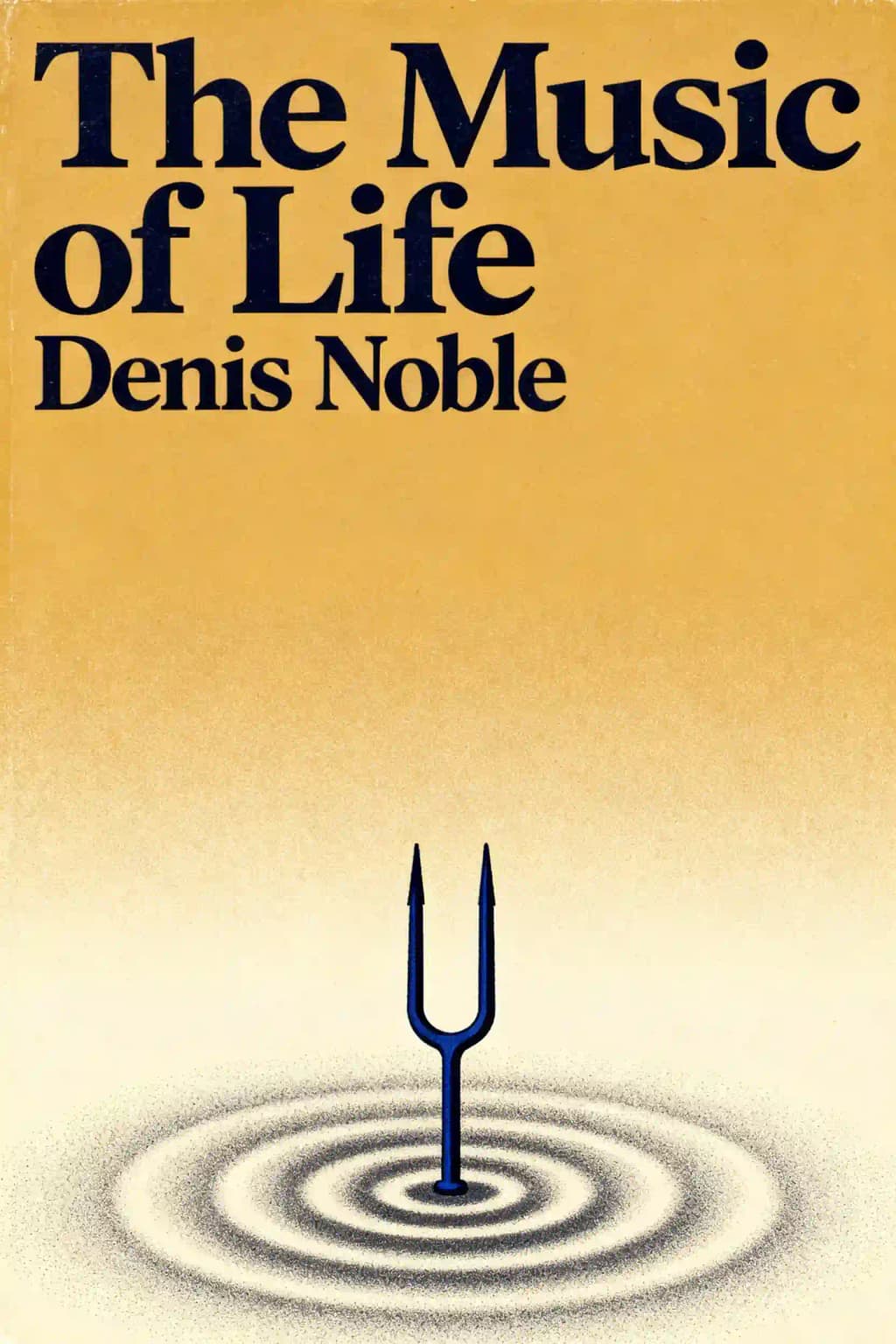
Challenging the gene-centric view of life, Denis Noble's "The Music of Life" reveals why genes are prisoners, not masters, of organisms. Fortune magazine's "all-time favorite" has sparked scientific revolution, selling 20,000+ copies worldwide and redefining how we understand biology's intricate symphony.
Denis Noble is a pioneering British physiologist and the author of The Music of Life: Biology Beyond Genes, a groundbreaking popular science work that introduced systems biology to general readers.
Born in 1936, Noble is Emeritus Professor of Cardiovascular Physiology at the University of Oxford. There, he developed the first viable mathematical model of the working heart in 1960—a discovery that founded the field of computational biology. His research spans over 700 published papers and earned him a CBE and Fellowship in the Royal Society.
Noble's expertise in integrating physiology with evolutionary theory drives the book's central metaphor: that living organisms are "more like a piece of music than a genetically determined machine." His other influential works include Dance to the Tune of Life and Understanding Living Systems, both exploring biological relativity and systems approaches to life. The Music of Life has been translated into 12 languages, establishing it as the definitive introduction to systems biology for non-specialist audiences worldwide.
The Music of Life by Denis Noble presents a systems biology approach to understanding life that challenges traditional gene-centered views. Denis Noble argues that life functions as a symphony, with genes, cells, organs, and environment interacting in complex, multilevel ways rather than genes acting as sole controllers. The book introduces readers to an alternative biological perspective where organisms are dynamic processes, not mere vehicles for genetic replication.
Denis Noble is a distinguished British physiologist who held the Burdon Sanderson Chair of Cardiovascular Physiology at Oxford University and is considered one of the founders of systems biology. Noble wrote The Music of Life to challenge the reductionist "selfish gene" view popularized by Richard Dawkins and present his pioneering research showing that life emerges from complex interactions across multiple biological levels. His work on cardiac cell modeling and heartbeat research informed his holistic perspective.
The Music of Life is ideal for readers interested in biology, philosophy of science, and anyone questioning reductionist explanations of life. Denis Noble writes in elegant, accessible prose that makes complex scientific concepts approachable for non-scientists while remaining substantive enough for those with scientific backgrounds. The book appeals particularly to readers interested in evolutionary biology, systems thinking, consciousness studies, and interdisciplinary perspectives that bridge science with philosophy and Eastern thought.
The Music of Life is worth reading for those seeking alternatives to gene-centric biology, with readers praising its combination of "Carl Sagan's learnedness with Bill Bryson's conversational readability". The book offers scientifically credible counterarguments to genetic determinism while exploring profound questions about life's nature. Some readers found certain sections drawn out or overly philosophical, but most appreciated Denis Noble's well-reasoned, accessible approach to complex biological and philosophical ideas.
The Music of Life argues that genes are not life's controllers but rather "prisoners" trapped in organisms, with the organism itself being the primary level of biological organization. Denis Noble contends that life emerges as a process through intricate interactions between genes, cells, organs, and environment, functioning like a symphony rather than following genetic instructions. This systems biology perspective repositions genes as databases that cells "read" based on organismal and environmental needs, fundamentally inverting the gene-centered view.
The Music of Life directly challenges Richard Dawkins' concept that living bodies are mere vehicles for genetic replication. Denis Noble argues this gene's eye view is "at best a gross oversimplification, and in part at least, subjective polemic". Noble reinterprets Dawkins' famous passage to show that organisms preserve genes, not the reverse, stating "we are the ultimate rationale for their existence". The book provides scientifically credible arguments from within biology showing genetic determinism oversimplifies life's multilevel complexity.
Systems biology, as presented in The Music of Life, views life as a multilevel, multicausal system where no single component can be isolated as the fundamental cause. Denis Noble, one of the field's founders, describes systems biology as recognizing that biological function emerges from complex interactions and feedback controls across genes, proteins, cells, organs, and environment. This approach treats life as an integral process—like music—rather than reducing it to any single mechanism or genetic program.
Denis Noble uses the music metaphor throughout The Music of Life to illustrate that life cannot be reduced to isolated components, just as music cannot be reduced to individual notes or piano keys. Life functions as a symphony with genes, cells, and organs acting like instruments in an orchestra, creating harmony through coordinated interaction rather than following a single conductor. This metaphor emphasizes that biological meaning emerges from relationships and processes, not from any single "thing" like genes.
Key concepts in The Music of Life include viewing genes as databases rather than controllers, organisms as complex systems with multiple interacting levels, and life as an emergent process rather than a fixed object. Denis Noble introduces the idea that cells "play" the genome like musicians reading sheet music, with transcription controlled by cellular and organismal machinery responding to environmental signals. The book also explores the concept of self as process rather than object, drawing on Buddhist philosophy about the non-existence of immutable selves.
Denis Noble presents genes in The Music of Life as "prisoners" locked inside organisms rather than autonomous controllers of life. Genes function as templates or databases that do "practically nothing on their own," requiring cellular machinery to read, transcribe, and translate them into proteins based on organismal needs. Noble argues that to say organisms exist for genes is like saying piano pieces exist for piano keys—it reverses the actual causation, since organisms determine when and how genes are expressed.
The Music of Life explores Buddhist concepts of anatman (non-existence of immutable self), arguing there is no particular biological object one can identify as "the self". Denis Noble draws connections between systems biology and Eastern philosophy, suggesting that viewing life and self as processes rather than objects aligns with contemplative traditions. The book also engages with philosophy of science, linguistics, and Chinese culture, while discussing how scientific metaphors shape our understanding of biological reality.
Critics of The Music of Life note that some content feels "light and over drawn out," with unnecessary inclusions like Buddhism that detract from the scientific arguments. Some readers felt Denis Noble tried to create "a generic brand copy of Gödel Escher Bach on a topic which had significantly less importance and room to explore". While praising the well-reasoned counterargument to reductionism, reviewers mentioned the book occasionally prioritizes philosophical musings over scientific depth, making it less focused than it could be.
Erlebe das Buch durch die Stimme des Autors
Verwandle Wissen in fesselnde, beispielreiche Erkenntnisse
Erfasse Schlüsselideen blitzschnell für effektives Lernen
Genieße das Buch auf unterhaltsame und ansprechende Weise
DNA itself is relatively passive.
There's no one-to-one correspondence between genes and biological functions.
Systems (organisms) live or die; genes merely contain the database for reconstruction.
The genome isn't a deterministic program that simply runs from start to finish.
Zerlegen Sie die Kernideen von The Hunchback of Notre Dame in leicht verständliche Punkte, um zu verstehen, wie innovative Teams kreieren, zusammenarbeiten und wachsen.
Destillieren Sie The Hunchback of Notre Dame in schnelle Gedächtnisstützen, die die Schlüsselprinzipien von Offenheit, Teamarbeit und kreativer Resilienz hervorheben.

Erleben Sie The Hunchback of Notre Dame durch lebhafte Erzählungen, die Innovationslektionen in unvergessliche und anwendbare Momente verwandeln.
Fragen Sie alles, wählen Sie die Stimme und erschaffen Sie gemeinsam Erkenntnisse, die wirklich bei Ihnen ankommen.

Von Columbia University Alumni in San Francisco entwickelt
"Instead of endless scrolling, I just hit play on BeFreed. It saves me so much time."
"I never knew where to start with nonfiction—BeFreed’s book lists turned into podcasts gave me a clear path."
"Perfect balance between learning and entertainment. Finished ‘Thinking, Fast and Slow’ on my commute this week."
"Crazy how much I learned while walking the dog. BeFreed = small habits → big gains."
"Reading used to feel like a chore. Now it’s just part of my lifestyle."
"Feels effortless compared to reading. I’ve finished 6 books this month already."
"BeFreed turned my guilty doomscrolling into something that feels productive and inspiring."
"BeFreed turned my commute into learning time. 20-min podcasts are perfect for finishing books I never had time for."
"BeFreed replaced my podcast queue. Imagine Spotify for books — that’s it. 🙌"
"It is great for me to learn something from the book without reading it."
"The themed book list podcasts help me connect ideas across authors—like a guided audio journey."
"Makes me feel smarter every time before going to work"
Von Columbia University Alumni in San Francisco entwickelt

Erhalten Sie die The Hunchback of Notre Dame-Zusammenfassung als kostenloses PDF oder EPUB. Drucken Sie es aus oder lesen Sie es jederzeit offline.
Imagine buying an expensive dictionary without a grammar book. That's how Nobel Prize-winning biologist Sydney Brenner described the Human Genome Project, perfectly capturing the central insight of "The Music of Life." Our genes aren't a deterministic program that simply runs from start to finish. They're more like a sophisticated database that requires complex interpretation. This perspective has captivated not just scientists but artists too-Radiohead's Thom Yorke cited the book as inspiration for "In Rainbows," drawn to its exploration of how complex systems create something greater than their parts. What makes this perspective so compelling is how it overturns our fundamental assumptions about genes without requiring specialized knowledge-just a willingness to see familiar concepts in an entirely new light.