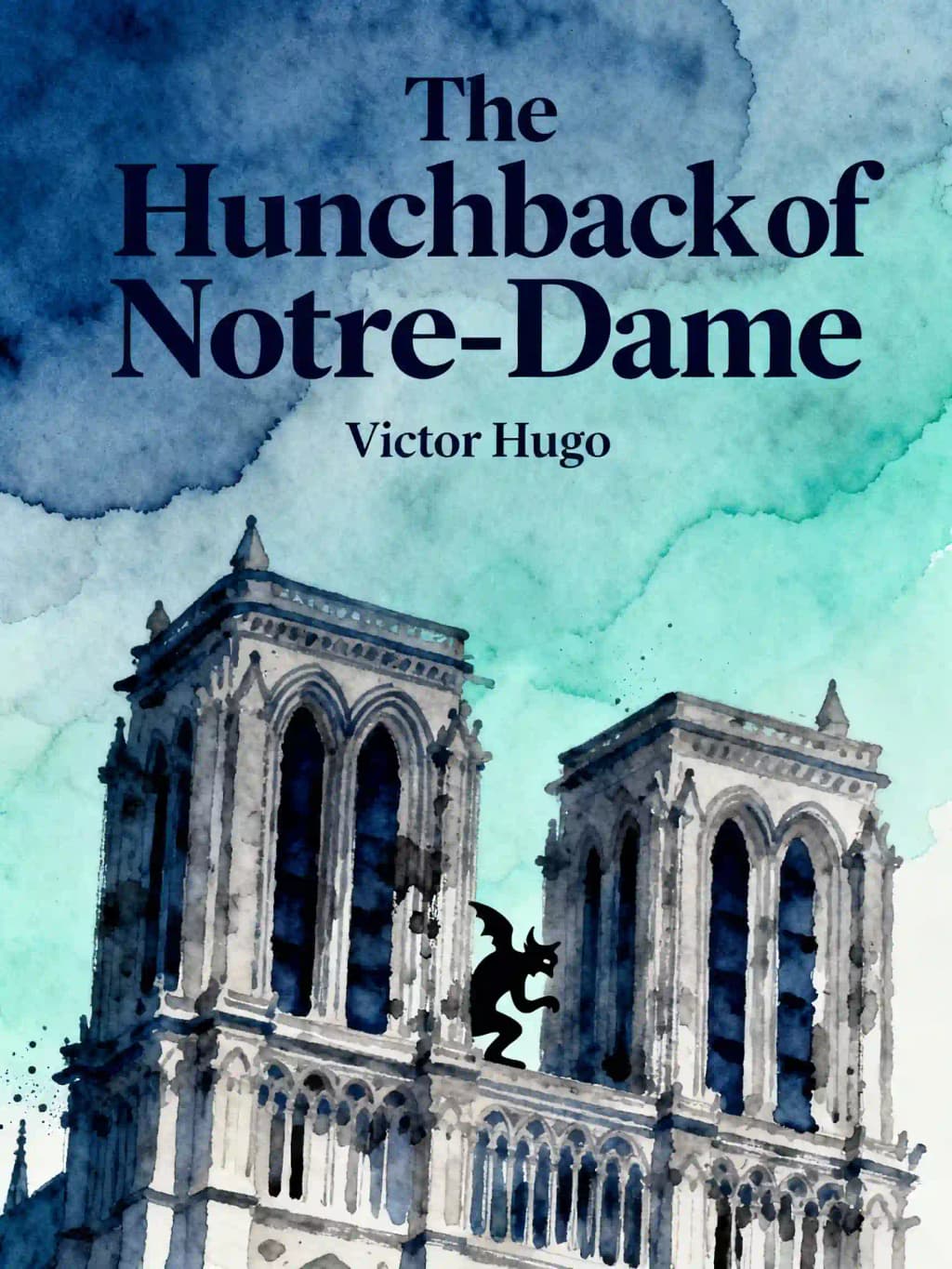
The Hunchback of Notre-Dame
Überblick über The Hunchback of Notre-Dame
Victor Hugo's masterpiece saved Notre-Dame Cathedral from destruction, inspiring actual renovations after its 1831 publication. This gothic tale of love, obsession, and societal outcasts revolutionized literature by making marginalized characters protagonists - a radical concept that influenced Dickens and countless adaptations since.
Kernthemen in The Hunchback of Notre-Dame
- gothic architecture
- social exclusion
- religious hypocrisy
- architectural preservation
- inner beauty
Zitate aus The Hunchback of Notre-Dame
He had tamed the cathedral.
The cathedral was not only his society, but his universe.
the only human connection in his life.
Beauty Within the Beast
Personen in The Hunchback of Notre-Dame
- QuasimodoThe deformed bell-ringer of Notre-Dame
- EsmeraldaA kind dancer who shows compassion to Quasimodo
- Claude FrolloThe austere archdeacon who adopts Quasimodo
- Victor HugoThe author and advocate for Gothic architecture
Über den Autor
Über den Autor von The Hunchback of Notre-Dame
Victor-Marie Hugo (1802–1885), the celebrated French Romantic author of The Hunchback of Notre-Dame, remains a titan of 19th-century literature, renowned for his Gothic storytelling and social critique.
Set in medieval Paris, this iconic novel blends themes of love, rejection, and societal injustice with Hugo’s impassioned advocacy for preserving Gothic architecture—a reflection of his broader campaigns against capital punishment and inequality.
A prolific poet, playwright, and politician, Hugo also penned the seminal Les Misérables, a sweeping exploration of redemption and revolution that solidified his global legacy. His works, characterized by vivid characters and moral urgency, have inspired countless adaptations, including operas, films, and the enduring musical Les Misérables.
Hugo’s state funeral in Paris drew over two million mourners, cementing his status as a national hero whose narratives continue to resonate across languages and cultures.
Zusammenfassung von The Hunchback of Notre-Dame herunterladen
Erhalten Sie die The Hunchback of Notre-Dame-Zusammenfassung als kostenloses PDF oder EPUB. Drucken Sie es aus oder lesen Sie es jederzeit offline.
FAQ zu diesem Buch
The Hunchback of Notre-Dame by Victor Hugo follows Quasimodo, a deformed bell-ringer at Notre-Dame Cathedral, who becomes entangled in a tragic love triangle with the dancer Esmeralda and his adoptive father, Archdeacon Claude Frollo. Set in 15th-century Paris, the novel explores themes of social injustice, obsession, and the struggle between moral duty and desire, with the cathedral itself symbolizing societal divides.
Fans of Gothic literature, historical fiction, and intricate character studies will find this book compelling. It’s ideal for readers interested in themes like societal prejudice, the duality of beauty and monstrosity, and the role of architecture in storytelling. Hugo’s rich prose and symbolism also appeal to those studying French Romanticism.
Yes—it’s a cornerstone of classic literature, celebrated for its emotional depth and critique of 15th-century Parisian society. Hugo’s exploration of human frailty, moral corruption, and resilience makes it timeless. The novel’s layered symbolism and unforgettable characters, like the tragic Quasimodo, offer enduring relevance.
Key themes include social injustice (seen in Quasimodo’s ostracization), obsession (Frollo’s destructive passion for Esmeralda), and appearance versus reality (Esmeralda’s kindness contrasted with societal prejudice). Hugo also critiques institutional hypocrisy and the fleeting nature of power.
The cathedral represents both sanctuary and imprisonment. Its Gothic architecture mirrors the characters’ inner turmoil, while its role as a setting highlights societal divides. Hugo uses it to critique the decay of medieval institutions and their impact on marginalized groups like the Roma.
- Quasimodo: The deformed bell-ringer, whose loyalty and love for Esmeralda drive the plot.
- Esmeralda: A Roma dancer wrongly accused of crimes, symbolizing purity amid prejudice.
- Claude Frollo: The conflicted archdeacon whose obsession leads to tragedy.
- Phoebus: A captain who exploits Esmeralda’s affections.
The story culminates in unrequited love, wrongful execution, and systemic oppression. Esmeralda dies due to Frollo’s manipulation, Quasimodo dies mourning her, and Frollo plunges to his death—a bleak reflection on societal cruelty and unchecked desire.
Frollo transforms from a disciplined scholar to a morally corrupt figure consumed by lust and jealousy. His internal conflict between faith and desire illustrates Hugo’s critique of religious hypocrisy and the dangers of repressed emotions.
Set in 1482 under Louis XI’s reign, the story reflects Hugo’s concerns about post-Napoleonic France. The collapsing feudal system and rising humanism parallel the characters’ struggles against rigid societal structures.
Praised for its emotional depth and social commentary, the novel solidified Hugo’s literary legacy. Critics highlight its critique of institutional power and exploration of humanity’s capacity for both cruelty and compassion.
The tragic fates of Esmeralda, Quasimodo, and Frollo underscore Hugo’s warning about obsession and societal prejudice. Their deaths symbolize the collapse of outdated systems and the enduring cost of injustice.
Yes—the story inspired films, stage plays, and musicals, though many soften Hugo’s darker themes. Adaptations often highlight Quasimodo’s humanity and the cathedral’s symbolic role, but the original novel remains the most nuanced.