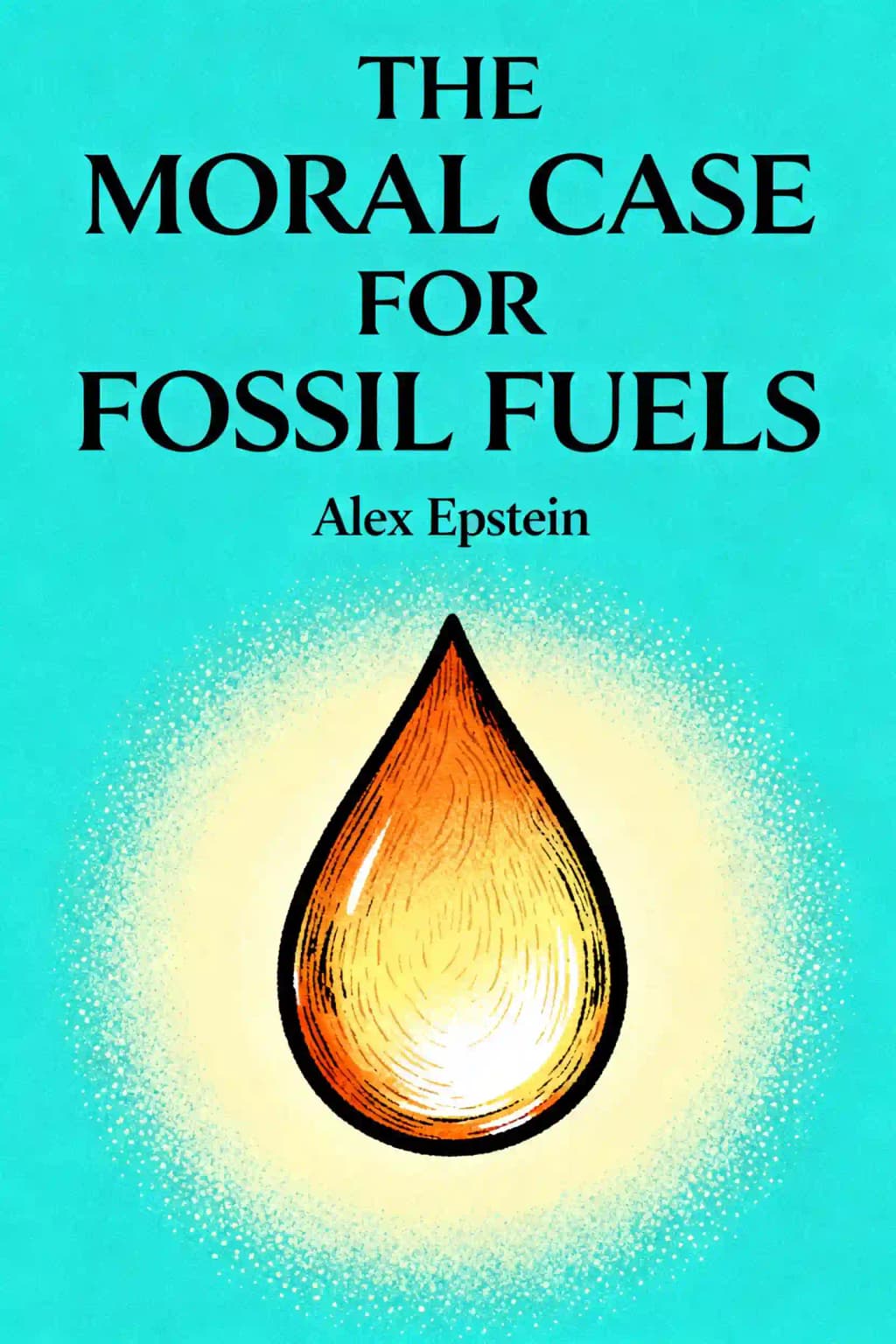
Moral Case for Fossil Fuels
Überblick über Moral Case for Fossil Fuels
Challenging environmentalist orthodoxy, "The Moral Case for Fossil Fuels" - a New York Times bestseller - argues fossil fuels drive human flourishing. Named "Most Original Thinker of 2014," Epstein's counterintuitive perspective has sparked fierce debate among climate activists and energy policy leaders alike.

Kernthemen in Moral Case for Fossil Fuels
- human flourishing
- energy density
- resource scaling
- environmental mastery
- energy reliability
Zitate aus Moral Case for Fossil Fuels
Fossil fuels have coincided with unprecedented human flourishing.
Humans are naturally weak.
Resources aren't naturally valuable-they're created through human ingenuity.
The fundamental mistake is viewing fossil fuels only through the lens of their potential risks.
Personen in Moral Case for Fossil Fuels
- Alex EpsteinAuthor and philosopher who argues for fossil fuels
- Paul EhrlichThinker who predicted economic collapse by 2000
Über den Autor
Über den Autor von Moral Case for Fossil Fuels
Alex Epstein is an American philosopher and energy expert, and the New York Times bestselling author of The Moral Case for Fossil Fuels. This groundbreaking work challenges mainstream climate narratives by advocating for fossil fuels as essential to global human flourishing.
Drawing on his philosophy background from Duke University and roles at the Cato Institute and Ayn Rand Institute, Epstein combines ethical arguments with energy policy analysis. He posits that fossil fuels elevate living standards and environmental resilience.
His follow-up book, Fossil Future, expands these ideas, urging increased fossil fuel use alongside nuclear innovation. Epstein is a sought-after speaker at Harvard, Yale, and Fortune 500 companies.
Epstein founded the Center for Industrial Progress and hosts a Substack platform reaching millions. His debates with Greenpeace and the Sierra Club, alongside consulting for ExxonMobil and Chevron, underscore his influence in reshaping energy discourse. The Moral Case for Fossil Fuels has sparked global debate, solidifying Epstein as a leading contrarian voice in environmental policy.
Zusammenfassung von Moral Case for Fossil Fuels herunterladen
Erhalten Sie die Moral Case for Fossil Fuels-Zusammenfassung als kostenloses PDF oder EPUB. Drucken Sie es aus oder lesen Sie es jederzeit offline.
FAQ zu diesem Buch
Alex Epstein’s The Moral Case for Fossil Fuels argues that fossil fuels are morally virtuous because they enhance human life by providing affordable, reliable energy, enabling economic growth, and improving living standards. Epstein challenges environmentalist critiques, asserting that fossil fuels’ benefits—like poverty reduction and climate resilience—far outweigh their risks, which he claims are manageable through innovation.
This book is ideal for policymakers, energy professionals, and readers interested in climate debates. It offers a counter-narrative to mainstream environmentalism, making it valuable for those seeking alternative perspectives on energy policy, fossil fuel ethics, or sustainable development. Critics of fossil fuels may also benefit from engaging with Epstein’s arguments.
Yes, for its provocative defense of fossil fuels grounded in human-centric ethics. Epstein’s data-driven approach and moral framework—prioritizing human flourishing over environmental preservation—spark critical dialogue, even among skeptics. The book’s emphasis on energy accessibility and technological optimism makes it a standout in climate literature.
Alex Epstein is a philosopher and energy theorist who founded the Center for Industrial Progress. He advocates for fossil fuels as essential to global progress, arguing that their responsible use benefits humanity more than renewable alternatives. His work influences conservative and libertarian energy policy discussions.
Epstein’s core thesis asserts that fossil fuels:
- Lift billions out of poverty through affordable energy.
- Enable climate resilience via infrastructure powered by reliable energy.
- Are irreplaceable for modern life, with renewables being less scalable and cost-effective.
He frames fossil fuel use as a moral imperative, rejecting “net zero” policies as harmful to human welfare.
Epstein acknowledges fossil fuels contribute to warming but argues their role in creating wealth and technology offsets climate risks. He advocates “climate mastery” through innovation (e.g., nuclear energy) rather than emissions reduction, claiming transitioning prematurely to renewables would cause greater harm.
Critics argue Epstein understates environmental costs, overstates renewables’ limitations, and dismisses consensus on climate urgency. Environmentalists reject his human-centric ethics, while energy experts challenge his dismissal of renewable scalability. Some call the book overly polemical.
Epstein claims fossil fuels are uniquely cost-effective and reliable, whereas renewables like solar and wind require subsidies, lack storage solutions, and destabilize grids. He supports nuclear energy long-term but opposes rapid transitions, asserting fossil fuels remain critical for energy security.
- “Mankind’s use of fossil fuels is supremely virtuous—because human life is the standard of value.”
- “If we go to net zero, billions of lives will be ruined.”
These lines encapsulate his human-centric ethics and opposition to rapid decarbonization.
The book opposes restrictive emissions policies, advocating instead for fossil fuel expansion to ensure energy access and economic growth. Epstein critiques green subsidies and mandates, urging governments to prioritize affordability and reliability over climate targets.
He accuses environmentalists of valuing “non-impact on nature” over human welfare, promoting policies that limit energy access for the poor. Epstein argues their anti-fossil fuel stance ignores the life-saving benefits of industrialization.
As debates over energy costs, grid reliability, and climate policies intensify, Epstein’s arguments resonate with critics of green transitions. The book provides a framework for justifying fossil fuel use amid calls for energy pragmatism in developing economies.