Kapitel 1
The Moral Compass Within Us: Navigating Tribal Conflicts in a Complex World
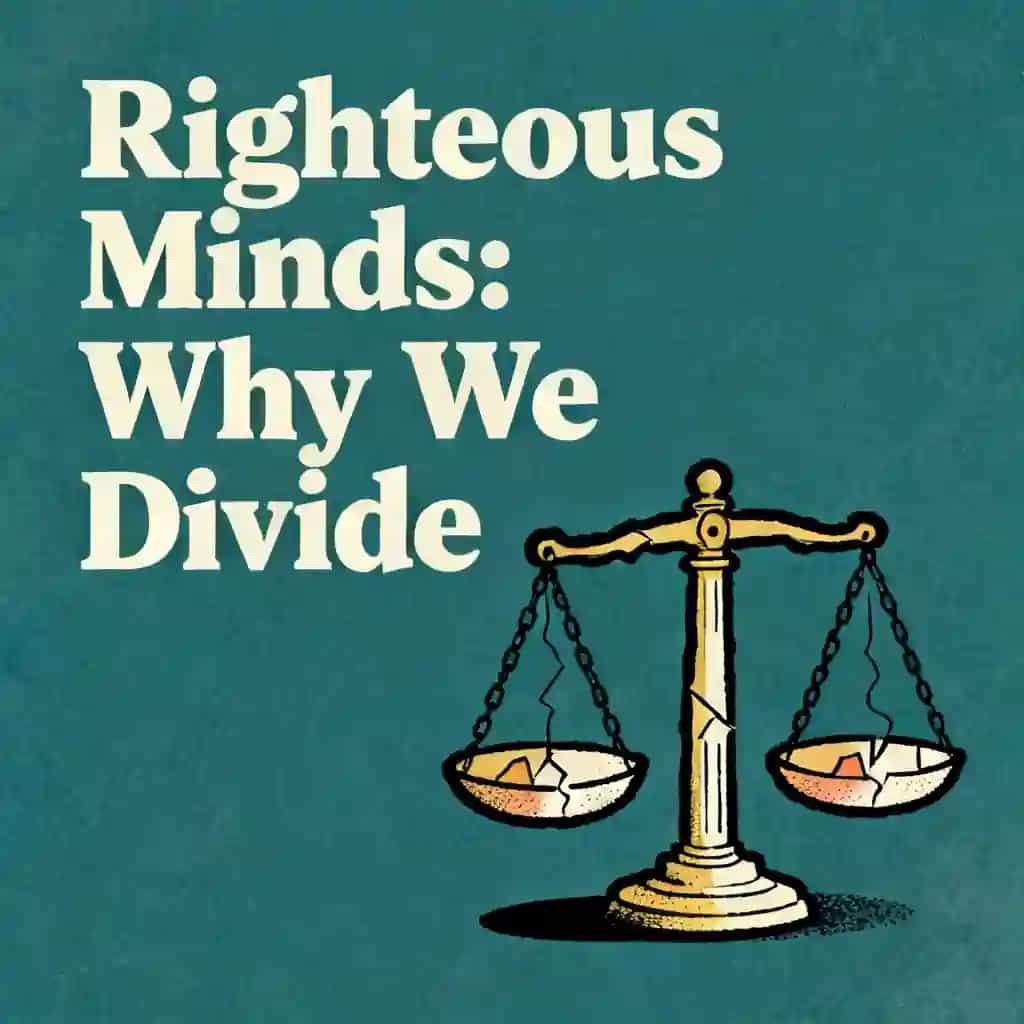
Joshua Greene's "Moral Tribes" has become something of a cultural phenomenon since its publication, with figures from tech billionaire Reid Hoffman to philosopher Peter Singer citing it as transformative to their thinking about ethics. The book's popularity stems from its rare ability to bridge evolutionary psychology, neuroscience, and philosophy while remaining accessible. As divisive moral issues increasingly dominate our public discourse, Greene's framework offers something increasingly precious: a roadmap for finding common ground across seemingly unbridgeable moral divides. Imagine waking up one morning to discover that your deepest moral convictions-the ones you've built your life around-are actually products of evolutionary psychology rather than timeless truths. How would this change your approach to disagreements with those whose moral intuitions differ radically from your own?
Kapitel 2
The Tragedy of Commonsense Morality
The classic "Tragedy of the Commons" describes how individual herders, acting rationally in self-interest, will inevitably destroy shared grazing land by adding more animals than the commons can sustain. While morality evolved as nature's solution to this problem-enabling cooperation within groups by putting "Us" ahead of "Me"-Greene identifies a deeper dilemma he calls the "Tragedy of Commonsense Morality." This occurs when different groups (or "tribes") with incompatible moral systems must share limited resources.
Consider two neighboring tribes with opposing values: Northern individualists who believe in personal freedom and Southern communitarians who prioritize brotherhood and tradition. When forced to share new pastures, each tribe's "commonsense" morality-the intuitions that feel obviously right to them-leads to conflict. The Northerners see the Southerners as oppressive, while the Southerners view the Northerners as selfish. Each tribe's moral intuitions evolved to solve cooperation problems within their group but create new problems between groups.
This scenario perfectly captures our modern political landscape. Conservatives and liberals aren't simply disagreeing about facts; they're operating with fundamentally different moral systems that feel self-evidently correct from within. Liberals prioritize care and fairness defined as equality, while conservatives emphasize loyalty, authority, and sanctity alongside fairness defined as proportionality. Each side believes their moral intuitions reflect objective truth rather than tribal adaptations.
The key insight is that evolution gave us moral emotions to solve Me-versus-Us problems, but provided no ready-made solution for Us-versus-Them conflicts. Our moral brains evolved primarily for tribal competition, not global cooperation. As Greene puts it, "Morality evolved not just to put 'Us ahead of Me' but also 'Us ahead of Them.'" This explains why moral disagreements feel so intractable-our moral machinery wasn't designed to resolve them.
Kapitel 3
Dual-Process Morality: Fast and Slow Moral Thinking
Greene's research into moral psychology began with a personal experience during a high school debate, when he was stumped by the "transplant dilemma": Would it be right for a doctor to kill one healthy person to harvest organs that could save five dying patients? This question eventually led him to study the famous "trolley problems" that reveal inconsistencies in our moral intuitions.
Most people approve of diverting a runaway trolley to kill one person instead of five (the "switch case") but disapprove of pushing a large man off a footbridge to stop the trolley and save five lives (the "footbridge case"). Why? Through brain imaging studies, Greene discovered that these different judgments reflect two distinct neural systems at work: automatic emotional responses (centered in the ventromedial prefrontal cortex) and deliberative reasoning (involving the dorsolateral prefrontal cortex).
This "dual-process" theory of moral judgment explains why we have such trouble with certain moral dilemmas. In the footbridge case, the emotional system generates a strong negative response to the idea of directly pushing someone to their death, overriding the utilitarian calculation that would save more lives. In the switch case, the emotional response is weaker, allowing the cognitive system's utilitarian reasoning to prevail.
Subsequent research has strongly supported this theory. Patients with damage to emotion-processing brain regions make consistently utilitarian judgments across all trolley scenarios. People under cognitive load make slower utilitarian judgments but equally fast emotional judgments. Those encouraged to deliberate make more utilitarian judgments, while those with higher emotional reactivity make fewer.
This dual-process framework extends beyond artificial dilemmas to real-world moral conflicts. In a study comparing medical doctors with public health professionals, Greene found that doctors (who focus on individual patients) consistently gave less utilitarian responses than public health professionals (who focus on population outcomes). One doctor insisted that making life-or-death decisions for capable individuals is "a gross violation of moral and ethical principles," while a public health professional argued that utilitarian thinking is "ultimately the most moral thing to do... the least murky and the most fair."
Kapitel 4
The Efficiency-Flexibility Trade-off and Our Moral Brain
Our dual-process brain represents an elegant evolutionary solution to a fundamental trade-off between efficiency and flexibility. Like a camera with both automatic settings and manual mode, our brains have evolved automatic responses optimized for typical situations and deliberative capacities for handling novel challenges. This dual system allows us to navigate both routine and unprecedented scenarios with remarkable adaptability.
Automatic settings (including emotions) provide efficient responses without conscious thought. They're like fast, energy-efficient processors that deliver immediate guidance based on past experience. When we instinctively pull back from a hot surface or automatically catch a falling object, we're utilizing these automatic processes. These rapid responses operate below the threshold of consciousness, processing information at speeds far exceeding our deliberative capabilities. They draw on accumulated evolutionary wisdom and personal experience to generate split-second decisions.
Manual mode (conscious reasoning) offers flexibility for solving novel problems but requires more time and cognitive resources. This system enables us to plan future actions, analyze complex situations, and override automatic responses when necessary. For instance, while our automatic response might be to flee from fire, our deliberative system allows us to rationally evaluate escape routes or even fight the fire if necessary. This dual architecture explains why humans have been able to adapt to virtually every terrestrial environment on earth while other species remain confined to specific ecological niches.
Our moral emotions function as automatic settings that enable cooperation, operating as sophisticated social algorithms refined over millennia of evolution. Emotions like empathy, guilt, anger, and disgust evolved because they efficiently promote behaviors that benefit the group. These emotions aren't random but represent evolutionary solutions to specific cooperation problems:
• Empathy and minimal decency promote basic concern for others, allowing us to understand and respond to others' suffering
• Anger, disgust, forgiveness, and gratitude facilitate direct reciprocity, helping maintain fair exchanges and deterring exploitation
• Vengefulness, honor, shame, and guilt enable commitment mechanisms, ensuring promises are kept and social bonds maintained
• Judgmentalism, gossip, and embarrassment support reputation management, creating social incentives for cooperative behavior
• Tribalism facilitates assortment (distinguishing cooperators from defectors), helping form cohesive social groups
• Righteous indignation drives indirect reciprocity (punishing non-cooperators), enforcing social norms even when we're not directly affected
Together, these emotional dispositions constitute our moral machinery, forming a sophisticated system for navigating social interactions. They're remarkably effective at solving cooperation problems within groups but often create problems between groups with different moral norms. This explains why moral conflicts between cultures can be so intractable - our automatic moral responses evolved for maintaining cooperation within groups, not between them. Understanding this limitation is crucial for addressing global challenges that require cooperation across cultural boundaries.
Kapitel 5
Finding Common Currency: The Search for Metamorality
If different tribes have incompatible moral intuitions, how can we resolve conflicts? Greene argues we need a "metamorality"-a higher-level moral system that can adjudicate among competing tribal values. This requires finding a "common currency" that all tribes can accept, much like how money serves as a universal medium of exchange in economics.
Religious approaches fail because they face two insurmountable problems: the scope of God's authority (whether God determines what's right or merely recognizes independent moral truths) and the accessibility of God's will (interpreting religious texts inevitably reflects our existing moral intuitions). Appeals to scripture cannot settle moral disagreements between competing religious traditions. For example, different religions have conflicting views on everything from dietary restrictions to gender roles, with each claiming divine authority. Even within single religions, interpretations vary widely - consider the diverse Christian views on issues like divorce or the use of violence.
Pure reason also fails because, unlike mathematics with its self-evident axioms, moral reasoning requires premises that aren't universally accepted. Consider abortion: pro-lifers claim fetuses have absolute rights to life, while pro-choicers assert women have absolute rights to choose. Pure reason cannot settle which right takes precedence without agreed-upon moral premises. Similar philosophical deadlocks occur in debates about animal rights, euthanasia, and wealth redistribution - logical arguments alone cannot resolve these without shared foundational values.
Science alone cannot deliver moral truth either. Evolution produced our moral emotions to enhance genetic fitness, not to discover moral truth. Our instincts for in-group loyalty, respect for authority, and purity may have served our ancestors well but don't necessarily lead to optimal moral outcomes today. Cooperation itself cannot be the ultimate moral good-what matters is the happiness and relief from suffering it brings. Scientific findings can inform our moral decisions but cannot tell us what we ought to value.
Without divine guidance, self-evident moral principles, or scientific moral truths, Greene proposes utilitarianism as our common currency. Not because it's definitively "moral truth," but because it becomes uniquely attractive once moral thinking has been objectively improved through scientific understanding of morality. Utilitarianism offers a framework that can accommodate diverse viewpoints while providing concrete guidance for resolving conflicts. It acknowledges both emotional and rational aspects of morality, allowing us to weigh competing claims and seek optimal outcomes. For instance, in addressing climate change, utilitarianism helps balance immediate economic concerns against long-term global welfare, providing a shared framework for negotiating between different national and cultural interests.
Kapitel 6
Utilitarianism: The Native Philosophy of Manual Mode
Greene argues that utilitarianism-maximizing happiness while weighing each person's happiness equally-emerges naturally from our manual-mode reasoning system. Our prefrontal cortex's general-purpose problem-solving machinery naturally seeks optimal outcomes, raising two fundamental questions: "Optimal for whom?" and "What counts as optimal?" This optimization tendency is evident in how we approach complex problems, from resource allocation to policy decisions.
When people with equal power encounter limited resources, impartiality emerges naturally as a practical solution. Consider children sharing a pizza or nations negotiating fishing rights - the fairest solution often involves equal distribution. Through cognitive development, we can recognize that while we each feel special to ourselves, others feel equally special about themselves, leading to the realization that no one is "especially special." This understanding develops gradually, from childhood egocentrism to mature perspective-taking abilities.
Though our automatic emotional settings aren't impartial (we care more about our finger than thousands dying in a distant earthquake), our manual mode can grasp impartiality as a moral ideal. This disconnect is visible in charitable giving patterns - people often donate more to single identifiable victims than to larger-scale catastrophes affecting many more people. However, when engaging our manual mode, we can recognize this bias and attempt to correct for it.
Utilitarianism combines three universal human capacities: our manual mode's tendency to maximize, our intrinsic valuing of happiness, and our intellectual recognition of impartiality. It provides a common currency accessible to all tribes because it harnesses the brain's general-purpose problem-solving system with universally accessible values: happiness and impartiality. This universality is demonstrated in cross-cultural studies showing similar responses to basic moral dilemmas across different societies.
However, utilitarianism isn't intuitive to anyone - it requires conscious effort and often conflicts with our emotional responses. Our automatic settings (moral emotions) vary between tribes and individuals, but no one's gut reactions are consistently utilitarian. For example, most people instinctively reject the idea of sacrificing one person to save five others, even while acknowledging the mathematical logic. This explains why utilitarianism seems partially right to everyone-we all "get it" through our manual mode-but also why it offends everyone's moral sensibilities through our non-utilitarian automatic settings.
The tension between utilitarian reasoning and emotional moral intuitions appears in various contexts, from medical resource allocation during pandemics to environmental policy decisions. While our manual mode can calculate the greatest good for the greatest number, our automatic responses often rebel against purely numerical thinking about human welfare.
Kapitel 7
Alarming Acts: When Doing Good Feels Wrong
The most powerful objections to utilitarianism come from cases where actions producing the best consequences still feel morally wrong. The footbridge dilemma exemplifies this problem-using someone as a human trolley-stopper may promote greater good but violates our moral intuitions.
Greene's research reveals that our negative reactions to such cases stem from specific features that trigger our moral alarm system. This system responds strongly when harm is caused as a means (rather than a side effect) using personal force (direct physical action). This "magic combination" triggers powerful emotional aversion regardless of consequences.
Why would humans have such an alarm system? As we evolved sophisticated planning abilities, we gained the capacity for premeditated violence. In human societies where anyone could potentially kill anyone else, and where victims or their allies seek revenge, indiscriminate violence became dangerous. The solution? An internal alarm system that triggers when contemplating violence against others.
This alarm system is "myopic"-blind to harmful side effects and sensitive only to harms planned as means to achieve goals. It can only process actions linearly, unable to represent branching causal paths. While this automatic system is blind to side effects, our conscious "manual mode" can recognize them perfectly well.
Our moral brain's dual-process nature guarantees cases where doing genuine good will feel terribly wrong, and vice versa. Like visual illusions that reveal how our visual system works, moral dilemmas reveal the operating characteristics of our moral machinery. Real-world moral problems mirror this pattern with life-and-death consequences, particularly in bioethics where modern technology gives us opportunities to do "pseudo-violent" things that promote greater good.
Kapitel 8
Justice, Fairness, and the Limits of Intuition
Critics frequently argue that utilitarianism fundamentally undervalues justice and fairness. They contend it might theoretically justify morally repugnant practices like slavery if such systems somehow maximized overall happiness, or demand extreme forms of self-sacrifice, essentially turning people into "happiness pumps" who must give away nearly everything they own to help those in desperate need. This critique often extends to scenarios involving organ harvesting or sacrificing innocent individuals for the greater good.
However, these objections fundamentally misunderstand how utilitarianism functions within the context of real human psychology and practical implementation. Being a flesh-and-blood utilitarian is analogous to maintaining a healthy diet - while perfect adherence might be theoretically optimal, it's neither practical nor sustainable. Our brains evolved in small tribal groups and weren't designed to care deeply about strangers' happiness with the same intensity as those close to us. Therefore, real-world utilitarianism necessarily requires finding a workable middle ground between theoretical extremes and practical reality. If what utilitarianism seems to demand feels absurd or impossible, then it's likely not what utilitarianism actually requires in practice.
Regarding justice specifically, many critics fall prey to what Greene calls the "wealthitarian fallacy" - conflating utility with material wealth or resources. In reality, careful utilitarian calculation would never justify gross injustices like slavery because the modest happiness gains a slaveholder might receive from additional wealth are vastly outweighed by the enormous suffering experienced by the enslaved person. Contemporary research in happiness studies consistently demonstrates that additional income above modest levels adds relatively little to subjective well-being, while oppression and loss of autonomy cause immense, lasting psychological damage and misery.
Our intuitive sense of justice may be better understood as a set of evolved heuristics - moral machinery that's generally useful but ultimately fallible. Like our innate preference for sugar or fat, our taste for retributive justice evolved to serve specific social purposes but can sometimes lead us astray in the modern world. Numerous psychological studies have shown that our punishment judgments are primarily driven by basic emotions like anger and disgust, rather than rational calculations about deterrence or social utility. Rather than assuming suffering is inherently worthy or that retributive justice has intrinsic value, it's more reasonable to understand our taste for justice as a useful evolutionary adaptation - similar to how we experience food as tasty rather than merely viewing it as fuel for survival.
This more nuanced understanding suggests that while justice and fairness are crucial practical components of any functioning moral system, their value should be understood instrumentally rather than treated as inviolable absolutes. The goal should be to create systems and institutions that promote both justice and overall well-being, recognizing that these aims typically align but may occasionally conflict in edge cases.
Kapitel 9
Deep Pragmatism: A Practical Approach to Moral Problems
Greene's solution to moral conflicts is what he calls "deep pragmatism"-putting aside ideologies to do what works best. This approach requires specificity about what counts as "best," using happiness and suffering as a common currency for making trade-offs among competing tribal values.
The key insight is matching the right thinking to the right problem: use automatic settings (gut reactions) for Me-versus-Us problems, but shift to manual mode for Us-versus-Them problems. How do we know which situation we're in? Simple: controversy. When whole tribes disagree, that's when automatic settings fail us because different tribes' emotional moral compasses point in opposite directions.
Deep pragmatism also requires confronting our ignorance. Studies show that when people try to explain how policies actually work and fail, they recognize their limited understanding and become more moderate in their opinions. Simply asking people to explain the mechanics of their favored policies-"So how exactly does that work?"-can reduce polarization.
We must also beware of rationalization-the tendency to construct rational-sounding justifications for feelings we already have. Even brilliant philosophers like Kant fell into this trap, developing elaborate justifications for cultural prejudices. Rights talk often serves as a rationalization device, presenting subjective feelings as objective facts. By "nounifying" moral feelings into "rights," we transform amorphous sensations into concrete things that can be defended, violated, or traded.
Despite these problems, rights language has important uses. When moral matters have truly been settled, rights language aptly expresses our firmest commitments. Rights serve as shields protecting moral progress and as weapons for making progress when arguments fail. However, in most moral controversies, we shouldn't bludgeon each other with rights claims but shift into manual mode, seeking bargains with common currency.
Kapitel 10
Six Rules for Modern Herders
Greene concludes with six practical rules to guide us through modern moral challenges, each addressing a specific aspect of our moral psychology and its limitations:
1. Consult but don't trust your moral instincts - While our gut reactions serve us well in personal relationships and immediate social situations, they can be dangerously misleading in complex tribal conflicts. These instincts evolved for small-group cooperation and can misfire when applied to global issues. For example, our immediate emotional response to immigration might not align with careful analysis of economic and social data.
2. Rights aren't for making arguments but ending them - When we invoke rights, we're often converting our emotional reactions into seemingly objective moral claims. For instance, claiming "I have a right to X" typically masks deeper disagreements about values and trade-offs. Instead of declaring rights, we should examine the underlying interests and consequences at stake.
3. Focus on facts - Before taking strong moral positions, invest time understanding the empirical realities. Many heated debates about policies like welfare programs or criminal justice reform suffer from insufficient attention to actual outcomes. Study data, examine evidence from multiple sources, and understand systemic effects before making moral judgments.
4. Beware biased fairness - We naturally interpret fairness in ways that benefit our group. This manifests in everything from tax policy debates to international trade discussions. For example, wealthy nations might consider it "fair" to maintain immigration restrictions while advocating free trade in goods - a position that typically benefits them more than poorer countries.
5. Use common currency - When facing seemingly intractable moral disputes, focus on measurable impacts on human welfare. Happiness and suffering provide universal metrics that transcend tribal differences. Scientific evidence offers our most reliable tool for assessing these impacts. For instance, rather than arguing abstract principles, examine how policies affect measurable outcomes like health, education, and economic opportunity.
6. Give - Our moral intuitions evolved in conditions where helping meant direct personal sacrifice for visible individuals. This makes us less motivated to help statistical lives through effective charitable giving. Yet small sacrifices from affluent individuals can dramatically improve lives in developing regions through evidence-based interventions like malaria prevention or direct cash transfers.
These rules provide a practical framework for transcending our tribal moral limitations. By understanding how evolution shaped our moral intuitions - optimizing them for small-group cooperation rather than global challenges - we can deliberately override these limitations when necessary. This doesn't mean abandoning all moral intuitions, but rather supplementing them with careful reasoning and empirical evidence.
The framework acknowledges that while we can't eliminate our tribal tendencies, we can recognize and compensate for them. Success in addressing global challenges requires understanding both the power and limitations of our moral instincts, while developing tools to work around these constraints for better outcomes.