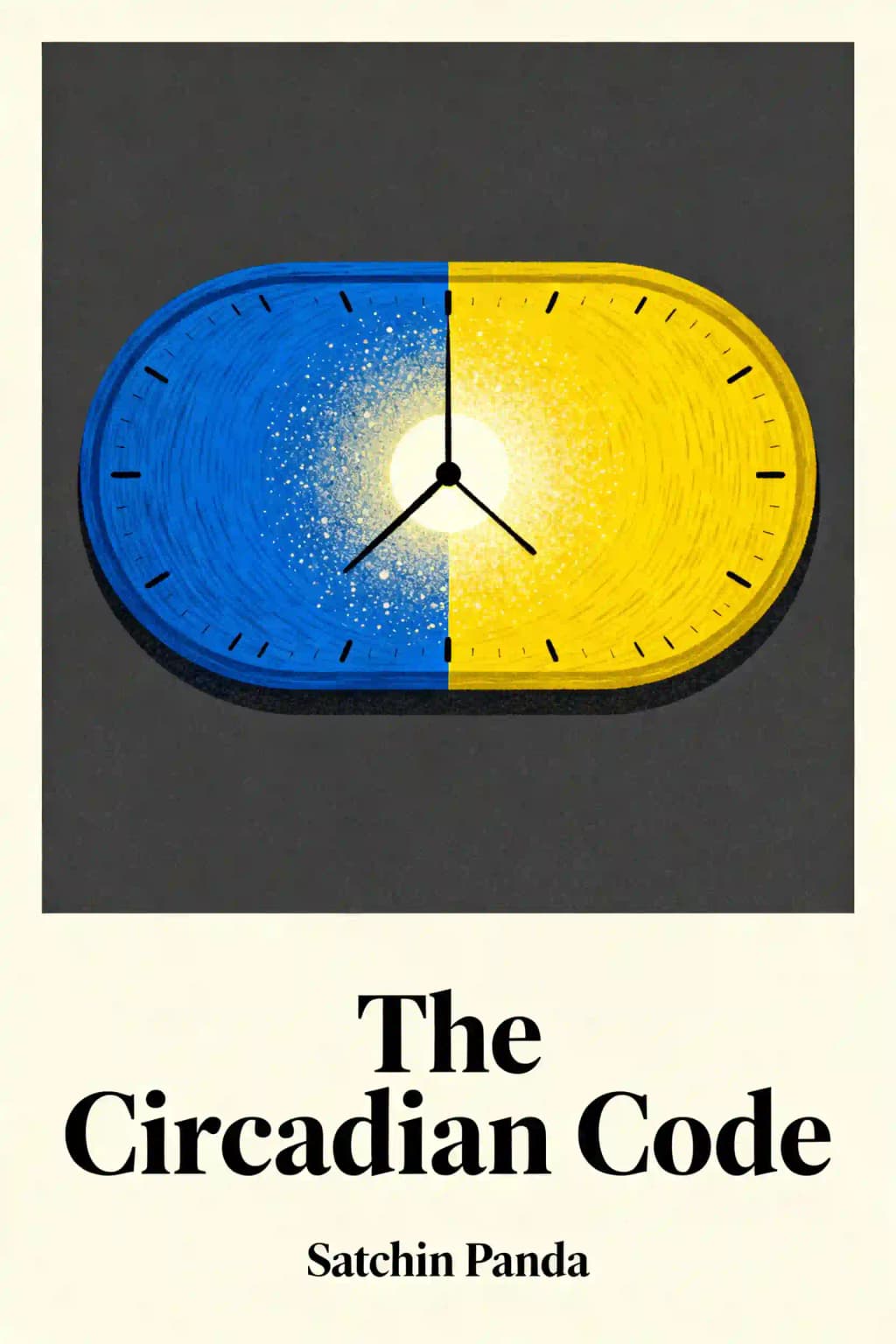
Discover how your body's internal clock controls everything from weight to longevity. Nobel Laureate Michael Rosbash calls "The Circadian Code" essential "circadian hygiene" while tech executive Linda Stone praises its solutions for maintaining vitality in our always-on digital world. Ready to hack your biological rhythms?
Dr. Satchidananda (Satchin) Panda, author of The Circadian Code: Lose Weight, Supercharge Your Energy, and Transform Your Health from Morning to Midnight, is a leading circadian rhythm researcher and professor at the Salk Institute for Biological Studies. A Pew Biomedical Scholar and Julie Martin Mid-Career Award recipient, his groundbreaking work on blue-light sensing retinal cells and time-restricted feeding (TRF) revolutionized understanding of metabolic health and sleep science. Born in Odisha, India, Dr. Panda combines his PhD in biological sciences with decades of research to address modern health challenges through circadian biology.
His insights are featured in TED Talks, NPR, and global conferences for the American Diabetes Association and Diabetes UK. Dr. Panda developed the MyCircadianClock app, used by millions to optimize eating schedules, and expands on his research in The Circadian Diabetes Code.
Translated into 15+ languages, The Circadian Code has been cited in over 1,000 clinical studies and endorsed by health institutions worldwide as a foundational resource for combating metabolic disorders.
The Circadian Code explores how aligning daily habits—like eating, sleeping, and light exposure—with your body’s natural 24-hour clock can improve weight management, energy levels, and long-term health. Dr. Panda emphasizes time-restricted eating (TRE), optimal sleep hygiene, and daylight exposure to sync circadian rhythms, reducing risks of obesity, diabetes, and mental health disorders.
This book is ideal for individuals seeking science-backed strategies to enhance sleep, energy, or metabolic health. It’s particularly relevant for shift workers, night owls, or anyone struggling with irregular schedules. Readers should expect a mix of research summaries and actionable advice, though some may find the reliance on animal studies overgeneralized.
Yes, for its accessible synthesis of circadian biology and practical tips like 10-hour eating windows. Critics note repetitive content and occasional hyperbolic claims, but the core principles—consistent meal timing, morning light exposure, and reduced evening screen use—are widely praised as transformative.
TRE involves limiting daily food intake to a 8–12-hour window (e.g., 7 AM–5 PM) to align with circadian metabolism peaks. Studies cited show TRE aids weight loss, improves blood sugar control, and enhances gut health by allowing prolonged fasting periods that activate cellular repair.
Morning sunlight resets the body’s clock by suppressing melatonin, boosting daytime alertness. Conversely, evening blue light from screens disrupts sleep. The book recommends 30+ minutes of morning outdoor light and using amber glasses post-sunset.
Some reviewers argue the book overstates mouse-study applicability to humans and repeats core concepts excessively. Others find the self-help tone at odds with its scientific foundation, though most agree the health recommendations are still valuable.
Both emphasize sleep’s health impact, but The Circadian Code focuses more on meal timing and light, while Why We Sleep delves deeper into sleep cycles. Panda’s work offers more actionable daily frameworks, whereas Walker’s provides broader neuroscientific context.
Yes—by aligning circadian rhythms, the book suggests reduced inflammation, better blood sugar regulation, and lower risks of heart disease, dementia, and cancer. Nightshift workers are advised to prioritize consistent sleep schedules and TRE.
These highlight the centrality of timing in metabolic health and systemic well-being.
Daytime exercise (especially morning) boosts circadian alignment by raising body temperature and cortisol levels naturally. Evening workouts may delay melatonin release, disrupting sleep. The book recommends finishing intense activity 3+ hours before bedtime.
No—it focuses on when to eat rather than what. However, avoiding late-night snacking and aligning meals with daylight hours are central. High-protein breakfasts and early dinners are encouraged to sync with metabolic peaks.
With increased screen time and erratic work schedules, its emphasis on digital detoxes, TRE, and morning routines addresses modern lifestyle challenges. The science remains validated by ongoing chronobiology research.
Yes: the book suggests using free apps like f.lux for screen dimming, fasting timers (e.g., Zero), and sunlight alarms. These help enforce consistent sleep/wake cycles and eating windows without cost.
Erlebe das Buch durch die Stimme des Autors
Verwandle Wissen in fesselnde, beispielreiche Erkenntnisse
Erfasse Schlüsselideen blitzschnell für effektives Lernen
Genieße das Buch auf unterhaltsame und ansprechende Weise
Today, we're all unwitting shift workers.
Even a single night of shift work can impair cognition for up to a week.
Food timing is a powerful circadian reset signal.
The notion that people are genetically predetermined to be either 'night owls' or 'morning larks' is largely a myth.
Late meals delay the fat-burning process.
Zerlegen Sie die Kernideen von The Circadian Code in leicht verständliche Punkte, um zu verstehen, wie innovative Teams kreieren, zusammenarbeiten und wachsen.
Destillieren Sie The Circadian Code in schnelle Gedächtnisstützen, die die Schlüsselprinzipien von Offenheit, Teamarbeit und kreativer Resilienz hervorheben.

Erleben Sie The Circadian Code durch lebhafte Erzählungen, die Innovationslektionen in unvergessliche und anwendbare Momente verwandeln.
Fragen Sie alles, wählen Sie die Stimme und erschaffen Sie gemeinsam Erkenntnisse, die wirklich bei Ihnen ankommen.

Von Columbia University Alumni in San Francisco entwickelt
"Instead of endless scrolling, I just hit play on BeFreed. It saves me so much time."
"I never knew where to start with nonfiction—BeFreed’s book lists turned into podcasts gave me a clear path."
"Perfect balance between learning and entertainment. Finished ‘Thinking, Fast and Slow’ on my commute this week."
"Crazy how much I learned while walking the dog. BeFreed = small habits → big gains."
"Reading used to feel like a chore. Now it’s just part of my lifestyle."
"Feels effortless compared to reading. I’ve finished 6 books this month already."
"BeFreed turned my guilty doomscrolling into something that feels productive and inspiring."
"BeFreed turned my commute into learning time. 20-min podcasts are perfect for finishing books I never had time for."
"BeFreed replaced my podcast queue. Imagine Spotify for books — that’s it. 🙌"
"It is great for me to learn something from the book without reading it."
"The themed book list podcasts help me connect ideas across authors—like a guided audio journey."
"Makes me feel smarter every time before going to work"
Von Columbia University Alumni in San Francisco entwickelt

Erhalten Sie die The Circadian Code-Zusammenfassung als kostenloses PDF oder EPUB. Drucken Sie es aus oder lesen Sie es jederzeit offline.
A night owl scrolls through social media at midnight, convinced they're simply wired differently. A shift nurse struggles with mysterious weight gain despite careful dieting. An entrepreneur pushes through afternoon brain fog with another espresso shot. What if I told you these aren't personality quirks or willpower failures, but symptoms of a biological system crying out for synchronization? Deep within every cell in your body ticks a molecular clock-an ancient timekeeping mechanism that evolved over millions of years to anticipate sunrise, optimize digestion, and coordinate thousands of cellular processes. When these clocks fall out of sync with modern life, the consequences ripple through every aspect of health. This isn't about productivity hacks or trendy wellness fads. It's about rediscovering a fundamental biological truth that could transform how you sleep, eat, think, and age.