Kapitel 1
Unveiling the Bible's Grand Narrative: A Journey Through God's Word
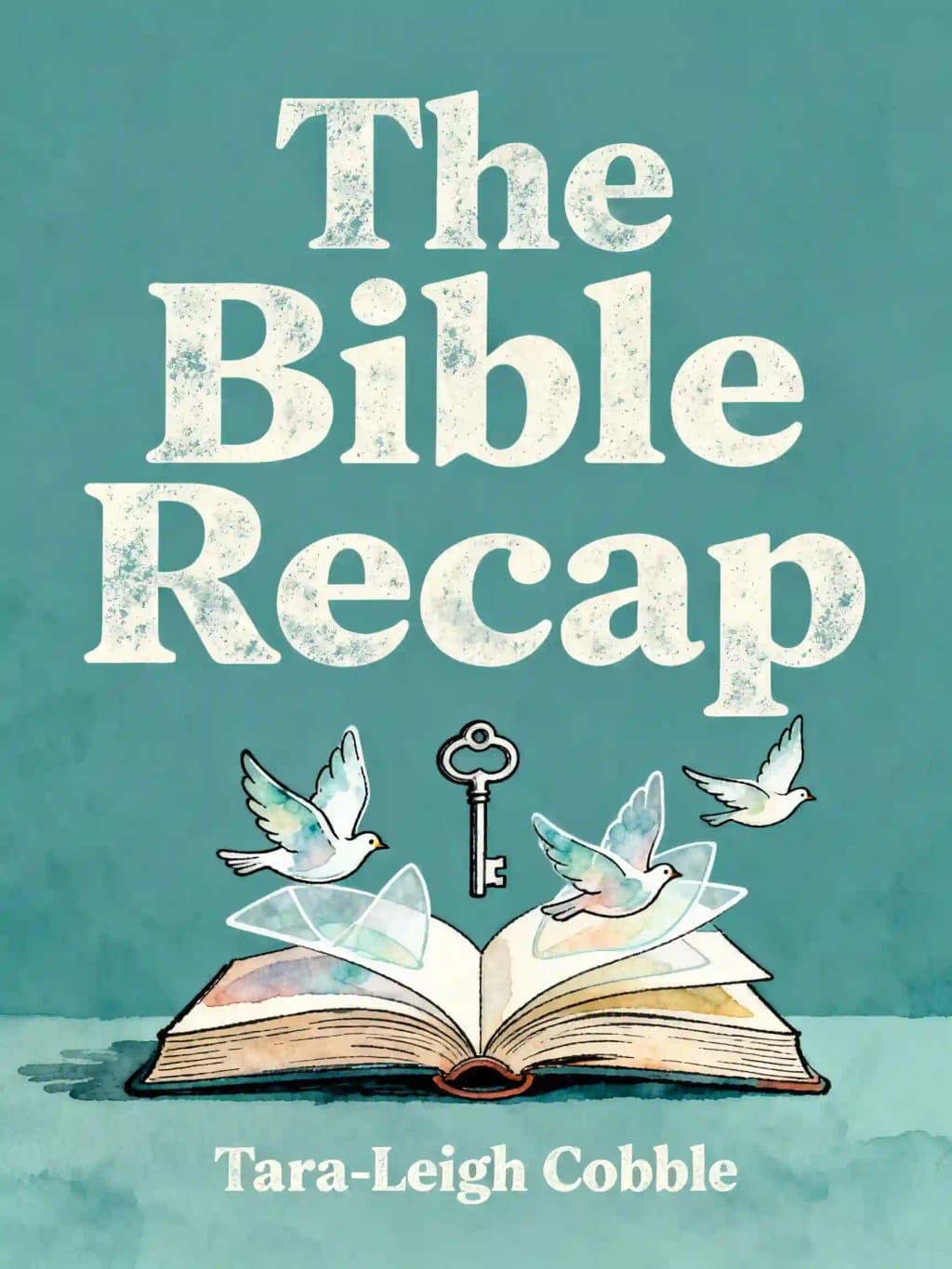
The Bible Recap by Tara-Leigh Cobble has become a global phenomenon, transforming how millions engage with Scripture. This bestseller, endorsed by spiritual leaders like Jamie Ivey and Jonathan Pokluda, has sparked a movement that's spread to over 20,000 churches worldwide. What began as Cobble's personal quest to understand the Bible has evolved into a revolutionary approach that helps readers see the cohesive story of God's pursuit of humanity. With over 25 million podcast downloads in just 18 months, Cobble's accessible, engaging style has resonated with both spiritual seekers and longtime believers who previously found the Bible intimidating or confusing. Even celebrities and influencers have praised her ability to make Scripture not just understandable but deeply personal and transformative.
Kapitel 2
God's Relentless Pursuit: The Heart of the Biblical Narrative
The Bible Recap presents Scripture not as a collection of disconnected stories or moral lessons, but as one cohesive narrative centered on God's character and His relentless pursuit of relationship with humanity. Cobble's approach transforms how we read the Bible by shifting our perspective from "what does this mean for me?" to "what does this reveal about God?" This fundamental reframing invites readers to discover the grand narrative that spans from Genesis to Revelation, revealing a consistent divine character throughout history.
This fundamental shift addresses what Cobble identifies as three common mistakes in Bible reading. First, approaching Scripture selfishly-seeking only personal application rather than seeing God's larger story. This tendency reduces the Bible to a self-help manual rather than a revelation of God's character and purposes. Second, cherry-picking familiar passages while avoiding difficult sections, which creates a fragmented understanding. Many readers gravitate toward comforting Psalms or inspiring Gospel stories while skipping challenging passages in Leviticus or Judges, missing crucial elements of God's character. Third, drawing premature conclusions about God's character before reading the whole Bible, missing the progressive nature of His revelation. This often leads to misconceptions about the supposed difference between the "Old Testament God" and the "New Testament God."
Through chronological reading, Cobble helps readers trace God's consistent character across both testaments. From creation through the patriarchs - where God establishes covenants with Abraham, Isaac, and Jacob - to Israel's formation under Moses and David, through the tumultuous period of exile and return, and ultimately through Christ's life and the early church, we see the same God working-merciful, gracious, slow to anger, abounding in steadfast love and faithfulness, forgiving sin yet not clearing the guilty. This continuity reveals that God's heart has never changed; He has always been pursuing reconciliation with His people. Examples abound: God seeking Adam and Eve in the garden after their sin, pursuing Israel despite their repeated idolatry, sending prophets to call His people back, and ultimately sending His Son as the ultimate expression of His pursuing love.
"The Bible isn't primarily about us," Cobble writes. "It's about Him." This perspective transforms Bible reading from an obligation into a relationship-building experience where we come to know God more intimately through His self-revelation. The narrative reveals that despite humanity's repeated rebellion - from the golden calf incident to the divided kingdom, from exile to the crucifixion - God never abandons His plan to restore relationship with us. This divine persistence culminates in Christ's sacrifice and extends through the church age to the promise of ultimate restoration in Revelation, where God's people will dwell with Him forever. The Bible thus becomes not just a historical document or rule book, but a love story of divine pursuit, with God as the initiator and humanity as the beloved, albeit wayward, object of His affection.
Kapitel 3
The Chronological Approach: Seeing Scripture in Context
One of The Bible Recap's most distinctive features is its chronological reading plan, which arranges Scripture in historical sequence rather than canonical order. This approach provides crucial context that illuminates confusing passages and reveals connections between books written centuries apart. Unlike traditional Bible reading plans that might jump from Genesis to Matthew, this method allows readers to follow the continuous thread of God's redemptive story as it actually unfolded in history.
For example, reading Job alongside Genesis helps us understand patriarchal culture, while placing prophetic books alongside the historical events they address brings clarity to their messages. When Isaiah prophecies about the fall of Jerusalem, reading it alongside 2 Kings provides immediate historical context. Psalms gain deeper meaning when read in the context of David's life experiences - Psalm 51 becomes more powerful when read directly after David's encounter with Nathan following his sin with Bathsheba. Paul's letters make more sense when positioned within the narrative of Acts, allowing readers to understand the specific challenges each church community was facing.
The chronological approach also highlights the Bible's historical reliability through multiple layers of confirmation. Archaeological discoveries consistently confirm biblical accounts, from the existence of Hittite civilization (once doubted by scholars) to details about ancient Babylon. The discovery of the Ebla tablets confirmed many biblical customs and place names. The Cyrus Cylinder corroborates the biblical account of Persian policy toward conquered peoples. Even seemingly dry genealogies serve important purposes-establishing legal rights, connecting narrative threads across generations, and ultimately tracing the lineage that leads to Christ. These family records also help authenticate historical claims and demonstrate God's faithfulness to His promises across generations.
Cobble acknowledges that chronological ordering involves some educated guesswork, especially for books without clear historical markers. Dating Job, some Psalms, and certain prophetic writings requires careful analysis of internal evidence and historical context. However, the benefits far outweigh these limitations. Reading Scripture in historical sequence reveals God's progressive revelation-how He disclosed more about Himself and His plans as humanity was ready to receive it. This progression is particularly visible in the gradually clarifying promises about the Messiah, from generic predictions about Eve's offspring to specific details about the tribe of Judah and the house of David.
This approach also illuminates the "already but not yet" tension that runs throughout Scripture. God's kingdom is already inaugurated through Christ but not yet fully realized - visible in passages from Daniel through Revelation. Believers are already declared righteous but not yet perfected, a theme Paul explores extensively. Creation is already being renewed but not yet fully restored, as Romans 8 describes. This tension helps explain why Christians still experience suffering despite God's promises of blessing and victory, and why the church lives in the intersection of present reality and future hope. Understanding this dynamic through chronological reading provides essential perspective for interpreting both Old and New Testament promises.
Kapitel 4
God's Character Revealed: The "God Shot" Perspective
Perhaps the most transformative element of Cobble's approach is what she calls the "God Shot"-identifying something about God's character in every day's reading. This practice trains readers to look for God's self-revelation rather than merely seeking personal application.
Throughout Scripture, God consistently reveals Himself as sovereign yet personal, holy yet merciful, just yet compassionate. He is portrayed as the Creator who maintains intimate knowledge of each person, the King who establishes His rule through servanthood, and the Judge who provides the sacrifice that satisfies His own justice.
Cobble highlights how God's attributes work in harmony rather than tension. His justice doesn't compete with His mercy; they complement each other. His sovereignty doesn't negate human responsibility; they mysteriously coexist. His holiness doesn't prevent His nearness; it defines the terms of relationship.
The Bible reveals God's heart through His actions and declarations. When Moses asks to see God's glory, God responds by proclaiming His character: "The LORD, the LORD, a God merciful and gracious, slow to anger, and abounding in steadfast love and faithfulness, keeping steadfast love for thousands, forgiving iniquity and transgression and sin, but who will by no means clear the guilty" (Exodus 34:6-7). This self-description appears repeatedly throughout Scripture, forming a consistent portrait of God's nature.
Even difficult passages reveal important aspects of God's character. The conquest narratives show His commitment to justice and holiness. The sacrificial system demonstrates both the seriousness of sin and God's provision for forgiveness. The exile reveals His faithfulness to both His promises of blessing and His warnings of judgment.
Through this "God Shot" approach, readers discover that knowing God's character transforms how they read Scripture. Difficult passages become opportunities to understand God more deeply rather than obstacles to faith. Familiar stories reveal new layers of meaning when viewed through the lens of God's self-revelation.
Kapitel 5
The Bible's Unity: Tracing Themes Through Scripture
The Bible Recap reveals the remarkable unity of Scripture despite its diverse authors, genres, and historical contexts. Cobble traces major themes that weave through both testaments, demonstrating how the entire Bible tells one cohesive story.
The theme of covenant runs from God's promises to Abraham through the Mosaic covenant, the Davidic covenant, and ultimately the new covenant established through Christ. Each covenant builds upon previous ones, revealing God's consistent commitment to relationship with His people.
The tabernacle/temple theme progresses from God's presence in a physical structure to His dwelling in human hearts through the Spirit, culminating in the vision of the new Jerusalem where God dwells directly with His people. This trajectory shows God's increasing intimacy with humanity throughout salvation history.
The kingdom theme develops from God's rule through judges and kings to Jesus's proclamation that the kingdom of God is at hand, with the promise of its future consummation when Christ returns. This reveals God's unchanging purpose to establish His righteous rule on earth.
The sacrifice theme evolves from animal offerings to Christ's once-for-all sacrifice, demonstrating both the consistent necessity of atonement and God's progressive revelation of how it would ultimately be accomplished.
Perhaps most significantly, Cobble traces the promise of the Messiah from the first hint in Genesis 3:15 through increasingly detailed prophecies in the Old Testament, showing how Jesus fulfills hundreds of specific predictions. This thread reveals God's meticulous planning and sovereignty over history.
These interconnected themes demonstrate that the Bible isn't a random collection of writings but a unified revelation with remarkable coherence despite being written over 1,500 years by dozens of authors from diverse backgrounds. This unity points to divine inspiration working through human authors.
Kapitel 6
Navigating Difficult Passages: Context, Culture, and Christ
Rather than avoiding challenging texts, The Bible Recap provides robust frameworks for understanding and interpreting difficult passages. Cobble addresses three main categories of challenging content: apparent contradictions, troubling ethical questions, and passages that seem to conflict with modern sensibilities. Her approach emphasizes careful study while maintaining reverence for the text.
For apparent contradictions, Cobble emphasizes the importance of context-both literary and historical. Many seeming discrepancies resolve when readers understand ancient literary conventions, recognize different perspectives on the same event, or appreciate the Bible's theological purposes alongside its historical reporting. For example, the varying details in the Gospel accounts of Jesus's resurrection reflect different eyewitness perspectives rather than contradictions. Similarly, the two creation accounts in Genesis serve distinct theological purposes - one emphasizing God's sovereign power, the other focusing on humanity's unique relationship with Creator.
When addressing ethically challenging passages like the conquest narratives or imprecatory psalms, Cobble provides extensive cultural and theological context. The conquest represented God's judgment on deeply corrupt cultures after centuries of patience, not arbitrary violence. She points out how God gave the Canaanite peoples 400 years to repent and how archaeological evidence confirms the biblical accounts of their practices. The imprecatory psalms express raw human emotions while ultimately entrusting vengeance to God rather than taking it personally - modeling how to process anger and injustice in prayer rather than through revenge.
For passages addressing gender roles, slavery, and other culturally charged topics, Cobble explains how Scripture often worked within existing cultural frameworks while planting seeds that would eventually transform those frameworks. She demonstrates how Jesus and Paul consistently elevated the status of women, slaves, and other marginalized groups beyond their cultural context, establishing principles that would ultimately undermine systems of oppression. For instance, Paul's instruction for slaves to obey masters came alongside revolutionary statements about spiritual equality and brotherhood that would eventually help dismantle slavery itself.
Most importantly, Cobble encourages reading difficult passages through the lens of Christ. Jesus claimed that all Scripture points to Him (Luke 24:27), suggesting that the entire Bible should be interpreted in light of His perfect revelation of God's character. This Christ-centered hermeneutic doesn't dismiss difficulties but places them within the larger narrative of God's redemptive work. When readers encounter troubling texts, she encourages them to ask how the passage connects to Christ's person and work, considering both immediate context and its place in the broader story of redemption.
The book provides practical tools for this interpretive work, including historical background information, cross-references to related passages, and questions for deeper reflection. Cobble also addresses common misconceptions about biblical interpretation, warning against both overly literal and overly allegorical readings while advocating for a balanced approach that considers genre, context, and the Bible's progressive revelation.
Kapitel 7
From Reading to Relationship: Practical Application
The Bible Recap isn't merely about intellectual understanding but about fostering genuine relationship with God. Cobble provides practical guidance for moving from information to transformation, offering specific strategies to deepen engagement with Scripture and its Author.
She recommends journaling insights and questions while reading Scripture, then returning to The Bible Recap for additional context and explanation. This two-step process might include noting confusing passages, writing down personal applications, or recording emotional responses to the text. For example, readers might journal about their reaction to difficult passages in the Old Testament, or document moments when a familiar verse suddenly takes on new meaning. This practice encourages active engagement rather than passive consumption, creating space for the Spirit to speak through the Word.
Cobble emphasizes reading Scripture communally as well as individually, suggesting specific formats like reading groups, church Bible studies, or even online communities. The Bible was primarily meant to be experienced in community, where diverse perspectives enrich understanding and application. She provides examples of how different cultural and generational viewpoints can illuminate passages in unexpected ways - a younger believer might see hope where an older one sees warning, or an international perspective might reveal cultural nuances missing from Western readings. This approach guards against individualistic interpretations and helps readers benefit from the collective wisdom of the church across time and space.
Prayer forms an essential component of Bible reading in Cobble's approach, with specific suggestions for different types of prayer responses. She encourages readers to respond to what they learn about God through praise (celebrating His attributes revealed in the text), confession (acknowledging where our lives don't align with His truth), thanksgiving (expressing gratitude for His character and actions), and supplication (asking for help in applying His Word). For instance, reading about God's faithfulness might lead to both thanksgiving for past provision and requests for current needs. This transforms Bible reading from a merely academic exercise into a conversational relationship.
Perhaps most importantly, Cobble emphasizes that the goal isn't merely to read the Bible but to know and love the God it reveals. She provides practical examples of how this shift in perspective changes our approach - from reading to meet a daily quota to reading to hear God's voice, from studying to acquire knowledge to studying to deepen intimacy. "The Bible isn't an end in itself," she writes. "It's a means to relationship with the Author." This perspective transforms Bible reading from an obligation into a delight-not because the text is always easy or immediately applicable, but because it consistently reveals the character of the God who pursues us with relentless love. She encourages readers to look for God's character in every passage, whether it's His justice in the prophets, His mercy in the gospels, or His wisdom in the epistles.
Kapitel 8
The Transformative Journey: From Confusion to Clarity
The Bible Recap doesn't promise to answer every question or resolve every tension in Scripture. Instead, it offers a framework for engaging with the Bible that transforms confusion into clarity, obligation into desire, and information into relationship. This approach acknowledges the complexity of Scripture while providing tools to navigate its depths with confidence and purpose.
Cobble shares compelling stories of readers who previously found the Bible intimidating, boring, or confusing but discovered new joy in Scripture through this approach. A business executive who had attempted to read the Bible annually for decades finally completed it using The Bible Recap's method. A young mother describes how the chronological format helped her understand the historical context of familiar stories she'd known since childhood. Others report how seeing God's character throughout Scripture has transformed their prayer lives, their relationships, and their approach to suffering. One reader noted how understanding the broader narrative arc helped them find hope during a personal crisis.
The chronological reading plan provides structure without rigidity, offering a clear path while acknowledging life's realities. Cobble encourages readers who fall behind to simply jump back in with the current day's reading rather than giving up altogether. This grace-filled approach recognizes that the goal isn't perfect performance but consistent exposure to God's Word. She includes practical strategies for catching up, like doubling up on readings or listening to audio versions during commutes.
The daily format makes Scripture accessible even to busy readers, breaking the Bible into digestible 15-20 minute segments. By providing historical context, cultural insights, and connecting threads between passages, The Bible Recap removes many barriers that prevent people from engaging with Scripture consistently. Each day's reading includes key themes, explanatory notes, and reflection questions that help readers process and apply what they've read.
Perhaps most significantly, Cobble's approach shifts the focus from what we should do to who God is. Rather than treating Scripture as primarily a manual for behavior modification, readers learn to see it as a revelation of God's character and purposes. This transformation from duty-driven religion to relationship-based faith reflects the heart of the gospel itself-that God's grace precedes and enables our response rather than depending on it. Readers report finding freedom from performance anxiety and discovering genuine delight in their Bible reading.
The method also emphasizes community engagement, encouraging readers to discuss their insights and questions with others. Many churches and small groups have adopted The Bible Recap as a shared reading experience, fostering rich discussions and deeper connections among participants. This communal aspect helps sustain momentum and provides multiple perspectives on challenging passages.
Kapitel 9
The Invitation: Joining God's Unfolding Story
The Bible Recap concludes where Scripture itself concludes-with an invitation. Just as Revelation ends with "Let the one who is thirsty come; let the one who desires take the water of life without price," Cobble invites readers to discover their place in God's ongoing story. This invitation echoes throughout Scripture, from Genesis's creation narrative to the final pages of Revelation, creating a continuous thread of divine welcome.
She reminds us that the Bible isn't merely a historical document but a living text through which God continues to speak. The same God who created the universe, established covenant with Abraham, delivered Israel from Egypt, spoke through the prophets, became incarnate in Christ, and empowered the early church continues to work in and through His people today. This living nature of Scripture manifests in how ancient texts speak to contemporary situations, offering wisdom and guidance across cultural and temporal boundaries.
This perspective transforms Bible reading from a backward-looking exercise to a forward-looking participation. We don't merely study what God has done but discover what He is doing and will do, finding our place in His unfolding plan of redemption. Cobble illustrates this through examples of how biblical narratives parallel modern experiences - from workplace challenges to family relationships, from personal trials to community building.
The Bible Recap emphasizes three key aspects of participation in God's story: recognition, response, and relationship. Recognition involves seeing God's patterns of faithfulness throughout Scripture and our lives. Response encompasses our active engagement with His Word and work. Relationship describes the deepening connection with God that develops through this engagement.
Ultimately, The Bible Recap offers more than a method for reading Scripture-it provides a framework for understanding our lives within God's larger story. As we recognize His consistent character and purposes throughout history, we gain confidence in His faithfulness to complete the good work He has begun, both in us and in His creation. This framework helps readers interpret their personal experiences in light of God's redemptive narrative.
"When we know who God is," Cobble writes, "we can trust Him with what He does." This simple yet profound insight captures the heart of The Bible Recap-that knowing God's character through His Word transforms how we interpret both Scripture and our lives, enabling us to face whatever comes with confidence in the One whose love has pursued us from creation to new creation. She reinforces this truth with numerous testimonies from readers who have found renewed purpose and peace through understanding their place in God's story.
The conclusion emphasizes that God's story continues beyond the Bible's pages through the lives of His people today. Each reader is invited to become not just a student of Scripture, but an active participant in God's ongoing work of redemption and restoration in the world. This participation involves both personal transformation and community engagement, as readers learn to see themselves as part of the larger narrative of God's kingdom work.