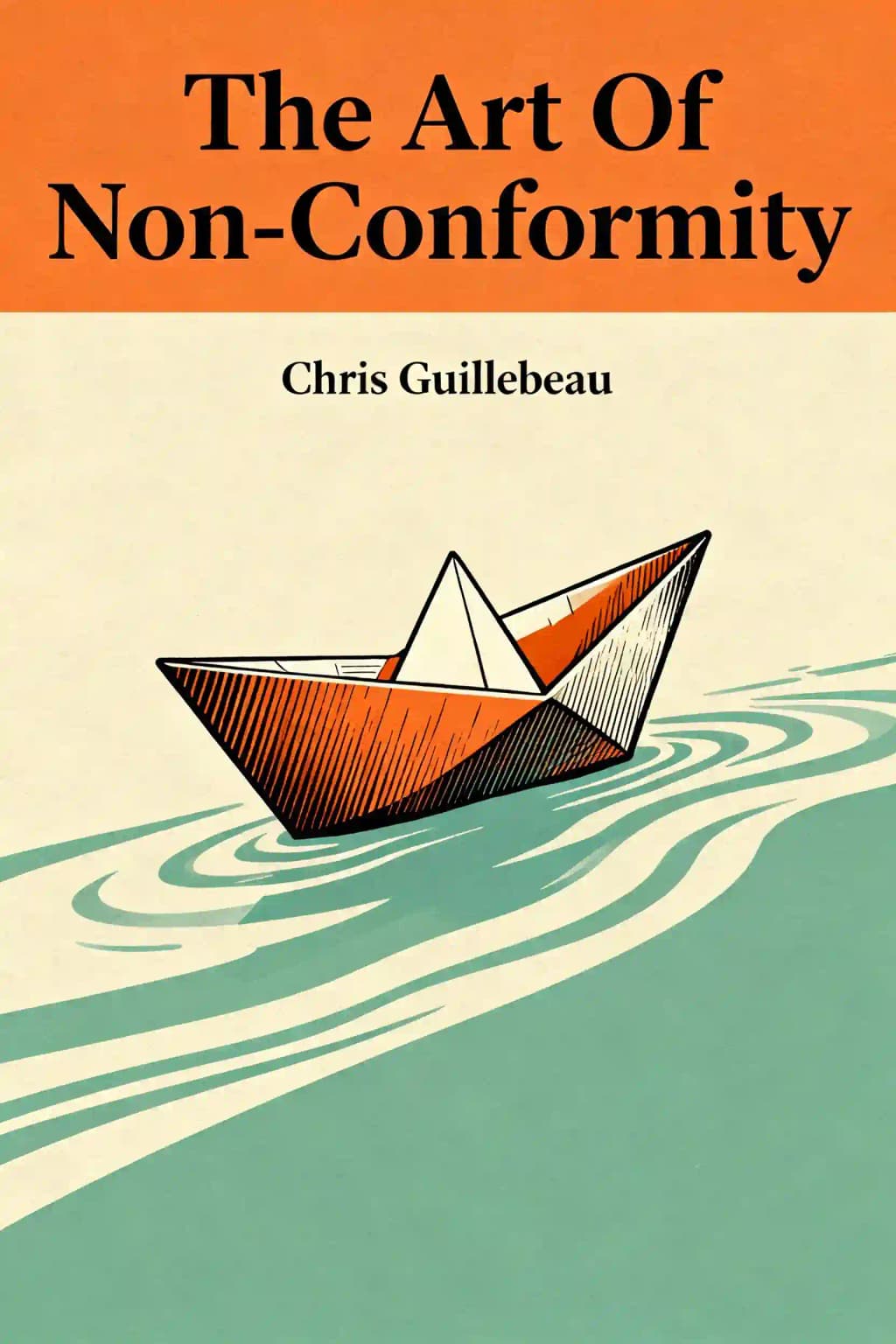
Break free from society's script and design your dream life. In "The Art of Nonconformity," Chris Guillebeau - endorsed by Richard Branson - reveals how to balance personal freedom with positive impact. What if conventional success is actually holding you back from true fulfillment?
Chris Guillebeau, New York Times bestselling author of The Art of Non-Conformity, is a pioneering voice in entrepreneurship and unconventional living. A lifelong advocate of self-directed lifestyles, Guillebeau blends his background in international studies with real-world experience—including visiting every country by age 35—to challenge societal norms and inspire purposeful action.
His work explores themes of personal freedom, creativity, and global citizenship, reflected in other influential titles like The $100 Startup and Born for This.
As the founder of the World Domination Summit, an annual gathering for innovators, and host of the Side Hustle School podcast (over 2 million monthly downloads), Guillebeau empowers millions to pursue meaningful work beyond traditional paths.
His insights have been featured in The Wall Street Journal, Entrepreneur, and TEDx talks, cementing his reputation as a trusted guide for aspiring nonconformists. The Art of Non-Conformity has become a modern classic in self-help and business genres, inspiring readers worldwide to design lives aligned with their values.
The Art of Non-Conformity challenges traditional societal norms, advocating for a life built on personal freedom, purpose, and global impact. Guillebeau provides frameworks for rejecting mediocrity, designing self-directed careers, and combining individual goals with service to others. Key themes include self-reliance, unconventional entrepreneurship, and redefining success beyond material wealth.
This book is ideal for entrepreneurs, career changers, and anyone feeling trapped by conventional paths. It resonates with readers seeking actionable strategies to align their work with personal values, fans of Tim Ferriss’s The 4-Hour Workweek, and individuals interested in minimalist lifestyles or socially conscious entrepreneurship.
Yes, particularly for those new to self-help or entrepreneurship. While some critics note overlaps with broader genre advice, the book’s practical steps—like conducting a “self-audit” or crafting a “one-year rebellion”—offer clarity for designing a meaningful life. Its emphasis on balancing personal ambition with community impact remains compelling.
Guillebeau argues that true fulfillment comes from autonomy, creativity, and intentional rule-breaking.
Guillebeau defines success as “freedom + purpose”—the ability to control your time while pursuing projects that matter. He contrasts this with societal metrics like wealth or status, emphasizing that success should be self-determined and tied to leaving a meaningful legacy.
Some readers find the advice overly generic if familiar with self-help tropes, noting that concepts like “define your own rules” lack granular implementation steps. Others argue the book’s focus on individualism underestimates systemic barriers to unconventional living.
The book provides tools to audit current dissatisfaction, identify transferable skills, and launch “side hustles” with minimal resources. Guillebeau’s “27-line business plan” helps readers test ideas quickly, while case studies illustrate transitioning from traditional jobs to passion-driven work.
Both advocate lifestyle design, but Guillebeau focuses more on community impact and incremental change, whereas Ferriss emphasizes radical efficiency and luxury. Non-Conformity also prioritizes ethical entrepreneurship over purely profit-driven ventures.
Guillebeau’s early high school dropout experience, volunteer work in West Africa with Mercy Ships, and visits to every country by age 35 inform his advocacy for self-directed living. His blend of global perspective and grassroots entrepreneurship grounds the book’s practical idealism.
Yes, including exercises like:
These tools help readers move from theory to action.
As remote work and AI reshape careers, the book’s emphasis on adaptability, micro-entrepreneurship, and purpose aligns with trends toward self-employment and socially conscious business models. Its critique of bureaucratic inefficiency remains timely amid corporate layoffs and gig economy growth.
Erlebe das Buch durch die Stimme des Autors
Verwandle Wissen in fesselnde, beispielreiche Erkenntnisse
Erfasse Schlüsselideen blitzschnell für effektives Lernen
Genieße das Buch auf unterhaltsame und ansprechende Weise
Determination matters more than intelligence.
I'm frightened of the old ones.
Most people want meaningful work worth pursuing, not easy work.
Zerlegen Sie die Kernideen von The art of non-conformity in leicht verständliche Punkte, um zu verstehen, wie innovative Teams kreieren, zusammenarbeiten und wachsen.
Destillieren Sie The art of non-conformity in schnelle Gedächtnisstützen, die die Schlüsselprinzipien von Offenheit, Teamarbeit und kreativer Resilienz hervorheben.

Erleben Sie The art of non-conformity durch lebhafte Erzählungen, die Innovationslektionen in unvergessliche und anwendbare Momente verwandeln.
Fragen Sie alles, wählen Sie die Stimme und erschaffen Sie gemeinsam Erkenntnisse, die wirklich bei Ihnen ankommen.

Von Columbia University Alumni in San Francisco entwickelt
"Instead of endless scrolling, I just hit play on BeFreed. It saves me so much time."
"I never knew where to start with nonfiction—BeFreed’s book lists turned into podcasts gave me a clear path."
"Perfect balance between learning and entertainment. Finished ‘Thinking, Fast and Slow’ on my commute this week."
"Crazy how much I learned while walking the dog. BeFreed = small habits → big gains."
"Reading used to feel like a chore. Now it’s just part of my lifestyle."
"Feels effortless compared to reading. I’ve finished 6 books this month already."
"BeFreed turned my guilty doomscrolling into something that feels productive and inspiring."
"BeFreed turned my commute into learning time. 20-min podcasts are perfect for finishing books I never had time for."
"BeFreed replaced my podcast queue. Imagine Spotify for books — that’s it. 🙌"
"It is great for me to learn something from the book without reading it."
"The themed book list podcasts help me connect ideas across authors—like a guided audio journey."
"Makes me feel smarter every time before going to work"
Von Columbia University Alumni in San Francisco entwickelt

Erhalten Sie die The art of non-conformity-Zusammenfassung als kostenloses PDF oder EPUB. Drucken Sie es aus oder lesen Sie es jederzeit offline.
What if the life you've been told to want isn't the life you actually want? Think about the last time you felt truly alive-not comfortable, not secure, but fully, vibrantly awake. For most of us, those moments didn't happen while following someone else's script. They happened when we broke the rules. This realization hit Chris Guillebeau hard after years working in West Africa, visiting over 100 countries, and watching people sleepwalk through lives they never chose. His philosophy is disarmingly simple: you don't have to live your life the way other people expect you to. Yet applying this idea requires courage most of us haven't been asked to summon since childhood, when adults posed that classic question: "If everyone else jumped off a bridge, would you?" Somehow we forgot the lesson. We grew up and started jumping. Living unconventionally demands four commitments. Stay open to new ideas without accepting them blindly. Cultivate dissatisfaction with the status quo-that "unremarkably average" existence of checking society's boxes while your soul quietly suffocates. Take personal responsibility for your future, regardless of your past. And be willing to work hard-not less work, but better work that energizes rather than drains you. These principles sound obvious until you realize how rarely anyone actually lives them. We're like the monkeys in that famous experiment: researchers sprayed them with cold water whenever they climbed toward bananas, until eventually the monkeys policed each other, stopping newcomers from climbing even after the water stopped. New monkeys learned the rule without understanding why. We do the same thing, accepting limitations we've never questioned. But here's the difference: we're not caged. We can climb the ladder, grab the bananas, and walk out the door.
