Kapitel 1
America's Existential Crisis: The End of an Era
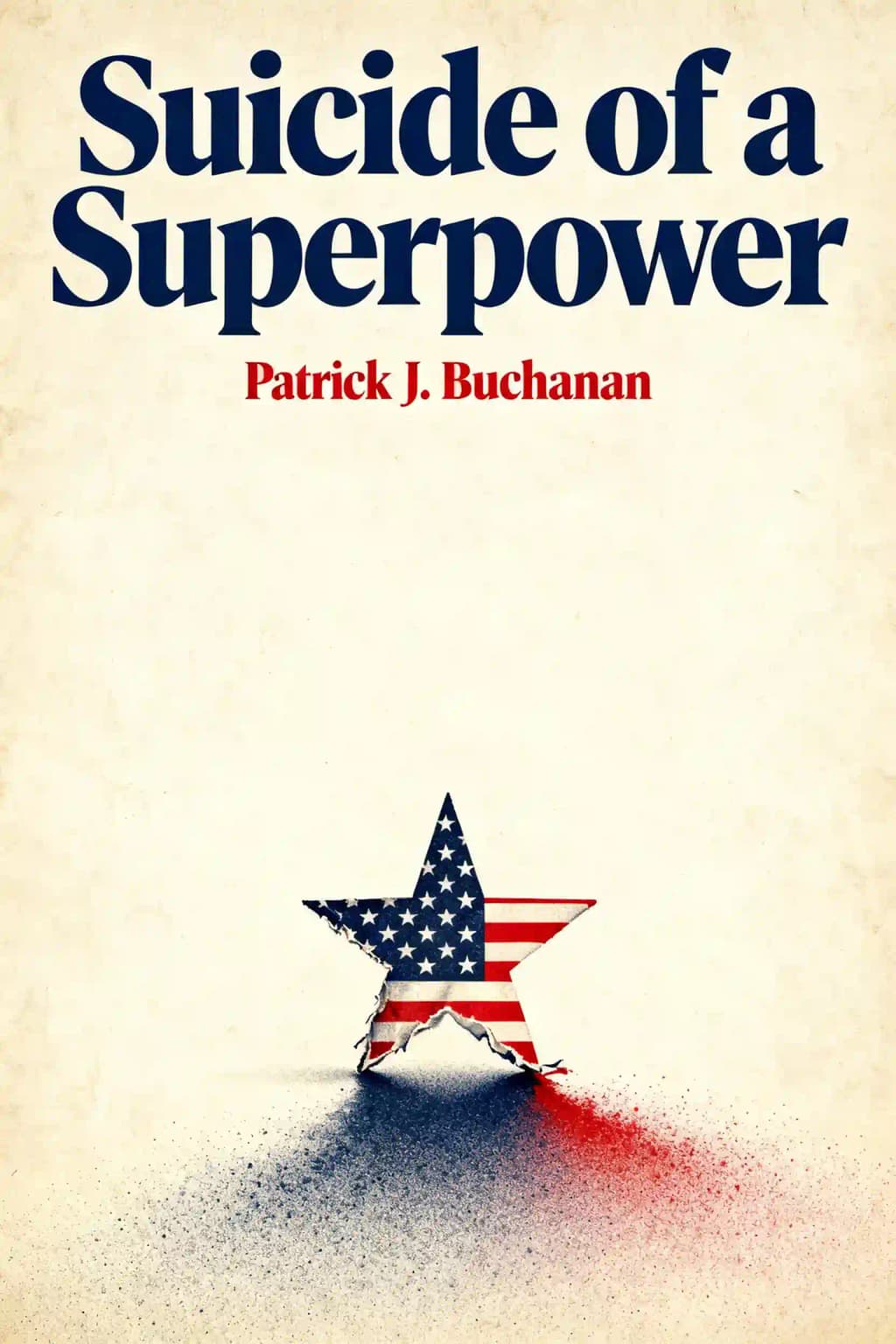
The year was 2011. While Americans struggled through the aftermath of the Great Recession, a controversial voice emerged with a stark warning: the United States was not merely experiencing economic troubles, but facing existential collapse. Patrick J. Buchanan's "Suicide of a Superpower" landed like a grenade in the political discourse, becoming an immediate New York Times bestseller despite-or perhaps because of-its provocative thesis. The book resonated deeply with conservatives alarmed by America's changing demographics and cultural shifts, while infuriating progressives who saw it as fearmongering. Buchanan, a former senior adviser to Presidents Nixon, Ford, and Reagan and three-time presidential candidate, had established himself as the voice of paleoconservatism-advocating economic nationalism, social traditionalism, and America First foreign policy decades before these positions entered mainstream political discourse. His previous work "Death of the West" had predicted Europe's demographic decline, but this book turned the lens squarely on America's future, arguing that the nation was committing civilizational suicide through abandonment of its founding principles, faith, and ethnic character.
Kapitel 2
The Disintegrating Nation: America's Fracturing Identity
America's unity has fractured along multiple fault lines-ethnic, cultural, moral, and political-creating what Buchanan describes as a "secession of the heart." The once-unifying pledge to "one nation, under God, indivisible" now feels like a relic from another era. Political leaders from both parties recognize this unprecedented polarization. As Theodore Roosevelt warned a century ago, "There is no room in this country for hyphenated Americanism." Yet today, hyphenated identities have become the norm.
The state simultaneously fails in its fundamental duties-defending borders, balancing budgets, and winning wars. America's financial position has deteriorated catastrophically, with the national debt approaching 100% of GDP. Leslie Gelb notes that "no nation with a massive debt has ever remained a great power." Political scientist Robert Pape found America's 30% relative decline since 2000 surpassed only by the Soviet Union's collapse in 1991.
This decline stems from abandoning economic nationalism for globalism, fiscal prudence for partisan vote-buying, and expanding the welfare state to European proportions while launching costly foreign wars. Manufacturing jobs have vanished as plants closed and production moved overseas. By 2010, manufacturing had fallen below retail, healthcare, and even leisure industries as a source of employment. The first decade of what was supposed to be the "Second American Century" saw zero net job creation, declining household incomes, and a 4% drop in average family net worth.
The housing bubble that crashed the economy began with Bush's 2002 initiative to increase minority homeownership by 5.5 million families. This well-intentioned but misguided policy ignored the real reasons for ownership disparities. Banks were pressured to make subprime mortgages to unqualified buyers, which were then sold to Fannie Mae and Freddie Mac, bundled into securities, and sold to Wall Street. When the Fed began tightening money, housing prices stabilized then fell, triggering defaults as homeowners couldn't sell their properties.
While ordinary Americans suffered through the recession, Washington D.C. thrived. Federal employment boomed during the recession-while 7.3 million private sector jobs disappeared, 416,000 government jobs were created. By 2009, federal employees earned average compensation of $123,049 compared to $61,051 for private workers. The three congressional districts surrounding D.C. rank among America's ten most affluent.
Kapitel 3
The Death of Christian America: Faith's Fading Influence
The 2009 inauguration marked America's transition to a post-Christian era. President Obama explicitly rejected America's Christian identity, declaring "We are a nation of Christians and Muslims, Jews and Hindus, and non-believers"-the first president to deny Christianity's primacy despite the Supreme Court's 1892 declaration that "This is a Christian nation."
Statistical evidence confirms Christianity's decline: 16% of adults (25% of those under thirty) have no religious affiliation; Northern New England has surpassed the Pacific Northwest as the least religious region; and Christians have declined from 86% to 76% of the population since 1990. Mainline Protestant denominations have suffered dramatic losses, falling from 50% of adults in 1958 to just 13%.
For the first time since America's founding, Protestants will soon be a minority, having fallen from 99% at the Revolution to just 51% by 2007. The generational shift is stark: while 62% of those over seventy identify as Protestant, only 43% of those under thirty do so. Michael Spencer predicts "a major collapse of evangelical Christianity" within a decade, suggesting evangelicals made a strategic error by tying their faith to political conservatism rather than focusing on articulating the Gospel.
The Episcopal Church exemplifies this decline, having lost a million members since 2000 and now representing less than 1% of the adult population. The church has fractured over issues including female clergy, homosexuality, and same-sex unions. While accommodationist churches continue their decline, more demanding denominations like Mormons (now with three times as many members as Episcopalians), Assemblies of God, and Jehovah's Witnesses are flourishing. As William Murchison observes, "whatever it is Mormons believe, they really believe it," while mainline churches offer merely "sweet tolerance and gentle affirmation."
The decline of Christian America has coincided with alarming social deterioration since 1960: illegitimacy rates have surged from 5% to 41% of all births; married-couple families with children have plummeted to just 21.6% of households; fifty million abortions have been performed since Roe v. Wade; teenage suicide rates tripled between 1960-1990; and violent crime soared 550% between 1960-1992. These statistics illustrate Dostoevsky's warning through Ivan Karamazov: "If God is dead, is not everything permitted?"
Today's social decomposition stems from Christianity's collapse and represents Antonio Gramsci's cultural revolution triumph. Unlike Lenin and Mao's eventually reversed violent victories, Gramsci recognized that Christianity immunized the West against Communism. He concluded Marxists must conduct a "long march through the institutions" to uproot Christianity from Western culture. Research confirms his insight: religious youth demonstrate better social outcomes-more charitable giving, volunteering, less substance abuse, and healthier lifestyles-while today's least religious young adults show alarming absence of moral responsibility.
Kapitel 4
The Crisis of Catholicism: An Institution in Freefall
No American institution has been more devastated by the post-1960s revolution than the Catholic Church. Once thriving under Pope Pius XII with doubling numbers of Catholics and priests, packed Sunday Masses, and cultural influence through figures like Fulton Sheen, the Church has experienced catastrophic decline since Vatican II.
The statistics reveal a Church in free fall: priests declining from 58,000 in 1965 to 45,000 by 2002; ordinations plummeting from 1,575 to 450; seminarians dropping by 90 percent; two-thirds of Catholic nuns lost; teaching nuns collapsing from 104,000 to 8,200; religious orders facing extinction with 99 percent fewer seminarians; and parochial schools losing two-thirds of their enrollment. The Pew Forum confirmed one in three Catholics raised in the faith have left, with Catholics maintaining their percentage of the population only through immigration. Latinos now comprise 29 percent of U.S. Catholics and may reach 50 percent by 2020.
Even Catholics who remain show diminishing devotion: Catholic marriages have fallen by a third while annulments skyrocketed from 338 to 50,000 annually; Sunday Mass attendance collapsed from 75 percent to 25 percent; and most lay teachers reject Church teachings on contraception, abortion, and divorce. A Georgetown University study found 45 percent of Catholics had never made a sacramental confession, while 70 percent of younger Catholics view the Eucharist as merely symbolic.
Anti-Catholicism, called "the deepest bias in the history of the American people" by Arthur Schlesinger, has emerged from the shadows as the Church has weakened. The entertainment industry regularly mocks Catholic symbols and beliefs through blasphemous art and media portrayals. While Hollywood fearlessly ridicules Catholicism, it cowers before Islam, with director Roland Emmerich admitting he destroyed Christian symbols but avoided Muslim ones in his film "2012" for fear of fatwa.
Notre Dame's 2009 invitation to President Obama to deliver its commencement address exposed deep divisions within American Catholicism. Despite Obama's perfect record of supporting abortion rights-including partial-birth abortion and embryonic stem cell research-the university honored him, prompting philosophy professor Ralph McInerny to declare Notre Dame had "forfeited its right to call itself a Catholic University." Bishop John D'Arcy boycotted the event, noting Obama had "separated science from ethics."
As America abandons its Christian roots, principled Catholic opposition to embryonic stem cell research, abortion, gay marriage, and euthanasia increasingly places believers outside the American mainstream. Pope Leo XIII's warnings about "Americanism" in 1899-that Catholics might rely too heavily on secular ideas and neglect spiritual values-now seem prophetic.
Kapitel 5
The End of White America: Demographic Transformation
According to the 2010 Census, white Americans will become a minority by 2041, with white children becoming a minority by 2019. Music critic and Vassar professor Hua Hsu welcomes this shift as "a cultural and demographic inevitability." The cultural response has already begun, with some white Americans eager to "divest themselves of their whiteness," as evidenced by Larry King's anecdote about his eight-year-old son wanting to be black because "black is in."
Census Bureau projections confirm that whites will become a minority by 2042, dropping to 46.3% of the population by 2050. The demographic transformation is already visible in schools-Hispanic children comprised 25% of kindergartners in 2010, up from 15% in 2000, while the white share fell from 59% to 53%. Former Census Bureau director Steve Murdock grimly predicts "it's basically over for Anglos" in Texas, where two-thirds of children are non-Anglo.
Buchanan identifies three causes for white America's decline: birth rates below replacement level for decades, a forty-year immigration wave primarily from Asia, Africa, and Latin America, and higher birth rates among Hispanic immigrants. Between 2000-2010, the number of white children fell by 4.3 million (10%), and by 2020, whites over 65 will outnumber those under 17.
In 1997, President Clinton celebrated America's demographic transformation as "the third great revolution," proving we could live "without having a dominant European culture." Most Americans, rather than being alarmed at becoming a minority, seem to welcome it. Buchanan calls this "ethnomasochism"-taking pleasure in one's own ethnic group's dispossession-a phenomenon Susan Sontag epitomized when she called "the white race the cancer of human history."
The 2007 census revealed alarming trends: illegitimacy rates rose to 71.6% for blacks, exceeded 50% for Hispanics (who account for one in four U.S. births), and reached 28% for whites. Overall, 41% of U.S. births occur outside marriage. Charles Murray calls illegitimacy "the single most important social problem of our time" because it drives everything from dropout rates to crime. Hopes that Catholic Hispanic immigrants might reinforce traditional values have proven false. Instead, Hispanics have assimilated into America's "culture of secular individualism."
Mexican presidents have repeatedly claimed extraterritorial rights in the United States. President Felipe Calderon declared "Mexico does not end at its borders. Where there is a Mexican, there is Mexico," continuing a tradition started by President Ernesto Zedillo who told Mexican Americans, "You're Mexicans who live north of the border." In 1998, Mexico changed its constitution to restore citizenship to Mexican Americans who had become U.S. citizens, aiming to strengthen ties between Mexican Americans and their mother country.
California has become a cautionary tale for America's demographic future. Once the golden land of opportunity, it now resembles a failing state with the nation's lowest bond rating, highest taxes, and worst business climate. Between 2000-2008, 1.4 million domestic migrants fled California while 1.8 million international migrants moved in. By 2010, immigrants comprised 35% of California's workforce, with illegal aliens holding 10% of all jobs, creating an estimated $22 billion fiscal burden on state and local governments.
Kapitel 6
Demographic Winter: The Global Population Implosion
Japan faces demographic catastrophe, projected to lose 25-32 million people by 2050, with a fifth of its population disappearing and one in six Japanese over 80. Tokyo's birth rate has plummeted to 1.09 children per woman. Despite government incentives like $3,000 child allowances, Japan's fertility has remained below replacement level since the 1970s. This demographic decline parallels Japan's economic stagnation-from 10% annual growth in the 1960s to the "lost decade" of the 1990s with just 1.8% growth.
Germany's demographic destiny has profoundly shaped European history. After two devastating world wars, Germans are now disappearing-the country hasn't seen births exceed deaths since 1972. This decline was temporarily masked by immigration, but since 2003, Germany's population has been shrinking, with projections showing a loss of eight million inhabitants by mid-century-equivalent to losing Berlin, Hamburg, Munich, Cologne and Frankfurt combined. By 2050, 32% of Germans will be over 65, and 14% over 80.
The United Kingdom appears to be the exception to shrinking European populations, projected to add 10 million people by 2050 while Germany loses 8.5 million. Yet Britain's fertility has been below replacement since the 1970s, with scores of native Britons emigrating annually. The growth comes from immigration, with Caribbean, African, Arab, and Asian populations keeping birthrates up. Oxford demographer David Coleman projects Britain's non-white population will grow from 9% in 2001 to 29% by 2051, with Britons becoming a minority by 2066.
Israel faces a demographic crisis more threatening than any Iranian weapon. While its population of 7.5 million is 80% Jewish, the Arab minority grows faster, except for ultra-Orthodox Jews who typically have eight children per family. By 2040, 78% of all primary school children will be either ultra-Orthodox or Arab. Palestinians west of the Jordan River will outnumber Jews two-to-one by midcentury. Without a two-state solution, Israel faces three unpalatable options: annexing the West Bank (creating a 40% Arab population that would eventually outnumber Jews), expelling Palestinians (inviting war and isolation), or permanent control of territories (creating what Defense Minister Barak warned would be "an apartheid state").
Russia faces catastrophic population decline, falling from 148 million in 1991 to a projected 116 million by 2050. With a fertility rate two-thirds of replacement level and 15 deaths for every 11 births per thousand Russians, the country is experiencing what experts call "hypermortality." Rampant alcoholism, HIV/AIDS, and a deteriorating healthcare system have created death rates comparable to less-developed countries. Simultaneously, Russia's Muslim population has grown 40% since 1989, potentially reaching one-fifth of the nation by 2020.
China faces its own demographic crisis after three decades of its one-child policy. The birthrate has plummeted from six children per couple to 1.8, while the elderly population is projected to reach 31.1% by 2050. Shanghai already has over 20% of its population above sixty with a birthrate below one child per couple. This demographic imbalance creates a "4-2-1" society where one child must support two parents and four grandparents.
Kapitel 7
Equality or Freedom: America's Founding Principles Reconsidered
The Founding Fathers believed in equality of God-given rights, not social equality or democracy. Jefferson's famous phrase "all men are created equal" has been taken out of context from a declaration primarily about independence from Britain. The Constitution and Bill of Rights never mention "equality" or "democracy." Jefferson himself owned slaves and referred to Native Americans as "merciless Indian Savages." In his writings, Jefferson repeatedly invoked blood ties with "British brethren" and described the Revolution as severing bonds of kinship.
Madison's Constitution makes no mention of equality, nor do The Federalist Papers he co-authored. This silence is striking-the founding document and its defense contain no reference to Jefferson's famous words about equality from the Declaration. Even the Bill of Rights that Madison introduced to the first Congress omits any mention of equality. As Willmoore Kendall observed, "Publius has a way of clamming up whenever the topic of equality heaves into sight."
Lincoln, though opposing slavery as a "monstrous injustice," explicitly rejected racial equality. In his 1858 debate with Douglas, he declared: "I am not, nor ever have been in favor of bringing about in any way the social and political equality of the white and black races." Lincoln believed in the "superior position assigned to the white race" and considered white supremacy a "universal feeling" among Americans. Lincoln went to war not to free slaves but to preserve the Union, writing to Horace Greeley: "If I could save the Union without freeing any slave I would do it."
The civil rights movement's goals shifted dramatically in 1965 when President Johnson declared at Howard University that "freedom is not enough." He committed the nation to "equality as a fact and equality as a result," arguing that equal opportunity alone couldn't overcome historical disadvantages. This radical shift had no basis in the Constitution or civil rights laws. By 1978, in Regents v. Bakke, the Supreme Court endorsed racial discrimination against whites to advance equality. As Justice Blackmun declared, "In order to get beyond racism, we must first take account of race."
Historians Will and Ariel Durant concluded that "Nature has not read very carefully the American Declaration of Independence." They argued that inequality is natural and inborn, growing with civilization's complexity. "Freedom and equality are sworn and everlasting enemies," they wrote. "To check the growth of inequality, liberty must be sacrificed."
Kapitel 8
The Diversity Cult: Unity vs. Multiculturalism
America's founding fathers understood that unity was essential for national strength, as reflected in the motto E pluribus unum. Yet today, many claim America's greatness comes from diversity, with some like Ben Wattenberg celebrating "the non-Europeanization of America" as "heartening news of an almost transcendental quality."
The contemporary concept of diversity represents an ideological construct distinct from traditional appreciation of variety in food, talents, or functional roles. As Peter Wood explains, diversity is a "contemporary set of beliefs" asserting that certain social categories deserve compensatory privileges due to historical discrimination. This ideology holds that preferential treatment for women and people of color is necessary until equality is achieved, and that diversity will transform attitudes, breeding tolerance and enhancing economic prosperity through a wider pool of skills.
America's founders would have rejected today's celebration of diversity. The Jamestown settlers built forts against Indians they viewed as enemies. Early colonists were WASP supremacists who drove out indigenous peoples and excluded Catholics. When Washington became president, the thirteen states were 99% Protestant, with citizenship restricted to "free white persons." Even Benjamin Franklin worried about German immigrants "Germanizing" Pennsylvania. In Federalist No. 2, John Jay described America as "one united people" of common ancestry, language, religion and principles, warning against splitting into "unsocial, jealous, and alien sovereignties."
Despite public celebration of diversity, Americans' private behavior reveals a different story. Harvard professor Orlando Patterson notes that Black Americans "remain remarkably excluded from most regions of the nation's private sphere," being more segregated than ever with few intimate friendships with non-blacks despite progress in public integration. Even Attorney General Eric Holder lamented persistent self-segregation half a century after the civil rights movement's triumph.
Multiple studies confirm that diversity undermines social cohesion. The New York Times' Eduardo Porter concluded that "racial and ethnic diversity undermine support for public investment in social welfare." Harvard economists traced America's lower social spending compared to Europe to America's "more varied racial and ethnic mix," as Europeans believe government programs benefit people like themselves while Americans suspect otherwise.
Kapitel 9
The Triumph of Tribalism: Ethnic Nationalism's Enduring Power
Ethnonationalism-the drive of ethnic groups to establish their own nation-states-represents one of the most powerful forces in human history. Jerry Muller's Foreign Affairs article argues that tribal ties of blood and kinship will threaten all multiethnic nations in the twenty-first century, with ethnic separation often being "the least bad answer" once ethnic nationalism takes hold.
The early 20th century demonstrated ethnonationalism's power through conflicts like the Boer War and Norway's separation from Sweden. The Balkans exemplified this violently, with Christian Slavs uniting to expel Muslim Turks in the First Balkan War (1912-1913). Serbia's nationalist fervor after the Balkan Wars led to Gavrilo Princip's assassination of Archduke Francis Ferdinand in Sarajevo-an act of ethnonational terrorism that triggered World War I. Marxists were stunned when workers across Europe abandoned class solidarity for tribal loyalty, as German Social Democrats unanimously voted for the kaiser's war credits.
H.G. Wells recognized in 1920 that artificial political boundaries couldn't suppress the "natural political map of the world" based on language, race and culture. He understood that nations are organic living entities, not fabricated constructs, writing that "It is extraordinarily inconvenient to administer together the affairs of peoples speaking different languages." Wells predicted that forcing different ethnicities into artificial states would lead to conflict, as the natural map "heaves and frets beneath the artificial political map like some misfitted giant."
When the Soviet Union collapsed, ethnonationalism triumphed over the moribund ideology of Marxism-Leninism. The USSR splintered into fifteen nations as the Baltic states, Belarus, Ukraine, Moldova, the Caucasus republics, and Central Asian states declared independence. But this was "only the end of the beginning"-minorities within these new nations demanded their own independence. Transnistria broke from Moldova, Nagorno-Karabakh from Azerbaijan, while Russia fought bloody wars to keep Chechnya.
China faces serious ethnic challenges that prompted President Hu Jintao to cancel a meeting with Obama during deadly riots between Han Chinese and Uighurs in Xinjiang. Unlike Soviet leaders who allowed their empire to dissolve, Chinese authorities demonstrate their willingness to crush secession through bloodshed, as seen in Tiananmen Square and Tibet. Beijing employs demographic engineering to maintain control over restive regions-flooding Inner Mongolia, Manchuria, Xinjiang and Tibet with Han Chinese settlers while relocating indigenous populations.
Is ethnonationalism mankind's genetic disease that good men should quarantine, or a natural force requiring accommodation for peace? The twentieth century showed ethnonationalism's horrors from Nanking to Auschwitz to Rwanda. Yet it also liberated captive nations, brought down the "evil empire," and birthed scores of African and Asian nations from European empires. America herself emerged from ethnonationalism-colonists' awakening consciousness that they were a new, unique people.
Kapitel 10
The Last Chance: America's Path to Renewal or Ruin
America's elites are conducting an unprecedented experiment-transforming a Western Christian republic into a global, egalitarian democracy encompassing all races, creeds, and cultures. They've dethroned God, purged faith from public life, rejected traditional morality, and declared all lifestyles equal. They impose equality through judges, bureaucrats, and cultural institutions despite Middle America's opposition. Buchanan argues this experiment is doomed to fail because it contradicts human nature and reality.
The president's first duty must be addressing America's financial crisis before facing default, currency collapse, or devastating inflation. With federal spending at 25% of GDP while taxes produce only 15%, substantial cuts must come from both entitlement programs (Medicare, Medicaid, Social Security) and the national security apparatus that costs over $1 trillion across wars, foreign bases, embassies, and intelligence work.
Buchanan argues it's absurd that America must borrow from countries to defend those same countries. He questions why 310 million Americans must defend 500 million wealthy Europeans from 140 million Russians, especially with buffer states between them. He advocates withdrawing from NATO, transferring leadership to Europeans, and closing costly overseas bases, citing U.S. Air Force General Brady's admission that "We've got too many daggone bases" and "big money" could be saved.
Buchanan contrasts photos of rebuilt Hiroshima with Detroit's decline to illustrate America's post-Cold War economic losses. He notes that America lost 50,000 factories and 6 million manufacturing jobs in the 2000s while trade competitors ran huge surpluses against us. The problem isn't worker quality but that "China, Japan, and Germany are trade predators not trade partners" who "practice economic nationalism" while reciting free trade rhetoric. Their policies-from currency manipulation to value-added taxes and subsidies-advantage their products in both markets.
If America is to regain unity, we must readopt immigration policies from the Eisenhower-Kennedy era so the melting pot can work again. Buchanan proposes a moratorium on new immigration until unemployment falls to 6 percent, reform of laws to prefer immigrants who share our values and bring skills, completing the border fence, deporting illegal aliens (criminals first), correcting the erroneous interpretation that grants citizenship to children of illegal aliens, raiding businesses that hire illegal workers, and making English our official language.
America has become two countries with wide, deep differences. We've seceded into enclaves of like-minded people, enabled by cable channels and internet sites that create separate worlds. Unlike the segregated past where we at least shared a culture, language, heroes and holidays, today we aren't one people anymore. We don't share a common faith, culture or vision of what America should be. Obama says we're "bound by ideals and values," but what values bind us when we can't even agree on what marriage is?