Kapitel 1
A Civilization in Twilight
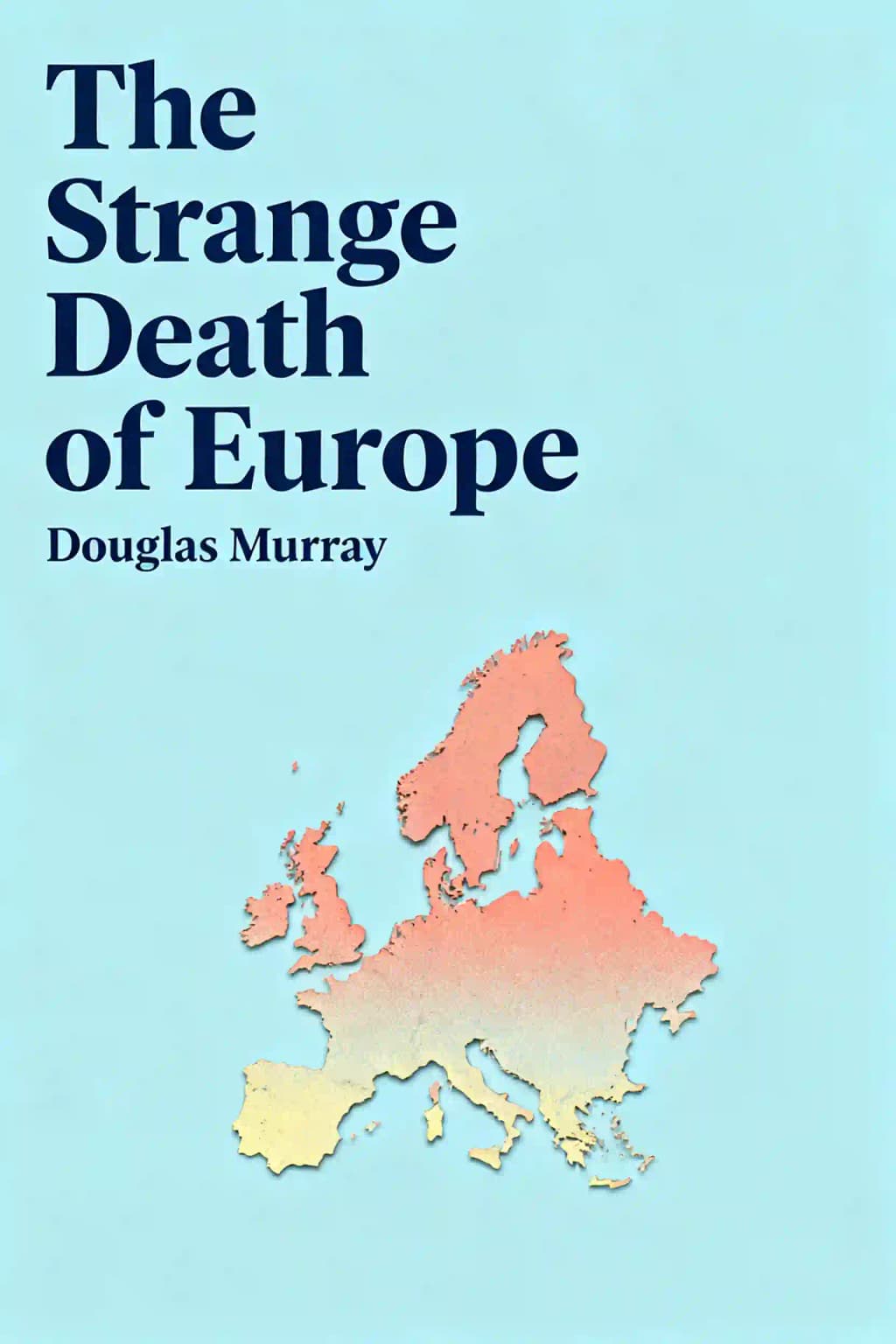
The Strange Death of Europe is not merely a book-it's a haunting prophecy unfolding in real time. Douglas Murray's controversial masterpiece has become required reading for political leaders across the Western world since its 2017 publication, with figures ranging from Viktor Orban to Jordan Peterson citing its influence. The book struck such a nerve that Murray required security protection after its release, yet it has sold over a million copies worldwide. What makes this work so powerful is its unflinching examination of two simultaneous forces: mass migration transforming Europe's demographics, and Europe's loss of faith in its own beliefs, traditions, and legitimacy. As Europe faces what Murray calls "civilizational exhaustion," his book asks the most uncomfortable question of our time: Can a civilization survive when it has lost faith in itself?
Kapitel 2
The Demographic Revolution No One Expected
In 2002, the census for England and Wales revealed a demographic transformation that would have been dismissed as alarmist fantasy just a decade earlier. Anyone in the 1990s who predicted that white Britons would become a minority in London within a decade would have been condemned as a racist fearmonger. Yet by the 2011 census, this had become reality-only 44.9% of London residents identified as "white British," and three million people lived in households where no adult spoke English as their primary language.
This transformation wasn't limited to Britain. Across Western Europe, similar patterns emerged after World War II. Countries instituted "guest-worker" schemes to fill labor shortages, drawing primarily from Turkey, North Africa, and former colonies. Germany's Turkish labor agreement of 1961 led to a massive influx, while France drew from North Africa under a partial sense of colonial obligation.
European authorities universally misunderstood the permanence of this migration. They expected temporary workers who would eventually return home. Instead, these workers established roots, brought families requiring assistance and education, and remained permanently attracted by Western living standards. Even when formal guest-worker arrangements ended (like Germany-Turkey in 1973), migration continued unabated, resulting in communities like Germany's four million Turkish-origin residents by 2010.
Throughout this period, politicians across the political spectrum talked tough on immigration control while failing to deliver. When Britain's Enoch Powell warned in his infamous 1968 "Rivers of Blood" speech that the country was "heaping up its own funeral pyre" through immigration, he was immediately sacked from the Conservative shadow cabinet. Yet polls showed around 75% of Britons agreed with his sentiments, revealing a profound disconnect between public opinion and political leadership.
What's striking now is how Powell's warnings, considered outrageous then, seem understated today. His mention of a street with only one white resident was dismissed as fabrication, yet Powell himself would have considered anyone predicting white Britons becoming a minority in London within a lifetime as a "maniac."
By the 1990s, Tony Blair's Labour government shattered the previous immigration consensus, opening borders on an unprecedented scale despite making no manifesto commitment to do so. Former Labour speechwriter Andrew Neather later claimed the government deliberately eased immigration rules to "rub the Right's nose in diversity" and create a Labour-loyal electorate.
The government catastrophically underestimated migration numbers. They predicted 13,000 annual arrivals from new EU countries; instead, Eastern Europeans in Britain rose from 170,000 in 2004 to 1.24 million by 2013. Their five-year predictions were off by nearly a million people. Despite this massive transformation, the British public remained remarkably tolerant, with no sustained outbreaks of racist violence, though polls showed deep concern about the country's future.
Kapitel 3
The Shifting Justifications for Mass Migration
Throughout the late twentieth and early twenty-first century, European governments pursued mass immigration policies without public consent, relying on shifting justifications ranging from economic benefits to cultural enrichment. These arguments became intertwined and mutually reinforcing-if immigration didn't make you richer, it would make you better; if it didn't improve your country culturally, it would strengthen it economically.
Despite claims that mass immigration brings economic benefits, the reality contradicts this narrative. UCL's own research reveals that while "recent migrants from the EEA between 2001 and 2011 had contributed around 22 billion into the UK economy," non-EEA migrants had actually taken out around 95 billion more in services than they paid in taxes. When all immigrants were included over the 1995-2011 period, they cost the United Kingdom between 114-159 billion.
Advocates of mass migration argue that Europe's "greying" population requires importing young people from abroad to support elderly Europeans. While European fertility rates have fallen below the 2.1 replacement level, this argument contains several fallacies. First, it wrongly assumes populations should always remain stable or grow, when many European countries are already densely populated. Second, evidence shows Europeans want children but face economic barriers. Rather than importing populations from elsewhere, governments could implement policies encouraging native procreation, as Poland has done by raising child benefits.
Importing migrants creates a pyramid scheme problem-immigrants also age and require support, necessitating ever-larger waves of immigration. Chancellor Merkel acknowledged Europe's challenge in 2012: with 7% of world population producing 25% of global GDP while financing 50% of global social spending, Europe must work hard to maintain its prosperity.
When economic arguments falter, advocates pivot to cultural benefits, suggesting Europe's "boring" societies need enrichment from outside cultures. While there's some truth to cultural exchange benefits, this argument contains fallacies. First, it assumes the best way to learn about other cultures is not through travel but by having others permanently relocate to your country. Second, it wrongly suggests cultural enrichment increases proportionally with migrant numbers-yet the enjoyment of Turkish food doesn't multiply with each additional Turkish immigrant.
Behind the "diversity" rhetoric lies a more radical ideology. Sarah Spencer, who co-authored New Labour's 2000 migration document, had previously argued that immigration policy should be seen as "a means of enriching cultural diversity" and proposed "integration" as a "two-way process of adaptation by migrant and host society"-a concept less palatable to the public than simple economic benefits.
The final justification is the fatalistic claim that nothing can be done anyway-it's simply our fate. Yet this "inevitability" argument collapses when examining countries like Japan and China. Despite being the world's third-largest economy, Japan avoids mass immigration through strict policies that discourage settlement. People flock to Europe not just for wealth, but because Europe has made itself desirable through generous welfare states, tolerance, and the likelihood of being allowed to stay.
Kapitel 4
The Mediterranean Crisis and Merkel's Fateful Decision
The tiny island of Lampedusa sits closer to North Africa than to Sicily, with a landscape more reminiscent of Tunisia or Libya than Italy. Throughout the 2000s, it became a primary entry point for migrants fleeing North Africa, the Middle East, and beyond. The short sea crossing made it an attractive route for smugglers charging desperate people high prices.
After the 2011 Arab Spring, Lampedusa's migrant trickle became a flood. The collapse of agreements with North African dictators and widespread civil unrest sent hundreds, sometimes thousands of people arriving daily on rickety vessels. Demographics revealed telling patterns: roughly 80% were young men, with some unaccompanied minors and occasional women.
In response to a 2013 tragedy where over 300 migrants drowned, Italy launched "Mare Nostrum" ("Our Sea"), deploying navy frigates and helicopters to patrol the waters around Lampedusa. The operation cost Italy nine million euros monthly and undoubtedly saved many lives, but created perverse incentives. Smugglers no longer needed seaworthy vessels-they simply launched boats knowing the Italian navy would intercept them.
Everything changed in 2015, not because of new developments in the Middle East or Africa, but because of Germany's response. By August 2015, Germany had revised expected arrivals to 800,000 and stopped enforcing Dublin procedures for Syrians. Chancellor Merkel declared "German flexibility is needed" and that "Europe fails on the question of refugees, its close connection with universal civil rights will be destroyed." Her rallying cry "Wir schaffen das" ("We can do this") opened Europe's doors.
The migration crisis took on a human face when the drowning of three-year-old Aylan Kurdi, whose body washed up on a Turkish beach, transformed the debate. His photograph dampened opposition to Merkel's policy as newspapers and celebrities rallied behind the "Refugees Welcome" movement. Merkel announced "no limit" on migrants Germany would accept, triggering immediate migration surges as people recognized a rare opportunity for European citizenship.
The Greek islands, particularly Lesbos, bore the brunt of Europe's compassionate impulse. In Mytilene, the island's main port with a population of 30,000, migrants arrived at rates of 8,000 per day in 2015. By winter 2015-2016, the system began to collapse. With 20,000 refugees in Mytilene, far exceeding capacity at both the Moria and Kara Tepe centers, migrants set up tents across the city on roundabouts and sidewalks.
The March 2016 EU-Turkey deal, which provided Turkey six billion euros and visa-free travel for Turks in exchange for stemming migrant flows, reduced arrivals to a few hundred daily by summer 2016. Yet Turkish naval forces remained inconsistent in enforcement, stopping some boats while allowing others through.
Kapitel 5
The Failure of Multiculturalism
In her 2010 Potsdam speech, Merkel delivered the most damning mainstream assessment of European integration failures to date: "Of course, the approach to build a multicultural society and to live side-by-side and to enjoy each other has failed, utterly failed." She acknowledged Germany had "kidded ourselves" about guest workers, thinking "They won't stay," when reality proved otherwise.
Merkel's frank assessment opened floodgates across Europe. In February 2011, British Prime Minister David Cameron declared that under "state multiculturalism, we have encouraged different cultures to live separate lives" and "failed to provide a vision of society to which they feel they want to belong." Days later, French President Nicolas Sarkozy also pronounced multiculturalism a "failure."
Despite prolific debates following these declarations, the term "multiculturalism" remained notoriously slippery. For many, it simply meant pluralism or living in an ethnically diverse society. For others, it represented a vision of nations as melting pots where every culture contributes. The political leaders' criticisms targeted state-sponsored multiculturalism specifically-the policy of encouraging parallel lives and separate customs rather than shared societal norms.
By 2010, Europeans increasingly worried about parallel societies developing within their countries. Terrorist attacks involving European-born individuals gave these concerns their sharpest edge, but non-violent expressions of difference also provoked anxiety. When Dutch Justice Minister Piet Hein Donner suggested in 2006 that Muslims could democratically institute Sharia law if numerous enough, public outrage followed.
Beyond legal concerns, some Europeans felt their history itself was being negotiated away. When German President Christian Wulff implied that Islam was as much part of Germany's history as Christianity and Judaism, backlash erupted even within his own party. Many sensed that multicultural Europe was expected to surrender its traditions while newcomers sacrificed little of theirs.
Ironically, the only culture that couldn't be celebrated in multicultural Europe was European culture itself. Countries that had been open and liberal enough to allow large-scale migration found themselves portrayed as uniquely racist. As American philosopher Samuel Huntington observed, "Multiculturalism is in its essence anti-European civilisation. It is basically an anti-Western ideology."
The fear lurking in European consciousness is what French philosopher Renaud Camus calls "Le Grand Remplacement." Saint-Denis, once the royal necropolis holding the tomb of Charles Martel (who halted Islamic expansion into Europe in 732), now resembles North Africa more than France. Its market square has become a souk, 30% of residents are Muslim while only 15% remain Catholic, and Friday prayers spill onto streets. This pattern repeats across Europe-from northern England to Stockholm, immigrant neighborhoods bear no resemblance to native areas.
Kapitel 6
The Prophets Without Honor
In the early 2000s, gay American author Bruce Bawer began noticing that gay men in Europe's most liberal cities were increasingly being attacked by Muslim men. Having left America partly to escape Christian anti-gay rhetoric, Bawer found himself confronting Islamic clerics who advocated throwing homosexuals from tall buildings. Like Pim Fortuyn before him, Bawer questioned why liberal societies seemed more concerned about offending Muslims than protecting gay citizens.
The 2005 publication of Mohammed cartoons in Denmark's Jyllands-Posten newspaper became another flashpoint. The newspaper had commissioned the cartoons after learning that a Danish children's publisher couldn't find any artist willing to illustrate a book about Islam. Testing this taboo triggered riots and embassy burnings across the Muslim world, while protests in Europe featured signs reading "Freedom go to hell," "7/7 is on its way," and "Behead those who insult Islam."
This pattern of threats and violence over perceived blasphemy became the new normal across Europe. In Norway, the editor of a Christian paper who reprinted the cartoons was threatened with prosecution by Prime Minister Jens Stoltenberg. Swedish artist Lars Vilks faced multiple assassination attempts after drawing Mohammed. Charlie Hebdo's offices were firebombed in 2011 after reprinting the Danish cartoons, and in 2015 terrorists massacred most of their editorial team.
Throughout this period, European politicians and media refused to acknowledge the underlying issues. After terrorist attacks, politicians like British Home Secretary Jacqui Smith insisted on calling such events "anti-Islamic activity" rather than "Islamic terrorism." After the brutal murder of Lee Rigby by two Koran-quoting converts, Prime Minister David Cameron declared it "a betrayal of Islam," while newspapers claimed the attack was "literally senseless" despite the killers' clear religious motivations.
Many immigrants followed Turkish President Erdogan's advice that "assimilation is a crime against humanity," creating ethnic enclaves across European cities where life continued much as it would in their countries of origin.
Kapitel 7
The Tyranny of European Guilt
When three-year-old Syrian boy Aylan Kurdi's body washed up on a Turkish beach in September 2015, Europe and North America responded with overwhelming guilt and shame. This collective guilt overshadowed practical questions about what could have been done for the Kurdi family or the countless others seeking to enter Europe. Important facts were ignored: the family had departed from Turkey, a safe country where the father had employment, specifically to reach Europe.
Europeans suffer from a profound sense of historical guilt that extends beyond war guilt and Holocaust guilt to include colonialism and racism. This burden has spread to other nations with European origins, particularly Australia, where colonialism has become the nation's founding sin.
The double standard of historical guilt becomes evident when examining how Turkey faces no consequences for its actions while European nations are expected to atone through mass migration. If migration is punishment for imperialism, why aren't countries like Turkey, Saudi Arabia, or Iran forced to accept diversity? This selective application reveals an anti-European bias.
Historical guilt implies a hereditary stain passing between generations-a concept modern society generally finds repugnant, except when applied to Europeans. As Pascal Bruckner notes in "La Tyrannie de la penitence," guilt has become a moral intoxicant in Western Europe that people imbibe because it transforms them from nobodies into self-appointed representatives of history.
Europeans uniquely judge themselves by their lowest moments while judging others by their highest achievements. While Europeans discuss the Spanish Inquisition, others highlight Andalusia. This psychological and political affliction may not be permanent-future generations might eventually reject this hereditary guilt.
Kapitel 8
Learning to Live with Terrorism and Sexual Violence
The summer of 2016 brought an almost daily series of attacks across Europe. Following the Nice truck attack that killed 86 people, a 17-year-old asylum seeker attacked train passengers with an axe in Bavaria, a Moroccan-born man stabbed a woman and her daughters near Montpellier for "dressing immodestly," an Iranian-German teenager killed nine people in Munich, a Syrian asylum seeker killed a pregnant woman with a machete in Stuttgart, another Syrian asylum seeker detonated a bomb outside a wine bar in Ansbach, and two men shouting ISIS slogans murdered Father Jacques Hamel during Mass in Rouen.
Beyond terrorism, Europe confronted another unmentionable crisis: sexual assaults by immigrant men against local women. Throughout the 2000s, authorities across Europe avoided addressing this phenomenon for fear of appearing racist. Even mentioning that most new arrivals were young men or questioning their attitudes toward women invited accusations of racism.
Only when mass assaults occurred on New Year's Eve 2015 in Cologne, where approximately 2,000 men sexually assaulted around 1,200 women, did the issue become impossible to ignore-though police initially concealed the perpetrators' identities until video evidence emerged showing they were of North African and Middle Eastern origin.
Throughout 2016, sexual assaults spread to all sixteen German federal states with daily attacks, most perpetrators never caught. Officials systematically suppressed crime data involving migrant suspects, pressured by "anti-racism" groups to remove racial identifiers from suspect descriptions.
Remarkably, some victims concealed their attackers' identities. A 24-year-old rape victim in Mannheim initially claimed her attackers were German, later admitting she lied to avoid fueling "aggressive racism." In an open letter to her attackers, she apologized, writing that they weren't the problem-society's racism was.
Kapitel 9
Europe's Civilizational Exhaustion
Europe suffers from a profound exhaustion that Germans call Geschichtsmude-"weary of history." This tiredness comes from the weight of Europe's layered past, which feels inescapable, as if historical traumas could resurface at any moment. This exhaustion isn't merely individual but societal. As Oswald Spengler argued in his pessimistic Decline of the West, civilizations follow life cycles, and Western civilization appears to be in its decaying phase.
Europe's lost faith leaves us living among the physical, moral and imaginative debris of Christianity. While cathedrals like Notre-Dame and Westminster Abbey still dominate their landscapes, they've become tourist attractions rather than places of pilgrimage, their deeper meaning lost. As theologian Don Cupitt observed, "Nobody in the West can be wholly non-Christian. You may call yourself non-Christian, but the dreams you dream are still Christian dreams."
This creates profound uncertainty about the foundations of "European values." The post-war human rights culture appears to be an attempt to implement a secular version of Christian conscience, but remains unstable without secure moorings. As human rights language grows ever grander, its inability to fulfill its aspirations becomes increasingly apparent.
After the Soviet Union's collapse, French philosopher Chantal Delsol offered the perfect metaphor for modern Europeans: we are like Icarus having survived the fall. We repeatedly tried reaching the sun, flew too close, and crashed back to earth. Though dazed, we somehow survived, surrounded by the wreckage of our failed dreams, religions, and political ideologies. With no illusions or ambitions left, what remains for us?
Perhaps we avoid discussing existential questions because we no longer believe in the answers, or find the underlying nihilism embarrassing. But with the arrival of large numbers of people with wholly different attitudes toward life's purpose, these questions demand urgent attention-nature abhors a vacuum. Politicians occasionally acknowledge these bubbling fears, but often with exhausted fatalism. Belgian Justice Minister Koen Geens told the European Parliament that Muslims would "very soon" outnumber Christians in Europe, while his colleague warned against making "an enemy of Islam."
The question posed by Ernst-Wolfgang Bockenforde in the 1960s remains: "Does the free, secularized state exist on the basis of normative presuppositions that it itself cannot guarantee?" If our freedoms arise from beliefs we've abandoned, what follows?
Kapitel 10
What Will Be
Rather than implementing effective solutions, Europe's politicians will likely continue their current course. Having shown little acknowledgment that mass immigration policies were regrettable, they lack both will and ability to reverse them. Every new migrant becomes harder to remove the longer they stay, and their children will naturally oppose immigration restrictions. Politicians willing to argue against this trend face not just career damage but physical danger, requiring constant police protection.
By mid-century, while China will still look like China and India like India, Western Europe will resemble a large-scale United Nations. This will have certain pleasures-cheap services, interesting conversations, cultural diversity-but it will no longer be Europe. European culture may survive in rural pockets where native Europeans retreat, while the wealthy maintain their lifestyle longer. Meanwhile, native Europeans will be told their traditions are oppressive even as they become minorities.
Europeans are discovering they'll become minorities in their own countries within the lifespan of people now alive. The Vienna Institute of Demography's confirmation that most Austrians under 15 will be Muslim by mid-century exemplifies this transformation. This occurred under the presumption that European cultures are somehow less equal than others, while claiming to promote "diversity" that becomes less diverse each year.
Ironically, the Muslims most threatened in Europe aren't radicals but those who embraced European liberal values. While Salafists, Khomeinists and Muslim Brotherhood leaders operate freely, progressive Muslims face persecution. Ayaan Hirsi Ali fled the Netherlands; Hamed Abdel-Samad lives under police protection in Germany; Maajid Nawaz faces threats in Britain; and Algerian writer Kamel Daoud was labeled "Islamophobic" by European intellectuals for addressing the Cologne sex attacks.
Immigration policies have transformed international politics into domestic concerns, paralyzing Europe's ability to act on the world stage. A leaked British Ministry of Defence report revealed that military intervention becomes increasingly impossible in an "increasingly multicultural Britain" where the government cannot gain public support for deploying troops in countries "from which UK citizens, or their families, come."
Michel Houellebecq emerges as our era's emblematic writer, chronicling both full-blown nihilism and suggesting what might follow it. His novel Submission, published the day of the Charlie Hebdo attacks, imagines France under Islamic rule by the 2020s after mainstream parties unite behind an Islamist party to prevent a National Front victory. The protagonist, a scholar of Huysmans (who converted to Catholicism), fails in his attempt to find Christian faith but ultimately considers converting to Islam for its practical benefits-wives, community, and comfort-in a society ripe for submission.
Houellebecq's genius lies in capturing a society tipping from over-ripeness into something else-but whether toward decadence and barbarism or salvation remains the question. For Europe, that question hangs in the balance, as a civilization that has lost faith in itself confronts forces that have not.