Journey into cybercrime's underbelly with Brian Krebs' explosive expose that spawned the "Krebs Cycle" - the gap between breach discovery and corporate admission. Security experts were shocked despite decades of experience. What dark secrets connect Russian pharma wars to your inbox?
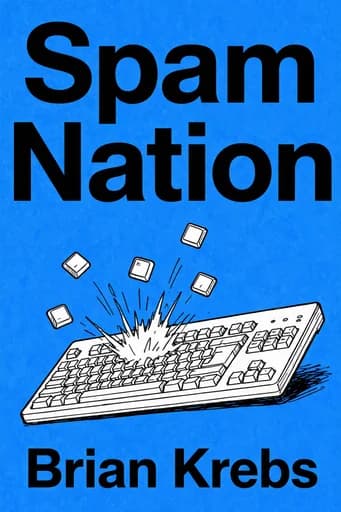
Brian Krebs, author of Spam Nation: The Inside Story of Cybercrime—From Global Epidemic to Your Front Door, is an award-winning investigative journalist and cybersecurity authority.
Born in Alabama in 1972, Krebs built his expertise through two decades of reporting on cybercrime, including a 14-year tenure at The Washington Post covering tech policy and security breaches.
His book, a cybersecurity and true crime exposé, delves into the shadowy networks of profit-driven hackers, informed by his groundbreaking investigations into high-profile breaches like the 2013 Target credit card hack.
Krebs’ acclaimed blog, KrebsOnSecurity.com, has become a cornerstone of cybersecurity journalism, blending technical depth with accessible analysis. A sought-after speaker for corporate and industry events, he translates complex cyber threats into actionable insights.
Spam Nation won the 2015 PROSE Award for excellence in professional/scholarly publishing, cementing Krebs’ reputation as a trusted voice in combating digital crime. His work has shaped global cybersecurity practices and revealed criminal networks operating across 121 countries.
Spam Nation exposes organized cybercrime networks behind global spam epidemics, focusing on Russian pharmaceutical spam empires like Rx-Promotion and GlavMed. Brian Krebs reveals how rival factions leaked internal data to sabotage each other, fueling the "Pharma Wars." The book also explores the rise of ransomware, corporate complicity in cybercrime, and actionable cybersecurity strategies.
Cybersecurity professionals, IT managers, and true-crime enthusiasts will gain insights into cybercrime economics and hacker psychology. While technical readers appreciate Krebs’ investigative depth, nontechnical audiences benefit from real-world examples like rogue pharmacy scams and ransomware tactics.
Yes – it combines investigative rigor with shocking revelations about cybercrime’s profitability and global impact. Krebs’ access to leaked Russian gang databases and firsthand interviews with key players like Pavel Vrublevsky makes it a seminal work on digital espionage.
The book centers on Rx-Promotion and GlavMed, rival Russian organizations that dominated pharmaceutical spam. Their internal feuds led to data leaks exposing money-laundering networks, bribed officials, and ties to ransomware operations like CryptoLocker.
Krebs used leaked emails, payment records, and hacker forum data to map spam empires. His reporting method – leveraging rival gangs’ hatred – uncovered botnet infrastructures, fake pharmacy supply chains, and payouts exceeding $150M annually.
Yes. Krebs traces ransomware’s evolution from 2000s pharmacy spam to today’s attacks, showing how gangs repurposed spam networks for malware distribution. Case studies detail ransomware’s profitability and corporate targets.
Some readers find the Russian cybercrime factions’ relationships overly complex without visual aids. However, Krebs offsets this with vivid storytelling about hacker sabotage and law enforcement challenges.
Unlike technical manuals, Spam Nation prioritizes narrative-driven exposés akin to Sandworm or This Is How They Tell Me the World Ends. It uniquely focuses on cybercrime’s business models rather than just technical exploits.
With ransomware attacks increasing 85% since 2023 (via CISA), Krebs’ insights into hacker collaboration and corporate vulnerabilities remain critical. The book’s lessons on threat intelligence and scam psychology help users navigate AI-driven phishing.
Healthcare and finance suffered heavily. Fake pharmacies sold counterfeit drugs, while banking trojans like Gozi siphoned $100M+ from accounts. Krebs also details spam’s role in enabling data breaches at major retailers.
Law enforcement dismantled key botnets (e.g., Rustock), while internal leaks caused infighting. Krebs notes many hackers shifted to ransomware as spam profits dwindled post-2013, marking the end of an era.
Erlebe das Buch durch die Stimme des Autors
Verwandle Wissen in fesselnde, beispielreiche Erkenntnisse
Erfasse Schlüsselideen blitzschnell für effektives Lernen
Genieße das Buch auf unterhaltsame und ansprechende Weise
These men weren't just mourning a colleague; they were the architects of a digital parasite.
The operation reportedly attracted 100,000 daily visitors and generated nearly $5 million monthly.
Tell Krebs 'Nice job on Atrivo,' but if he's thinking about doing McColo next, he's pushing his luck.
Global spam volumes instantly plummeted by 75% as millions of bots lost connection to their control servers.
Krebs realized Vrublevsky was feeding him information about other cybercriminals to divert attention from himself.
Zerlegen Sie die Kernideen von Spam Nation in leicht verständliche Punkte, um zu verstehen, wie innovative Teams kreieren, zusammenarbeiten und wachsen.
Erleben Sie Spam Nation durch lebhafte Erzählungen, die Innovationslektionen in unvergessliche und anwendbare Momente verwandeln.
Fragen Sie alles, wählen Sie Ihren Lernstil und gestalten Sie Erkenntnisse, die wirklich zu Ihnen passen.

Von Columbia University Alumni in San Francisco entwickelt
"Instead of endless scrolling, I just hit play on BeFreed. It saves me so much time."
"I never knew where to start with nonfiction—BeFreed’s book lists turned into podcasts gave me a clear path."
"Perfect balance between learning and entertainment. Finished ‘Thinking, Fast and Slow’ on my commute this week."
"Crazy how much I learned while walking the dog. BeFreed = small habits → big gains."
"Reading used to feel like a chore. Now it’s just part of my lifestyle."
"Feels effortless compared to reading. I’ve finished 6 books this month already."
"BeFreed turned my guilty doomscrolling into something that feels productive and inspiring."
"BeFreed turned my commute into learning time. 20-min podcasts are perfect for finishing books I never had time for."
"BeFreed replaced my podcast queue. Imagine Spotify for books — that’s it. 🙌"
"It is great for me to learn something from the book without reading it."
"The themed book list podcasts help me connect ideas across authors—like a guided audio journey."
"Makes me feel smarter every time before going to work"
Von Columbia University Alumni in San Francisco entwickelt

Erhalten Sie die Spam Nation-Zusammenfassung als kostenloses PDF oder EPUB. Drucken Sie es aus oder lesen Sie es jederzeit offline.
A navy blue BMW 760 and a Porsche Cayenne collide on a Moscow street. The driver of the BMW, 23-year-old Nikolai "Kolya" McColo, dies instantly. At his funeral, an unusual gathering forms-not grieving family members, but the world's most notorious spammers: Igor "Desp" Gusev, Dmitry "SaintD" Stupin, and Dmitry "Gugle" Nechvolod. These men weren't just colleagues; they were architects of a billion-dollar criminal empire hiding behind every "Viagra for cheap!" email you've ever deleted. What follows is the untold story of how spam became a global industry, how it nearly destroyed two former friends, and why the pills advertised in those annoying emails might contain uranium instead of medicine.
"Bulletproof hosting" networks-mostly in Russia and former Soviet states-charge ten times normal rates ($600-800 monthly) for one feature: they won't shut you down. The Russian Business Network pioneered this model with a fake "abuse team" requiring impossible-to-obtain Russian court orders-appearing legitimate while being untouchable. RBN's origins trace to Alexander Rubatsky, a 22-year-old who partnered with organized crime to create Alfa-Pay, processing payments for child pornography sites generating nearly $5 million monthly. When rivals launched cyber warfare, he pivoted to hosting, creating RBN under hacker Eugene "Flyman" Sergeenko. By 2007, RBN had become cybercrime's epicenter-until journalist Brian Krebs exposed them in the Washington Post, forcing providers to cut ties. Nearly a year later, Krebs targeted Atrivo, a California provider ignoring law enforcement. His reporting led to Atrivo's disconnection. Shortly after, Krebs received a warning about targeting McColo next. He ignored it. On November 11, 2008, armed with evidence showing McColo hosted servers controlling the world's top five spam botnets, Krebs contacted their internet partners. Within hours, McColo vanished. Global spam volumes instantly plummeted 75%.
Two days after Krebs exposed Pavel Vrublevsky-chairman of Russia's anti-spam working group-as running a pharmaceutical spam operation, he received threatening emails referencing his wife. Vrublevsky denied involvement and threatened a $100,000 defamation lawsuit. Then anonymous hackers sent Krebs massive leaks of ChronoPay's internal documents. The sheer volume proved authenticity-tens of thousands of emails, accounting records, and phone conversations detailing ChronoPay's involvement in rogue pharmacy and fake antivirus operations. Vrublevsky then began calling Krebs daily, claiming this helped evade surveillance. Despite his insults, he was disarmingly charming, constantly sharing anecdotes about power brokers and cybercriminals. After a month, Krebs realized Vrublevsky was feeding him information about other criminals to divert attention from himself. Meanwhile, an anonymous source called "Boris"-likely Igor Gusev, Vrublevsky's rival-sent massive troves of compromising ChronoPay data. Krebs found himself with gigabytes of internal data from two of the world's largest spam operations, caught in the "Pharma Wars"-a bitter feud between former partners that would ultimately destroy both empires.
Using leaked data from over a million customers, Krebs interviewed dozens of spam pharmacy buyers. The primary driver was affordability-Americans face the world's highest prescription drug prices, with brand-name drugs jumping 25% in 2012. Many sought discretion from embarrassment or to hide purchases from spouses, typically those self-treating venereal diseases or ordering impotence drugs. Some with medical knowledge bypassed doctor visits. Kimberly, a nurse struggling with fertility, ordered Clomid online rather than consulting a specialist. "Instead of having to pay a doctor tons of cash to explain something I already knew how to do, I opted to do it myself," she explained. Most concerning were customers purchasing controlled substances. Goran, a 41-year-old former POW with severe back injuries, spends $250-500 monthly on hydrocodone and tramadol after doctors stopped prescribing pain medication. Customers making more than five orders had an 80-85% chance of purchasing tramadol or Soma-pills worth $5 on the street but yielding $1,300 profit per bottle if resold. Painkillers and restricted drugs generated 48% of Rx-Promotion's revenue, suggesting abuse drove substantial demand.
Marcia Bergeron's 2006 death exposed spam pharmacy dangers. The 57-year-old ordered from what appeared to be a Canadian pharmacy, but her pills contained uranium and lead. She suffered hair loss, blurred vision, nausea, and extreme fatigue before dying just after Christmas. GlavMed marketed drugs as Canadian, but most shipped from unregulated facilities in India, China, and Pakistan. Studies show 8-10% of drugs imported to the US are counterfeit or substandard, fueling a $75 billion global market. UK resident Deborah G. was hospitalized after her GlavMed weight-loss pills - containing "poisons, cement, and talcum powder" - caused depression and stomach illness. Neither the FDA nor pharmaceutical companies comprehensively test rogue pharmacy drugs. Testing costs, constantly changing suppliers, and fear that results might show many "rogue" drugs are chemically similar to approved medications all deter investigation. With over 41,000 active online pharmacies and only 200 legitimate ones, consumers face a 99% chance of using an unapproved site with no objective safety data.
By October 2011, leaked SpamIt data exposed the world's top spammers through a Microsoft Excel spreadsheet revealing their real identities. "Software Seller" was Dmitry Nechvolod, operator of Cutwail-the largest spam botnet at the time. He earned over $175,000 promoting pharmacy sites while running a legitimate software firm. By 2008, Cutwail controlled 125,000 infected computers sending 16 billion spam messages daily. Another major player, using nicknames "Cosma," "Tarelka," and "Bird," earned over $3 million in three years. His Rustock botnet infected 150,000 PCs, sending 30 billion spam messages daily at its peak. He lived lavishly-once mentioning he'd been mugged by thugs targeting his $100,000+ Porsche Cayenne. SpamIt's second most successful affiliate, "GeRa," generated over 80,000 pharmaceutical sales, earning $2.7 million. Evidence suggests he masterminded the Grum botnet, capable of sending 18 billion emails daily before its 2012 takedown. These weren't shadowy criminals-they drove luxury cars and viewed themselves as legitimate entrepreneurs.
By summer 2008, SpamIt and GlavMed generated nearly $6 million monthly. Yet co-owner Igor "Desp" Gusev considered leaving cybercrime for legitimate work. During a Spanish vacation, his partner Dmitry Stupin reacted with frustration. Then urgent news arrived: Pavel Vrublevsky's partner had bribed police to investigate Gusev for money laundering. This sparked the "Pharma Wars"-a costly grudge match where each spent fortunes bribing officials to destroy the other. Gusev was thoughtful and frugal, a "golden boy" from wealth. Vrublevsky was vulgar, impulsive, and extravagant. Despite warnings, Gusev underestimated his former partner's resolve. By 2010, Gusev faced FSB investigation. He attempted to bribe officials by "sponsoring" Russia's Volleyball Federation for $500,000, hoping to leverage its head, former FSB director Nikolai Patrushev. As Gusev explained: "In Russia, sports is not really a business. It's a way of getting business settled." Gusev hired a lawyer promising to incarcerate Vrublevsky for $1.5 million. In summer 2010, thousands of ChronoPay emails leaked, exposing Vrublevsky's activities. Vrublevsky retaliated by paying a hacker to leak the SpamIt and GlavMed customer database to American authorities. Gusev fled Russia, launching a blog documenting Vrublevsky's past. The final blow came from researchers led by professor Stefan Savage, who mapped money-laundering networks through hundreds of "test buys." Visa's crackdown devastated the industry. One spammer lamented: "fucking Visa is burning us with napalm." In June 2011, Vrublevsky fled to the Maldives after learning Moscow prosecutors were preparing charges for a cyberattack on Aeroflot's systems. Russian authorities convinced him to return, then arrested him. Leaked chats revealed Gusev and Stupin had paid $1.5 million for the prosecution. Despite questionable evidence, all defendants were found guilty in July 2013. Vrublevsky received 2.5 years but was unexpectedly released in June 2014-possibly connected to Russia's need for a national payment system after Visa and MasterCard stopped servicing Russian banks following Ukraine sanctions. The spam empire collapsed not from law enforcement, but from greed and betrayal. Behind every spam email was a billion-dollar war zone where fortunes were made, lives destroyed, and two men proved that even in cybercrime's lawless world, betrayal remains the deadliest weapon.