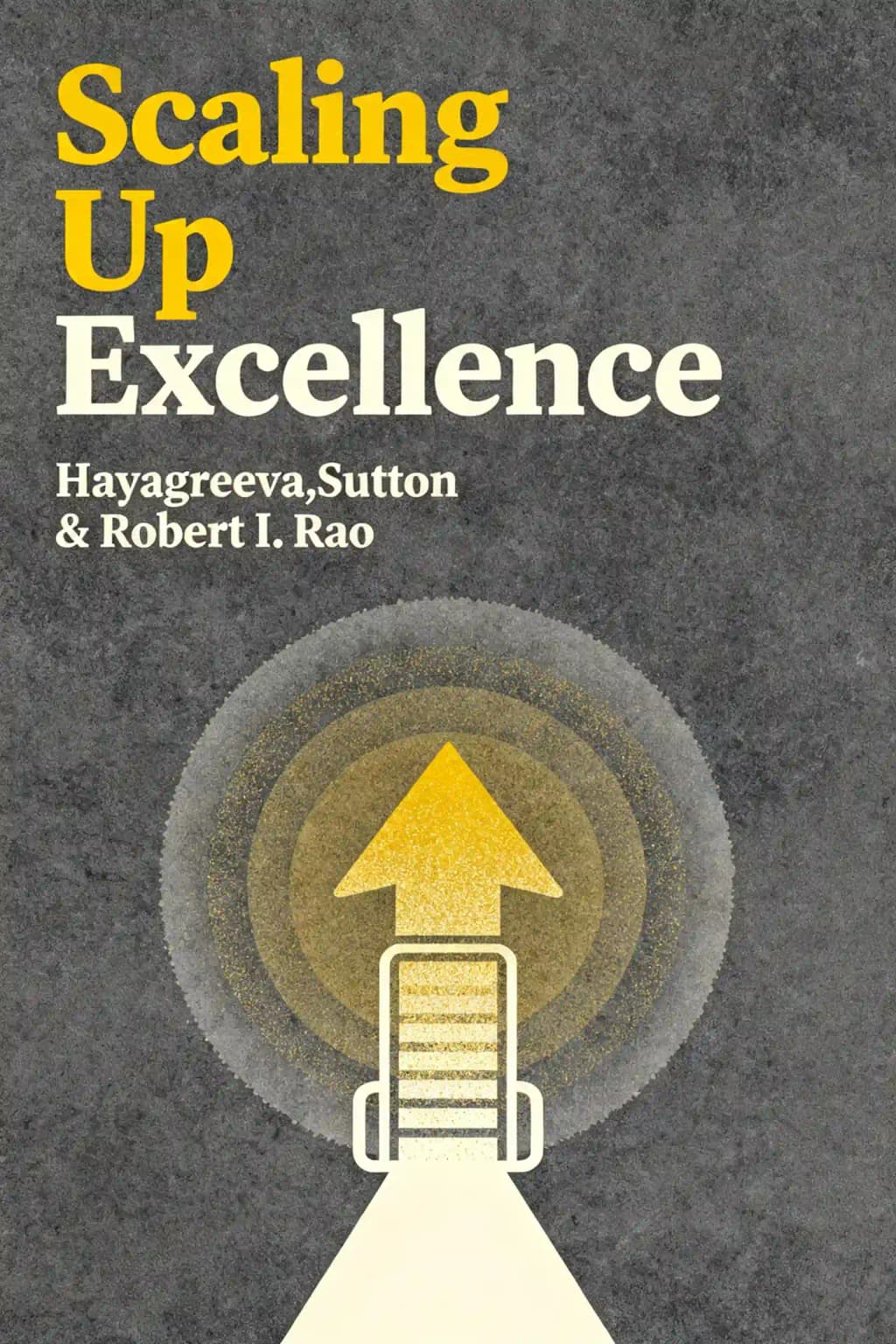
Scaling up Excellence
Getting to More Without Settling for Less
Überblick über Scaling up Excellence
Discover how Facebook, Google, and the U.S. Marines scale excellence without sacrificing quality. The first major business book on organizational growth reveals counterintuitive principles that transformed companies worldwide. Learn why scaling requires both addition and subtraction to achieve lasting success.

Kernthemen in Scaling up Excellence
- organizational growth
- behavioral change
- cultural replication
- operational excellence
- mindset shift
Zitate aus Scaling up Excellence
Scaling isn't just about getting bigger-it's about getting better.
Scaling excellence requires vigilance against complacency.
Excellence rarely vanishes all at once.
Successful scaling requires engaging all five senses.
Personen in Scaling up Excellence
- Robert SuttonAuthor and Stanford professor
- Huggy RaoAuthor and Stanford professor
- Claudia KotchkaLeader who scaled innovation at Procter & Gamble
- Andy PapaCoach who transformed NASCAR pit crew performance
Über den Autor
Über den Autor von Scaling up Excellence
Hayagreeva Rao and Robert I. Sutton are the Wall Street Journal bestselling authors of Scaling Up Excellence: Getting to More Without Settling for Less, recognized globally for their expertise in organizational behavior and leadership.
Rao, the Atholl McBean Professor of Organizational Behavior at Stanford Graduate School of Business, and Sutton, Stanford professor emeritus of management science and engineering, combine decades of research and consulting for Fortune 500 companies like Google and Pixar. Their book, a cornerstone in business strategy, tackles the challenge of spreading excellence across organizations while avoiding mediocrity—blending case studies from IKEA to the U.S. Marines with actionable frameworks like the “Buddhism vs. Catholicism” scaling continuum.
Their collaborative works, including the acclaimed The Friction Project (2024), establish them as pioneers in diagnosing systemic inefficiencies. Rao’s prior Market Rebels and Sutton’s The No Asshole Rule further cement their authority in leadership and innovation.
Scaling Up Excellence has been translated into 12 languages, featured in Financial Times’ and The Washington Post’s top business book lists, and adopted by executives and educators worldwide. The duo’s insights regularly appear in Harvard Business Review, Wall Street Journal, and keynote talks at global summits, reflecting their enduring impact on modern management practices.
Zusammenfassung von Scaling up Excellence herunterladen
Erhalten Sie die Scaling up Excellence-Zusammenfassung als kostenloses PDF oder EPUB. Drucken Sie es aus oder lesen Sie es jederzeit offline.
FAQ zu diesem Buch
Scaling Up Excellence by Robert I. Sutton and Huggy Rao explores how organizations can spread successful practices without compromising quality during growth. The book emphasizes balancing standardization with local adaptation, fostering shared mindsets, and eliminating barriers to excellence. Drawing on case studies from companies like Google, Facebook, and the U.S. Marines, it provides actionable strategies for leaders navigating the challenges of scaling.
Executives, managers, and entrepreneurs seeking to expand their organizations effectively will benefit from this book. It’s also valuable for nonprofit leaders, educators, and teams handling organizational change. The principles apply to startups scaling rapidly and established companies aiming to revitalize processes.
Yes—this book combines rigorous research with practical examples, offering a roadmap for scaling without mediocrity. It’s praised for its actionable insights, such as the “Buddhism vs. Catholicism” framework and strategies for linking “hot causes to cool solutions.” Readers gain tools to cascade excellence while avoiding common growth pitfalls.
This metaphor contrasts customizable scaling (“Buddhism”—adapting to local needs) with standardized replication (“Catholicism”—uniform practices). The authors argue that effective scaling requires balancing both: preserving core principles while allowing flexibility. For example, IKEA maintains consistent branding globally but tailors store layouts to regional preferences.
It highlights the “problem of more” (expanding reach) and the “problem of better” (improving quality). Key solutions include fostering accountability through shared ownership (“I own the place, the place owns me”), pruning destructive habits, and using “premortems” to anticipate risks. The Girl Scouts and Bridge International Academies exemplify scaling while enhancing standards.
- Link hot causes to cool solutions: Pair urgent goals with practical tools (e.g., Salesforce’s gamified training).
- Be a “poet and plumber”: Inspire teams while addressing logistical details.
- Reduce “cognitive load”: Simplify processes to avoid overwhelming employees.
- Leverage “credible transporters”: Use respected insiders to spread best practices.
Unlike generic leadership guides, this book focuses specifically on scaling challenges through real-world examples. It complements works like Good to Great by addressing how to sustain excellence during expansion, not just achieve it initially.
Case studies include:
- Facebook: Scaling transparency via “hackathons” and open communication.
- Johns Hopkins Hospital: Reducing infection rates through checklist adoption.
- JetBlue: Maintaining customer service standards during rapid growth.
- Rocketship Charter Schools: Replicating educational success across locations.
Some note that smaller organizations may struggle to apply certain strategies without ample resources. Others argue the book prioritizes mindset over measurable metrics. However, its principles remain adaptable to diverse contexts.
Yes—the Girl Scouts and Bridge International Academies show how nonprofits scale impact. The book advises tailoring approaches to mission-driven contexts, such as using “hot causes” to rally volunteers or replicating successful programs across regions.
With remote work and global teams now commonplace, its lessons on balancing consistency with flexibility are critical. The focus on reducing complexity and fostering accountability aligns with modern challenges like hybrid collaboration and AI-driven scaling.
The authors recommend “subtracting” obstructive practices, engaging skeptics through peer influence, and using storytelling to align teams. For example, Wyeth Pharmaceuticals phased out outdated rituals hindering drug development.