Kapitel 1
Beyond the Infinite: Ringworld's Engineering Marvel
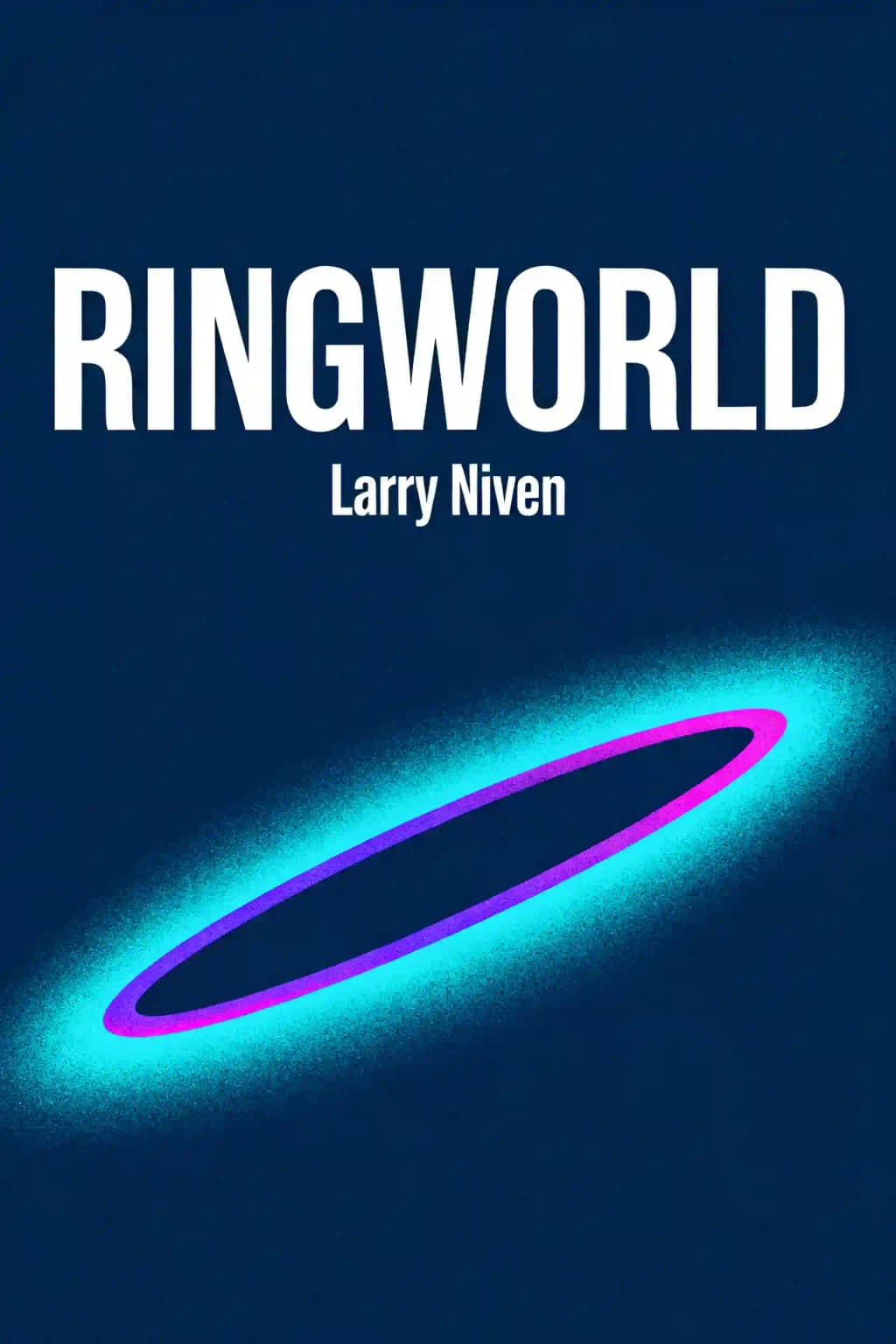
Larry Niven's "Ringworld" has captivated readers since its 1970 debut, winning both the Hugo and Nebula awards and establishing itself as one of science fiction's most influential works. The novel's central concept-an artificial habitat encircling a star-has inspired countless works across media, from Halo's ringworlds to Iain M. Banks' Orbitals. Even Elon Musk has cited the book as inspiration for his vision of space habitation. What makes this work so enduring is how it balances mind-bending engineering concepts with deeply human (and alien) characters navigating a universe where technology approaches magic but human nature remains unchanged. As we explore this masterpiece of hard science fiction, prepare to journey through a construct that makes our most ambitious megastructures look like children's toys-a ring around a sun where the horizon doesn't curve down, but up.
Kapitel 2
The 200-Year-Old Explorer
Louis Wu celebrates his 200th birthday by hopping through transfer booths across Earth, chasing the sunset from Beirut to Budapest to Munich. Despite his artificially whitened queue, chrome yellow skin, and royal blue robe adorned with a golden dragon, age sags his face when his smile fades. After two centuries of life, Louis finds himself profoundly bored with Earth's homogenized culture-a planet where transfer booths have erased all meaningful cultural distinctions, leaving only "mere flatlanders" speaking the universal language of Interworld.
This ennui is precisely why Louis proves receptive when he unexpectedly materializes in a hotel room facing a three-legged, two-headed alien-a Pierson's puppeteer, a species long thought to have fled human space. The puppeteer, speaking with an incongruously seductive voice, reveals it manipulated the transfer booth network specifically to find Louis. The alien explains that its species fled toward the Magellanic Clouds to escape radiation from the galactic core explosion, though some remained behind.
The puppeteer, who calls himself Nessus, shows Louis a hologram of what appears to be a star encircled by a blue hoop. Without explaining what this structure is, he proposes forming a four-member exploration team for a mysterious mission. The offer intrigues Louis, who has taken multiple "sabbaticals" from civilization throughout his extended lifespan. The prospect of exploring something genuinely new-something beyond the homogenized worlds of human space-appeals to his adventurer's spirit.
What makes Louis such a compelling protagonist is how he embodies the paradox of extended human lifespans. He possesses the accumulated wisdom and experience of two centuries, yet this very longevity has led to a profound restlessness. How does one maintain curiosity and purpose when one has seemingly experienced everything? For Louis, the answer lies in the unknown-in venturing beyond the boundaries of known space to discover something that might reawaken his sense of wonder.
Kapitel 3
A Crew of Calculated Diversity
In Louis's office, protected by bugproofing technology, an unlikely team assembles: Louis Wu, the 200-year-old human explorer; Nessus, the seemingly cowardly but manipulative puppeteer; and Speaker-To-Animals, a massive orange-furred kzin whose species once waged devastating wars against humanity. As Speaker requests hot bourbon and Nessus sips vegetable juice, Louis reflects on the violent history between humans and kzinti-six brutal wars that cost the aggressive feline species two-thirds of their male population each time.
Nessus explains why a puppeteer would recruit a kzin for protection: his species once considered exterminating the kzinti but instead observed their rapid evolution through natural selection. With each war, only the more cautious kzinti survived, gradually producing a more intelligent, restrained species. Speaker-To-Animals represents this evolved kzinti intelligence-still dangerous but capable of controlling his predatory instincts.
The final team member arrives unexpectedly. While resting his head in the lap of twenty-year-old Teela Brown at his birthday party, Louis discovers Nessus has been searching for her specifically. Despite Louis's protests that she lacks experience as an explorer, Nessus reveals his startling criterion: Teela is descended from five generations of Birthright Lottery winners. The puppeteers believe Earth may be breeding for luck through these lotteries, which award extra birthrights to winners.
"Luck isn't a genetic trait," Louis objects, but Nessus remains adamant. When Teela initially refuses to join this "ridiculous" expedition, Louis argues she's too young and lacks the necessary restlessness for space exploration. Yet after spending more time with Louis and learning about the galactic core explosion that will eventually threaten all of Known Space, Teela reconsiders, driven by both curiosity and her growing feelings for Louis.
This diverse crew-a bored immortal human, a seemingly cowardly puppeteer, an aggressive kzin warrior, and a possibly "lucky" young woman-creates a perfect microcosm of the novel's larger themes. Each character represents different evolutionary strategies: human adaptability, puppeteer caution, kzinti aggression, and perhaps most intriguingly, the emergence of luck as an evolutionary trait. Their interactions highlight how different species might approach the same challenges from radically different perspectives, forcing each to reconsider their assumptions about intelligence, courage, and survival.
Kapitel 4
The Quantum Leap
The expedition team travels to Nereid, Neptune's moon, where the Outsiders-mysterious interstellar traders who deal in information-have established a base. These strange beings live on thermoelectricity generated by temperature differences, explaining their maze-like basking structures. Here waits their spacecraft-the Long Shot, an enormous transparent bubble over a thousand feet in diameter filled with hyperspace shunt machinery, featuring only two tiny rooms for the crew.
This vessel represents a quantum leap in technology-a quantum II hyperdrive ship that crosses a light year in just 75 seconds. Though mostly filled with drive machinery, leaving little cargo space, this revolutionary technology would earn Speaker-To-Animals a name from the Kzinti Patriarch if he could bring it back to his people. The temptation proves too great, and Speaker attempts to betray the team, only to be immobilized by Nessus using a tasp-a device that remotely stimulates the pleasure center of the brain.
"Repeated use would make you dependent on the sensation," Nessus explains, effectively threatening to enslave Speaker through addiction. The kzin, recognizing this danger, reluctantly agrees not to cause further trouble. With the crew dynamics tentatively stabilized, Louis pilots the Long Shot beyond the solar system's singularity and into hyperspace.
The journey proves uncomfortable and demanding. Unlike conventional hyperdrives, the quantum II version requires constant vigilance of the mass indicator. After about five and a half hours, Louis reaches the coordinates Nessus provided-not toward the Magellanic Clouds as originally claimed, but about two hundred light years directly outward from the galactic plane.
What awaits them defies astronomical possibility: five planetary bodies arranged in a perfect pentagon formation-a Kemplerer rosette, a theoretically stable but naturally impossible configuration. A puppeteer ship, windowless and painted shocking pink, maneuvers to rendezvous with the Long Shot. The truth begins to emerge: this is the puppeteer fleet, a civilization that moved its entire planetary system away from its sun to escape the waste heat of their advanced civilization.
This revelation showcases Niven's brilliance in conceptualizing how truly advanced civilizations might operate. Rather than simply building bigger ships or more powerful weapons, the puppeteers literally moved their planets, creating an artificial solar system that could travel between stars. It's a perfect example of how "Ringworld" explores the logical extremes of technological development-not just asking what we might build, but how our very concept of civilization might transform when engineering operates at stellar scales.
Kapitel 5
The Civilization That Moved Its Sun
Aboard the puppeteer ship-a single-room vessel with curved walls, varied crash couches, and artificial gravity-Nessus reveals the astonishing history of his species. Half a trillion puppeteers half a million years ago faced extinction from their civilization's waste heat. With no effective population control beyond abstinence or surgery, they purchased an Outsider reactionless drive and moved their homeworld away from their sun.
As their population reached a trillion, they abandoned their sun entirely, placing their world and four agricultural planets in a Kemplerer rosette formation-a theoretically stable arrangement where five worlds orbit each other in a perfect pentagon. When their original sun expanded into a red giant while humans were still primitive, they added artificial lighting to their farming worlds.
"This explains why humans never found the puppeteer homeworld," Louis realizes. "We were searching near the wrong types of stars."
The puppeteers' migration demonstrates a civilization thinking in geological timeframes. They didn't merely react to immediate threats but anticipated problems millennia in advance. When their astronomers detected the explosion in the galactic core 20,000 years before its radiation would reach Known Space, they immediately began their exodus toward intergalactic space.
As they land on the puppeteer world, Louis and his companions follow a floating blue light through a park filled with the spicy-chemical smell of puppeteers. Inside a pearly dome, they meet a projected image of a silver-maned puppeteer called Chiron who finally reveals the true purpose of their mission: to investigate an artificial ring encircling a star-a structure of such immense proportions that it provides living space equivalent to three million Earths.
This is the Ringworld-a band ninety million miles in radius and nearly a million miles wide, rotating at 770 miles per second to create artificial gravity on its inner surface. Despite appearing delicate, it's approximately fifty feet thick with remarkable tensile strength. Most puzzling is its ability to stop 40% of neutrinos-something no known material can do.
The scale of the Ringworld exemplifies Niven's approach to "big idea" science fiction. Rather than merely extrapolating current technology, he imagines what might be possible with materials science and engineering principles pushed to their theoretical limits. The Ringworld isn't just bigger than a planet-it represents an entirely different approach to habitat construction, one that maximizes living space while minimizing resource requirements. It's the ultimate expression of efficiency in stellar engineering.
Kapitel 6
The Deadly Encounter
The team departs the puppeteer world aboard their new ship-a General Products #2 hull fitted into a triangular wing, christened the "Lying Bastard" in recognition of Nessus's manipulations. After a week in hyperdrive covering two light years, they drop into normal space within the Ringworld system. From the edge of the system, the Ringworld is already visible as a halo around the G2 star, growing more impressive as they approach.
The transparent General Products hull gives them an unobstructed view of space, with only the control panels, furniture, and private cabins appearing solid in the apparent emptiness. As they decelerate at nearly 200 gravities, the Ringworld becomes more visible-a checkered blue ribbon with a rim wall at least a thousand miles high that holds in the atmosphere. The wall appears sculptured like eroded rock, moon-colored against the blackness of space.
Despite hours of attempts to contact the Ringworld using radio, lasers, and even Morse code via fusion motors, they receive no response. The spaceport they discover at the rim appears abandoned, with two massive fusion-ramships sitting idle on a narrow ledge. As they approach closer to investigate, disaster strikes-the ship suddenly lights up like a flashbulb as it's struck by X-ray lasers, destroying everything outside the General Products hull: thrusters, fusion plants, landing gear, and all external equipment.
"We're under attack!" Speaker declares, taking command, but Louis realizes they've triggered automatic meteor defense systems programmed to destroy anything on a collision course with the Ringworld. With no propulsion remaining, they're now merely a glass needle falling toward the sun, their course still intercepting the ring. Nessus curls into a catatonic ball, unable to function in the face of certain death.
As they continue their helpless trajectory, they discover the shadow squares-enormous rectangular structures that orbit between the Ringworld and its sun, creating an artificial day-night cycle. When they pass between these structures, they encounter something extraordinary: a thin, writhing black thread outlined in violet-white light stretching from the sun past their ship. This thread-part of the shadow square system-proves impossibly strong, heat-resistant, and thin, slicing cleanly through steel with barely any resistance.
The encounter with the shadow square wire demonstrates how even seemingly minor components of the Ringworld's systems operate on principles beyond Known Space technology. What appears to be a simple day-night cycle mechanism utilizes materials with properties that would revolutionize engineering throughout human space. This reinforces a central theme of the novel: that truly advanced civilizations don't just build bigger versions of familiar technologies-they develop entirely new physical principles and materials that make their engineering seem like magic to less advanced species.
Kapitel 7
Crash Landing on an Impossible World
The Lying Bastard crashes onto the Ringworld's surface in a blinding flash of violet-white light, creating a massive furrow in the landscape. The ship comes to rest at an awkward angle, thirty-five degrees short of being completely upside down. Despite the violent landing, the crew survives thanks to the stasis field. They discover the surface beneath them is a strange, translucent gray material that's incredibly slippery and impervious to heat-even Speaker's laser leaves no mark on it. Louis identifies it as the ring's foundation material.
Exiting the ship to explore, they find themselves in a shallow gully with black lava slopes. Louis climbs to higher ground and discovers they've landed in a vast desert of white sand. Their ship has bounced multiple times, leaving a long trail of impact craters stretching toward the horizon. Unlike planetary worlds, the Ringworld has no curved horizon-land and sky merge at a distant vanishing point that mesmerizes Louis.
"It's not like a planetary horizon at all," Louis marvels. "The land just keeps going up and up until it vanishes in the distance."
In the distance stands an impossibly massive conical mountain, so large its peak might extend beyond the atmosphere. Despite searching in all directions, Louis sees no signs of civilization, concerning the crew who need technological help to repair their ship and escape the Ringworld.
The crew prepares their flycycles-compact vehicles with individualized saddles for each species-and rises into the air in diamond formation. As darkness falls suddenly from the shadow squares passing over the sun, they witness an extraordinary sight: an enormous arch taking shape against the darkening sky, revealing the true glory of the Ringworld overhead. The arch narrows as it rises, striped in baby blue swirled with white cloud and bands of near-black, cut at the zenith by the shadow squares.
This moment-when the crew first comprehends the true scale of the Ringworld-perfectly captures the sense of cosmic awe that defines the novel. The Ringworld isn't just big; it fundamentally alters one's perception of space itself. On a normal planet, the horizon curves downward, reinforcing our sense of being on a sphere. On the Ringworld, the horizon curves upward, creating the illusion of an infinite arch stretching across the sky. This visual inversion challenges not just the characters' but also the readers' fundamental assumptions about how worlds work.
Kapitel 8
The Human Mystery
As the expedition flies over the Ringworld's surface, they make a shocking discovery: the natives appear to be human. This raises profound questions about the relationship between Earth and the Ringworld. How could humans exist on a structure built by an obviously superior civilization? Were Earth humans transplanted to the Ringworld, or were Ringworld humans brought to Earth?
Their first contact with these humans goes disastrously wrong. Landing in a ruined city called "Zignamuclickclick," they encounter short, ghost-white humanoids with long fingers and uncut ash-blond hair and beards covering their faces. The spokesman, with a blue tattooed bird on his hand, believes Louis and his companions are the Ringworld engineers returning. When Louis demonstrates his flashlight-laser, the spokesman becomes outraged, declaring fighting with light is "forbidden." The confrontation turns violent, forcing the team to flee.
As they continue their journey, they discover more evidence of the Ringworld civilization's long decline. Vast areas of ring foundation material lie exposed where erosion has stripped away the surface. Cities lie in ruins, with once-floating buildings crashed to the ground after some catastrophic power failure. Most tellingly, they find no signs of advanced technology still in operation-the civilization that built this marvel appears to have collapsed.
Louis develops a theory: without transmutation technology, the Ringworld has no way to mine metals from its artificial structure. With only dirt above impenetrable foundation material, civilization fell and could never rise again. The implications are sobering-even the most impressive engineering feat in known space couldn't prevent societal collapse when key technologies failed.
This exploration of technological dependency and fragility gives "Ringworld" its philosophical depth. The novel doesn't just celebrate engineering achievements; it questions their sustainability. What happens when a civilization becomes so dependent on advanced technology that it can no longer maintain that technology? The Ringworld represents both the pinnacle of engineering achievement and a cautionary tale about civilizational fragility.
Kapitel 9
The Luck Factor
Throughout their journey, Teela Brown's supposed genetic luck manifests in increasingly undeniable ways. When her flycycle drops into a deadly atmospheric funnel, she loses consciousness from oxygen deprivation. Yet impossibly, her unconscious head hits the dashboard in exactly the right way to activate emergency thrust, shooting her flycycle out of the danger at four times the speed of sound.
This miraculous escape forces Louis to confront the reality of Teela's psychic luck. He realizes she has never truly experienced pain or danger-she walks clumsily because she never needed to learn coordination, having never fallen or hurt herself. Her luck has protected her so thoroughly that she lacks basic survival instincts.
"You've never been hurt," Louis tells her. "You've never learned caution. Your luck won't let you hurt yourself."
Later, when Teela disappears after their flycycles are captured by an electromagnetic trap in an abandoned city, Louis assumes the worst-that her luck has finally run out. He discovers her flycycle among the wreckage without crash balloons, leading him to believe she fell to her death. "Bad luck you met me," he laments.
But Teela reappears alive, accompanied by a muscular, heroic-looking man called Seeker-an ancient Ringworld inhabitant sustained by a boosterspice-like substance who has spent centuries on a quest to reach "the base of the Arch." Teela has fallen in love with him and plans to travel the Ringworld with him, teaching people as they go.
Louis realizes this is the work of Teela's luck, which has manipulated them all to bring her to this point where she could meet her perfect mate and learn about pain and fear-experiences she needs for personal growth. Her luck wasn't working for the expedition's benefit but for hers alone.
This exploration of luck as an evolutionary trait raises fascinating questions about determinism and free will. If Teela's genes predispose her to experience good fortune, is she truly making choices, or is she merely following a predetermined path? Does her luck represent a higher form of evolution or a limitation that prevents her from developing resilience through adversity? By personifying luck in Teela, Niven transforms an abstract concept into a concrete character study, allowing readers to examine how fortune shapes character from multiple perspectives.
Kapitel 10
Escape Through Impossibility
With their ship stranded on the wrong side of the thousand-mile-high rim wall, Louis and his companions must find another way off the Ringworld. Their salvation comes from an unexpected source: Halrloprillalar Hotrufan (Prill), a crewmember of the ramship Pioneer that traveled between five worlds and the Ringworld on a 24-year cycle before civilization collapsed.
Prill reveals the existence of the cziltang brone-a device that makes the Ringworld floor permeable. This technology could be their ticket home by allowing the Liar to sink through the floor and out the other side. However, finding a working cziltang brone proves impossible, forcing Louis to devise an alternative plan involving Fist-of-God mountain-the impossibly tall conical peak they spotted after landing.
Louis theorizes that Fist-of-God isn't a natural mountain but the result of a massive meteor impact from below. If they could reach its peak, they might find a hole through the Ringworld floor into open space. The challenge becomes how to ascend a thousand-mile-high mountain and then survive the fall through space on the other side.
The solution comes from the shadow square wire they encountered during their crash. After retrieving a section of this impossibly strong material, they attach one end to the Lying Bastard and the other to their captured floating building (the Improbable). As they ascend Fist-of-God using the Improbable's electromagnetic lifting power, the wire slides through the Liar until Prill closes the airlock on command, creating a connection between the two vessels.
When they reach the crater's jagged rim, they suddenly find themselves falling into a crater filled with stars-they've broken through the Ringworld floor into open space. Tethered to the Lying Bastard by the shadow square wire, they'll be pulled along as the ship accelerates to 770 miles per second, eventually matching the Ringworld's rotation and allowing them to escape.
This ingenious solution exemplifies how "Ringworld" combines hard science with creative problem-solving. The characters don't overcome challenges through convenient plot devices but by applying their understanding of physics and materials science to the unique properties of the Ringworld. The escape sequence brings together everything they've learned about the structure-its rotation speed, the properties of shadow square wire, and the nature of Fist-of-God mountain-into a solution that feels both surprising and inevitable.
Kapitel 11
The Universe Beyond
As they swing beneath the Ringworld, Louis reflects on how little of this vast structure they've actually explored. Despite their harrowing journey across thousands of miles, they've seen less than a fraction of a percent of the Ringworld's surface area. The enormity of what remains unknown haunts Louis-entire civilizations, ecosystems, and technologies they'll never encounter.
This sense of the universe's vastness-that even the most ambitious exploration barely scratches the surface of what exists-is perhaps "Ringworld's" most profound message. The novel presents a cosmos where engineering operates at scales that dwarf planetary thinking, where civilizations rise and fall over timeframes that make human history seem momentary, and where evolution itself might be manipulated by sufficiently advanced species.
Yet amid this cosmic perspective, the novel remains deeply human. Louis's boredom and restlessness, Teela's journey from naivety to experience, Speaker's struggle between aggression and reason, and Nessus's battle with fear all remind us that consciousness experiences the universe through personal emotions, regardless of scale.
As they depart the Ringworld, Louis carries with him knowledge that could transform human civilization-shadow square wire technology alone could revolutionize engineering throughout Known Space. More importantly, he carries a warning about technological dependency and the fragility of even the most impressive civilizations.
The Ringworld itself remains-a monument to what sentient beings can achieve and a reminder of how even the greatest works can fall to ruin when their creators lose the knowledge to maintain them. In this tension between achievement and impermanence, "Ringworld" finds its lasting resonance, challenging us to build wonders while remembering that all constructions, no matter how grand, require constant renewal to endure.