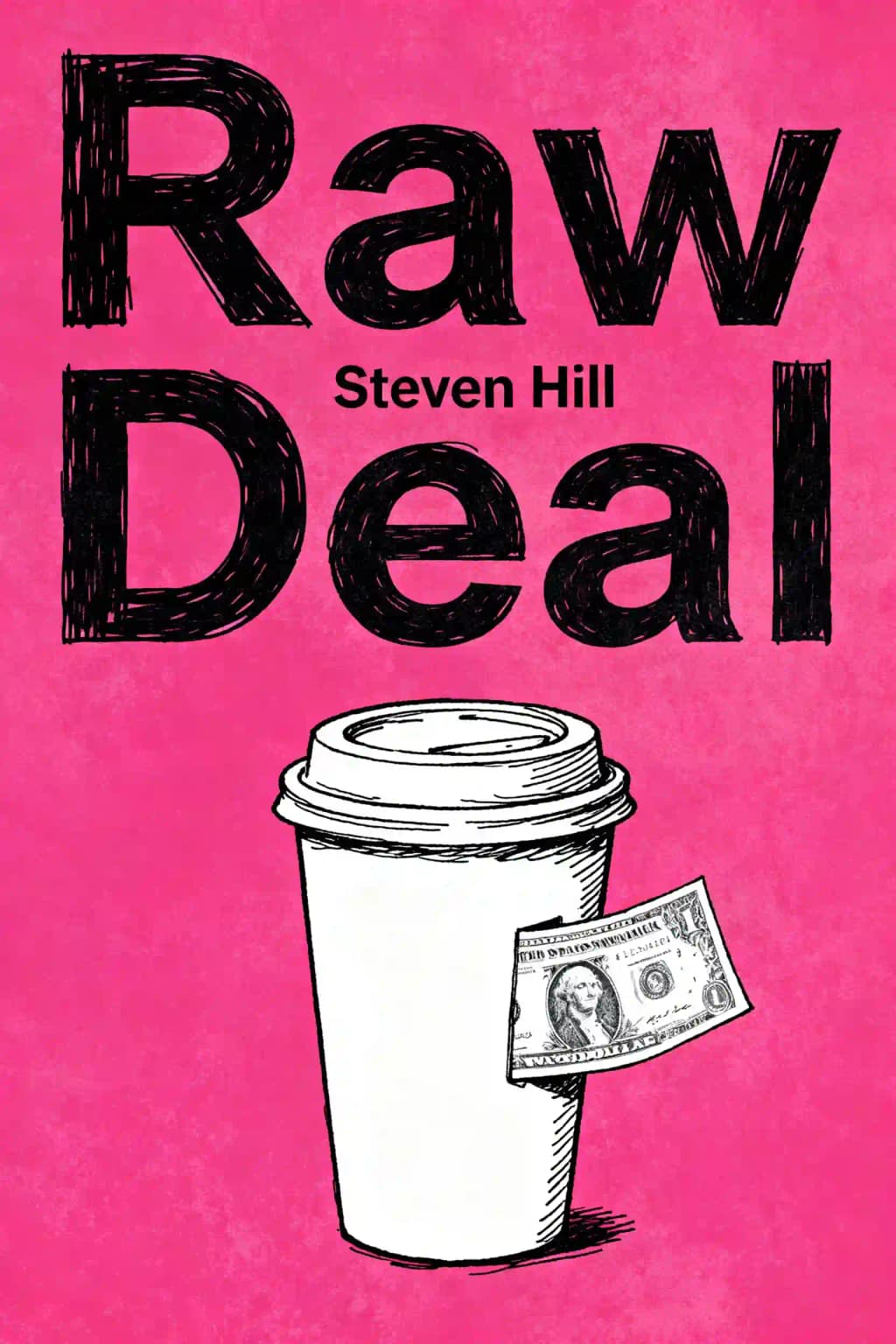
Raw Deal
How the Uber Economy and Runaway Capitalism Are Screwing American Workers
Überblick über Raw Deal
"Raw Deal" exposes how Uber and gig economy giants exploit American workers under the guise of innovation. Steven Hill's eye-opening 2015 analysis reveals shocking labor disparities between the US and other developed nations, sparking crucial debates about the future of work on national platforms like C-SPAN.

Kernthemen in Raw Deal
- gig economy exploitation
- vanishing employee benefits
- labor market deregulation
- precarious freelance work
- algorithmic management
Zitate aus Raw Deal
Companies now want a workforce they can switch on and off as needed.
His story represents the new reality where Americans must monetize anything of value to generate income.
A house is just a space, but a home is where you belong.
Personen in Raw Deal
- Steven HillAuthor and investigator of the gig economy
- Frederic LarsonFormer Pulitzer-finalist turned gig worker
- Jimmy MaerinaFacebook shuttle driver and union organizer
- Chris YoungPerma-temp worker at a Nissan manufacturing plant
- Maria FernandesWorker who held three jobs at Dunkin' Donuts
Über den Autor
Über den Autor von Raw Deal
Steven Hill, bestselling author of Raw Deal: How the “Uber Economy” and Runaway Capitalism Are Screwing American Workers, is a San Francisco-based journalist and policy expert with over two decades of experience analyzing labor markets, political reform, and socioeconomic trends.
A former policy director at the Center for Humane Technology and co-founder of FairVote, Hill combines investigative rigor with policy expertise to expose systemic inequities in the gig economy and modern capitalism. His work has been featured in the New York Times, Washington Post, Financial Times, and NPR, and he’s a frequent commentator on platforms like BBC and PBS.
Hill’s other acclaimed books include Europe’s Promise: Why the European Way Is the Best Hope in an Insecure Age and Expand Social Security Now: How to Ensure Americans Get the Retirement They Deserve, both of which explore alternatives to U.S. economic models. Raw Deal was named a Top Ten Book by The Globalist and has become a critical resource for debates on labor rights and corporate accountability.
Zusammenfassung von Raw Deal herunterladen
Erhalten Sie die Raw Deal-Zusammenfassung als kostenloses PDF oder EPUB. Drucken Sie es aus oder lesen Sie es jederzeit offline.
FAQ zu diesem Buch
Steven Hill’s Raw Deal critiques the gig economy’s exploitation of workers, arguing companies like Uber and Airbnb evade labor laws by classifying employees as independent contractors. The book highlights dwindling job security, eroded benefits, and corporate practices that prioritize profits over worker welfare, while proposing policies like universal healthcare and portable benefits to counter these trends.
This book is essential for policymakers, labor advocates, and anyone interested in economic inequality. Entrepreneurs in the gig economy, freelancers, and workers navigating precarious employment will gain insights into systemic issues and policy reforms needed to protect labor rights in a rapidly shifting job market.
Yes, particularly for its eye-opening analysis of how corporations like Merck and Nissan exploit legal loopholes to deny benefits. Hill blends data with real-world stories, making complex labor issues accessible. However, some critics note its occasionally polemic tone.
The 1099 Economy refers to freelancers and gig workers classified as independent contractors (via IRS Form 1099), denying them benefits like healthcare or paid leave. Hill argues this model shifts risk from corporations to workers, creating a “race to the bottom” in wages and job stability.
Uber is highlighted as a prime example of “runaway capitalism,” sidestepping labor laws by labeling drivers as contractors. Hill reveals how this practice avoids payroll taxes, insurance costs, and overtime pay, forcing workers to bear expenses while companies profit.
Hill advocates for a “New Deal 2.0,” including portable benefits tied to workers (not employers), a universal safety net, and stricter regulations to prevent worker misclassification. He cites Germany and South Korea as models with stronger labor protections.
The U.S. lags behind nations like Japan and Brazil, which mandate benefits for gig workers. Hill contrasts America’s fragmented safety net with Europe’s universal healthcare and paid leave, urging reforms to prevent a “freelance society” devoid of worker rights.
Merck, Nissan, and Airbnb are criticized for replacing full-time employees with contractors. For example, Merck sold a factory, rehiring workers as contractors without benefits—a tactic Hill calls “corporate arbitrage”.
Some reviewers argue Hill’s passionate tone overshadows nuanced analysis. However, his storytelling—highlighting individual worker struggles—balances statistical evidence, making the case relatable despite occasional polemics.
Hill warns that without policy intervention, the gig economy will erode middle-class stability. He emphasizes rebuilding labor unions and creating multi-employer benefit systems to adapt to flexible work arrangements while safeguarding worker dignity.
- “The sharing economy is the tip of the iceberg in a freelance society.”
- “Uber is a corporate minotaur, devouring labor standards.”
These lines underscore Hill’s critique of Silicon Valley’s disruption narrative and its human cost.
Unlike purely academic texts, Raw Deal combines investigative journalism with policy advocacy. It complements books like The Age of Acquiescence but stands out for its actionable solutions and global labor comparisons.





