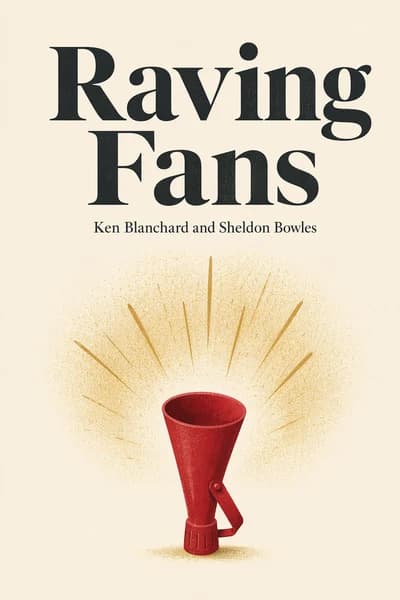
Raving fans
a revolutionary approach to customer service
Überblick über Raving fans
In "Raving Fans," Ken Blanchard reveals how exceeding expectations transforms customers into vocal advocates. With over 1 million copies sold, this 1993 classic sparked a service revolution across industries. Why do Amazon's top 25 bestselling authors all practice this counterintuitive approach to customer loyalty?

Kernthemen in Raving fans
- customer experience vision
- brand advocacy
- operational excellence
- word-of-mouth marketing
- customer retention strategy
Zitate aus Raving fans
Satisfaction is merely the baseline - the absolute minimum expected.
Exceptional service becomes the only meaningful differentiator.
Creating raving fans isn't just good business - it's survival.
Emotions drive loyalty far more than rational considerations.
Decide what you want. Not in vague terms like 'great service'.
Personen in Raving fans
- Ken BlanchardCo-author and business management expert
- Sheldon BowlesCo-author and entrepreneur
- SallyMarket owner used as a vision case study
Über den Autor
Über den Autor von Raving fans
Ken Blanchard and Sheldon Bowles, bestselling authors of Raving Fans!, are renowned leadership experts and pioneers in transformative management strategies.
Blanchard, coauthor of the iconic The One Minute Manager—a global phenomenon with over 28 million copies sold—has penned more than 70 books on leadership, teamwork, and organizational success. Bowles, an entrepreneur and president of Ode to Joy Limited, brings real-world business acumen to their collaborations.
Raving Fans!, a cornerstone in customer service literature, emphasizes creating obsessive customer loyalty through proactive engagement, reflecting Blanchard’s decades of corporate consultancy and Bowles’ operational leadership. Their partnership also produced Gung Ho! and Big Bucks!, which further explore performance-driven cultures and wealth-building principles.
Blanchard’s work as chairman of Blanchard Training and Development, Inc., and Bowles’ founding role at Domo Gasoline Corporation underscore their practical authority. Translated into 47 languages, their books, including Raving Fans!, have shaped leadership frameworks in Fortune 500 companies and business schools worldwide.
Zusammenfassung von Raving fans herunterladen
Erhalten Sie die Raving fans-Zusammenfassung als kostenloses PDF oder EPUB. Drucken Sie es aus oder lesen Sie es jederzeit offline.
FAQ zu diesem Buch
Raving Fans by Ken Blanchard and Sheldon Bowles outlines a 3-step framework to transform customers into passionate advocates by delivering unmatched service. The book argues that mere satisfaction isn’t enough—businesses must create "raving fans" who enthusiastically promote their brand through personalized, consistent, and visionary customer experiences.
Entrepreneurs, business leaders, and customer service professionals seeking to build loyalty and organic growth will benefit most. It’s ideal for those in competitive industries where standout service drives differentiation. Sales teams and small business owners aiming to reduce marketing costs through word-of-mouth will also gain actionable strategies.
Yes. Despite being published in 1993, its principles remain vital in today’s reputation-driven digital economy. The focus on systemic consistency, personalization, and exceeding expectations aligns with modern demands for AI-enhanced yet human-centric service.
- Vision: Define an ultra-clear service standard before interacting with customers.
- Listen: Continuously gather feedback to adapt to unspoken needs.
- Deliver+1: Consistently exceed promises with small, memorable extras (e.g., handwritten notes or surprise upgrades).
- “Satisfied customers aren’t enough—you need raving fans!” (core thesis)
- “Your customer is only satisfied because their expectations are so low”
- “Systems create service miracles, not smiles”
While Atomic Habits focuses on individual behavior change, Raving Fans targets organizational systems for customer loyalty. Both emphasize consistency, but Blanchard’s work prioritizes structured frameworks over incremental habit-building.
Some argue its fable format oversimplifies complex service challenges. Others note it undervalues cultural differences in global markets. However, most agree its core principles are adaptable to modern contexts like AI-driven personalization.
- Use chatbots for 24/7 query resolution (vision).
- Analyze reviews to identify unmet needs (listen).
- Include free samples with orders (deliver+1).
The “plus one” principle turns transactions into memorable experiences. Examples include complimentary shipping upgrades or birthday discounts—small gestures that cost little but cement loyalty and trigger word-of-mouth referrals.
It advocates training teams to internalize the service vision through role-playing and real-world simulations. Employees must understand why systems matter, not just follow scripts.
Proactive feedback loops are non-negotiable. The book recommends embedding surveys into post-purchase workflows and rewarding customers for critiques—turning detractors into improvement partners.
With hybrid teams, the book’s emphasis on systemic consistency (not individual charisma) ensures uniform service quality across digital and in-person channels. Automated workflows paired with human checks align with distributed team needs.





