Kapitel 1
When Penguins Face Climate Change: A Tale of Organizational Transformation
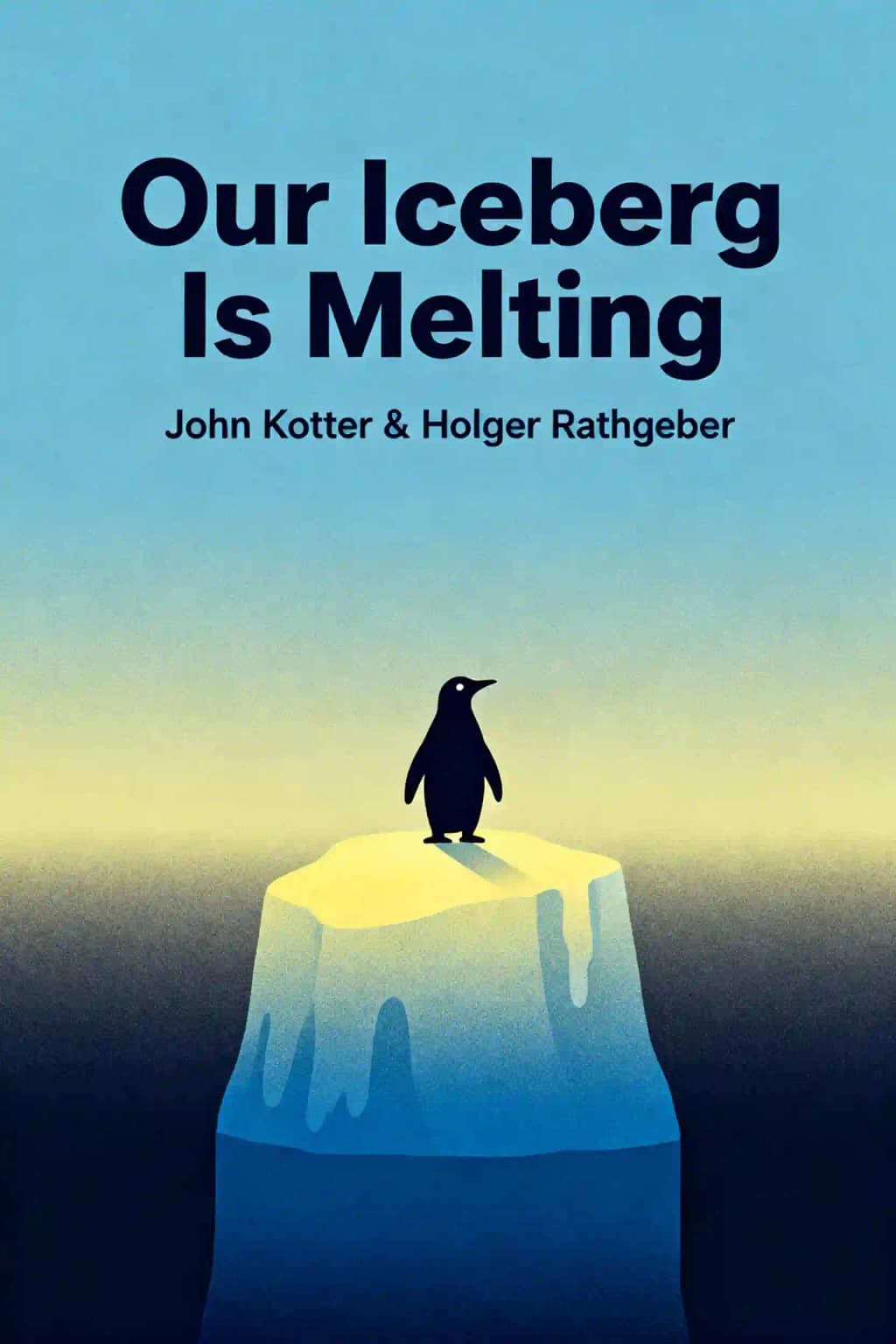
Have you ever felt like you're standing on thin ice, sensing danger but unsure how to convince others? This is precisely the dilemma at the heart of "Our Iceberg Is Melting," John Kotter's revolutionary business fable that has transformed how organizations approach change. Since its publication in 2006, this slim volume has become required reading in boardrooms worldwide, from Fortune 500 companies to government agencies. Even Oprah Winfrey featured it as one of her "Books That Help You Through Hard Times." What makes this simple story about penguins so powerful? Unlike traditional management texts, Kotter-Harvard Business School's leadership guru-disguises his renowned Eight-Step Change Process within an accessible fable that resonates emotionally while delivering profound insights. As Warren Buffett reportedly said after reading it, "Sometimes the simplest stories teach the most complex lessons."
Kapitel 2
The Colony's Comfortable Complacency
In the frigid waters near Cape Washington, Antarctica, 268 emperor penguins have made their home on an ancient iceberg. Their lives follow predictable patterns-hunting for fish, raising their young, and maintaining their close-knit community. The penguins believe their iceberg is eternal, protected by snow walls and surrounded by food-rich waters. Their society functions like a well-oiled machine, with a Leadership Council making decisions and colony members following long-established traditions.
Among these penguins is Fred, outwardly unremarkable but possessing unusual curiosity. While others focus solely on daily survival, Fred spends time observing their environment with keen attention. He studies the iceberg's structure, the surrounding waters, and subtle changes others ignore. This natural inquisitiveness makes Fred uniquely positioned to notice what others miss.
The colony's stability creates a dangerous complacency. They've survived in harsh conditions for generations by relying on each other and their established ways. Their success reinforces the belief that their current approach will always work. This mindset-that past success guarantees future prosperity-is precisely what makes organizations vulnerable. They become blind to emerging threats and resistant to new ideas.
This comfortable complacency mirrors what happens in many organizations. Success breeds confidence, confidence becomes certainty, and certainty calcifies into rigid thinking. Companies like Kodak, Blockbuster, and Nokia all stood atop their respective icebergs, believing their foundations were solid-until they weren't. Their stories remind us that even the most seemingly stable environments can undergo dramatic, unexpected change.
What makes Fred's perspective valuable isn't superior intelligence or special training, but simply his willingness to look where others don't. How many potential "Freds" exist in organizations today, noticing warning signs but hesitating to speak up? And how many leaders create environments where such observations are welcomed rather than dismissed?
Kapitel 3
The Uncomfortable Discovery
During one of his underwater explorations, Fred notices something alarming: their iceberg is melting from within. He discovers fissures and deterioration beneath the surface, along with water-filled caves inside the iceberg. With his rudimentary understanding of physics, Fred realizes these water-filled cavities could freeze during winter, expand, and potentially shatter their home-a catastrophic scenario for the colony, especially during the harsh Antarctic winter.
Fred's discovery creates an excruciating personal dilemma. He remembers how another penguin named Harold was subtly ostracized after raising similar concerns years earlier. The colony had labeled Harold an alarmist, and he eventually became an outcast. Fred fears the same fate. He has no authority as a leader and no established credibility for making such predictions. Yet his growing alarm compels him to act despite his fears.
This internal struggle perfectly captures what whistleblowers and change advocates face in organizations. The psychological burden of carrying troubling knowledge is immense. Fred experiences what psychologists call "cognitive dissonance"-the mental discomfort that occurs when beliefs clash with evidence. He knows the colony needs this information, yet fears the personal consequences of delivering it.
Fred's situation mirrors countless organizational scenarios where employees notice problems but remain silent. Studies show that approximately 85% of employees have concerns they never voice, fearing repercussions or believing speaking up won't make a difference. This "organizational silence" costs companies billions annually in missed opportunities, preventable crises, and lost innovation.
What makes Fred's eventual decision to speak up remarkable is that he overcomes this powerful social pressure despite his lack of status. He chooses potential ostracism over the certainty of disaster. This courage-putting collective welfare above personal comfort-represents the first essential spark in any meaningful change process.
Kapitel 4
Finding the First Ally
Fred makes a crucial decision: rather than approaching the Head Penguin directly or spreading alarm throughout the colony, he seeks out Alice-a respected, practical member of the Leadership Council known for her approachability. This strategic choice demonstrates Fred's emotional intelligence. He understands that his message needs credibility to be heard, and Alice can provide that bridge.
Initially skeptical, Alice agrees to investigate Fred's claims, demonstrating another vital change principle: the willingness to examine uncomfortable evidence. Fred leads her underwater to see the fissures and deterioration, then through canals into a large water-filled cave inside the iceberg. As Alice observes the evidence firsthand, her skepticism transforms into genuine concern.
This pivotal moment illustrates how change often begins-not with mass movements but with a crucial one-on-one conversation. Fred doesn't overwhelm Alice with technical jargon or apocalyptic predictions. Instead, he shows her the problem and trusts her intelligence to reach her own conclusions. This approach-presenting evidence rather than opinions-proves far more persuasive than emotional appeals alone.
Alice's response demonstrates another essential quality of effective change agents: the ability to balance urgency with thoughtfulness. She promises to bring this to the Leadership Council's attention but warns Fred that some penguins will resist acknowledging the problem. She doesn't minimize the challenge ahead or offer false reassurance.
Their conversation creates what psychologists call a "coalition of two"-the minimum social unit needed to begin challenging established thinking. Research shows that having just one ally increases a person's willingness to voice contrary opinions by over 35%. Fred and Alice's alliance creates mutual courage-each strengthening the other's resolve.
With the harsh Antarctic winter only two months away, Fred feels both relieved to have shared his burden and anxious about finding a solution in time. This tension between urgency and uncertainty characterizes all meaningful change efforts. The clock is always ticking, yet the path forward remains unclear.
Kapitel 5
Creating a Sense of Urgency
Alice arranges for Fred to present his findings to the Leadership Council. Rather than delivering a statistics-heavy presentation that might bore or alienate the leaders, Fred creates an ice model of their iceberg to demonstrate the problem visually. This creative approach engages both analytical and emotional processing-a technique far more effective than data alone.
The council's reaction reveals the spectrum of responses typical in any organization facing unwelcome news. Some leaders appear receptive, demonstrating curiosity and concern. Others, particularly NoNo-the colony's weather forecaster-react defensively. NoNo vehemently objects, insisting the melting is normal seasonal fluctuation and challenging Fred to guarantee his conclusions are "100 percent accurate."
NoNo's reaction exemplifies what psychologists call "motivated reasoning"-the tendency to process information in ways that protect existing beliefs. As the colony's weather expert, NoNo feels personally threatened by Fred's discovery, which implies a failure in his forecasting. His demand for absolute certainty is a classic resistance tactic, setting an impossible standard that no prediction can meet.
When Fred honestly admits he cannot provide absolute certainty, Alice intervenes with a powerful emotional appeal, asking what they would tell parents who lost children if disaster struck and they had failed to act. This reframes the discussion from abstract risk to moral responsibility-a far more compelling motivation.
The Head Penguin Louis acknowledges the urgency with winter only two months away. The council debates forming a committee while keeping the matter secret, but Fred proposes a brilliant experiment: using a glass bottle filled with water to demonstrate how freezing water expands and breaks containers. This simple, visible demonstration provides what psychologists call a "concrete anchor"-a tangible representation of an abstract threat.
The next day, when the bottle is found broken, most council members are convinced they must act. Louis calls a colony assembly where Fred and Alice present their evidence, successfully creating a sense of urgency throughout the colony. This represents the critical first step in Kotter's change model-establishing why change must happen now rather than later.
The brilliance of their approach lies in combining multiple persuasion techniques: visual models, emotional appeals, scientific demonstration, and personal testimony. Together, these create what neuroscientists call "multiple pathway processing," engaging different brain regions to strengthen overall conviction.
Kapitel 6
Building a Guiding Coalition
Louis recognizes that managing this crisis requires more than just his authority-it demands diverse talents working in concert. He assembles a small team to guide the colony through the crisis, carefully selecting Alice, Fred, Buddy, and Jordan (known as "the Professor"). When questioned about his choices, Louis wisely encourages the Professor to analyze the group's complementary strengths.
This team embodies the essential qualities needed for successful change leadership:
• Louis brings experienced leadership and legitimate authority
• Alice contributes practical drive and emotional intelligence
• Buddy offers trustworthiness and strong community connections
• Fred provides curiosity and observational skills
• The Professor adds analytical rigor and critical thinking
Louis understands that team formation requires more than just assembling talented individuals-it requires building genuine cohesion. He begins with a simple exercise asking everyone to point east, revealing their lack of alignment despite sharing the same goal. This physical demonstration makes the abstract concept of misalignment concrete and memorable.
Next, he takes them squid hunting-an activity requiring coordination and mutual dependence. This shared challenge creates what psychologists call "swift trust"-rapid bonding through collaborative achievement. Most importantly, Louis deepens their connection through hours of meaningful conversation about hopes and dreams rather than just problems. This approach builds what management researchers call "affective commitment"-emotional investment in the team's success beyond mere compliance.
Within just two days, Louis transforms these individuals into a unified team capable of guiding necessary change. This represents the essential second step in Kotter's framework-creating a powerful coalition with the right composition and sufficient trust to work effectively together.
What makes this approach remarkable is its efficiency. Many organizations spend months forming committees that never develop true cohesion. Louis achieves in days what others fail to accomplish in much longer timeframes by focusing on emotional connection and shared experience rather than formal structures and procedures.
The guiding coalition's diversity proves crucial to their success. When organizations face complex challenges, homogeneous teams-regardless of how talented-lack the varied perspectives needed to develop comprehensive solutions. Research consistently shows that diverse teams outperform homogeneous groups in solving complex problems, though they often experience more conflict in the process.
Kapitel 7
Developing a Vision for Change
The newly formed team faces their first major challenge: finding a solution. They begin by soliciting ideas from colony members, receiving suggestions ranging from drilling holes to finding a "perfect iceberg" to creating superglue from whale blubber. This approach demonstrates their commitment to inclusive problem-solving rather than top-down directives.
The breakthrough comes unexpectedly when Fred spots a seagull-an unusual sight in Antarctica. This chance encounter illustrates how innovation often emerges from unexpected connections rather than linear planning. The seagull explains he's a scout for his nomadic clan, which travels between seasonal homes rather than remaining in one location permanently.
This conversation triggers what creativity researchers call a "conceptual blend"-combining previously unrelated ideas to create a novel solution. The penguins realize they could become nomadic themselves rather than trying to save their melting iceberg. This represents a fundamental paradigm shift from "how do we fix our home?" to "what if home isn't a fixed location?"
The Professor, despite initial skepticism, eventually embraces this radical vision. His conversion is particularly significant because it demonstrates how analytical thinkers can be persuaded through logical examination of alternatives rather than emotional appeals. The team succeeds in creating what change theorists call a "plausible, attractive future state"-a vision that seems both achievable and desirable.
This vision development process illustrates several key principles:
1. The best solutions often come from outside one's immediate frame of reference
2. Transformational change frequently requires questioning fundamental assumptions
3. Effective visions address root causes rather than symptoms
4. The most powerful visions leverage existing capabilities in new ways
The penguins' new vision doesn't require them to develop entirely new skills-they already know how to swim, navigate, and function as a community. Instead, it requires applying these existing capabilities in a new context. This approach reduces the perceived difficulty of change by building on familiar strengths.
What makes this vision particularly effective is that it preserves the colony's core values-community, safety, and family-while changing only their implementation strategy. Research shows that change initiatives succeed more often when they explicitly connect to enduring organizational values rather than appearing to reject them.
Kapitel 8
Communicating the Change Vision
Louis calls a colony-wide meeting to communicate their vision. Rather than using the Professor's complex presentation filled with technical details, Louis takes a more emotional approach. He begins by reminding the penguins of their core values-family, community, and mutual support-emphasizing that these aren't tied to their physical iceberg but to their identity as a colony.
This approach demonstrates profound understanding of change psychology. By anchoring the new vision in existing values, Louis makes the change feel like an extension of identity rather than a threat to it. Research shows that people resist change most fiercely when they believe it contradicts their core values or identity.
Buddy shares the seagull's story, providing what narrative psychologists call a "possibility model"-evidence that the proposed change has worked elsewhere. Louis then delivers a stirring speech about finding new homes, using vivid imagery and emotional language to make the abstract concept concrete and compelling.
The colony's reaction is realistically mixed: 30% embrace the vision immediately, 30% are considering it, 20% are confused, and 20% are skeptical or hostile. This distribution closely matches what change researchers typically find in organizations-roughly one-third early adopters, one-third potential followers, and one-third resistant.
Rather than becoming discouraged by this mixed response, Alice organizes a comprehensive communication campaign with ice-posters and "talking circles" to reinforce and clarify the message. This multi-channel approach recognizes that people absorb information differently and often need to encounter messages multiple times before internalizing them.
The communication strategy succeeds in:
1. Reducing complacency by maintaining awareness of the threat
2. Addressing fears through specific information about how the change will work
3. Building optimism by focusing on new possibilities rather than just avoiding disaster
4. Creating shared language that makes the abstract concept discussable
What makes this approach particularly effective is its balance between emotional and rational appeals. The emotional component creates motivation, while the rational component provides direction. Research shows that successful change communication must address both "heart" and "head" to overcome the natural human tendency toward inertia.
The team also wisely avoids what communication researchers call "the curse of knowledge"-the difficulty experts have in remembering what it's like not to know something. By using simple language, metaphors, and stories rather than technical explanations, they make the vision accessible to everyone regardless of background or education.
Kapitel 9
Empowering Action and Overcoming Obstacles
Thirty to forty penguins begin actively planning for their nomadic future, working in groups to select scouts, map trips to new icebergs, and organize the colony's move. This spontaneous self-organization demonstrates what change theorists call "distributed leadership"-initiative emerging throughout an organization rather than flowing solely from formal authorities.
However, several significant obstacles emerge that threaten their progress:
1. NoNo spreads fear and doubt through the colony
2. Kindergarten children have nightmares after their teacher shares apocalyptic scenarios
3. Leadership Council members fight over who will lead the prestigious scout teams
4. Most critically, there's no system to feed the scouts who won't have time to fish for themselves
These challenges cause many enthusiastic volunteers to drop out of the planning group, creating what change researchers call "implementation dip"-the period when initial enthusiasm confronts practical difficulties, often leading to abandonment of change efforts.
The guiding team takes decisive action to remove these barriers:
• They neutralize NoNo by having the Professor shadow him constantly, limiting his ability to spread negativity
• They address the kindergarten teacher's fears about her future role in a nomadic colony
• They intervene to stop the leadership infighting by refocusing on the collective mission
• Most ingeniously, they solve the scout feeding problem through "Tribute to Our Heroes Day"
When kindergartner Sally Ann asks Alice how to be a hero, it leads to a brilliant celebration where parents break tradition by bringing fish as admission. This creative solution demonstrates what innovation researchers call "positive deviance"-finding solutions by identifying and amplifying successful exceptions to normal patterns.
This phase illustrates several crucial principles of successful change implementation:
1. Removing barriers is often more effective than pushing harder
2. Emotional obstacles (fear, status anxiety) can be more powerful than practical ones
3. Creative solutions often come from unexpected sources (like a child's question)
4. Successful change requires adapting quickly to emerging challenges
The team's approach to NoNo deserves particular attention. Rather than attempting to convert him or expel him from the colony, they simply contain his influence. This pragmatic approach recognizes that not everyone will embrace change, and sometimes managing opposition is more realistic than eliminating it.
The "Heroes Day" solution is particularly brilliant because it works within the colony's value system rather than directly challenging it. By framing fish-sharing as honoring heroes rather than breaking tradition, they make the deviation acceptable within existing cultural norms.
Kapitel 10
Creating Short-Term Wins
Fred selects an elite team of scouts to search for potential new homes, with Louis emphasizing that everyone must return safely to maintain colony morale. This approach demonstrates understanding of what psychologists call "loss aversion"-people's tendency to weigh potential losses more heavily than equivalent gains. By prioritizing safety, Louis addresses the colony's greatest fear first.
The scouts' biggest challenge remains securing enough food upon their return, as colony tradition dictates adults only share food with their children. Sally Ann's "Tribute to Our Heroes Day" brilliantly solves this problem by requiring two fish per adult as admission to a festive celebration timed to coincide with the scouts' return.
This celebration creates what Kotter calls a "short-term win"-a visible, unambiguous success that validates the change effort and builds momentum. The event accomplishes multiple objectives simultaneously:
1. It solves the practical problem of feeding returning scouts
2. It creates a public celebration of progress toward the larger goal
3. It provides a platform for scouts to share their experiences and findings
4. It establishes a new positive tradition that supports the change vision
5. It silences critics by demonstrating tangible success
Despite NoNo's dire predictions of disaster, every scout returns safely, though exhausted. They share exciting tales of their journey and potential new icebergs while feasting on the collected fish. The kindergartners award them hero medals, and Louis presents Sally Ann with the legendary broken bottle in recognition of her contribution.
The psychological impact of this success extends far beyond the practical information gathered. Research shows that visible achievements early in change processes significantly increase the likelihood of overall success by:
• Converting skeptics who take a "wait and see" approach
• Rewarding early supporters and reinforcing their commitment
• Silencing critics who predicted failure
• Creating positive emotional associations with the change effort
• Providing concrete evidence that the vision is achievable
The celebration's emotional component is particularly important. Change theorists note that purely intellectual approaches to organizational transformation often fail because they neglect the emotional journey involved. By creating a joyful, communal experience associated with the change, the penguins make progress feel rewarding rather than merely necessary.
The recognition of Sally Ann's contribution also demonstrates an important principle: acknowledging contributions from all levels of the organization, not just formal leaders. This inclusive approach helps create what sociologists call "collective efficacy"-the shared belief that together, the group can accomplish challenging goals.
Kapitel 11
Sustaining Momentum and Institutionalizing Change
After the scouts' triumphant return, Louis calls a meeting to evaluate potential new homes. The Professor's rigorous questioning helps separate facts from opinions, demonstrating the continued importance of critical thinking even amid growing enthusiasm. This analytical rigor prevents the colony from making decisions based solely on excitement or relief.
Following Heroes Day, more birds volunteer for the second wave of scouts tasked with selecting a single iceberg from promising options. Alice maintains relentless momentum, convincing Louis to eliminate irrelevant meetings and pushing back when he suggests slowing down. Her persistence illustrates what change researchers call "implementation discipline"-the determination to maintain focus and energy through the middle stages of change when enthusiasm naturally wanes.
The second wave finds a suitable iceberg that's structurally sound, protected by snow walls, near good fishing, and accessible via a route with rest stops for young and elderly penguins. The Professor reluctantly agrees to assess the new iceberg more scientifically, demonstrating how initial skeptics can become valuable contributors once they see evidence of progress.
On May 12, just before Antarctica's winter, the colony successfully relocates despite some chaos. The following season, they move again to an even better iceberg, demonstrating their commitment to not becoming complacent. This pattern of continuous improvement rather than one-time change represents what organizational theorists call "dynamic stability"-maintaining core identity while constantly adapting to changing conditions.
Most remarkably, the colony's culture transforms fundamentally after their successful relocations:
• Louis reorganizes the Leadership Council despite initial reluctance
• Scouts gain prestige and special recognition in the colony's social structure
• The education system incorporates scouting into its curriculum
• The Professor becomes chief weather forecaster, replacing NoNo
• Fred joins the Leadership Council as Head of Scouts
• Louis eventually retires, becoming a beloved teacher
• Alice becomes Head Penguin, institutionalizing the change mindset
These structural and role changes demonstrate what Kotter calls "anchoring new approaches in the culture." Rather than treating their nomadic lifestyle as a temporary emergency measure, the penguins rebuild their entire social system around it. Research shows that without such institutional reinforcement, organizations typically revert to previous patterns within 12-18 months after initial change efforts.
A healthy tension emerges between those maintaining order and those driving necessary change, but most penguins understand both are needed. This balance represents what organizational theorists call "ambidexterity"-the ability to simultaneously exploit current capabilities while exploring new possibilities.
Perhaps most significantly, the colony grows less afraid of change itself. Volunteers become an "irresistible force for innovation, learning, and extraordinary achievement." This shift in mindset-from seeing change as threatening to viewing it as opportunity-represents the deepest level of transformation.
Kapitel 12
The Eight-Step Process: A Universal Framework for Change
The penguins' journey illustrates Kotter's renowned Eight-Step Process for Leading Change-a framework developed through decades of research and observation of hundreds of organizations. This process provides a structured approach to transformation that addresses both the rational and emotional dimensions of change.
The first phase, "Set the Stage," begins with creating a sense of urgency. Fred and Alice accomplish this through compelling evidence, emotional appeals, and the bottle demonstration. Without this foundation, change initiatives typically fail because people see no reason to abandon comfortable routines. The second step involves assembling a guiding coalition with the right mix of skills, credibility, and emotional intelligence-exemplified by Louis's carefully selected team.
In the "Decide What to Do" phase, the team develops a clear, compelling vision of becoming a nomadic colony rather than trying to save their melting iceberg. This vision provides direction and motivation by answering the fundamental questions: "Where are we going?" and "Why should we want to get there?"
The "Make It Happen" phase includes four crucial steps. First, communicating effectively through multiple channels and emotional appeals rather than just rational arguments. Second, empowering others by removing barriers like NoNo's negativity and solving the food problem for scouts. Third, generating short-term wins through the successful scouting missions and Heroes Day celebration. Fourth, maintaining momentum by quickly launching the second wave of scouts and eliminating unnecessary meetings.
Finally, the "Make It Stick" phase involves creating a new culture where nomadic living becomes "the way we do things around here." The penguins accomplish this through structural changes, education reform, leadership transitions, and new traditions that reinforce their adaptive mindset.
What makes this framework particularly valuable is its recognition that change is not merely a technical challenge but a human one. Each step addresses both practical requirements and psychological needs. The process acknowledges that transformation requires not just different behaviors but different thinking-a shift in how people perceive themselves and their environment.
Organizations facing their own "melting icebergs"-whether technological disruption, changing customer preferences, or emerging competitors-can apply these same principles. The specific circumstances may differ, but the fundamental human dynamics of change remain remarkably consistent across contexts.
The penguin fable reminds us that successful change isn't about dramatic heroics but rather persistent, thoughtful leadership at all levels. It requires creating the conditions where people can see reality clearly, envision a better future, and work together to make that vision reality. As Louis tells the colony: "We cannot control the weather, the sea, or the fish. But we can control how we respond to a changing world."
Kapitel 13
From Fable to Reality: Applying the Penguin Wisdom
The power of the penguin story lies not in its charming characters but in how effectively it translates complex organizational dynamics into accessible wisdom. When teams discuss the book together, they develop a shared language and mental model for addressing their own challenges. Phrases like "our iceberg is melting" or "we need more scouts" become shorthand for sophisticated change concepts.
Consider how different organizations have applied these principles:
• A healthcare system used the "broken bottle demonstration" concept to create compelling visual evidence of patient safety risks, generating urgency for protocol changes
• A technology company identified their "NoNos" and developed strategies to address resistance rather than ignoring it
• A school district created their own version of "Heroes Day" to celebrate early adopters of new teaching methods
• A manufacturing firm assembled a diverse guiding coalition rather than leaving change leadership to executives alone
The penguin approach works because it addresses the three dimensions of successful change:
1. The cognitive dimension-helping people understand why change is necessary
2. The emotional dimension-creating positive feelings about the new direction
3. The behavioral dimension-providing clear guidance on what to do differently
Most failed change initiatives focus exclusively on the cognitive dimension, overwhelming people with data and logical arguments while neglecting emotional engagement and practical guidance. The penguins' success comes from addressing all three dimensions simultaneously.
Perhaps the most valuable lesson from the story is the recognition that change is not an event but a process-one that requires different approaches at different stages. The skills needed to create initial urgency differ from those required to sustain momentum or institutionalize new practices. By understanding these distinctions, leaders can adapt their strategies as the change journey unfolds.
The penguin colony's transformation from rigid tradition to adaptive learning reminds us that organizations are ultimately human systems. Their capacity to change depends not on formal structures or strategic plans but on people's willingness to embrace new possibilities. As Fred discovers when he first spots the seagull, sometimes the most powerful question we can ask is simply: "What if there's another way?"