Kapitel 1
When Democracy Hangs by a Thread
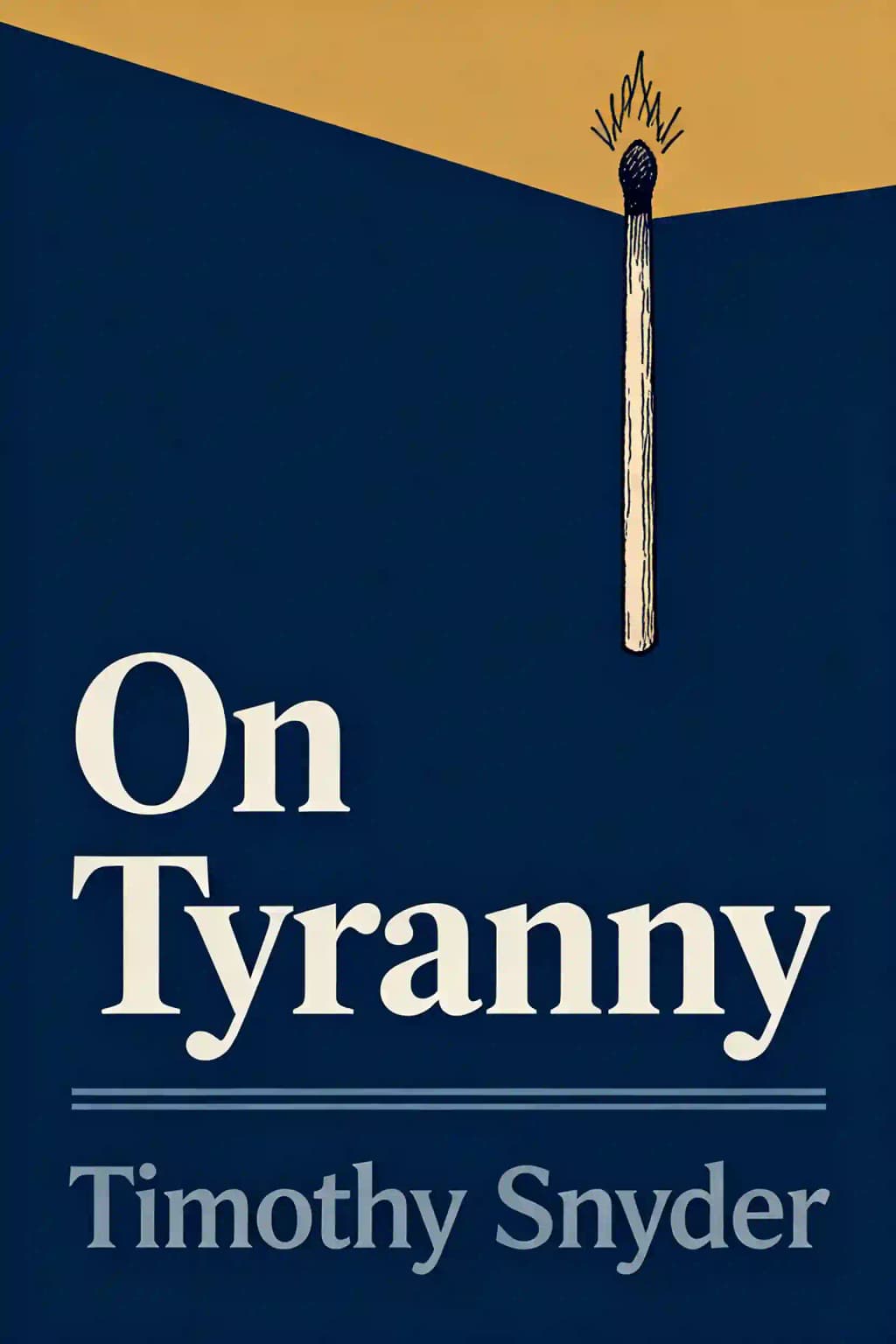
Democracy is not a given-it's a fragile achievement that can unravel with terrifying speed. Timothy Snyder's "On Tyranny" arrived like an urgent warning flare in 2017, quickly becoming a cultural phenomenon that sold over a million copies worldwide. This slim volume-barely 130 pages-has been spotted in the hands of celebrities from Leonardo DiCaprio to Emma Watson, and has been translated into over 40 languages. What makes this book so compelling is not just its historical insights, but its practical approach to defending democracy. Snyder, a Yale historian specializing in 20th century European totalitarianism, doesn't merely theorize-he provides a survival guide for citizens caught in democracy's twilight. The book's cultural impact speaks to our collective anxiety: when The New Yorker featured Snyder in a profile, they called him "the historian of our political nightmare." His warning resonates because it taps into something we sense but struggle to articulate-that the guardrails of democracy are more vulnerable than we ever imagined.
Kapitel 2
The Seduction of Anticipatory Obedience
The most dangerous moment for a democracy isn't when authoritarians seize power-it's when citizens surrender it voluntarily. This anticipatory obedience-complying with what we imagine rulers want before they even ask-teaches tyrants what they can get away with. It's like offering your wallet before the mugger demands it.
History provides chilling examples. After Hitler formed a government in 1932, and after communists won in Czechoslovakia in 1946, it wasn't immediate violence that transformed these societies-it was voluntary cooperation. When Germany annexed Austria in 1938, ordinary Austrians enthusiastically joined in persecuting Jews and stealing their property without being ordered to do so. This eager participation showed Nazi leadership what was possible, leading directly to Kristallnacht and eventually to systematic mass murder.
We might comfort ourselves thinking this is uniquely German, but Stanley Milgram's famous 1961 Yale experiment proved otherwise. When instructed by authority figures, 65% of ordinary Americans willingly administered what they believed were potentially fatal electric shocks to strangers. Milgram's disturbing conclusion? People readily accept new rules in new settings and are surprisingly willing to harm others when directed by authority. "I found so much obedience," he reflected, "that I hardly saw the need for taking the experiment to Germany."
This pattern repeats throughout history: citizens who think they're being practical by getting ahead of authoritarian demands actually accelerate the destruction of their own freedoms. Consider how quickly professionals in Nazi Germany abandoned ethical standards to participate in atrocities, or how rapidly Soviet citizens adapted to denouncing neighbors.
The antidote to anticipatory obedience is simple but requires courage: wait to be asked. When facing subtle pressure to compromise your values, remember that each small surrender makes the next one easier. The space between what authoritarians want and what you're willing to give is where democracy lives or dies. By refusing to volunteer your compliance, you force power to show its hand and give resistance time to organize.
Kapitel 3
The Fragility of Democratic Institutions
We often speak of "our institutions" as though they were immortal guardians of democracy, but institutions don't defend themselves-they need us to defend them. This misunderstanding has led to catastrophic complacency throughout history.
Consider the fatal error made by German Jews after the Nazis formed a government in 1933. Many believed constitutional protections would hold despite Hitler's explicit promises to dismantle them. They assumed rulers who gained power through institutions couldn't possibly destroy those same institutions. Within less than a year, Nazi Germany had consolidated into a one-party state where every major institution had been hollowed out or corrupted.
By November 1933, German authorities held sham parliamentary elections and a referendum with predetermined outcomes to legitimize the new order. Some German Jews voted as directed, hoping this gesture of loyalty would protect them-a vain hope that history would soon crush.
Institutions maintain their power through our collective belief in them. When we abandon them, they collapse with shocking speed. Courts can't enforce their own rulings. Newspapers can't physically prevent being shut down. Laws don't enforce themselves. Each requires active defense from citizens who recognize their value.
This defense must be specific and practical. Don't just vaguely support "institutions"-pick particular ones you value and take their side. Subscribe to quality newspapers practicing investigative journalism. Support organizations that defend voting rights. Attend local government meetings. Run for office yourself, even at the smallest level.
The most dangerous assumption is that institutions will naturally withstand direct attacks. History shows they won't. When leaders openly express contempt for courts, elections, or press freedom, believe them. The warning signs are rarely subtle. Authoritarians typically announce their intentions to dismantle democratic guardrails-they just count on our disbelief that they really mean it.
Remember that institutions exist in a delicate ecosystem-when one falls, others become more vulnerable. The preservation of democracy requires constant vigilance and active participation, not passive faith in institutional immortality.
Kapitel 4
The Mechanics of Democratic Collapse
How do democracies die? Rarely through dramatic military coups. More often, they erode through a series of seemingly small compromises that accumulate until the point of no return has silently passed. The parties that successfully remake states weren't omnipotent from the start-they exploited historic moments to make political life impossible for their opponents.
The most dangerous pathway begins with legitimate elections followed by the systematic dismantling of democratic safeguards. Both fascist and communist regimes in 20th century Europe followed remarkably similar playbooks: win elections (often with minorities of the vote), create constant crises to justify emergency powers, use those powers to silence opposition, and finally consolidate one-party rule.
The tactics are predictable: first comes the spectacle-rallies, symbols, and emotional appeals that bypass rational thought. Then comes the strategic use of fear-identifying enemies within who threaten the nation's purity or security. Next is the deployment of "salami tactics"-eliminating opposition layer by layer so no single action provokes sufficient resistance. Finally, the corruption of language itself-redefining words like "freedom," "truth," and "the people" to mean their opposites.
Many voters in these fallen democracies never realized they were casting their final meaningful ballot. The tragedy is that each small step seemed reasonable or necessary at the time. Emergency powers to address genuine crises. Security measures against plausible threats. Restrictions on "dangerous" speech. By the time the pattern became clear, organized resistance had become nearly impossible.
America's constitutional system was specifically designed to prevent this concentration of power, but it faces modern vulnerabilities. Extreme wealth inequality creates oligarchic pressure. Campaign finance systems give the wealthy disproportionate influence. Gerrymandering distorts representation. Electronic voting systems create opportunities for tampering. Social media enables unprecedented propaganda distribution.
The solution begins with recognizing these vulnerabilities honestly. We need paper ballots that cannot be tampered with remotely. We must fix gerrymandering to ensure equal votes. We should support multiple viable political parties rather than entrenching a two-party duopoly. Most importantly, we must recognize that democracy requires constant maintenance-it's not a stable endpoint but a continuous process that can reverse at any time.
Kapitel 5
The Politics of Everyday Choices
Democracy isn't just about elections-it's embedded in our daily interactions and choices. The seemingly small decisions we make about what we tolerate, what symbols we accept, and how we treat others collectively determine whether free societies can endure.
In Stalin's Soviet Union, propaganda portrayed prosperous farmers as pigs before seizing their land-a dehumanization process that eventually led to mass starvation. In Nazi Germany, marking shops as "Jewish" transformed ethics through envy and greed, making the eventual disappearance of Jews seem natural. Even accepting such markings as normal represented a compromise with a murderous future.
Symbols of loyalty quickly become tools of exclusion. In Nazi Germany, some wore swastika pins while others were forced to wear yellow stars. These visual markers divided society into those who belonged and those who didn't. Even when citizens are demoralized, public symbols sustain tyrannical regimes by creating the appearance of unanimous support.
Czech playwright Vaclav Havel explained this through his parable of a greengrocer placing a communist slogan in his window-not from belief but to avoid trouble. When everyone follows this logic, the public sphere fills with loyalty symbols and resistance becomes unthinkable. The greengrocer's sign works not because of its content but because it accepts "the prescribed ritual" and "appearances as reality," allowing the regime's game to continue.
Our everyday choices about language matter too. When we repeat dehumanizing terms for immigrants, religious minorities, or political opponents, we're participating in the groundwork for future persecution. When we normalize the idea that some people aren't fully human or don't truly belong, we're creating the conditions for their rights to be stripped away.
This extends to our online behavior. When we share false information because it confirms our biases, we're eroding the factual basis democracy requires. When we participate in pile-ons against designated enemies, we're rehearsing mob behavior that can turn physically dangerous.
The most powerful resistance begins with everyday choices: refusing to display symbols of hate, correcting dehumanizing language, maintaining connections across political divides, and treating everyone with the dignity democracy demands. These aren't just matters of personal virtue-they're political acts that collectively determine whether free societies can survive.
Kapitel 6
Professional Ethics as Democracy's Backbone
When political leadership fails, professional ethics become the last line of defense against tyranny. History shows that atrocities require not just evil masterminds but the willing participation of doctors, lawyers, engineers, bureaucrats, and other professionals who abandon their ethical standards.
In Nazi Germany, lawyers were overrepresented among Einsatzgruppen commanders who organized mass shootings. Physicians conducted ghastly experiments and participated in "euthanasia" programs. Businessmen exploited camp labor. Engineers designed more efficient crematoriums. If these professionals had simply adhered to their pre-existing ethical codes-no execution without fair trial, no surgery without consent, no slavery-the Holocaust would have been practically impossible to implement at scale.
This pattern repeats across authoritarian regimes. Stalin's purges required prosecutors who brought false charges and judges who imposed predetermined sentences. Modern surveillance states need computer scientists willing to build tools for monitoring citizens. Torture regimes require doctors to supervise "enhanced interrogation."
Professional ethics matter precisely when situations are deemed "exceptional." The true test of ethical commitment isn't adherence during normal times but maintaining standards when political pressure is highest. When leaders declare emergencies that supposedly justify abandoning normal constraints, professionals must recognize this as the moment when ethical commitments matter most.
These ethical standards can't be maintained individually-they require collective reinforcement through professional associations, educational institutions, and peer networks. When professions maintain internal ethical conversations that are impossible between isolated individuals and distant governments, they gain the confidence and power to resist collectively.
For doctors, this means refusing to participate in torture or execution even when ordered. For journalists, it means maintaining commitment to factual reporting despite pressure to promote official narratives. For scientists, it means defending evidence-based conclusions against politically motivated distortions. For lawyers, it means upholding due process even for unpopular defendants.
Professional ethics aren't just about personal integrity-they're essential democratic infrastructure. By maintaining independent standards of conduct derived from their specialized knowledge and traditions, professionals create zones of autonomy that can resist authoritarian control. When these standards collapse, democracy's foundation crumbles with them.
Kapitel 7
The Power of Standing Out
In moments of democratic crisis, the most crucial act can be simply refusing to go along with the crowd. History is changed by those willing to endure the discomfort of being different when conformity seems safest.
After World War II, myths of widespread resistance emerged in formerly occupied countries, but the reality was far different. In the 1930s, accommodation and even admiration of Nazi Germany dominated. By 1940, most Europeans had accepted Nazi power as inevitable, while prominent Americans like Charles Lindbergh opposed war under the slogan "America First."
When Winston Churchill became prime minister in May 1940, Britain stood alone against Nazi-dominated Europe. Hitler expected Churchill to negotiate surrender after France fell and the Luftwaffe bombed British cities. Instead, Churchill made the lonely choice to continue fighting, defining Britons as people who would calmly resist evil rather than submit to it. By refusing to concede, Churchill forced Hitler to change plans and attack the Soviet Union while still fighting Britain-creating the two-front war that ultimately led to Nazi defeat.
Standing out doesn't always require grand historical roles. Teresa Prekerowa, a young Polish woman in Nazi-occupied Warsaw, chose to think of others when most focused on mere survival. When Jews were forced into the Warsaw ghetto in late 1940, Teresa repeatedly entered it, bringing food and medicine to Jews she knew and strangers alike. She helped a Jewish friend escape and later saved the girl's family from deportation to Treblinka during the "Great Action" of 1942. Though Teresa later became a Holocaust historian, she rarely wrote about herself and called her actions normal. From our perspective, they were extraordinary.
The courage to stand out often comes not from dramatic heroism but from small decisions to maintain humanity when others abandon it. It might mean being the one person who doesn't laugh at a dehumanizing joke, who questions a false claim when others nod along, or who maintains relationships with marginalized groups when others cut ties.
These acts may seem futile in the moment-Teresa couldn't save most Warsaw Jews, and Churchill couldn't immediately defeat Hitler-but they preserve possibilities that conformity would extinguish. By standing out, we create reference points for others who share our doubts but fear expressing them. We demonstrate that alternatives exist. Most importantly, we maintain our capacity to recognize truth and act on it-the essential foundation for any future resistance.
Kapitel 8
Truth as Democracy's Oxygen
Democracy cannot survive without a commitment to shared factual reality. When we abandon truth for comfortable fictions, we surrender both individual autonomy and our collective ability to solve problems through democratic processes.
Truth dies in four distinct modes: First comes open hostility to verifiable reality, as when leaders present obvious lies as facts. Second is shamanistic incantation-the endless repetition of phrases and slogans that create emotional connections rather than describing actual plans. Third is magical thinking that embraces contradiction, like promising tax cuts, debt reduction, and increased spending simultaneously. Fourth is misplaced faith that replaces individual discernment with oracular pronouncements from leaders who claim, "I alone can solve it."
These attacks on truth aren't merely rhetorical strategies-they're essential to authoritarian control. When citizens can no longer distinguish fact from fiction, they become dependent on authority figures to tell them what's real. When everything becomes spectacle controlled by wealth and power, criticism becomes impossible because there's no shared standard against which to judge claims.
As playwright Eugene Ionesco depicted in "Rhinoceros," propaganda transforms ordinary people into bizarre creatures through a series of small concessions to unreality. Each abandoned fact makes the next abandonment easier until the person has been completely transformed while believing they've remained the same.
What we now call "post-truth" isn't new-George Orwell captured it seventy years ago as "doublethink." Fascist movements have always despised daily truths, preferred myths to journalism, and used new media technologies to arouse feelings before facts could be ascertained. Post-truth is pre-fascism.
Defending truth requires both individual and collective action. Individually, we must investigate claims rather than passively consuming them, support investigative journalism through subscriptions, and take responsibility for what we share with others. Collectively, we need to maintain institutions dedicated to factual inquiry-universities, scientific organizations, courts, and independent media.
Most importantly, we must recognize that truth isn't just about facts but about maintaining the possibility of shared reality. When we retreat into separate information bubbles where incompatible "truths" circulate, we lose the common ground democracy requires. The defense of truth is ultimately the defense of democracy itself.
Kapitel 9
Building Resilience Through Human Connection
The most effective defense against tyranny isn't isolation but connection. Authoritarians thrive when citizens are atomized, distrustful, and afraid. By cultivating relationships across social boundaries, we create networks of trust that can resist manipulation and coordinate action when necessary.
This begins with simple acts like making eye contact and engaging in small talk with strangers. These aren't merely polite gestures-they're essential citizenship that helps you understand your surroundings, break down social barriers, and determine whom to trust. In tyrannical regimes throughout history, simple gestures like smiles and greetings took on profound significance when neighbors avoided contact out of fear. By affirming everyone you meet, you ensure vulnerable people feel safer while building your own support network.
Physical presence matters enormously. While social media can organize protest, "nothing is real that does not end on the streets." Poland's Solidarity movement succeeded because intellectuals and workers formed unexpected alliances, creating trust across social divides. Their persistence through strikes, marches, and demonstrations eventually led to communism's fall, showing how physical presence creates lasting change.
This "corporeal politics" requires crossing two boundaries: bringing together diverse people who don't agree on everything, and gathering in unfamiliar places among new groups. Power wants you passive-physically softening in chairs while emotions dissipate on screens. Resistance requires getting your body into public spaces alongside others who share your concerns.
At the same time, maintaining a private sphere is essential. We're free only when we control the boundary between visibility and privacy. Protect yourself by regularly removing malware, remembering email is essentially public, using alternative internet forms, or simply using technology less. Have personal conversations face-to-face rather than through potentially monitored channels.
By balancing public engagement with protected privacy, we create the conditions for effective resistance. In dangerous times, trusted relationships become "the politics of last resort," and making new connections is the first step toward change. When formal institutions fail, these informal networks of trust become the foundation for rebuilding democracy.
Kapitel 10
Patriotism Versus Nationalism
The distinction between patriotism and nationalism isn't merely semantic-it represents fundamentally different relationships to country that lead to radically different political outcomes. Understanding this difference is crucial for democracy's survival.
Nationalism is rooted in resentment toward others and obsession with power. As George Orwell noted, a nationalist "broods on power, victory, defeat, revenge" but remains "uninterested in what happens in the real world." Nationalists define their country through opposition to enemies, real or imagined. They insist on national purity and reject universal values. Most dangerously, nationalists believe their nation is inherently virtuous regardless of its actions-making critical self-examination impossible and accountability unthinkable.
Patriotism, by contrast, is rooted in love for country that demands it live up to its highest ideals. Patriots concern themselves with the real world-the only place where their country can be loved and sustained. They hold universal values and standards by which they judge their nation, always wishing it would do better. While nationalists insist "it can't happen here," patriots acknowledge it could happen here, but vow to stop it.
This distinction manifests in practical ways. True patriotism isn't dodging military service while mocking war heroes, discriminating against active-duty personnel, avoiding taxes, or admiring foreign dictators. It isn't cultivating relationships with despots or inviting foreign interference in elections. These behaviors, often wrapped in nationalist rhetoric and symbols, actually undermine national strength and sovereignty.
Genuine patriotism means serving your country by holding it accountable to its founding principles. It means defending democratic institutions even when they produce outcomes you dislike. It means recognizing your nation's flaws while working to correct them. Most importantly, it means understanding that a country's greatness comes not from mythical past perfection but from its capacity for self-correction and improvement.
The politics of eternity-dwelling on victimhood and mythical past glory-prevents us from considering possible futures. When nations define themselves by inherent virtue rather than potential, politics becomes a battle of good versus evil instead of problem-solving. The perpetual crisis creates a permanent emergency where planning seems impossible or disloyal.
True patriots reject both the politics of inevitability (the belief that progress happens automatically) and the politics of eternity (the belief that nothing ever changes). Instead, they embrace history-with all its complexities and contradictions-as the foundation for meaningful action in the present.
Kapitel 11
Courage as Democracy's Essential Ingredient
The defense of democracy ultimately requires courage-the willingness to accept personal risk for collective benefit. If none of us is prepared to face discomfort, social rejection, or even physical danger for freedom, then all of us will eventually live under tyranny.
This courage manifests in many forms, from dramatic acts of resistance to small daily choices. It might mean being the first person to question an unjust policy at work, risking career advancement to maintain ethical standards, or physically placing yourself between vulnerable people and those who would harm them.
History shows that authoritarian regimes exploit moments of shock to transform democracy into tyranny. The Reichstag fire exemplifies this pattern. When the German parliament burned in February 1933, Hitler-whether responsible or not-seized the opportunity, declaring "This fire is just the beginning" and "Anyone standing in our way will be cut down." The next day, basic rights were suspended. Within weeks, Hitler's party won elections, political opponents were imprisoned, and parliament passed an "enabling act" allowing rule by decree. Germany remained in emergency for twelve years.
Modern authoritarians are even more sophisticated terror managers. Vladimir Putin rose from obscurity after apartment bombings (likely staged by Russian security forces) enabled his war in Chechnya. His popularity soared, leading to electoral victory. He later exploited a theater attack to seize private television and a school siege to eliminate elected regional governors-using real, fake, and questionable terrorism to consolidate power.
For tyrants, one moment of shock enables an eternity of submission. For citizens, natural fear and grief must not enable institutional destruction. Courage means recognizing and resisting terror management immediately, when it seems most difficult. As James Madison noted, tyranny arises "on some favorable emergency."
This courage isn't about recklessness or martyrdom-it's about calculated risk-taking in service of principles that matter more than personal comfort. It requires preparation: building networks of trust before crises occur, understanding historical patterns so you can recognize dangerous moments, and practicing smaller acts of courage so larger ones become possible when needed.
Most importantly, courage is contagious. When one person stands against injustice, others find it easier to follow. This cascading effect explains how seemingly invincible regimes can collapse with surprising speed once resistance reaches a critical threshold. By choosing courage over compliance-even in small ways-we not only preserve our own integrity but create possibilities for others to do the same.