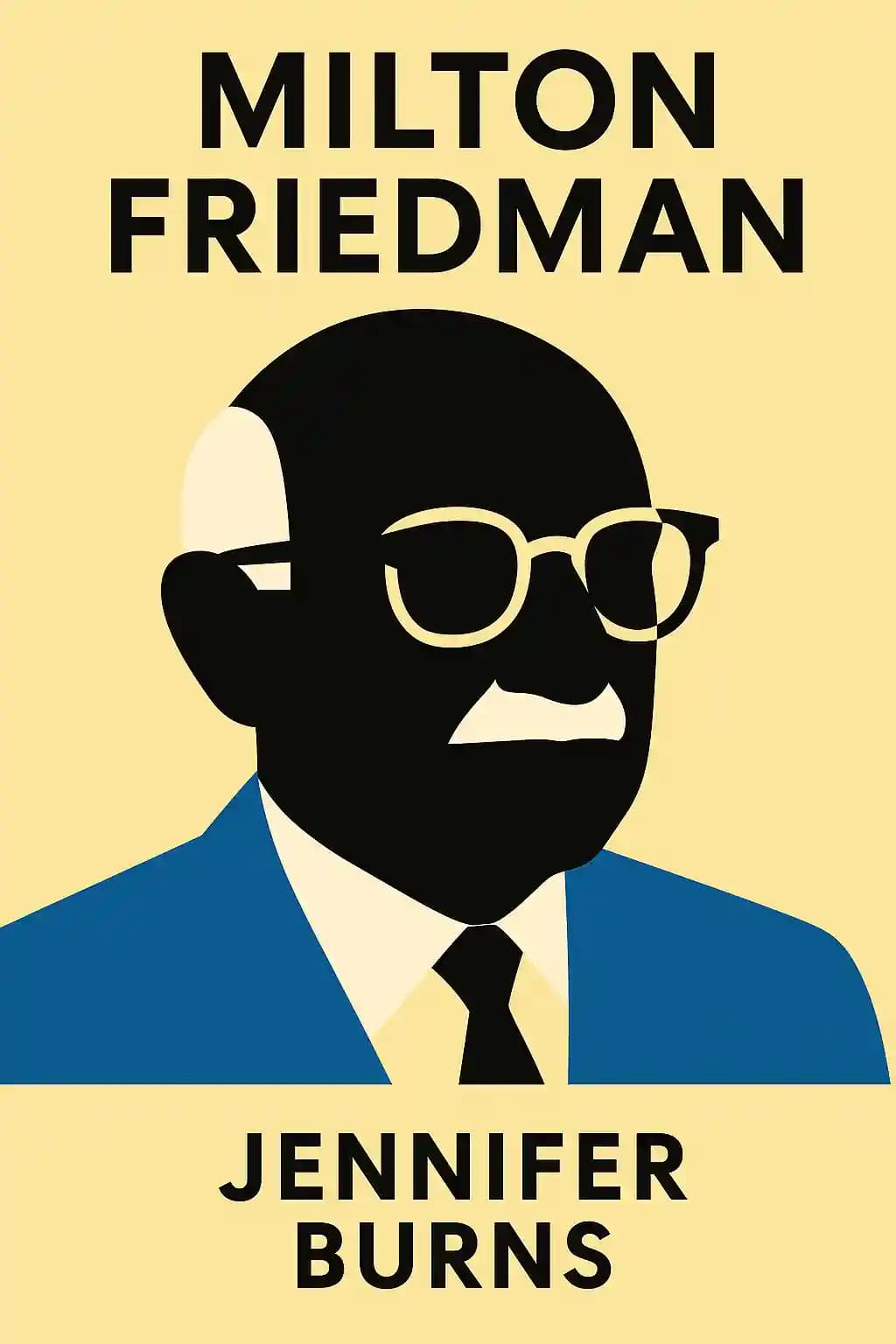
Milton Friedman
The Last Conservative
Überblick über Milton Friedman
Jennifer Burns' landmark biography unveils how Milton Friedman transformed economics from radical theory to presidential policy. The first scholar with full archive access reveals how this controversial Nobel laureate influenced Reagan, Thatcher, and global markets while challenging our fundamental assumptions about freedom and government.

Kernthemen in Milton Friedman
- monetary policy history
- chicago school economics
- free market ideology
- quantity theory of money
- keynesianism vs monetarism
Zitate aus Milton Friedman
the state could do only harm.
neo-liberalism - presenting it as a new faith to offer.
formal models of imaginary worlds, not generalizations about the real world.
a devil figure.
Personen in Milton Friedman
- Milton FriedmanNobel-winning economist and subject of the book
- Rose DirectorEconomist and Milton Friedman's wife
- Anna Jacobson SchwartzEconomist and Friedman's research collaborator
- Aaron DirectorChicago economist and brother of Rose Director
- Henry SimonsChicago School economist and Friedman's colleague
Über den Autor
Über den Autor von Milton Friedman
Jennifer Burns, Associate Professor of History at Stanford University and research fellow at the Hoover Institution, is the acclaimed author of Milton Friedman: The Last Conservative, a landmark biography exploring the economist’s transformative impact on modern conservatism and global economic policy.
A leading expert on 20th-century U.S. intellectual history, Burns intertwines rigorous scholarship with accessible narrative, tracing Friedman’s evolution from academic thinker to policymaker.
Her prior work, Goddess of the Market: Ayn Rand and the American Right—hailed as the definitive Rand biography—established her authority on libertarian thought and conservative movements. Burns’ analysis has been featured on The Daily Show with Jon Stewart and The Colbert Report, and she co-founded initiatives like the Hoover Institution’s Workshop on Political Economy.
Milton Friedman: The Last Conservative synthesizes decades of archival research, offering the first comprehensive study of Friedman’s enduring legacy. The book has been widely praised for its nuanced portrayal of free-market ideology’s intersection with political power.
Zusammenfassung von Milton Friedman herunterladen
Erhalten Sie die Milton Friedman-Zusammenfassung als kostenloses PDF oder EPUB. Drucken Sie es aus oder lesen Sie es jederzeit offline.
FAQ zu diesem Buch
Milton Friedman: The Last Conservative by Jennifer Burns is a comprehensive biography exploring Friedman’s transformative role in 20th-century economics and conservatism. It delves into his groundbreaking work on monetary policy, free-market advocacy, and critiques of government intervention, while examining his collaborations with figures like Anna Schwartz and influence on policymakers. Burns uses archival sources to reveal his intellectual evolution and legacy as a neoliberal pioneer.
This book is ideal for economics enthusiasts, historians, and readers interested in conservatism’s ideological roots. Burns’ accessible explanations of complex theories make it valuable for both academics and general audiences seeking to understand Friedman’s impact on modern economic policy and political thought.
Yes. Critics praise Burns’ balanced approach, meticulous research, and engaging narrative. The biography offers nuanced insights into Friedman’s personal and professional life, making it a definitive resource on his contributions to economics and conservatism.
The book highlights Friedman’s advocacy for monetarism (emphasizing money supply’s role in inflation), free-market capitalism, and limited government intervention. Burns explains his analysis of wage disparities, critiques of Keynesian economics, and belief in individual freedom as drivers of prosperity.
Burns positions Friedman as a foundational figure in neoliberal thought, arguing he redefined conservatism by merging free-market principles with anti-statist ideology. His work influenced policies like deregulation and tax cuts, shaping Republican and libertarian movements.
The biography details Friedman’s partnership with economist Anna Schwartz on monetary history, his complex ties to Fed Chair Arthur Burns, and advisory roles under leaders like Richard Nixon. Burns also explores his alliances with think tanks to advance libertarian ideas.
Yes. Burns critiques Friedman’s opposition to 1960s civil rights legislation, arguing his rigid free-market principles sometimes clashed with social justice. She also examines accusations that his policies exacerbated inequality.
As the first biography using Friedman’s personal archives, Burns offers unprecedented insights into his intellectual journey and private correspondence. Earlier accounts lacked this depth, often focusing narrowly on his economic theories.
- Monetarism’s enduring influence on central banking.
- Friedman’s role in popularizing neoliberalism.
- The tension between free-market ideals and societal equity.
- His legacy as a bridge between academia and policymaking.
Burns argues his ideas remain vital in debates over inflation, stimulus spending, and government overreach. His critiques of centralized planning resonate in discussions about AI regulation and post-pandemic recovery.
Some reviewers note Burns underplays negative consequences of Friedman’s policies, such as income inequality. Others argue her focus on archival material occasionally overshadows broader historical context.
As global economies grapple with climate regulations and tech-driven markets, Burns’ analysis provides a framework for understanding libertarian responses to modern crises. The biography also revisits Friedman’s warnings about bureaucratic overreach in light of recent policy debates.





