Kapitel 1
A Midnight's Birth, A Nation's Fate
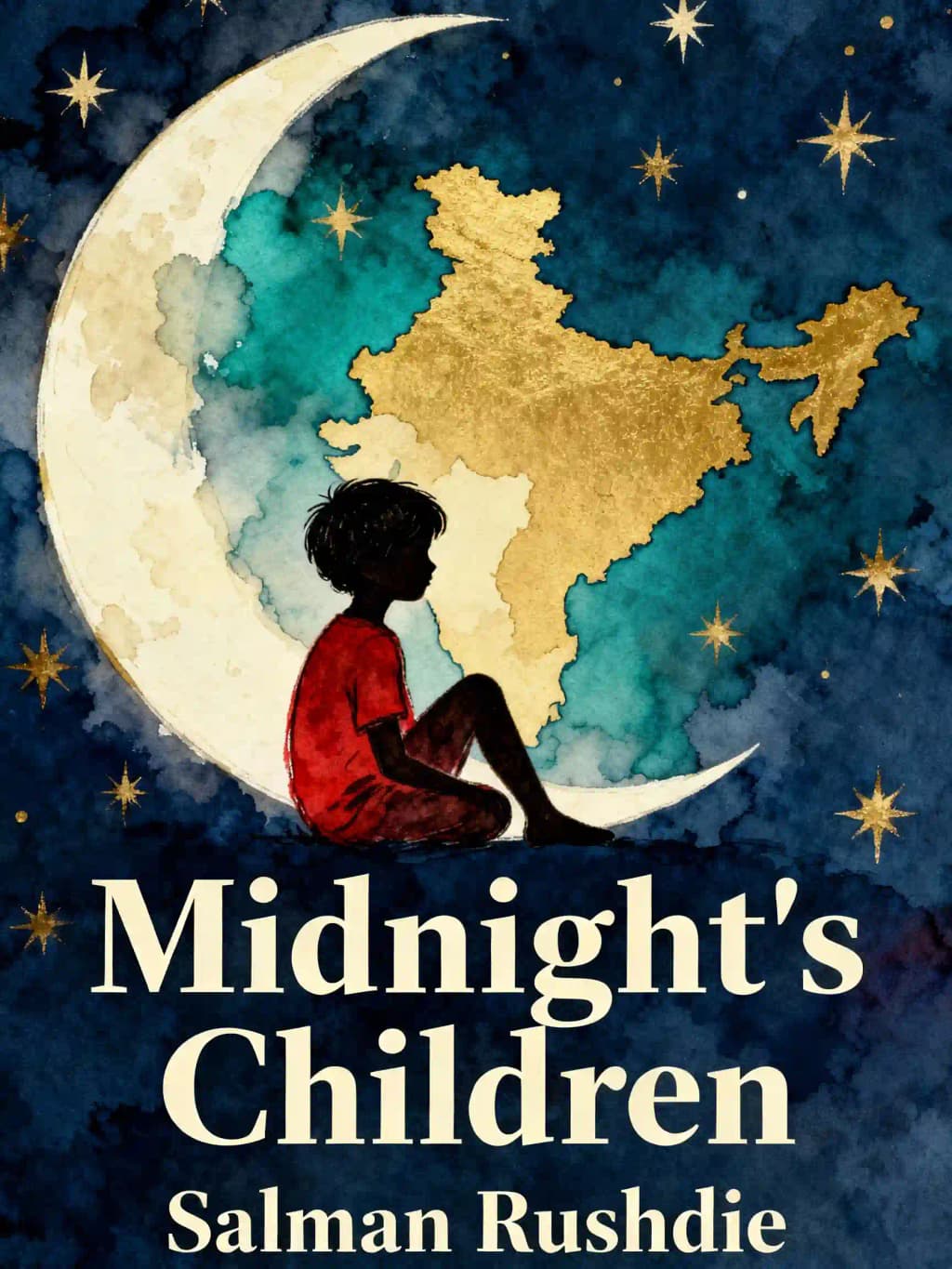
In 1981, a relatively unknown Indian-British writer named Salman Rushdie published a novel that would forever change the landscape of world literature. "Midnight's Children" didn't just win the prestigious Booker Prize that year-it later won the "Booker of Bookers" and the "Best of the Booker," cementing its status as one of the most important literary works of the 20th century. The novel's magical realist approach to India's independence and partition became a cultural touchstone, influencing generations of writers and earning Rushdie international acclaim long before the controversy of "The Satanic Verses" thrust him into global headlines. Beloved by literary giants like Margaret Atwood and Gabriel Garcia Marquez, the novel's inventive narrative style, rich symbolism, and profound exploration of identity continue to captivate readers four decades after its publication. Through the extraordinary life of Saleem Sinai, born at the exact moment of India's independence, Rushdie crafted not just a personal story but a sweeping allegory of a nation's tumultuous birth and coming of age.
Kapitel 2
The Perforated Sheet: Fragmented Beginnings
In Kashmir, 1915, the story begins with a peculiar medical arrangement that serves as the novel's central metaphor. Young Doctor Aadam Aziz is summoned to treat Naseem, the daughter of wealthy landowner Ghani, but with one extraordinary condition-he must examine her through a seven-inch hole cut in a sheet, seeing only the part of her body requiring treatment. "My grandfather had fallen in love with a woman whom he had never seen in her entirety, having been permitted only to observe her through a perforated sheet," our narrator Saleem tells us. Over three years of weekly visits for various ailments, Aziz gradually constructs a mental collage of this "partitioned woman," falling in love with her piecemeal, body part by body part.
This fragmented courtship brilliantly foreshadows the coming partition of India itself-a nation that will be known only in fragments, divided by religion, language, and class. When Aziz and Naseem finally marry, their relationship quickly reveals fault lines. Their arguments establish the pattern for their marriage-"a place of frequent and devastating warfare" that transforms them both into "different, stranger beings." When Aziz witnesses the Jallianwala Bagh massacre in Amritsar, where British troops fire 1,650 rounds into an unarmed crowd, he returns home covered in blood. Naseem mistakes it for spilled Mercurochrome, a telling confusion between medicine and violence that will echo throughout the novel.
The perforated sheet becomes the first of many recurring symbols in the narrative-objects that accumulate meaning as they pass through generations. It represents not just the fragmented way we come to know others, but also the incomplete, hole-filled nature of memory and history itself. As Saleem later reflects, "Reality is a question of perspective; the further you get from the past, the more concrete and plausible it seems-but as you approach the present, it inevitably seems more and more incredible." The perforated sheet introduces the novel's central concern: how do we piece together a coherent identity-personal or national-from fragmentary, often contradictory parts?
Kapitel 3
Midnight's Promise: The Birth of a Nation and a Child
As India approaches independence in August 1947, the narrative shifts to Bombay where Saleem's parents, Ahmed and Amina Sinai, enter into a peculiar real estate arrangement with an Englishman named William Methwold. They purchase one of four identical mansions on Methwold's Estate with two strange conditions: they must buy the houses complete with all contents, and the transfer won't take place until midnight on August 15th-the exact moment of India's independence. "A sort of tribute of power from us to them," Methwold explains with "a very Indian lust for allegory."
This symbolic transfer of power from British to Indian hands coincides with the Times of India announcing a prize for any Bombay mother giving birth at the exact moment of independence. Amina becomes convinced she will win, remembering a fortune-teller's prediction about her unborn child. Meanwhile, the residents of Methwold's Estate undergo a subtle transformation, adopting English habits and "imitation Oxford drawls" during cocktail hour. As midnight approaches, everything becomes saffron and green-the colors of the new Indian flag-while Amina and another woman, Vanita, go into labor simultaneously.
At the stroke of midnight, as Nehru declares India's awakening "to life and freedom," two babies howl their "unavailing protests" as they enter the world. But midwife Mary Pereira, driven by love for a Communist revolutionary, commits her own "private revolutionary act"-swapping the name-tags on the infants, giving "the poor baby a life of privilege" and condemning "the rich-born child to accordions and poverty." This fateful switch means Saleem Sinai, celebrated as a midnight's child and recipient of the Prime Minister's congratulatory letter, is not his parents' biological son.
The midnight birth establishes the novel's central conceit-Saleem's life will mirror India's destiny, his personal triumphs and tragedies reflecting the nation's own journey. "I had been mysteriously handcuffed to history," Saleem explains, "my destinies indissolubly chained to those of my country." This handcuffing creates both burden and possibility, as Saleem struggles throughout the novel with the weight of symbolism thrust upon him. His birth represents the promise of the newly independent nation-full of potential, blessed with attention, yet fundamentally built on a hidden switch, a secret that undermines the very foundation of his identity.
Kapitel 4
Midnight's Children: Supernatural Gifts and National Destiny
On his tenth birthday, Saleem makes an extraordinary discovery-he possesses telepathic powers that connect him to all the other children born during the first hour of India's independence. These "midnight's children" number exactly 1,001, each possessing magical abilities proportional to their proximity to the midnight hour. "The children of midnight were also the children of the time: fathered, you understand, by history," Saleem explains. Their powers range from time travel to multiplication, shape-shifting to prophecy.
Through his telepathic "All-India radio," Saleem creates the Midnight Children's Conference-a mental parliament where these extraordinary children gather nightly between midnight and 1 a.m. This supernatural assembly represents the diverse potential of the new nation, bringing together children of all religions, languages, and social classes. Yet even in this magical space, the same divisions that plague India soon emerge-"they were, despite their gifts, as unremarkable as any other children," Saleem laments, noting how they reproduce the prejudices of their parents.
Two children born exactly at midnight possess the greatest powers-Saleem with his telepathy, and his counterpart Shiva with his deadly, powerful knees. Their rivalry establishes the novel's central conflict, as Shiva (named for the Hindu god of destruction) represents a darker vision of India's future. While Saleem believes in purpose and meaning, Shiva espouses a brutal philosophy: "What thing in the whole sister-sleeping world got reason?" Their philosophical clash-idealism versus materialism, hope versus cynicism-mirrors competing visions for India's future.
The midnight children serve as a powerful allegory for the promise of the newly independent nation-diverse, gifted, yet ultimately vulnerable to the same forces that threaten India itself. As Saleem observes, "We, the children of Independence, rushed wildly and too fast into our future." Their supernatural abilities represent the extraordinary potential of a free India, while their subsequent struggles reflect the difficulties of realizing that potential amid entrenched divisions and political machinations. Through this magical conceit, Rushdie explores how the optimism of independence gradually gives way to disillusionment, as both Saleem and India struggle to live up to their midnight promise.
Kapitel 5
Fragmentation and Identity: The Many Faces of Saleem Sinai
Throughout the novel, Saleem's identity undergoes constant fragmentation and reconstruction, mirroring the fractured nature of post-independence India. His physical appearance-with his enormous cucumber nose, temple-dents, and birthmarks that resemble the map of India-makes him a literal embodiment of the nation. "I am the sum total of everything that went before me, of all I have been seen done, of everything done-to-me," he declares, positioning himself as both an individual and a collective entity.
This fragmentation becomes literal when Saleem loses his telepathic powers after a sinus operation, then experiences "drainage" that severs his connection to the midnight children. Later, during the 1965 Indo-Pakistani War, he's struck by his mother's silver spittoon and experiences "the emptying-out of Saleem"-a complete amnesia that transforms him into "the buddha," a human tracker dog used by the Pakistani army. This emptied vessel represents the erasure of history, as Saleem becomes "a perfect citizen of Pakistan" precisely by forgetting his past.
His identity crisis reaches its peak when Mary Pereira confesses to switching the babies, revealing that Saleem is actually the biological son of the poor street musician Wee Willie Winkie and his wife Vanita (who was secretly impregnated by the departing Englishman, Methwold). This means Saleem-the Muslim child of privilege, celebrated as a symbol of India's promise-is actually the illegitimate son of a Hindu woman and an Englishman. Meanwhile, his biological counterpart Shiva-raised in poverty-is actually the true heir to the Sinai fortune.
This complex tangle of parentage underscores the novel's exploration of identity as constructed rather than innate. "Who what am I?" Saleem asks. "My answer: I am the sum total of everything that went before me, of all I have been seen done, of everything done-to-me." His identity emerges not from blood or birth but from experience and narrative-from the stories told about him and the history he embodies. Through Saleem's fragmented self, Rushdie suggests that national identity similarly depends not on some pure racial or religious essence, but on the collective stories a people tell about themselves.
Kapitel 6
The Widow's Revenge: History, Power, and Persecution
The novel takes a darker turn as it chronicles India's slide from democratic idealism into authoritarian control under Indira Gandhi (never named directly but referred to as "the Widow"). The Emergency period of 1975-1977-when Gandhi suspended civil liberties and ruled by decree-becomes the novel's most harrowing section, as Saleem reveals the Widow's secret campaign to destroy the midnight's children.
"The Widow, by bringing us here, to break us, has in fact brought us together!" Saleem initially thinks when imprisoned with the other magical children. But this hope proves crueler than any torture. The children undergo not simple sterilization but complete "ectomies"-hysterectomies and testectomies that irreversibly remove their reproductive organs. Worse, their magical abilities are somehow excised as well. The final horror comes when Saleem smells their removed parts being fried with spices and fed to street dogs.
This brutal episode transforms the novel's magical realism into political allegory. The midnight children-with their diverse backgrounds and supernatural gifts-represent the pluralistic promise of Indian democracy. Their sterilization symbolizes Gandhi's attempt to neutralize opposition and impose a single vision on India's multiplicity. As the Widow's representative explains: "The people of India worship our Lady like a god. Indians are only capable of worshipping one God." The midnight children must be eliminated because they represent rival deities to the Prime Minister's aspirations to be Devi, the multi-limbed Mother-goddess.
Through this allegorical treatment of the Emergency, Rushdie delivers his most pointed political critique. The persecution of the midnight children represents the betrayal of India's founding ideals-plurality, democracy, and tolerance-in favor of centralized control and personality cult. The Widow becomes the novel's ultimate villain not just for her cruelty, but for her attempt to impose a singular narrative on India's inherently plural identity. As Saleem observes, "there is no escape from recurrence" in Indian history-cycles of hope and betrayal, promise and disappointment continue to shape the nation's destiny.
Kapitel 7
Preservation and Memory: The Pickling of History
In the novel's final section, Saleem finds work at a pickle factory owned by Mary Pereira, where he creates thirty special pickle blends containing not just fruits and spices but memories, dreams, and ideas. Each jar represents a year of India's post-independence history, carefully preserved through his distinctive combination of ingredients and techniques. "My special blends," he explains, "are connected to my nocturnal scribblings-by day amongst the pickle-vats, by night within these sheets, I spend my time at the great work of preserving. Memory, as well as fruit, is being saved from the corruption of the clocks." The number thirty is significant, matching both Saleem's age and the years since India's independence.
This act of preservation through pickling becomes the novel's central metaphor for storytelling itself. Like pickles, stories preserve experience but also transform it-adding spices, altering flavors, creating something new from raw materials. The process of pickling mirrors the way memory works: some elements are enhanced, others diminished, and the final product is both preservation and transformation. Just as pickles require time to mature and develop their full flavor, stories too evolve and deepen with time. Saleem acknowledges imperfections in his pickle-preserved memories but defends his narrative with the stubborn sentence: "It happened that way because that's how it happened." He hopes his pickles, despite their overpowering smell and strength, "possess the authentic taste of truth" and are "despite everything, acts of love."
The pickle metaphor speaks to the novel's broader concern with how history is preserved and transmitted. Throughout the narrative, Saleem struggles against forgetting-both personal amnesia and national amnesia about painful historical events. His pickle-jars stand ready "to be unleashed upon the amnesiac nation," combating the tendency to sanitize or simplify the past. The spices he uses - turmeric, cardamom, cinnamon, and others - represent the diverse flavors of Indian history, while the preservation process itself suggests how historical narratives are inevitably altered by the very act of preservation. Like India itself, these pickles are messy, pungent, and complex-preserving not just triumphs but failures, not just heroism but shame.
This preservation takes on particular urgency as Saleem's body begins to crack and disintegrate, mirroring the fractures in both his personal history and the nation's collective memory. Approaching his thirty-first birthday-the same age as independent India-he senses his imminent death. The cracks appearing in his body parallel the fissures in Indian society: religious divisions, class conflicts, and regional tensions. His final vision is of being trampled by India's multitudes-"four hundred million five hundred six"-the same fate he foresees for his son and all generations to come. This apocalyptic ending suggests that individual lives are ultimately consumed by the larger forces of history, yet the act of narration-of pickling memories-offers some resistance against complete erasure. The pickle jars become time capsules, preserving not just Saleem's story but the complex, contradictory narrative of a nation in transition.
Kapitel 8
The Burden of History: Personal and National Destiny
Throughout the novel, Saleem grapples with the burden of being "handcuffed to history"-of having his personal fate intertwined with national events. This connection manifests in uncanny coincidences: his birth coincides with India's independence; his nose is blocked during the language riots; he loses his telepathic powers during India's war with China; he's "drained" during the Indo-Pakistani war; and he's sterilized during the Emergency. "I am so far gone, in my desperate need to establish the importance of handcuffs," he admits, "that I have begun to believe that everything that happened, happened because of me."
This megalomaniacal perspective-where personal events take on cosmic significance-reflects both Saleem's narrative self-importance and the novel's exploration of how individuals relate to historical forces. "Most of what matters in our lives takes place in our absence," Saleem observes, noting how decisions made before his birth shaped his destiny. Yet he simultaneously insists on his centrality to India's story, positioning himself as both victim and agent of historical change.
The novel ultimately suggests that this tension between individual agency and historical determinism defines the postcolonial experience. Like Saleem, newly independent nations struggle with the burden of history-the weight of colonial legacies, the pressure of great expectations, the challenge of forging new identities while acknowledging the past. The handcuffs binding Saleem to history represent both constraint and connection, limitation and meaning.
In the novel's final vision, Saleem foresees himself and his son being trampled by India's masses, for it is "the privilege and the curse of midnight's children to be both masters and victims of their times, to forsake privacy and be sucked into the annihilating whirlpool of the multitudes, and to be unable to live or die in peace." This ambivalent conclusion suggests that the relationship between individual and nation remains unresolved-neither complete submission to historical forces nor absolute freedom from them is possible. Instead, like Saleem's cracking body, we are all ultimately absorbed back into the collective from which we emerged, our stories becoming part of the larger narrative that outlives us.
Kapitel 9
The Art of Storytelling: Truth, Lies, and National Narratives
At its heart, "Midnight's Children" is a novel about storytelling itself-about how narratives shape both personal identity and national consciousness. Saleem is an unreliable narrator who frequently acknowledges errors and inconsistencies in his account, creating a complex tapestry of truth and fabrication. "Memory has its own special kind," he admits. "It selects, eliminates, alters, exaggerates, minimizes, glorifies, and vilifies also; but in the end it creates its own reality, its heterogeneous but usually coherent version of events." This admission serves not only as a disclaimer but as a central thesis about the nature of historical truth itself.
This self-conscious unreliability extends to his treatment of historical events, where personal memory intertwines with national mythology. Saleem presents multiple contradictory versions of the Indo-Pakistani War, noting how "reality can have metaphorical content; that does not make it less real." During the conflict, "Voice of Pakistan announced destroying more aircraft than India ever possessed; in eight days, All-India Radio massacred Pakistan's entire army." These competing propaganda narratives highlight how national stories are constructed and contested, with truth becoming whatever authorities declare it to be. The novel demonstrates this through numerous examples, from the Emergency period's censorship to the whitewashing of political violence in official accounts.
The novel positions storytelling as both potentially liberating and potentially oppressive, a double-edged sword in the hands of both individuals and nations. Saleem's sprawling, digressive narrative-with its magical elements and historical reimaginings-represents a form of resistance against official histories and singular truths. His "chutnification of history" preserves multiplicity and contradiction, refusing the neat resolutions of authorized accounts. This approach mirrors the diverse, chaotic reality of India itself, with its multiplicity of languages, religions, and cultural traditions. Yet the novel also shows how narratives can be weaponized-how the Widow's attempt to eliminate the midnight children represents an effort to impose a single story on India's diversity, much like the sterilization campaigns of the Emergency period sought to control and standardize the population.
Through this exploration of storytelling, Rushdie suggests that nations, like individuals, are ultimately narrative constructions-collective fictions that gain power through repetition and belief. "India, the new myth-a collective fiction in which anything was possible, a fable rivalled only by the two other mighty fantasies: money and God," Saleem observes. This insight extends beyond India to all nations and their founding myths, from America's tales of manifest destiny to the Soviet Union's communist utopia. The novel's achievement lies in exposing these fictions while simultaneously creating new ones-stories that acknowledge fragmentation and contradiction as essential parts of both personal and national identity. By weaving together history, mythology, and personal narrative, Rushdie creates a meta-commentary on the act of nation-building itself, suggesting that all countries are, in essence, stories we tell ourselves about who we are and who we wish to become.
Kapitel 10
Legacy and Inheritance: The Future of Midnight's Children
As the novel concludes, Saleem's focus shifts to his son Aadam-born with enormous elephant-like ears at the exact moment Indira Gandhi declared the Emergency. This next-generation midnight's child, whose first word is the magical "Abracadabra," represents both continuity and transformation. Though Saleem has been sterilized, his legacy continues through this adopted son who carries forward the magical inheritance of midnight.
Aadam's elephant ears connect him to the Hindu god Ganesh, suggesting a syncretic identity that transcends religious divisions. His silence throughout most of the novel-he doesn't speak until age three-positions him as a listener rather than a narrator, perhaps indicating a different relationship to history than his father's compulsive storytelling. When he finally speaks, his choice of "Abracadabra"-"not an Indian word at all but a cabbalistic formula"-hints at influences beyond national boundaries.
Through Aadam, the novel gestures toward future possibilities while acknowledging the weight of inheritance. Saleem foresees his son facing the same fate-being trampled by the multitudes-yet Aadam's different attributes suggest he might navigate this burden differently. The novel ends not with resolution but with continuation, as Saleem imagines his imminent death coinciding with India's thirty-first independence celebration.
This open-ended conclusion reflects the novel's broader view of history as cyclical rather than linear. "There is no escape from recurrence," Saleem observes, noting how patterns repeat across generations. Yet within these recurring cycles, variations emerge-new possibilities alongside persistent challenges. The midnight children may have been sterilized, but their legacy continues through Aadam and through Saleem's narrative itself, preserved in thirty pickle jars ready "to be unleashed upon the amnesiac nation."
In its final pages, the novel balances despair with stubborn hope, acknowledging both the crushing weight of history and the persistent possibility of renewal. Like India itself, Saleem's story ends not with neat closure but with ongoing transformation-cracking, fragmenting, yet somehow continuing, preserved through the art of storytelling against the corruption of time.