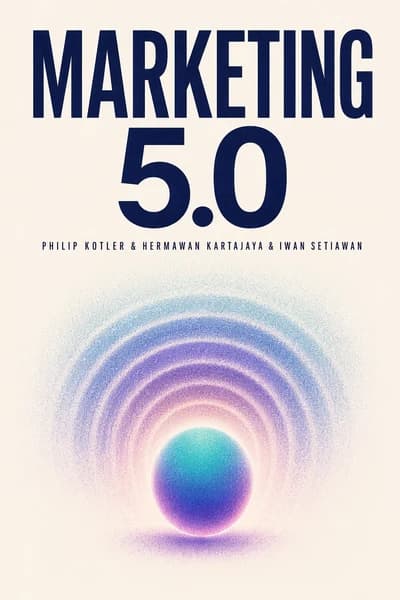
Marketing 5. 0
Technology for Humanity
Überblick über Marketing 5. 0
In "Marketing 5.0," Philip Kotler reveals how technology and humanity converge to transform business. Inspired by Japan's Society 5.0, this guide blends AI, AR, and human empathy to create personalized customer journeys. How will you navigate marketing's next frontier?
Kernthemen in Marketing 5. 0
- human-centric technology
- generational marketing gap
- data-driven decision making
- digital transformation strategy
- next-generation customer experience
Zitate aus Marketing 5. 0
Technology can enhance humanity rather than replace it.
Marketing 5.0 emerges as the application of human-mimicking technologies.
Human marketers are essential for interpreting customer motives.
Globalization's paradox is promoting economic inclusivity while creating inequality.
They value experiences over ownership, seek peer validation, and question established norms.
Personen in Marketing 5. 0
- Philip KotlerLead author and influential marketing thinker
- Hermawan KartajayaCo-author and marketing expert
- Iwan SetiawanCo-author and marketing strategist
Über den Autor
Über den Autor von Marketing 5. 0
Philip Kotler, Hermawan Kartajaya, and Iwan Setiawan, authors of Marketing 4.0: Moving from Traditional to Digital, are globally recognized pioneers in modern marketing strategy and digital transformation.
Kotler, hailed as the "father of modern marketing," revolutionized the field through his foundational Marketing Management textbook and the iconic Four Ps framework. Kartajaya, an Indonesian marketing visionary and founder of MarkPlus, Inc., bridges Eastern and Western business practices, while Setiawan specializes in data-driven customer engagement models.
Together, they explore the shift to omnichannel strategies, blending behavioral economics with emerging technologies. Their prior collaboration, Marketing 3.0: From Products to Customers to the Human Spirit, laid the groundwork for this evolution by emphasizing purpose-driven branding.
Kotler’s work is taught in top MBA programs worldwide, and his concepts underpin campaigns for Fortune 500 companies like IBM and Coca-Cola. Translated into over 25 languages, Marketing 4.0 has become essential reading for navigating today’s hyperconnected markets, with its framework adopted by startups and multinational corporations alike.
Zusammenfassung von Marketing 5. 0 herunterladen
Erhalten Sie die Marketing 5. 0-Zusammenfassung als kostenloses PDF oder EPUB. Drucken Sie es aus oder lesen Sie es jederzeit offline.
FAQ zu diesem Buch
Marketing 5.0 explores the integration of advanced technologies like AI, IoT, and data analytics with human-centric marketing strategies. It addresses modern challenges like generational shifts, digital divides, and sustainability, offering frameworks to balance automation with empathy. The book emphasizes using tech to enhance customer experiences while maintaining ethical and inclusive practices.
This book is essential for traditional and digital marketers, business leaders, and students seeking actionable strategies to navigate technological disruptions. It’s particularly valuable for professionals aiming to bridge generational gaps (Baby Boomers to Gen Alpha) and leverage AI, blockchain, or AR in campaigns.
Yes—it provides timely insights on post-pandemic digital transformation, combining Kotler’s foundational marketing principles with cutting-edge tech applications. Readers gain actionable steps for agile marketing, hyper-personalization, and corporate activism, making it a practical handbook for modern challenges.
- Generation Gap: Balancing strategies for tech-savvy Gen Z and traditional Baby Boomers.
- Prosperity Polarization: Addressing income inequality through inclusive marketing.
- Digital Divide: Bridging gaps between digitally engaged customers and underserved populations.
The book positions technology as a tool to mimic human capabilities, like AI for personalized campaigns and IoT for real-time customer insights. It stresses augmented intelligence—using tech to enhance, not replace, human creativity in areas like transmedia storytelling and CX design.
This philosophy advocates using tech to advance societal well-being, such as AI-driven sustainability initiatives or blockchain for ethical supply chains. It encourages brands to prioritize non-material needs (e.g., trust, community) alongside profit.
- Assess digital readiness across teams and tools.
- Migrate customers to digital channels via incentives (e.g., exclusive app offers).
- Adopt agile workflows for rapid tech integration.
CX will blend immersive tech (AR/VR), predictive analytics, and omnichannel consistency. Examples include AI chatbots resolving issues in real-time or IoT devices automating replenishment orders.
While retaining Product, Price, Place, Promotion, the book adds digital layers:
- Virtual try-ons for “Product”
- Dynamic pricing algorithms for “Price”
- Social commerce integrations for “Place”
The book acknowledges risks like over-reliance on automation and data privacy concerns. It advises ethical governance frameworks and hybrid strategies where humans oversee AI decisions.
Unlike Marketing 4.0’s focus on digital transition, this edition emphasizes tech-human synergy, with dedicated sections on blockchain, metaverse marketing, and corporate social responsibility.
Yes—it recommends cost-effective tools like chatbots for SMEs and microlocal targeting via geofencing. However, the book stresses scalability assessments to avoid over-investment in complex tech.
While light on case studies, it references Nike’s AR-powered app trials and Unilever’s blockchain-led sustainability audits as models for balancing innovation with ethical practices.