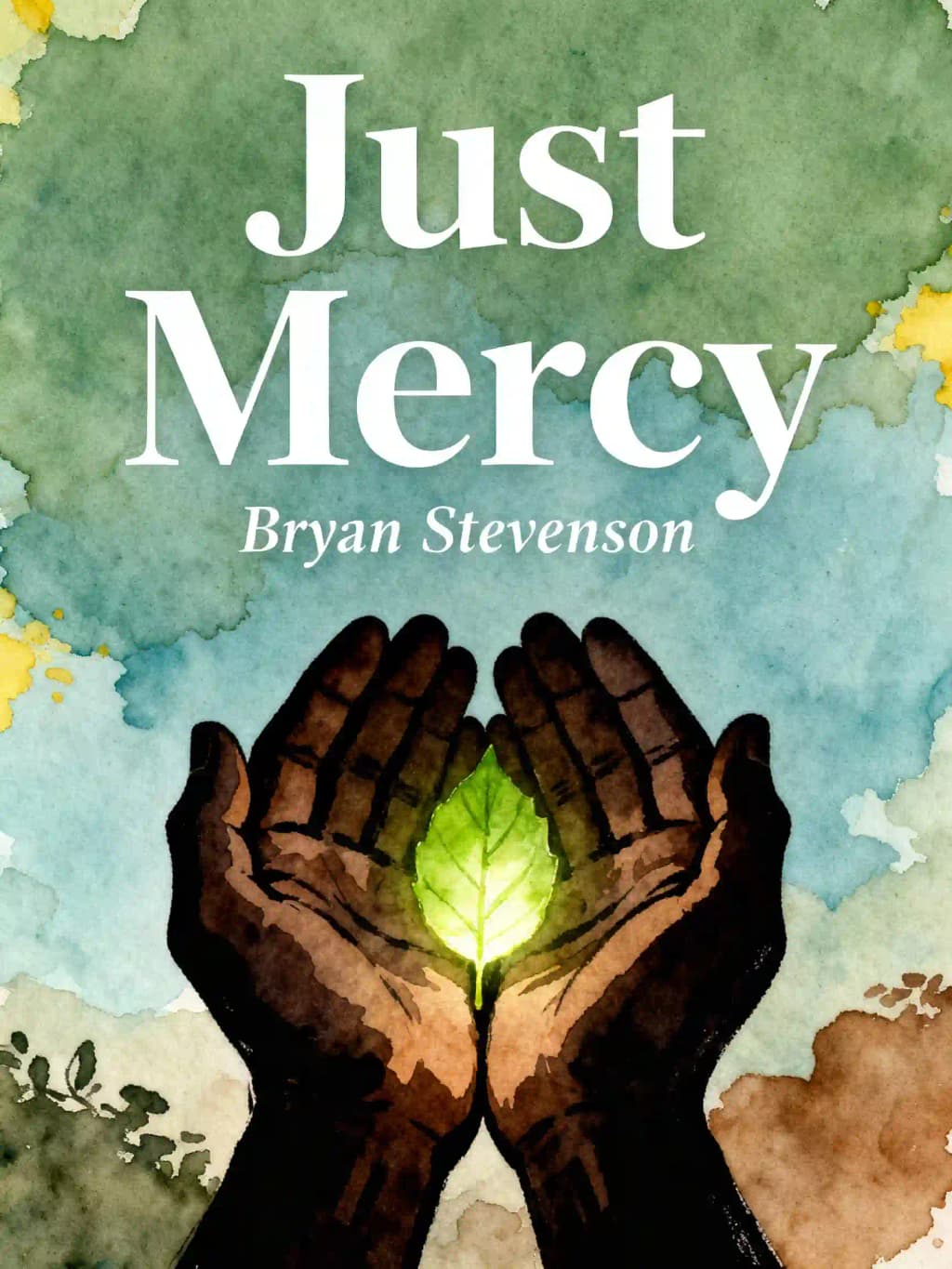
Bryan Stevenson's "Just Mercy" exposes America's broken justice system through heart-wrenching cases of wrongful convictions. Endorsed by Oprah and adapted into a film starring Michael B. Jordan, this New York Times bestseller asks: How can mercy triumph when the innocent are condemned?
Bryan Stevenson, author of the New York Times bestseller Just Mercy: A Story of Justice and Redemption, is a groundbreaking civil rights lawyer and founder of the Equal Justice Initiative (EJI), a Montgomery-based organization dedicated to defending the wrongfully convicted and challenging systemic racial inequality.
A Harvard-trained attorney and professor at New York University School of Law, Stevenson has argued pivotal U.S. Supreme Court cases, including the 2012 landmark ruling banning mandatory life sentences without parole for juveniles. His memoir intertwines legal expertise with firsthand accounts of defending clients like Walter McMillian, an innocent man sentenced to death, exposing flaws in America’s criminal justice system.
Stevenson’s 2012 TED Talk, “We Need to Talk About an Injustice,” has garnered millions of views, amplifying his advocacy for prison reform and historical reckoning. Recognized with a MacArthur “Genius Grant” and the Olof Palme Prize, he also spearheaded the 2018 opening of the National Memorial for Peace and Justice, a monument to victims of racial terror.
Just Mercy was adapted into an acclaimed 2020 film and named Best Nonfiction by the American Library Association, solidifying its status as a seminal work on social justice.
Just Mercy chronicles Bryan Stevenson’s legal career defending wrongfully convicted individuals, focusing on Walter McMillian, a Black man sentenced to death for a murder he didn’t commit. The book exposes systemic racism, unethical prosecutions, and the dehumanizing effects of mass incarceration, while advocating for mercy and justice reform. Stevenson intertwines personal stories with critiques of the U.S. criminal justice system.
This book is essential for readers interested in criminal justice reform, social activism, and memoirs about resilience. It resonates with law students, educators, and advocates working toward racial equity. Those seeking insights into systemic oppression, wrongful convictions, or the death penalty will find it particularly impactful.
Yes. The book is a memoir detailing Stevenson’s real-life experiences as a lawyer and founder of the Equal Justice Initiative (EJI). Central to the narrative is Walter McMillian’s wrongful conviction in 1980s Alabama, which Stevenson successfully overturned after years of litigation.
Key themes include:
Stevenson highlights disproportionate sentencing of Black defendants, police misconduct, and prosecutorial corruption. For example, Walter McMillian’s case involved coerced testimony, withheld evidence, and racial profiling. The book notes that 1 in 3 Black men born in the 21st century is likely to be incarcerated.
These lines underscore Stevenson’s critique of dehumanization and economic inequality in legal systems.
Stevenson humanizes statistics by detailing clients’ lives, such as:
These narratives illustrate systemic failures and the urgent need for empathy.
While praised for its compelling storytelling, some critics argue the book focuses narrowly on individual cases rather than broader policy solutions. Others note its emotional intensity may overwhelm readers new to criminal justice issues.
The book mobilizes readers by showing how legal advocacy, grassroots activism, and public education can challenge injustice. Stevenson’s EJI has exonerated over 140 death-row prisoners, demonstrating systemic reform is achievable.
Both books critique racial bias in U.S. courts, but Just Mercy emphasizes personal narratives and legal battles, while The New Jim Crow analyzes mass incarceration’s societal roots. Together, they provide complementary perspectives on racial justice.
Hope is framed as a survival tool for the wrongly incarcerated. For example, Walter McMillian’s eventual exoneration after six years on death row fuels Stevenson’s belief that “hopelessness is the enemy of justice”.
The book remains timely amid ongoing debates about police reform, wrongful convictions, and racial disparities in sentencing. Its lessons about empathy and equity continue informing legislative and cultural shifts toward restorative justice.
Erlebe das Buch durch die Stimme des Autors
Verwandle Wissen in fesselnde, beispielreiche Erkenntnisse
Erfasse Schlüsselideen blitzschnell für effektives Lernen
Genieße das Buch auf unterhaltsame und ansprechende Weise
Sometimes you need to get close to understand.
Justice in America has never been colorblind.
These weren't just legal cases; they were human beings trapped in a system designed to break them.
Zerlegen Sie die Kernideen von Just Mercy in leicht verständliche Punkte, um zu verstehen, wie innovative Teams kreieren, zusammenarbeiten und wachsen.
Destillieren Sie Just Mercy in schnelle Gedächtnisstützen, die die Schlüsselprinzipien von Offenheit, Teamarbeit und kreativer Resilienz hervorheben.

Erleben Sie Just Mercy durch lebhafte Erzählungen, die Innovationslektionen in unvergessliche und anwendbare Momente verwandeln.
Fragen Sie alles, wählen Sie die Stimme und erschaffen Sie gemeinsam Erkenntnisse, die wirklich bei Ihnen ankommen.

Von Columbia University Alumni in San Francisco entwickelt
"Instead of endless scrolling, I just hit play on BeFreed. It saves me so much time."
"I never knew where to start with nonfiction—BeFreed’s book lists turned into podcasts gave me a clear path."
"Perfect balance between learning and entertainment. Finished ‘Thinking, Fast and Slow’ on my commute this week."
"Crazy how much I learned while walking the dog. BeFreed = small habits → big gains."
"Reading used to feel like a chore. Now it’s just part of my lifestyle."
"Feels effortless compared to reading. I’ve finished 6 books this month already."
"BeFreed turned my guilty doomscrolling into something that feels productive and inspiring."
"BeFreed turned my commute into learning time. 20-min podcasts are perfect for finishing books I never had time for."
"BeFreed replaced my podcast queue. Imagine Spotify for books — that’s it. 🙌"
"It is great for me to learn something from the book without reading it."
"The themed book list podcasts help me connect ideas across authors—like a guided audio journey."
"Makes me feel smarter every time before going to work"
Von Columbia University Alumni in San Francisco entwickelt

Erhalten Sie die Just Mercy-Zusammenfassung als kostenloses PDF oder EPUB. Drucken Sie es aus oder lesen Sie es jederzeit offline.
Bryan Stevenson's "Just Mercy" isn't just a book-it's a profound journey into America's broken criminal justice system. Growing up in a segregated community, I witnessed how Confederate flags weren't merely symbols but boundaries marking where I wasn't welcome. These early experiences planted seeds that would later bloom into a lifelong mission for equality and justice. It wasn't until law school, however, that I truly began to understand the depth of injustice plaguing our system. Meeting Henry, a death row inmate who greeted me with unexpected kindness and spiritual hymns, shattered my preconceptions and ignited my commitment to represent the condemned. His humanity, preserved despite his circumstances, taught me that proximity to suffering reveals truths that statistics alone cannot convey. When we get close to marginalized communities, we discover not just their struggles but our shared humanity. This proximity doesn't just change how we see others-it transforms how we see ourselves, revealing our own capacity for both brokenness and mercy.
