Kapitel 4
The Natural Virtues of Foolishness
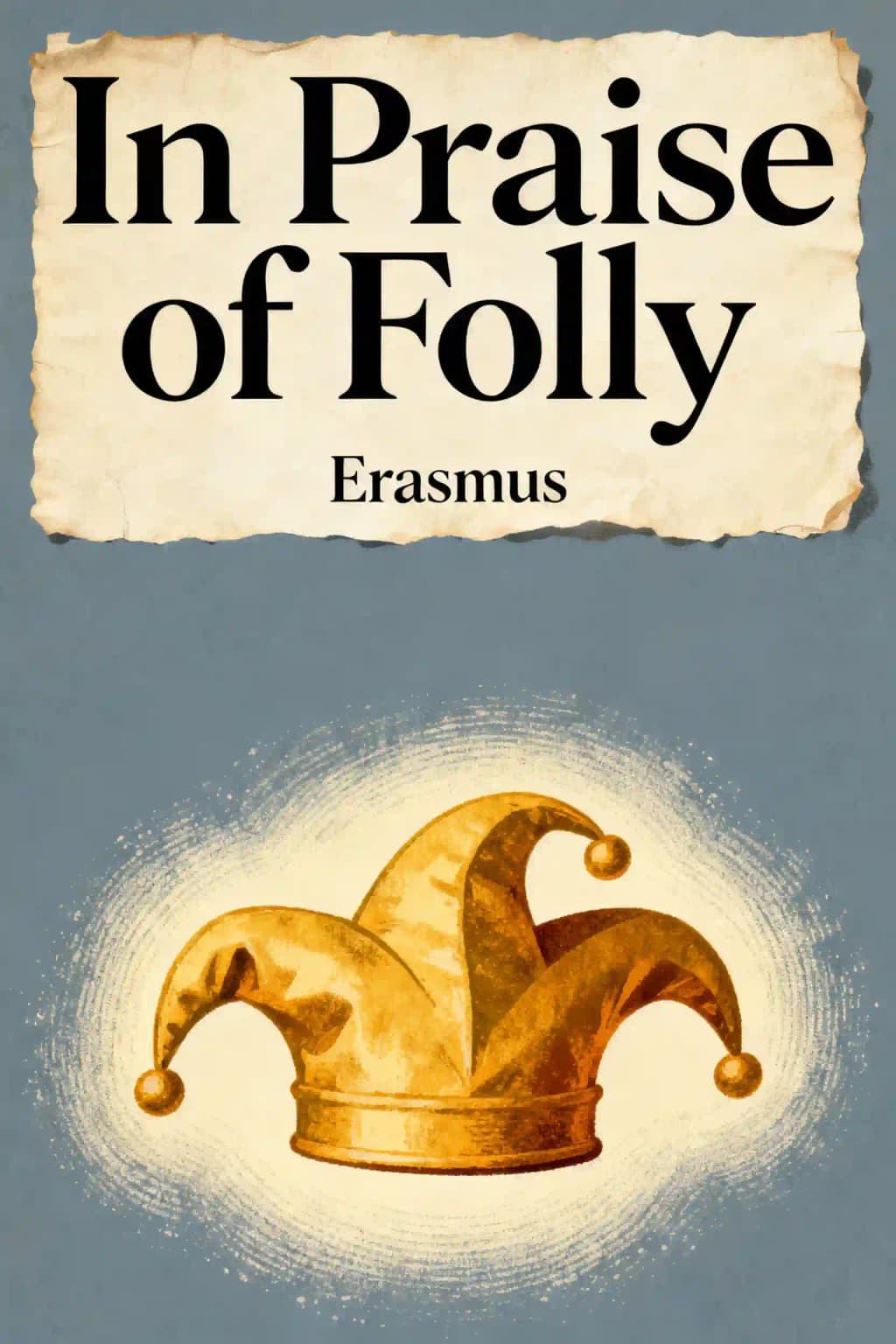
Folly begins her self-praise by establishing her divine credentials. She claims to be the daughter of Plutus (god of wealth) and Freshness, born not from "the gloomy head of Jupiter" like Minerva, but amid the carefree nymphs on the Islands of the Blessed. Unlike wisdom, which makes people anxious and pale from study, Folly brings joy, vitality, and natural happiness to humanity.
She points to children as her perfect disciples-beloved by all precisely because they lack reason and judgment. Their innocent charm, spontaneity, and unfiltered emotions represent humanity in its most delightful state. As people age and acquire wisdom, they become less lovable, more anxious, and increasingly burdened by knowledge. "The happiest times of life," Folly insists, "are the first and the last-childhood before reason has taken hold, and senility when reason has mercifully departed."
This celebration of natural foolishness extends to Folly's companions: Flattery, Self-Love, Forgetfulness, Pleasure, and others who make life bearable. Without Self-Love, Folly argues, who would marry, perform in public, or create art? "Remove this one affection from life," she declares, "and the orator's voice will freeze, the musician's melodies will please no one, the actor will be hissed off the stage, the poet and his inventions will be derided, the painter and his art will starve."
Folly's most compelling argument comes when she points to the fundamental role of illusion in human happiness. The wise man who sees everything clearly becomes paralyzed by truth-seeing the full extent of human corruption, the inevitability of death, and the vanity of all ambition. The fool, blissfully ignorant, pursues love, builds families, fights for causes, and enjoys simple pleasures without philosophical torment.
Consider friendship, Folly suggests. True friends overlook each other's flaws, even find them endearing. This selective blindness-"being blind to the warts of our friends"-is precisely what makes deep human connection possible. The wise person who sees all faults clearly becomes incapable of love. Similarly, marriage would collapse without the sweet delusions that make spouses overlook each other's defects and maintain harmony despite inevitable disappointments.
This defense of natural foolishness culminates in a radical proposition: perhaps nature and God intentionally limited human reason precisely to make happiness possible. The person who sees too clearly becomes paralyzed; the one who thinks too deeply becomes depressed. Folly's gift is the capacity for joy despite the objectively tragic circumstances of human existence.
Kapitel 5
The Folly of Human Institutions
Having established folly's role in individual happiness, Erasmus's Folly turns her attention to society's institutions, delivering a scathing critique disguised as praise. She begins with education, mocking scholars who waste their lives on trivial questions and meaningless distinctions. These academics "grow old in studying trifles, consuming their lives with nonsense," yet consider themselves supremely wise while contributing nothing of value to humanity.
The legal profession receives particularly pointed criticism. Lawyers, Folly claims, consider themselves the most learned of professionals while merely stringing together legal citations without understanding or consistency. "The profession that is most self-important," she observes, "is precisely the one most dependent on glorious nonsense." Their success comes not from wisdom but from the ability to complicate simple matters with technical jargon and ancient precedents, creating problems they alone can solve-for substantial fees.
Medicine fares little better. Folly notes that physicians enjoy unearned authority despite their frequent failures. "The more ignorant and reckless the physician," she remarks, "the more he is esteemed by bejeweled nobles," because people desperately want to believe in medical authority. Their Latin prescriptions, impressive-sounding diagnoses, and solemn pronouncements mask a profession built largely on guesswork and placebo effects.
Politicians and courtiers receive special attention as masters of beneficial folly. The successful courtier learns to flatter, dissemble, and adapt to the ruler's whims-all skills directly opposed to wisdom's honesty and consistency. Yet without these "foolish" arts, governance would collapse. "The man who would speak truth to power," Folly observes, "would quickly find himself without influence or position." The smooth functioning of government depends on strategic ignorance, tactical flattery, and the collective pretense that rulers possess special wisdom.
Even marriage and friendship-the foundations of human society-depend on mutual self-deception. Husbands overlook wives' flaws; wives tolerate husbands' deficiencies; friends convince themselves of each other's exceptional qualities. Without these "foolish" delusions, human bonds would dissolve under the harsh light of complete honesty.
The most brilliant aspect of this critique is how Erasmus uses Folly's voice to reveal uncomfortable truths while maintaining plausible deniability. By having Folly "praise" these professions for their dependence on deception and self-importance, he delivers devastating social criticism while technically avoiding direct accusation. The reader becomes complicit in the satire, nodding along as each profession's pretensions are systematically deflated through mock celebration.
Kapitel 6
The Church Under Folly's Microscope
Erasmus reserves his most daring critique for the Catholic Church-an institution he loved but believed had strayed far from its spiritual foundations. Through Folly's voice, he systematically exposes religious hypocrisy while maintaining the fiction that she's merely celebrating her influence in religious affairs.
Monks receive particularly pointed attention. Folly mocks those who "count their prayers by mathematical computations" and obsess over minute details of dress and ceremony while neglecting genuine spirituality. She describes monks who "place such stress on external observances that they think one heaven is hardly sufficient reward for their labors," yet show little genuine charity or humility. Their elaborate rituals, precise fasting schedules, and complicated prayer formulas have replaced the simple message of Christ with mechanical religion.
The clergy fare no better. Bishops "hunt after wealth more than souls" while cardinals who claim to be successors of the apostles live in princely luxury. Priests perform sacred rites mechanically while remaining ignorant of their meaning. "Many can't even read the texts they recite," Folly observes, yet they collect fees for every baptism, marriage, and funeral as if selling divine services.
Theologians receive special attention for their endless, pointless debates: "How many angels can dance on the head of a pin? Could God have taken the form of a woman, a devil, an ass, a gourd, or a stone? If so, how would a gourd have preached, performed miracles, or been crucified?" These abstract questions, Folly suggests, distract from Christ's simple message of love and charity.
The sale of indulgences-pardons for sins sold by the Church-receives particular scorn. Folly describes merchants of salvation who "prescribe precise periods of purgatory down to the year, month, day, and hour" and then sell relief from these invented punishments. People who purchase these pardons "measure out the duration of purgatory with hourglasses, calculating centuries, years, months, days, and hours as if using mathematical tables."
Even the papacy isn't spared. Folly describes popes who, though claiming to be Christ's vicars, accumulate wealth, wage wars, and live in splendor while neglecting spiritual duties. "If they considered what their vestments mean," she remarks, "their white robes would remind them of pure lives, their red hats of burning charity, their flowing robes of all-embracing love-but how many actually reflect on this?"
What makes this critique so powerful is that Erasmus delivers it not as an attack from outside the Church but as loving criticism from a devoted son. He doesn't question Catholic doctrine-only its implementation by fallible humans who have substituted ritual for genuine faith. By having Folly praise these religious hypocrisies, he exposes them more effectively than direct condemnation ever could.
Kapitel 7
The Foolishness of Christ: A Theological Paradox
In the work's most profound section, Erasmus daringly connects Christian theology to his concept of beneficial folly. Through Folly's voice, he reminds readers that Scripture itself celebrates a kind of divine foolishness that transcends human wisdom. This argument transforms what began as satire into a profound theological meditation.
Folly quotes the Apostle Paul: "The foolishness of God is wiser than men" and "God has chosen the foolish things of the world to confound the wise." She reminds readers that Christ himself said we must "become as little children" to enter heaven-embracing innocence over sophistication, faith over rationalization. The early Christians were considered fools by the sophisticated Romans and Greeks, yet their "foolish" belief in resurrection and divine love conquered the rational empire.
Christ's teachings themselves often celebrate values that worldly wisdom rejects: "Blessed are the poor in spirit," "Love your enemies," "The last shall be first." These paradoxical statements invert conventional wisdom, suggesting that true divine understanding appears as foolishness to worldly minds. The greatest saints were often considered madmen-St. Francis speaking to birds, martyrs joyfully accepting torture, hermits abandoning society for solitary communion with God.
Erasmus draws a striking contrast between two paths to knowledge of God. The first-the way of scholastic theology-involves complex syllogisms, citations of authorities, and abstract reasoning. This path, while intellectually impressive, often leads to pride and endless disputes rather than genuine spiritual insight. The second path-embracing "holy folly"-means accepting divine mysteries with childlike faith rather than trying to rationalize them into human systems.
"The entire Christian religion," Folly suggests, "bears a certain affinity to folly and in no way agrees with wisdom." The central Christian belief-that God became human and died on a cross to save sinners-appears absurd by rational standards. Yet this "foolishness" contains deeper wisdom than all philosophical systems. Those who try to explain Christianity through Aristotelian logic miss its essential character as a religion of paradox and mystery.
This theological argument represents Erasmus at his most brilliant. By connecting his satirical praise of folly to core Christian doctrines, he transforms what could have been mere mockery into a profound spiritual insight. The work comes full circle: what began as amusing satire culminates in the suggestion that perhaps folly, rightly understood, isn't opposed to wisdom but is a higher form of it-one that transcends human rationality and touches divine truth.
The paradox is complete when we realize that Folly, in her most insightful moments, stops being foolish at all. Her "praise" of religious folly becomes genuine praise of spiritual wisdom that appears foolish to worldly eyes. Erasmus thus suggests that the boundaries between wisdom and folly are not fixed but fluid-that sometimes what seems foolish contains the deepest wisdom.
Kapitel 8
The Therapeutic Value of Laughter
Throughout "In Praise of Folly," Erasmus demonstrates a profound understanding of humor's psychological and social value. Far from being mere entertainment, laughter becomes a therapeutic tool that helps humans cope with life's inevitable sufferings and absurdities. This insight anticipates modern psychological theories by centuries.
Folly argues that her jesters and fools serve an essential function in society-they can speak truths that would be dangerous coming from wise men. "The most bitter truths," she observes, "can be spoken by fools without offense, while the same words from a wise man's mouth might cost him his head." Kings and nobles keep jesters precisely because they need someone who can puncture their pretensions and remind them of reality without threatening their authority.
This therapeutic humor extends beyond courts to everyday life. Folly celebrates those who lighten tense situations with jokes, who use self-deprecation to defuse conflict, and who help others laugh at shared human weaknesses. "The ability to laugh at oneself," she suggests, "is perhaps the highest wisdom disguised as folly." Those who take themselves too seriously become rigid, defensive, and ultimately unhappy.
Erasmus demonstrates this principle through the very structure of his work. By framing his social critique as a humorous oration by Folly, he makes medicine go down with honey. Readers laugh at his descriptions of pompous theologians or corrupt clergy, and in that laughter find themselves more open to considering the underlying criticisms. The humor creates psychological distance that allows for self-reflection without triggering defensive reactions.
This approach reflects Erasmus's humanist philosophy that education should be engaging rather than punitive. Unlike stern moralists who condemned human weakness, he recognized that gentle mockery often proves more effective than harsh criticism. "People resist direct attacks on their follies," Folly observes, "but they can laugh at those same follies when presented as universal human traits rather than personal failings."
The therapeutic value of this approach extends to the author himself. Writing during a period of illness while staying with Thomas More, Erasmus found that composing this satirical work lifted his spirits. The creative act of transforming social frustrations into comedy provided catharsis and perspective. Rather than becoming bitter about ecclesiastical corruption or academic pedantry, he transformed these observations into art that could both entertain and reform.
This understanding of humor's psychological function makes "In Praise of Folly" remarkably modern. Centuries before Freud wrote about humor as a release mechanism or modern psychologists studied laughter's role in stress reduction, Erasmus recognized that our capacity for humor isn't peripheral to human nature but central to our psychological resilience. In a world full of tragedy, injustice, and inevitable death, the ability to laugh becomes not a trivial distraction but an essential survival skill.
Kapitel 9
A Renaissance Masterpiece's Enduring Relevance
Nearly five centuries after its publication, "In Praise of Folly" remains startlingly relevant to contemporary life. Its insights into human psychology, institutional dysfunction, and the limits of rationality speak directly to our modern condition, proving that Erasmus's genius transcended his historical moment.
Consider how perfectly his critique of academic specialization applies to today's universities, where scholars still often pursue increasingly narrow questions while losing sight of broader human concerns. His mockery of physicians who hide uncertainty behind technical jargon resonates in an age of medical specialization and pharmaceutical marketing. His observations about politicians who prioritize appearance over substance could describe any modern election cycle.
The work's psychological insights seem particularly prescient. Erasmus understood the role of beneficial self-deception long before cognitive psychologists documented our various optimistic biases. His recognition that excessive self-awareness can lead to paralysis and depression anticipates existentialist philosophy and modern research on overthinking. His celebration of childhood's innocent joy reflects what psychologists now call "flow states"-moments when we become fully absorbed in activity without self-consciousness.
Perhaps most relevant is Erasmus's nuanced view of human rationality. Writing at the dawn of the modern age, when faith in human reason was beginning its ascendance, he offered a crucial counterbalance-not rejecting reason, but recognizing its limits. This perspective speaks powerfully to our current moment, when technological rationality has delivered remarkable benefits alongside unforeseen problems. Erasmus reminds us that human flourishing requires more than logical calculation; it demands the "foolish" virtues of love, faith, and hope that transcend rational analysis.
The work's approach to religious reform also offers a model for constructive criticism. Erasmus demonstrated how to love an institution while critiquing its failures-a middle path between uncritical acceptance and complete rejection. He showed how humor could serve serious moral purposes without descending into mere mockery. This balanced approach to institutional critique remains as valuable as ever in our polarized times.
What ultimately makes "In Praise of Folly" timeless is its profound humanity. Erasmus embraced the full complexity of human nature-our rationality and our irrationality, our nobility and our absurdity. Rather than demanding impossible perfection, he celebrated our imperfect, contradictory nature. His vision of wisdom includes recognizing our own foolishness; his path to virtue acknowledges our inevitable weaknesses.
In a world still torn between ideological certainties, Erasmus offers the liberating perspective that perhaps we are all, in different ways, fools-and that acknowledging this shared folly might be the beginning of true wisdom. Five hundred years on, his gentle laughter still echoes, inviting us to view ourselves and others with more compassion, humor, and genuine understanding.