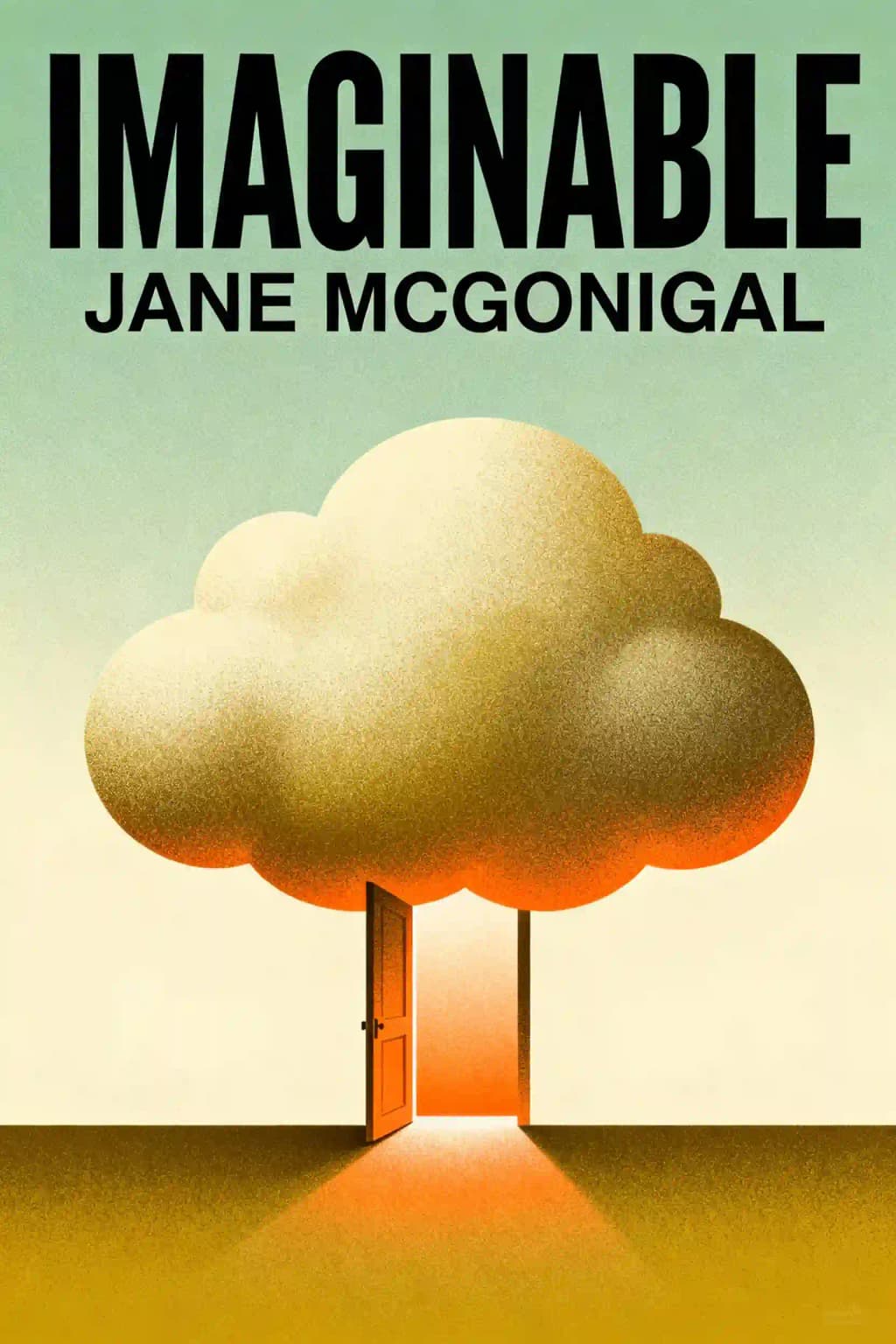
In "Imaginable," futurist Jane McGonigal reveals how to anticipate seemingly impossible futures. Endorsed by innovation titan Peter Diamandis as "more than a book - a mindset upgrade," it transforms pandemic-era anxiety into "urgent optimism" through thought experiments that make you excited about tomorrow, not fearful.
Jane McGonigal, New York Times bestselling author of Imaginable: How to See the Future Coming and Feel Ready for Anything—Even Things That Seem Impossible Today, is a pioneering game designer and futurist renowned for merging gameplay with real-world problem-solving. As Director of Game Research and Development at the Institute for the Future, her work bridges speculative fiction and practical strategies to help individuals and organizations build resilience against uncertainty.
A PhD holder in Performance Studies from UC Berkeley, McGonigal has designed groundbreaking alternate reality games like SuperBetter—which has empowered over 1 million players to overcome health challenges—and World Without Oil, commissioned by institutions including the World Bank and American Heart Association.
Her expertise in using games to tackle global crises, from climate change to mental health, is showcased in her other influential works, Reality is Broken and SuperBetter, which explore how game mechanics can enhance motivation and collaboration. A two-time TED speaker with 15+ million views, McGonigal’s ideas have been featured in The New York Times, Wired, and NPR.
Imaginable distills her decades of research into actionable techniques for future-proofing decisions, combining neuroscience insights with her signature approach to "urgent optimism." The book has been adopted by Fortune 500 companies and academic programs worldwide as a guide to navigating disruption.
Imaginable explores how to train your mind to envision and prepare for radical futures using neuroscience-backed strategies. McGonigal combines game design principles with psychological research to help readers build mental resilience, practice "future simulation" exercises, and reframe uncertainty as a solvable challenge. The book argues that imagining worst-case scenarios empowers proactive problem-solving for crises like climate change or technological disruption.
This book is ideal for futurists, leaders, and anyone facing rapid change in their career or personal life. Educators, policymakers, and innovators will appreciate its actionable frameworks for stress-testing ideas against potential futures. McGonigal’s approach also appeals to gamers interested in applying collaborative problem-solving skills to real-world challenges.
Yes—critics praise its blend of scientific rigor and practicality. The book offers 10+ exercises like “time traveling” to 10 years ahead or role-playing dystopian scenarios, making abstract futurism tangible. With examples from pandemic preparedness to AI ethics, it’s particularly valuable for post-2025 readers navigating accelerating technological shifts.
Core ideas include:
While Reality is Broken focused on gaming’s societal benefits and SuperBetter tackled personal resilience, Imaginable scales these ideas to collective futures. It expands on her EVOKE and Superstruct games, teaching readers to apply "massively multiplayer foresight" to climate, health, and tech ethics.
This exercise involves vividly imagining yourself 10 years in the future, navigating hypothetical scenarios like AI-dominated workplaces or climate migrations. By journaling from this “future self” perspective, you build neural pathways to handle ambiguity and spot early warning signs of emerging risks.
McGonigal proposes “climate victory” games where players strategize net-zero policies or disaster responses. One case study shows how simulating 2040 food shortages helped urban planners design vertical farming networks. The book emphasizes turning eco-anxiety into collaborative action through time-bound missions.
Some reviewers note the exercises require significant time investment and group participation, which may limit solo readers’ results. Others argue its optimism about collective problem-solving underestimates systemic barriers to change. However, most praise its evidence-based approach to overcoming “future fatigue”.
The book teaches “job mutation” thinking: analyzing how AI/automation might transform your role, then gaming out upskilling paths. A chapter profiles workers who used future scenarios to transition into hybrid tech-ethics roles during industry disruptions.
Notable exercises:
With AI adoption accelerating and climate thresholds nearing, McGonigal’s methods help individuals and organizations stress-test decisions against multiple futures. The book’s focus on “adaptive hope” resonates amid global polycrises, offering tools to avoid paralysis in uncertain times.
Both address existential risks, but Imaginable focuses on psychological readiness rather than statistical risk analysis. McGonigal emphasizes emotional resilience and everyday practice, while Ord prioritizes institutional reforms. They complement each other for readers seeking both personal and systemic strategies.
Erlebe das Buch durch die Stimme des Autors
Verwandle Wissen in fesselnde, beispielreiche Erkenntnisse
Erfasse Schlüsselideen blitzschnell für effektives Lernen
Genieße das Buch auf unterhaltsame und ansprechende Weise
This isn't fortune-telling; it's deliberate imagination training.
Ten years lifts the ceiling on our imagination.
We set maximal goals focused on the best possible outcomes.
Imagining anything in your far future increases motivation.
The most valuable aspect of future simulations isn't perfect prediction but preparing our minds.
Zerlegen Sie die Kernideen von Imaginable in leicht verständliche Punkte, um zu verstehen, wie innovative Teams kreieren, zusammenarbeiten und wachsen.
Erleben Sie Imaginable durch lebhafte Erzählungen, die Innovationslektionen in unvergessliche und anwendbare Momente verwandeln.
Fragen Sie alles, wählen Sie Ihren Lernstil und gestalten Sie Erkenntnisse, die wirklich zu Ihnen passen.

Von Columbia University Alumni in San Francisco entwickelt
"Instead of endless scrolling, I just hit play on BeFreed. It saves me so much time."
"I never knew where to start with nonfiction—BeFreed’s book lists turned into podcasts gave me a clear path."
"Perfect balance between learning and entertainment. Finished ‘Thinking, Fast and Slow’ on my commute this week."
"Crazy how much I learned while walking the dog. BeFreed = small habits → big gains."
"Reading used to feel like a chore. Now it’s just part of my lifestyle."
"Feels effortless compared to reading. I’ve finished 6 books this month already."
"BeFreed turned my guilty doomscrolling into something that feels productive and inspiring."
"BeFreed turned my commute into learning time. 20-min podcasts are perfect for finishing books I never had time for."
"BeFreed replaced my podcast queue. Imagine Spotify for books — that’s it. 🙌"
"It is great for me to learn something from the book without reading it."
"The themed book list podcasts help me connect ideas across authors—like a guided audio journey."
"Makes me feel smarter every time before going to work"
Von Columbia University Alumni in San Francisco entwickelt

Erhalten Sie die Imaginable-Zusammenfassung als kostenloses PDF oder EPUB. Drucken Sie es aus oder lesen Sie es jederzeit offline.
Have you ever been blindsided by a world-changing event that seemed to come out of nowhere? In 2020, as the pandemic upended our lives, many described it as "unimaginable." Yet twelve years earlier, Jane McGonigal had simulated a global respiratory pandemic with remarkable accuracy. Her 2008 Superstruct simulation predicted mask resistance, school closures impacting working mothers, and religious gatherings becoming superspreader events. This wasn't coincidence - it was the result of deliberate future-thinking techniques that anyone can learn. The most valuable aspect of future simulations isn't perfect prediction but preparing our minds for flexibility and resilience. These mental exercises create lasting habits, particularly watching for early signals that imagined scenarios might be becoming reality. By practicing these techniques, we develop what McGonigal calls "urgent optimism" - the ability to recognize serious challenges while maintaining realistic hope about our capacity to address them.
When does the future begin? Most people say ten years-a timeframe creating what McGonigal calls "time spaciousness," the empowering feeling we have enough time for significant changes. This ten-year horizon isn't arbitrary. History shows major social movements and transformative technologies typically need a decade to achieve historic victories or global impact. With this timeline, we become less risk-averse and more creative, setting "maximal goals" focused on best possible outcomes rather than "minimal goals" that merely avoid negative ones. Counterintuitively, feeling "time-rich" rather than "time-poor" often leads to faster action and greater accomplishment. Imagining ten years ahead is powerful because your brain draws on past experiences, hopes, fears, and intuitions to invent something new-creating neurological pathways and a "memory of the future." Scientists call this episodic future thinking (EFT)-mentally transporting yourself forward to pre-experience future events. Unlike casual daydreaming, EFT grounds itself in reality, connecting your present self with plausible future experiences. It activates eleven brain regions and involves three types of sense-making: scene construction, opportunity detection, and emotional pre-feeling. Research shows EFT reduces depression and anxiety symptoms by training the imagination to construct detailed scenes with positive possibilities. People who vividly imagine their personal futures make healthier choices, maintain habits, save money, and stick with long-term resolutions.
Professional futurists use "future scenarios" - detailed descriptions of particular futures where at least one thing is dramatically different from today - to navigate ten years ahead. These scenarios explain what has changed, how things work, and what's considered normal in this alternate reality. McGonigal shares the example of "Thank You Day," where citizens receive $2,000 from the government - half to keep and half to give to essential workers from a national registry. This addresses economic inequality and social division by creating a gratitude ritual while supporting undervalued essential workers. Scenarios are powerful imagination tools because they provide the essential facts of a future reality, allowing your brain to bypass the challenging "semantics" part of scene construction. Rather than getting stuck trying to envision a specific future, scenarios let you jump straight to personalizing the experience and considering your actions and feelings. McGonigal emphasizes that scenarios aren't fixed - if something seems implausible or undesirable, you can rewrite it, which mirrors reality itself. Rewriting scenarios becomes practice for changing the actual future.
"Any useful statement about the future should at first seem ridiculous." This principle, known as Dator's Law, has proven true repeatedly throughout history, from the initial dismissal of the internet to the widespread adoption of smartphones. The scenarios that catch us off guard aren't the reasonable ones but the possibilities we dismiss as impossible. McGonigal introduces a brainstorming game called "Stump the Futurist" where participants list things they believe cannot possibly change in the next decade, while futurists look for clues that these "unchangeable truths" might already be changing. She emphasizes the importance of seriously imagining future threats, particularly high-impact, low-probability (HILP) events. The "future memories" created through simulation provide psychological benefits beyond mere preparation. When imagined scenarios actually occur, we experience recognition rather than shock, giving us confidence and agency. This "pre-exposure therapy" for difficult futures acts like a vaccine against future shock, allowing people to respond adaptively rather than reactively when faced with real crises. By deliberately exploring outlandish scenarios, we expand our range of possible futures and increase our adaptive capacity.
Our future selves are neurologically strangers to us. When imagining your future self, your brain's medial prefrontal cortex powers down, treating future-you as someone else. This makes it harder to make decisions benefiting our future selves - we save less, procrastinate more, and care less about long-term challenges like climate change. McGonigal distinguishes between "easy empathy" (directly relating to others' experiences) and "hard empathy" (requiring creative effort when we lack personal experience with someone's situation). Hard empathy broadens perspective, deepens humanity, heals social rifts, and makes relationships more resilient. Research across 63 countries shows societies with higher hard empathy scores enjoy greater well-being and prosocial behavior. The most effective way to develop hard empathy is finding stories about people in radically different circumstances, then imagining your life transformed by their reality. Far-future thinking and hard empathy reinforce each other as cross-training for your imagination. When you practice feeling how someone else's life differs from yours, you become better at envisioning all kinds of change.
A landmark psychology experiment showed that when we learn our actions don't matter in one situation, we carry that belief to others, remaining passive even when solutions exist. This "learned helplessness" theory was eventually reversed by neuroscientist Steven F. Maier, who discovered our brains actually assume helplessness by default. The passive "freeze" response is our most hardwired reaction to adversity. We overcome this by activating brain pathways that turn off this instinct through experiences that prove our actions matter. This explains why gamers often show greater agency-games train us to overcome challenges and build confidence in affecting outcomes. Each of us has a "you-shaped hole"-unique skills, knowledge, communities, passions and values we bring to future challenges, regardless of whether they seem "essential." Every strength could potentially serve others during crises. Simulating future scenarios isn't about predicting specific events but building mental resilience, psychological flexibility, and "learned helpfulness" for any unthinkable situation. Like dreams preparing our brains for reality, these impossible futures help us remain calm and optimistic when facing actual shocks. When 2033 arrives, you might experience deja vu-not because these exact scenarios occurred, but because you recognize the feelings: society's extreme actions, hope mixed with uncertainty, and the clarity from doing difficult but necessary things. Despite challenges ahead, you have something important to contribute. The future isn't just bright with hope-it's also dark with unknowability, meaning it can be anything we imagine. Our gift isn't prediction but creativity. To tackle our biggest challenges, we need mental time trips and social simulations that help us envision different possibilities. Remember that "to make a difference" literally means "to make something different"-which our imagination proves is always possible.