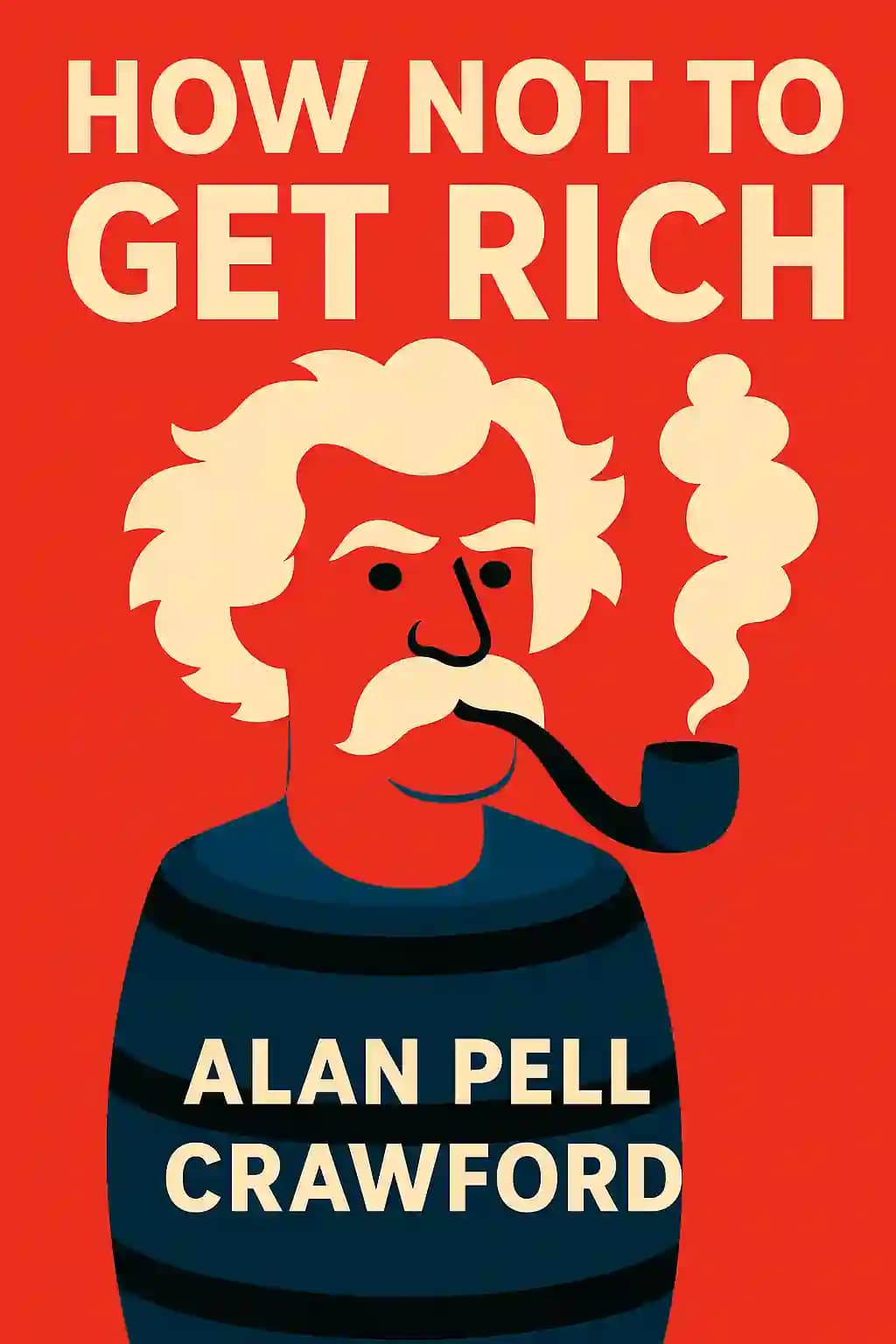
Mark Twain, literary genius but financial disaster. Crawford's "How Not to Get Rich" reveals the shocking money blunders behind America's beloved humorist. Even brilliant minds make costly mistakes - a cautionary tale that turns Twain's financial follies into your money wisdom.
Alan Pell Crawford, acclaimed historian and bestselling author of How Not to Get Rich: The Financial Misadventures of Mark Twain, specializes in uncovering the human complexities behind iconic American figures.
A seasoned journalist whose work has graced The Wall Street Journal, The Washington Post, and The Atlantic, Crawford merges rigorous scholarship with narrative flair, exploring themes of ambition, legacy, and financial folly in historical contexts. His expertise in political history is further showcased in Twilight at Monticello: The Final Years of Thomas Jefferson, a Washington Post bestseller that delves into Jefferson’s retirement, and the 2024 release This Fierce People, a groundbreaking analysis of the Revolutionary War’s southern theater.
Crawford’s career spans decades of illuminating the personal struggles and societal impact of leaders like James Madison and John Adams. A frequent speaker at historical forums, he transforms archival research into accessible insights, revealing how past missteps resonate today.
How Not to Get Rich exemplifies his knack for blending wit with meticulous analysis, charting Mark Twain’s financial unraveling as a cautionary tale of Gilded Age excess. Crawford’s works, required reading in university history courses, continue to shape public understanding of America’s founding era and its enduring lessons.
This book chronicles Mark Twain’s hilarious series of failed financial ventures during America’s Gilded Age. Despite striking silver, inheriting vast land, and investing in inventions, Twain’s relentless pursuit of wealth led to bankruptcy. Alan Pell Crawford blends biography and economic history, revealing how Twain’s misadventures mirrored the era’s speculative excesses and unchecked optimism.
Fans of Mark Twain, Gilded Age history, or humorous financial failures will enjoy this book. It’s ideal for readers interested in entrepreneurial cautionary tales or those seeking insights into 19th-century America’s economic culture. Business enthusiasts will appreciate Crawford’s analysis of Twain’s misplaced inventiveness.
Twain’s disasters included:
Crawford depicts Twain as an irrepressible optimist whose business naivety clashed with his literary genius. Despite comical failures, Twain remained convinced “next year” would bring riches—a trait mirroring America’s speculative spirit.
The book frames Twain’s failures as symbolic of America’s boom-bust cycles. Crawford argues Twain’s misplaced faith in innovation and speculative ventures epitomized the era’s reckless capitalism and inflated optimism.
Yes. Crawford meticulously documents Twain’s ventures using financial records, letters, and historical context. He converts 19th-century dollar amounts into modern equivalents, emphasizing the scale of Twain’s losses.
Unlike traditional biographies focusing on Twain’s literary career, this book zeroes in on his financial blunders. It complements works like Ron Powers’ Mark Twain: A Life by highlighting his lesser-known role as a serial entrepreneur.
Some reviewers argue Crawford oversimplifies Twain’s motivations, downplaying his genuine literary ambitions. Others note the book’s narrow focus on finances skips deeper analysis of Twain’s personal struggles.
In an age of crypto crashes and startup burnouts, Twain’s story is a timeless reminder of the risks in chasing trends. Crawford’s wit and Twain’s relatable blunders make 19th-century folly feel modern.
Yes. The audiobook version captures Twain’s humor through lively narration, ideal for fans of comedic history. No film adaptations exist yet.
Erlebe das Buch durch die Stimme des Autors
Verwandle Wissen in fesselnde, beispielreiche Erkenntnisse
Erfasse Schlüsselideen blitzschnell für effektives Lernen
Genieße das Buch auf unterhaltsame und ansprechende Weise
"Whatever I touch turns to gold," he once declared.
"We were always going to be rich-next year," Twain later recalled.
Literature was merely Twain's side hustle.
"By temperament, I was the kind of person that DOES things."
"Nothing that glitters is gold."
Zerlegen Sie die Kernideen von How not to get rich in leicht verständliche Punkte, um zu verstehen, wie innovative Teams kreieren, zusammenarbeiten und wachsen.
Destillieren Sie How not to get rich in schnelle Gedächtnisstützen, die die Schlüsselprinzipien von Offenheit, Teamarbeit und kreativer Resilienz hervorheben.

Erleben Sie How not to get rich durch lebhafte Erzählungen, die Innovationslektionen in unvergessliche und anwendbare Momente verwandeln.
Fragen Sie alles, wählen Sie die Stimme und erschaffen Sie gemeinsam Erkenntnisse, die wirklich bei Ihnen ankommen.

Von Columbia University Alumni in San Francisco entwickelt
"Instead of endless scrolling, I just hit play on BeFreed. It saves me so much time."
"I never knew where to start with nonfiction—BeFreed’s book lists turned into podcasts gave me a clear path."
"Perfect balance between learning and entertainment. Finished ‘Thinking, Fast and Slow’ on my commute this week."
"Crazy how much I learned while walking the dog. BeFreed = small habits → big gains."
"Reading used to feel like a chore. Now it’s just part of my lifestyle."
"Feels effortless compared to reading. I’ve finished 6 books this month already."
"BeFreed turned my guilty doomscrolling into something that feels productive and inspiring."
"BeFreed turned my commute into learning time. 20-min podcasts are perfect for finishing books I never had time for."
"BeFreed replaced my podcast queue. Imagine Spotify for books — that’s it. 🙌"
"It is great for me to learn something from the book without reading it."
"The themed book list podcasts help me connect ideas across authors—like a guided audio journey."
"Makes me feel smarter every time before going to work"
Von Columbia University Alumni in San Francisco entwickelt

Erhalten Sie die How not to get rich-Zusammenfassung als kostenloses PDF oder EPUB. Drucken Sie es aus oder lesen Sie es jederzeit offline.
Mark Twain-America's beloved literary genius-harbored a lifelong obsession with wealth that repeatedly led him to financial ruin. Born Samuel Clemens in 1835, Twain entered the world during America's greatest economic transformation. While contemporaries like Rockefeller and Carnegie built lasting empires, Twain squandered millions on fantastical inventions and ill-conceived schemes. "Whatever I touch turns to gold," he once declared-before losing it all. His father had instilled this wealth obsession by claiming the family's Tennessee land would someday make them "fabulously wealthy." This inheritance became what Twain called "the curse of it"-a perpetual belief that prosperity waited just around the corner. This tantalizing prospect of imminent wealth would haunt him throughout his life, driving him to pursue fortune through increasingly desperate ventures while his true talent-writing-remained merely his means to financial ends.