Kapitel 1
The Transformative Journey Through Life's Final Third
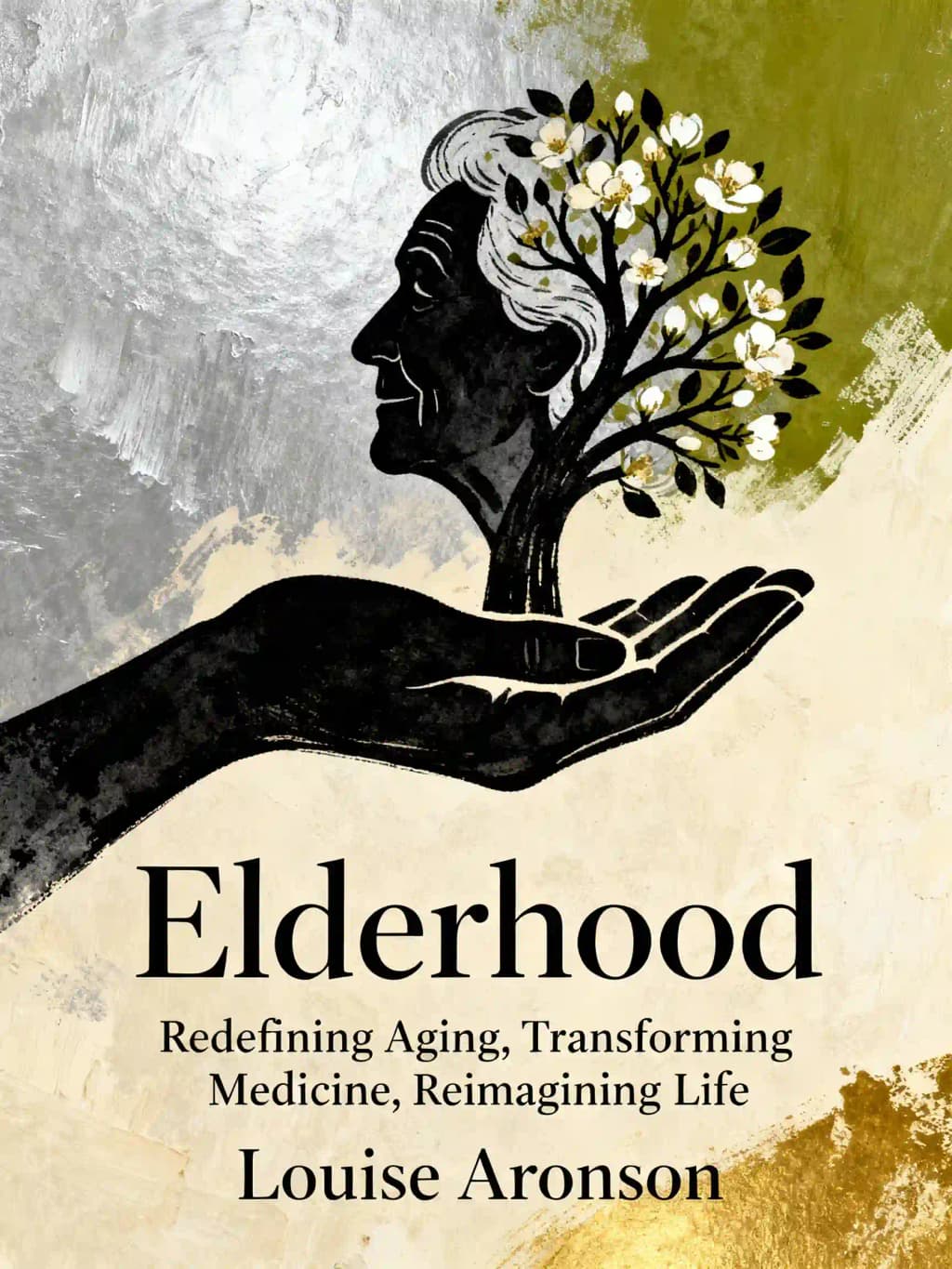
When Dr. Louise Aronson's memoir "Elderhood" hit shelves in 2019, it struck a nerve in American culture. Named a Pulitzer Prize finalist and a New York Times bestseller, the book arrived at a critical moment as baby boomers began crossing the threshold into their senior years en masse. Unlike typical medical memoirs, Aronson's work transcends the clinical, weaving personal stories with scholarly insights to reimagine our final decades not as a period of inevitable decline, but as a distinct and valuable life stage worthy of the same attention we give to childhood and adulthood. Oprah Winfrey called it "a book that could change the way we age," while The Washington Post praised it as "an intimate look at aging and death in America." Beyond accolades, the book sparked a movement to reclaim the word "elderhood" itself, challenging our youth-obsessed culture's dismissal of life's final third.
Kapitel 2
Redefining the Final Third of Life
Our humanity is our burden and our life - we need not battle for it, but accept it, a challenge infinitely more difficult.
Aronson entered medicine wanting to help people, only to discover medical education focused more on biology and diseases than humanity and healing. When she finally began working with patients in her third year, medicine became what she'd hoped - meaningful human connection combined with opportunities to help people in need.
Nearly thirty years later, she still finds joy in being a doctor, but recognizes how medicine undermines its mission by dismissing knowledge that can't be easily measured or experimented upon. This is especially true for patients over sixty, who taught her what questions truly matter as we age.
When Professor Guy Micco asked medical students to write their first associations with the word "old," they responded with "wrinkled," "bent over," "slow," "weak," and "fragile." Yet when prompted with "elder," they wrote "wise," "respect," "leader," and "experience." This disconnect reveals how our culture views aging negatively, missing the opportunity to examine the final third of life with the same curiosity and rigor as the first two-thirds.
Working as a geriatrician, Aronson battled a medical system that prioritizes treatment over prevention, parts over wholes, and machines over humans. Her patients could easily get expensive procedures but not basic services that would improve their quality of life. Her own health challenges gave her perspective on how medicine is broken for everyone. We've created a society that does everything to stay alive yet dreads being old.
As Aristotle noted, a whole has a beginning, middle, and end. With modern longevity, most of us can expect a third act-elderhood-lasting decades. This isn't a repeat of earlier acts but contains our story's climax and resolution. Aronson examines old age in new ways, drawing from science, medicine, history, and culture to help us reimagine elderhood as something meaningful and satisfying.
Kapitel 3
Early Lessons in Aging: Personal and Professional
Among my earliest memories of old age are my great-grandmother's breasts. At six years old, I watched in shock as Granny casually disrobed in her dressing room, revealing her aged body as she chatted and dressed. The experience highlighted how differently I perceived older family members - as a separate class with formal clothes, behaviors, and living spaces.
My grandfather provided contrasting memories - thrilling us grandchildren by pretending to let his car freewheel down San Francisco's steepest hills, creating adventures that made time with him extraordinarily fun.
These memories reveal what I should have understood about old age but didn't. I focused on Granny's exposed breasts rather than considering how aging affected her life, and I enjoyed my grandfather's playfulness without appreciating how much he relished grandparenthood. Gender shaped their experiences dramatically - Granny lived a quiet widow's life of occasional outings and family obligations, while my grandfather, after retiring, enjoyed dating, travel, and pursuing interests with fewer social restrictions.
In June 1992, I returned to San Francisco with my new MD to begin residency. While working in the Emergency Department felt manageable because I was surrounded by skilled professionals, my weekly clinic appointments were more daunting. There, patients ranging from nineteen to ninety would arrive expecting competent care from their new internist - and instead got me, a brand-new doctor.
Every three years, outpatient clinics were passed from graduating residents to new interns, with patients often clustered by disease type or demographic characteristics. My clinic had a disproportionate number of older patients.
At twenty-something, "old" seemed a uniform category to me then. I saw little distinction between sixty-five and ninety, though they're a generation apart. Among my elderly patients was Anne Rowe, age eighty-nine, who became special to me. Through her care, I learned about geriatric medication dosing and the dangers of common drugs like NSAIDs in the elderly.
When Anne had to place her sister in a nursing home, she became deeply depressed. I prescribed a new antidepressant at the standard dose, failing to consider her age and size. When her son brought her in later barely responsive, she was hospitalized with dangerously low sodium levels - a complication of the medication I'd prescribed. This humbling experience taught me why geriatrics needed to be a distinct specialty, though I wouldn't fully understand that for several more years.
Kapitel 4
The Historical Context of Aging and Medicine
Eight hundred years before Christ, Greco-Roman and Egyptian thinkers developed various theories about aging. Hippocrates cataloged ailments specific to the elderly, while Egyptian medical texts included instructions for transforming old men into youths. Plato's Republic featured discussions of how aging varies among individuals. Aristotle proposed his pneuma theory, suggesting a finite life force that diminished over time. Cicero argued that while older people might not do what young people do, they accomplish "much greater and better things" through "talent, authority, judgment." Galen maintained that aging was natural, not pathological, and taught that proper diet and behavior could slow aging.
Two millennia later, our response remains similar. Google and others echo the Egyptians with campaigns to "end aging forever." The UK appointed a minister of loneliness for the elderly, while medical care of older adults remains unstandardized and unpopular. Throughout history, societies have often considered their oldest citizens less than fully human.
After Greece fell, advances in elder care came from the Middle East. In Europe, religious views dominated until the Scientific Revolution, when philosophers like Descartes believed humans could prolong life through research. By the eighteenth century, European understanding distinguished normal aging from disease, recognizing chronic conditions and different disease presentations in old age.
The nineteenth century brought a significant reconceptualization, acknowledging poverty's impact on health and communities' social responsibilities toward older citizens. Despite scientific advances, medical care for the elderly remained neglected until the 1930s, when surgeon Marjory Warren advocated for rehabilitation of sick elderly patients. She demonstrated that with appealing surroundings, hope, and help, many older patients could return to regular lives.
Although geriatrics wasn't an official specialty in the United States until the 1970s, medical interest in elder care periodically surged during the twentieth century. Throughout history, the experience of being old has been shaped by economics, social priorities, medical knowledge and technology, and our beliefs about life and health. The debates about normal versus pathological aging continue today, though approaches touted as innovative are often novel only in their specifics, not in their fundamental purpose.
Kapitel 5
The Othering of the Elderly
Despite old age being universal for those who don't die young, we persistently "other" the elderly in ways we don't with other social identities. Ironically, this may happen precisely because aging is indiscriminate - it affects everyone regardless of status or privilege.
Youth is celebrated for its increasing strength and power, qualities that are inherently temporary and thus more precious. This wasn't always the case; in Puritan America, elders represented the pinnacle of human achievement and were venerated. Today's culture celebrates youth while relegating the elderly to extraterrestrial status, as poet Donald Hall described - treated with responses ranging from callous to goodhearted, but always condescending.
This othering begins early in life. Children view parents as fixed entities rather than evolving humans, and throughout history, humans have reduced those different from themselves to abstract representatives of groups rather than unique individuals. We "other" across countless dimensions - race, religion, gender, class - and even across life stages we don't currently inhabit, with younger people dismissing those "over the hill" while older adults complain about "kids these days."
Our language shapes our self-perception, as poet Molly McCully Brown noted about her cerebral palsy - her earliest self-understanding came through a list of what was "wrong" with her body. Similarly, when Americans began viewing bodies as machines rather than divine gifts in the late nineteenth century, older people were reframed as inefficient and obsolete rather than closer to God. This mechanistic definition of human worth persists today, with aging associated with decline rather than development.
Medical education teaches that "normal" is a healthy 70 kg male - implicitly white, heterosexual, and middle-aged. Everyone else represents a deviation requiring special consideration. Children, despite constituting a quarter of most lives, receive only a fraction of medical education time.
This framework reflects medicine's historical development. For most of Western medical history, children were treated as miniature adults, matching the broader social view that didn't distinguish childhood as a unique developmental stage. Only after child labor laws emerged in mid-1800s England did childhood become recognized as distinct, with pediatrics following as a specialty.
Similarly, women's health only gained legitimacy when female medical students reached near parity, while racial health disparities received attention only when student bodies began reflecting population diversity. Yet these efforts often function as overlays rather than fundamentals, reinforcing the status quo by defining people by what they are not.
Kapitel 6
The Evolution of Aging: Physical and Psychological
Bruce Springsteen, at 66, revealed his awareness of aging when discussing his memoir with David Remnick, joking he "wanted to do it before I forgot everything." Yet this conversation occurred while Springsteen was touring worldwide, playing physically demanding three-hour concerts and launching a successful book that revealed new talents as a writer. The irony went unnoticed - they positioned him as declining while his career was actually expanding into new territories and possibilities.
Aging is a gradual evolution rather than devolution. Though Springsteen falls within traditional definitions of "old" (historically set around 60-70, and formalized at 65 with Social Security in 1935), his situation demonstrates how physical changes need not limit possibilities but can transform them. The transition to old age happens gradually over decades beginning at age twenty, with changes both positive and negative, though we tend to focus on the latter.
Unlike childhood's clear developmental milestones, aging's boundaries blur as we age. While a ten-year-old is always a child, eighteen-year-olds can be teenagers or young adults. After our twenties, development seems to slow but never stops - physically, functionally, and psychologically. By our forties and fifties, these accumulated changes become undeniable.
Despite physical challenges, aging brings valuable psychological evolution: greater comfort with self, deep-seated confidence, and life satisfaction. Studies worldwide confirm these benefits. The transition between adulthood and old age varies greatly - some remain vigorous into their late seventies, while stressors like homelessness, poverty, or incarceration can cause accelerated aging in people's fifties.
Old age isn't a switch thrown but a series of thresholds crossed, often noticed first by others. While daily changes seem imperceptible, looking back over years reveals profound transformation. This isn't new - Egyptian hieroglyphs from 2800 BC depicted bent elders leaning on staffs, and ancient Greeks theorized that aging occurred as one's internal vital spirit gradually diminished.
At my exercise class, I observed an elderly woman - likely in her late seventies or early eighties - who maintained impressive fitness, performing planks, push-ups and weightlifting despite physical limitations. Her beauty seemed carefully preserved through hair dye, plastic surgery, and makeup. But when she lay down and gravity pulled her hair away from her forehead, I glimpsed the disturbing contrast between her lustrous blonde-brown hair and translucent skin, revealing the competing forces of surgical alterations and natural aging. What had seemed pretty suddenly appeared grotesque, like "a mannequin in a horror film" - the unintended consequence of trying to force one reality into another.
The anti-aging industry thrives on our cultural aversion to aging, generating over 46 million internet search results. These resources promise to "prevent," "reverse," and provide "corrective" measures for "age spots," "wrinkles," and hormonal changes. The scientific-sounding language lends legitimacy to what are essentially cosmetic products while reinforcing the notion that aging - despite being our universal experience - is something to be fought against rather than accepted.
Kapitel 7
The Medical Mistreatment of Elders
Before clinic one day, I learned my new patient was ninety-eight years old and went by the name of Kid. As I reviewed his records, I discovered a neurologist had prescribed daily aspirin for stroke prevention. This concerned me greatly - aspirin has risks that increase considerably with age, including internal bleeding, hospitalization, and death. It's one of the top drugs associated with emergency hospital visits in older adults. What does prevention even mean when someone has outlived 99.99% of humans? The routine prescription of medications with proven benefits in younger adults but only proven harms in old people happens constantly. Old people are excluded from the clinical trials that show benefit, then prescribed drugs that may harm them, with adverse events often misattributed to age or disease.
In the third year of medical school, doctors-in-training rotated through core medical specialties. I began certain I wouldn't become a surgeon due to being nearly blind in my left eye, which meant I lacked depth perception. I watched with fascination as surgeons opened patients' abdomens, removed faulty parts, and closed them again. Despite finding the technical aspects impressive, I realized surgery wasn't for me - the cafeteria discussions revealed a culture where women were rated on appearance scales, and I wanted work more intellectual and relational. I cycled through pediatrics (heartbreaking cases of sick children), psychiatry (where I struggled with my reactions to mental illness), neurology, and obstetrics before finding my niche in internal medicine - a specialty offering breadth across adult care while allowing for meaningful patient conversations and shared decision-making.
As a new doctor in 1992 at San Francisco General Hospital's emergency department, I stood frozen in the trauma room while a team worked frantically to save a young man with multiple critical wounds. Unlike my colleagues who moved with purpose, I hesitated, unsure how to help without causing harm. When finally instructed to prep the chest wall, I meticulously cleaned the area with antiseptic in slow, careful circles - only to have the female surgeon grab the bottle from me, pour it directly onto the patient, and proceed with the chest tube insertion. The violence of medicine shocked me - metal, plastic and fingers shoved into the patient's body without explanation or comfort. Years later, I recognized that while procedural skills were valued as essential, compassion and communication were treated as mere bonuses - an ethically charged prioritization that defines medical culture.
Kapitel 8
The Broken Healthcare System and Its Impact on Elders
Medical violence remains largely unexamined within the profession. Searching medical databases for "violence" yields results about violence toward doctors, not by them. While the medical community discusses racism and societal violence, we rarely question the violence inherent in our own practice. By the WHO definition - "the intentional use of physical force or power" likely to cause harm - medicine contains inherent violence, though typically with healing intent. The line between necessary and unnecessary medical violence remains blurry and contextual. Repeated exposure leads to tachyphylaxis - diminished sensitivity to others' suffering - which some justify as necessary adaptation but which contributes to the documented decline in empathy during medical training. The immersive, sleep-deprived nature of medical education resembles indoctrination, normalizing a culture where violence becomes invisible background to the work, even to those with conscience who recognize when patients suffer unnecessarily.
Like all doctors, I make mistakes. Early in my career, I made faulty assumptions about a young patient named Kate based on stereotypes, assuming her sexual orientation incorrectly during a routine interview. Though we continued as if nothing happened, the truth hung between us, damaging our relationship. I never apologized, establishing a pattern of missed opportunities to acknowledge my missteps. Studies show doctors who apologize are less likely to be sued, as few things are more infuriating than having medical professionals pretend nothing went wrong. With Maria Calderon, an 86-year-old with multiple conditions including severe trigeminal neuralgia, I missed her Parkinson's disease diagnosis when she complained of feeling unstable. My co-resident Sunny spotted it immediately when Maria walked down the hall. I apologized for missing it, but Maria and her daughters surprised me with gratitude for my care. Sometimes being a doctor fills you with equal measures of joy, satisfaction, sadness, and chagrin.
During a routine housecall, I found my elderly patient Millie in distress after suffering a heart attack. She was leaning against the wall - disheveled, sweaty, pale, weak, and breathless. After a quick assessment, I gave her an aspirin and called her nephew first rather than 911, honoring her advance directive to avoid hospitalization. Together we decided she should go to the emergency room for diagnosis and comfort care. I called 911, briefed the paramedics, and phoned ahead to the emergency department before rushing to my next appointment. Hours later, I discovered Millie was still waiting to be seen. My message had been garbled through a series of hand-offs, the paramedics had accidentally taken their paperwork, and when asked how she was doing, a temporarily improved Millie had politely said "Much better" and invented a stomach flu to explain her presence. She'd been parked in the hallway ever since.
In the trauma room, an EKG revealed a completed heart attack that might have been partially treatable if communication hadn't broken down. The disconnect between Millie's appearance and her story of minor illness should have prompted cognitive assessment and follow-up calls, especially since more than a third of people over eighty-five have dementia.
Kapitel 9
The Burnout Crisis in Medicine
I had always imagined a camel's back breaking as a dramatic collapse, but when burnout struck me, it was remarkably quiet. Standing alone after a successful meeting during what should have been a triumphant period in my career, I took a routine phone call. Something ordinary was said - something like "Keep up the great work" - and I felt an internal snap. Reality as I'd lived it for twenty-five years shattered, not like a ceramic pot that might be repaired, but like a car windshield after collision - hundreds of tiny, irreparable pieces.
I'd been ignoring my unhappiness, exhaustion, and the fact that I spent most of my clinic time on the computer rather than with patients. Burnout has three criteria, and I met them all. First was emotional exhaustion - being depleted at day's end and unable to recover with time off. I'd stopped reading at night, jumping at unexpected sounds, and developed disturbed eating patterns. My spouse would say I'd become "scary," transforming from calm professional to "whirling dervish of wrath" at the slightest provocation.
When my internist screened me, I scored at the highest level for anxiety. The medical profession uses the word "erosion" for physical deterioration but not for the wearing away of a doctor's agency, hope, and self. For every hour with patients, doctors now spend two to three hours on electronic medical records (EMRs), plus "pajama time" at night finishing notes. These systems, designed for billing rather than care, embody the nefarious values driving healthcare. They reduce patients' illness stories to standardized text and checkboxes, desecrating the human connection that makes medicine meaningful.
The second criterion of burnout is depersonalization - cynicism toward job duties. Our health system ran expensive advertising while patients waited over an hour on phones only to learn no appointments were available. Our geriatric housecalls practice had a nine-month waitlist, with people dying before we could reach them. When healthcare organizations proclaim patient-centered values while implementing productivity metrics and systems that undermine doctor-patient relationships, an Orwellian disconnect emerges between words and actions.
The third burnout criterion is reduced accomplishment, as the doctor wonders whether what she does really matters at all. After the final straw, it became clear to me that there was no point in seeing patients, helping with our new medical school curriculum, or leading innovative programs. Each activity suddenly seemed about as useful as moving chairs to an upper deck of the Titanic.
Kapitel 10
Reimagining Elderhood: Toward a More Meaningful Final Act
In 1960, Philippe Aries, director of France's Institute of Applied Research for Colonial Fruits, made the radical claim that childhood as a concept didn't exist in medieval society. His work, though controversial, helped legitimize family as a scholarly topic and showed how our experience of life stages varies by time and place.
Before the eighteenth century, most people didn't know their exact ages - they were labeled "youth" or "old" based on appearance and behavior, not years since birth. Even within recent generations, norms have dramatically shifted. My grandfather worried my mother was becoming an "old maid" at twenty-four, while my generation typically married in our thirties.
The human brain naturally categorizes life stages, but our language hasn't caught up with our extended lifespans. In the 1970s, the French created "Universities of the Third Age," and historian Peter Laslett popularized the term, defining it as the "crown of life" - the post-work, post-children phase of personal fulfillment. He distinguished it from the "Fourth Age" of frailty and dependence.
This division creates problems - Third Agers are defined by lifestyle and agency, Fourth Agers by biology and loss. Such segregation ultimately harms everyone, offering false comfort to Third Agers before they inevitably face the degradation of the Fourth Age. Rather than accepting this division, we need innovative approaches that recognize the humanity in all phases of elderhood.
Contrary to popular belief, studies show midlife is actually the time of least happiness and greatest anxiety. Life satisfaction follows a U-shape, with happiness beginning to increase around age sixty and continuing upward. By their late sixties or early seventies, older adults surpass younger adults on all well-being measures, showing less stress, depression, worry, and anger, and more enjoyment and satisfaction.
As poet Mary Ruefle observed, "You should never fear aging because you have absolutely no idea the absolute freedom in aging; it's astounding and mind-blowing. You no longer care what people think." This freedom comes partly from becoming "invisible" (which happens faster to women) and from authority figures drifting away.
People between 65-79 report the highest levels of personal well-being, followed by those over 80, then those 18-21. Ironically, those in middle age-with the most societal power-are the unhappiest yet perpetuate negative stereotypes about aging.
Many Americans remember their first AARP solicitation as a momentous life initiation. When mine arrived at age forty-eight, I wrote "OMG" on the envelope - shocked by this reminder that I too would become old. My first reaction was distancing and denial.
Simone de Beauvoir captured this stance perfectly: "When we look at the image of our own future provided by the old we do not believe it: an absurd inner voice whispers that that will never happen to us-when that happens it will no longer be ourselves that it happens to." We naturally separate our current self from our future self to distance ourselves from the diminishment of old age.
The people who most fiercely reject the label "old" are those in their sixties through eighties who don't yet match stereotypes. They argue they're not ill, disabled, despondent or dependent, therefore not "old," regardless of chronological age. We've created a society where carrying the "old" label is so awful that even octogenarians with walkers adamantly deny their age. The problem isn't the human life cycle but societal prejudice that has stripped the category "old" of respect and social worth.
Kapitel 11
Finding Meaning in Life's Final Chapter
The year my mother turned eighty-one, she had a confrontation with a Homeland Security officer at the airport. When instructed to remove her shoes, she smiled and replied, "No, I don't." The officer insisted it was required, with no exceptions. "But I'm old," my mother argued. Learning she needed to be seventy-five or older to keep shoes on, she matter-of-factly stated her age. The officer stared, muttered "That's incredible," and waved her through.
This officer, like many, assumed old age inevitably meant infirmity. He didn't check her ID, likely because society sees aging as so undesirable that no one would claim to be older than they are. Unlike young adults who must prove their age to buy alcohol, older people are rarely "carded."
Health, appearance, and function vary more in later years than any other life period. The "successful aging" movement celebrates resilience and accomplishments in old age - a message both helpful and sometimes counterproductive.
The concept of successful aging has ancient roots, from the Fall in Eden (where difficult old age was seen as consequence of moral failure) to Aristotle's concept of "eugeria" (a good old age). In 1997, the landmark MacArthur Foundation study identified three key ingredients for quality life in old age: maintained low disease risk, high community engagement, and high physical and cognitive function.
The problem arises when we imply that being old inherently means being inactive, disengaged, or unattractive - requiring qualifiers like "successful" or "exceptional" to describe vibrant elders.
My octogenarian mother exemplifies an "exceptional senior" - exercising daily, volunteering at a museum, taking university classes, and maintaining an active social life. She achieved this through inclination, effort, and good luck. She ate healthfully before it was fashionable and took up exercise at sixty when she noticed physical decline. Most impressively, she adapts to changes - spreading dinner party preparations across a week when she slowed down, and practicing using alternative transportation before giving up driving.
But willpower and wise decisions aren't the whole story. Like Queen Elizabeth (another "exceptional senior"), my mother benefits from privilege: whiteness, citizenship in a developed country, relative wealth, education, being female (women live longer), possible genetic advantages, and avoiding random misfortunes like accidents or serious illness.
Different fields define successful aging differently: health professionals focus on disease absence and function maintenance; psychologists emphasize life satisfaction and resilience; older adults themselves prioritize independence, spirituality, meaningful relationships, and societal contributions.
While personal choices matter, much of aging results from genetics, social circumstances, and public policies. Those labeled "exceptional seniors" often resemble those privileged throughout life. We must beware implications that disability equals lives not worth living or that aging is inherently negative - neither necessarily precludes happiness, as exemplified by 103-year-old Holocaust survivor Alice Herz-Sommer who continued playing piano beautifully despite profound losses.
In her essay "On Sixty-Five," Emily Fox Gordon described feeling her age while hastening to add she wasn't infirm: "I'm as vigorous as I ever was, and reasonably healthy." She noted cognitive changes too: "Mentally I'm quite intact, though my memory, always bad, grows worse." This reveals the disconnect between old age's reality and our beliefs about it.
Both Diana Athill and Doris Grumbach reached one hundred years old, publishing books in their nineties and essays in their hundredth year - proving that seventy isn't necessarily "an unmitigated disaster." At eighty, Penelope Lively described becoming "almost a new person" whose spirit remained eager while the body "unfortunately calls the shots." Doris Lessing noted the disconnect between body and self: "The great secret that all old people share is that you really haven't changed in seventy or eighty years. Your body changes, but you don't change at all."
May Sarton wrote at eighty-two about the "difficult transition" into "real old age," struggling with both small frustrations like buttoning shirts and larger aspirations like writing poems. Diana Athill at ninety lamented "dwindling energy" - a universal experience shared by the pregnant, injured, or overworked. Though elderhood brings closer proximity to illness and death, the tragedy, as geriatrician Robert Butler noted, is not aging itself but how we've made it "unnecessarily and at times excruciatingly painful, humiliating, debilitating, and isolating."
Our society's shame about aging manifests in widespread hair dye and cosmetic interventions. The author imagines a world where we accept natural aging, where gray-haired people are seen doing all they already do, where elders are valued "both for who you were and for who you are, a person completing the full arc of a human life."