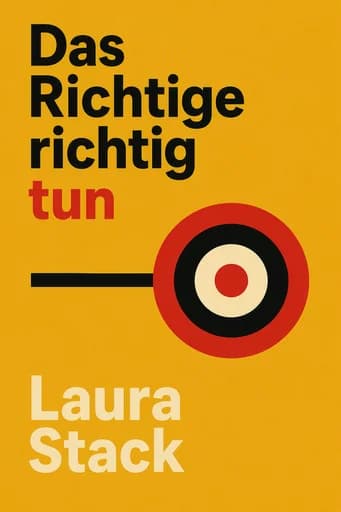
Laura Stack's "Doing the Right Things Right" transforms Peter Drucker's leadership philosophy for today's executives. Brian Tracy called it "21st century efficiency reinvented." With its 3T Leadership Model, this book answers the question every leader asks: How can I achieve more with less effort?
Laura Stack, author of Doing the Right Things Right, is a bestselling author and award-winning productivity expert known as “The Productivity Pro®.” With an MBA in Organizational Management and over 30 years of experience consulting Fortune 500 companies like Walmart and IBM, Stack specializes in helping leaders optimize workplace performance and build high-productivity cultures.
Her insights on time management, team efficiency, and leadership excellence stem from her role as CEO of The Productivity Pro, Inc., and her tenure as president of the National Speakers Association, where she earned induction into the CPAE Speaker Hall of Fame—a distinction held by fewer than 175 speakers globally.
Stack’s authority extends across eight books, including FASTER TOGETHER and Leave the Office Earlier, praised by the New York Times for its practical strategies. A frequent media contributor, she has appeared on CBS Early Show, CNN, and NPR, and her work has been featured in Forbes, The Wall Street Journal, and O Magazine. Her monthly productivity newsletter reaches subscribers in 38 countries, and her books have been translated into five languages, solidifying her global influence in organizational performance.
Doing the Right Things Right by Laura Stack provides actionable strategies for leaders to balance efficiency (executing tasks correctly) and effectiveness (prioritizing high-impact goals). The book combines productivity frameworks, real-world examples, and tools to help professionals eliminate time-wasters, focus on critical objectives, and drive measurable results in high-pressure environments. Stack emphasizes reducing distractions, optimizing workflows, and empowering teams to align daily actions with organizational priorities.
This book is ideal for executives, managers, entrepreneurs, and professionals seeking to maximize productivity while maintaining strategic focus. It’s particularly valuable for leaders in fast-paced industries, teams grappling with burnout or inefficiency, and individuals aiming to improve time management, delegation, and decision-making skills. Stack’s insights cater to both seasoned professionals and emerging leaders.
Yes — the book is praised for its practical, no-nonsense approach to productivity. Stack’s blend of research-backed methods, case studies, and humor makes complex concepts accessible. Readers gain actionable tactics to streamline workflows, reduce stress, and achieve sustainable success. Its emphasis on “doing less better” resonates in overloaded work cultures.
Key frameworks include:
Stack argues that great leaders protect their team’s time by eliminating bureaucracy, clarifying priorities, and fostering autonomy. The book provides tools for delegation, communication, and creating a “high-value mindset” to empower teams to innovate without micromanagement. It also addresses sustaining productivity during organizational change.
These lines underscore the book’s focus on intentionality and strategic action.
The book offers tactics like auditing time expenditures, automating repetitive tasks, and implementing “focus blocks” for deep work. Stack also advocates for standardizing processes, reducing meeting overload, and leveraging technology to minimize manual work. Case studies show how these methods cut wasted time by 20–30%.
Unlike generic advice, Stack’s approach integrates leadership development with personal productivity. The book uniquely addresses team dynamics, offering scalable solutions for organizations rather than individual habits alone. Its focus on measurable outcomes and real-world adaptability sets it apart.
This book expands on themes from Faster Together (team productivity) and SuperCompetent (high-performance habits) by adding leadership-specific strategies. It synthesizes Stack’s 30 years of research into a unified system for organizational excellence, reflecting evolved insights on remote work and digital distractions.
Yes — Stack argues that true productivity creates space for personal time by eliminating inefficiencies. The book teaches readers to set boundaries, say “no” to low-impact tasks, and delegate effectively. Techniques like time-blocking and email management help reclaim 1–2 hours daily for non-work priorities.
Examples include a tech startup that doubled output by restructuring meetings, a healthcare team reducing errors through standardized workflows, and a Fortune 500 company boosting morale by aligning KPIs with employee strengths. Stack also shares anecdotes from her consulting career to illustrate frameworks.
The book includes updated strategies for remote collaboration, such as asynchronous communication protocols, virtual accountability systems, and tools to combat digital fatigue. Stack emphasizes clear goal-setting and trust-based leadership to maintain productivity across distributed teams.
Erlebe das Buch durch die Stimme des Autors
Verwandle Wissen in fesselnde, beispielreiche Erkenntnisse
Erfasse Schlüsselideen blitzschnell für effektives Lernen
Genieße das Buch auf unterhaltsame und ansprechende Weise
Leadership isn't about position but about contribution.
Only marketing and innovation generate profit - everything else is expense.
The snake which cannot cast its skin has to die.
An ounce of action is worth a ton of theory.
Reduce, reduce, reduce.
Zerlegen Sie die Kernideen von Doing the Right Things Right in leicht verständliche Punkte, um zu verstehen, wie innovative Teams kreieren, zusammenarbeiten und wachsen.
Erleben Sie Doing the Right Things Right durch lebhafte Erzählungen, die Innovationslektionen in unvergessliche und anwendbare Momente verwandeln.
Fragen Sie alles, wählen Sie Ihren Lernstil und gestalten Sie Erkenntnisse, die wirklich zu Ihnen passen.

Von Columbia University Alumni in San Francisco entwickelt
"Instead of endless scrolling, I just hit play on BeFreed. It saves me so much time."
"I never knew where to start with nonfiction—BeFreed’s book lists turned into podcasts gave me a clear path."
"Perfect balance between learning and entertainment. Finished ‘Thinking, Fast and Slow’ on my commute this week."
"Crazy how much I learned while walking the dog. BeFreed = small habits → big gains."
"Reading used to feel like a chore. Now it’s just part of my lifestyle."
"Feels effortless compared to reading. I’ve finished 6 books this month already."
"BeFreed turned my guilty doomscrolling into something that feels productive and inspiring."
"BeFreed turned my commute into learning time. 20-min podcasts are perfect for finishing books I never had time for."
"BeFreed replaced my podcast queue. Imagine Spotify for books — that’s it. 🙌"
"It is great for me to learn something from the book without reading it."
"The themed book list podcasts help me connect ideas across authors—like a guided audio journey."
"Makes me feel smarter every time before going to work"
Von Columbia University Alumni in San Francisco entwickelt

Erhalten Sie die Doing the Right Things Right-Zusammenfassung als kostenloses PDF oder EPUB. Drucken Sie es aus oder lesen Sie es jederzeit offline.
Ever noticed how the busiest people aren't always the most successful? You could work 80-hour weeks, attend endless meetings, and still feel like you're spinning your wheels. Here's why: there's a fundamental difference between motion and progress. Since Peter Drucker distinguished between "doing things right" (efficiency) and "doing the right things" (effectiveness) in 1967, the business world has evolved dramatically. Today's leaders can't choose one or the other-they need both simultaneously. This concept of "efficient effectiveness" represents the sweet spot where strategic vision meets flawless execution. Think of it like a GPS system: effectiveness ensures you're heading to the right destination, while efficiency determines whether you take the scenic route or the highway. In our hyper-connected, rapidly changing business environment, mastering this balance isn't optional-it's survival. Leadership has fundamentally transformed from command-and-control to something more nuanced and collaborative. The 3T Leadership Model breaks down what modern executives actually do into three interconnected dimensions: Strategic Thinking (THINK), Team Focus (TEAM), and Tactical Work (TACTICS). What makes this framework powerful is its recognition that leadership isn't one-size-fits-all. Senior leaders spend most time on strategic thinking, then team development, then tactics. Directors flip the priority to team, strategy, tactics. Managers focus on team, tactics, strategy. Individual contributors concentrate on tactics, team, strategy. Notice how "team" appears in every configuration? That's intentional. The old image of the isolated genius leader is dead. Even perceived lone wolves like Einstein and Steve Jobs surrounded themselves with talented collaborators. Your role as a leader increasingly resembles that of an orchestra conductor-you're not playing every instrument, but you're ensuring everyone plays in harmony toward a shared vision.
Strategic thinking starts with one question: "What is the desired outcome?" The Execution Continuum shows how clarity flows from core values through mission, vision, strategic objectives, down to individual performance metrics. When Hostess Brands collapsed, it wasn't about product quality-they failed to adapt to health-conscious consumers. Cultural inertia killed them. Strategy means embracing change. Only marketing and innovation generate profit; everything else is expense. Yet leaders resist innovation because it demands leaving comfort zones. As Nietzsche observed, "The snake which cannot cast its skin has to die." Effective strategic thinking requires clear communication, decisive action, and courage to occasionally take a wrong turn rather than no turn at all. Analysis paralysis kills more projects than bad decisions. Organizations grow top-heavy when leaders won't abandon failing initiatives. The solution: reduce bureaucracy, apply simple rules, include sunset clauses for all projects. With change accelerating, rigid three-to-five-year plans become obsolete. Front-line employees need permission and flexibility to execute in the moment using whatever tactics achieve company goals.
Modern executives function as visionary facilitators rather than dictators - a crucial shift in a knowledge economy where talented employees can leave anytime. Building effective teams starts with meaningful challenge. Smart workers achieve more but bore easily; studies show employees with demanding work report higher satisfaction than those with too little. When Robert Eckert joined struggling Mattel as CEO in 2000, he thanked employees for their fine work and the even better work they were about to do. This simple gratitude helped transform Mattel into a manufacturing leader, landing them on Fortune's "Best Companies to Work For" list for six consecutive years. You can't directly motivate people, but you can create motivating environments. HubSpot CEO Brian Halligan "fires" employees with great ideas, then appoints them CEOs of their own change initiatives within the company. Unleashing creativity costs nothing except relinquishing control. Google's 20% time produced Gmail and AdSense.
Modern loyalty doesn't require lifelong commitment-foster it through trust, respect, consistency, and empowering people without excessive interference. Engagement thrives when teams understand strategic goals, feel trusted to take initiative, and see strong leadership by example. While technology has freed workers from traditional restraints, you can still create environments where people naturally want to overdeliver. Build on this foundation through metacognition-our ability to evaluate our own thinking. Engineer your work patterns for maximum effectiveness: disable wireless connections if the internet distracts you, or schedule demanding tasks when your mental energy peaks. Metacognition also reveals how others think, letting you assign work aligned with their natural strengths. Ironically, those gravitating toward leadership tend to be independent types, yet humans achieve peak productivity only through teamwork. The advantages are clear: efficiency through many hands, leveraging multiple skill sets, increased accountability from not wanting to disappoint teammates, and synergy that produces results greater than individual contributions combined.
Adopting employer thinking means treating the business as your own and taking full accountability. True professionals don't blame others for failures. When respected colleagues offer criticism, listen carefully-they're helping you improve. Practice four key steps: listen without excuses, ask for specific examples, take corrective action, and follow up. Time is your most precious, non-renewable resource. Once you've determined your hourly value, delegate extensively and avoid false economy. Combat "infobesity" by limiting information exposure, taking real breaks, and checking email only 5-7 times daily rather than constantly monitoring it. The 6-D Information Management System provides a practical framework: **Discard** anything unnecessary, **Delegate** when possible, **Do** items requiring less than three minutes immediately, **Date** tasks you can't do now, **Drawer** information that may be useful later, and **Deter** unnecessary information by unsubscribing. This system helps maximize productivity while protecting your time and mental energy.
In today's environment, agility-responding to change with speed and flexibility-is essential. Break projects into independent pieces with separate milestones that can progress simultaneously. Hire for versatility rather than indispensability. When someone becomes irreplaceable, the team can't advance without them. Build backup through overlapping skills, cross-training, clear documentation, and succession planning. Effective leadership requires self-care. Health enables productivity, not the reverse. Working long hours often cuts into activities that keep us healthy, creating an unproductive cycle. Five critical health factors are sleep (7-9 hours nightly), nutrition, hydration (at least a quart daily), exercise (which increases energy), and mental health (maintaining happiness through pleasant surroundings and breaks). These factors are interrelated-improvements in one area positively affect others, collectively boosting productivity. Instead of doing more to sharpen mental alertness, leaders should do less. Overworking dulls your mental edge rather than honing it.
Work hard, but don't live to work. Master productivity to leave on time, recharge, and invest in relationships. As one executive notes, business is "a series of sprints"-you summon full energy when needed, knowing intense effort is temporary. Doing the right things right means finding where effectiveness meets efficiency-where strategic vision translates into flawless execution through engaged, empowered teams. The future belongs to leaders who understand leadership is about contribution, not position-who facilitate rather than dictate, and recognize that results define productivity, not busyness. Modern leadership requires balancing thinking strategically, building motivated teams, managing your energy, and creating adaptable systems. Thriving leaders aren't necessarily the smartest or hardest working-they're those who orchestrate these elements into a coherent whole, creating organizations where people are engaged, strategies are clear, execution is flawless, and everyone maintains the energy to sustain excellence over time.