Kapitel 1
Where Buddhism Meets Modern Psychology: A Journey Through the Ego
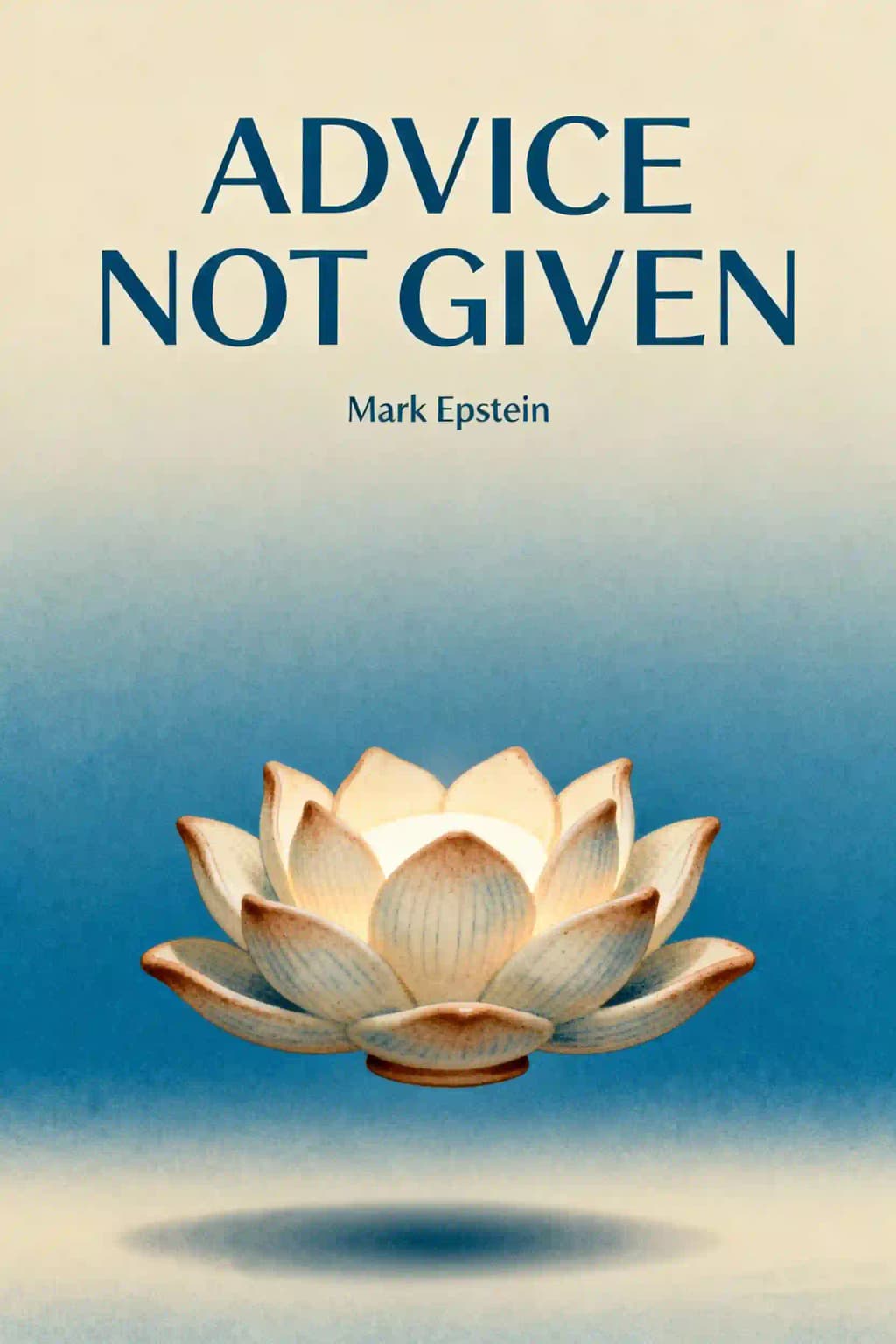
Have you ever wondered why even the most successful people still struggle with anxiety, dissatisfaction, and a persistent sense that something's missing? Mark Epstein's groundbreaking book "Advice Not Given" offers a fascinating answer: our egos are getting in the way. This psychiatrist-turned-Buddhist-practitioner has created what Oprah Winfrey called "one of the most transformative books on psychology" and what Daniel Goleman described as "a revolutionary approach to mental health." Drawing from four decades at the intersection of Western psychotherapy and Eastern mindfulness practices, Epstein reveals how the Buddha's ancient wisdom about the ego perfectly complements modern psychological understanding. The book has become required reading in mindfulness programs worldwide and continues to influence how therapists approach the delicate balance between strengthening and transcending the self.
Kapitel 2
The Ego: Our Common Affliction
The ego-that sense of "I" or "me" that forms the core of our identity-is the one affliction we all share. While our culture encourages developing a stronger sense of self through endless self-improvement, even people with robust egos suffer when they can't let go of control. The untutored ego doesn't know how to surrender, but we possess the capacity to talk back to it and direct ourselves inward instead of focusing solely on external success.
Both Buddhist psychology and Western psychotherapy identified the untrammeled ego as the limiting factor in our well-being. Neither seeks to eradicate it-we need our egos to navigate daily life-but both aim to rebalance it through self-reflection. Freud empowered the observing "I" through free association and dream analysis, while Buddhism teaches mindfulness to help people watch their minds without believing everything they think.
Though similar in approach, their focuses differ: Freud explored the unconscious instincts revealed through self-observation, encouraging a humbled ego aware of its limitations. Buddhism seeks to give people a taste of pure awareness, using mindfulness as a mirror to all mental activity. In deep meditation, one's usual identity temporarily falls away, leaving only mirrorlike knowing-a freedom from the ego-driven state that comes as profound relief.
This intersection between Eastern and Western approaches offers something revolutionary: a comprehensive way to work with our egos rather than being controlled by them. When we learn to observe our minds with compassion rather than judgment, we discover that our most persistent problems often stem from our relationship with ourselves rather than external circumstances.
Kapitel 3
Embracing Reality: The Power of Right View
Have you ever noticed how easily meditation becomes yet another thing to excel at or fail? Many approach mindfulness practice with the same achievement-oriented mindset that drives the rest of their lives. One patient worried about meditation duration, another felt defeated by physical tension, and a third became frustrated when she couldn't reproduce an initial peaceful state.
This is precisely why the Buddha began his Eightfold Path with Right View-a way of encouraging realism about ourselves and the nature of things. Rather than turning meditation into another achievement to strive for, Right View asks us to acknowledge impermanence-the incontrovertible truth that everything changes. This paradoxical approach counters our instinctive habit of looking away from what threatens us.
When meditating, we notice how our attention constantly shifts and how easily we're driven from the present by likes and dislikes. By directly facing life's transience in small moments, we prepare ourselves for the inevitable larger challenges: aging, illness, death, and separation from loved ones.
The Buddha's use of "right" in the Eightfold Path doesn't imply that other approaches are mistaken. The original term (samma) is better translated as "realistic," "complete," or "balanced." The path isn't about perfection; it's about orienting yourself so fears and habits don't tip your existence off balance.
Consider the story of a young Buddhist woman who lost faith after witnessing her teacher, fresh from a three-year retreat, dying in fear despite his Buddhist training. His final words-"No, no, no. Help, help"-made her question whether his practice had been worthless. But perhaps he was modeling honesty in the face of death. The Buddha's agenda for Right View extends to facing impermanence at death without pretense. Looking death in the face and responding truthfully may be the best we can do.
Right View reminds us that meditation isn't meant to create a comfortable hiding place; its fundamental purpose is to acquaint the mind with impermanence moment by moment. While meditation can temporarily quiet the mind, this serves deeper observation rather than being an end itself. When the mind settles, we perceive life's ephemeral nature more clearly, reducing resistance and allowing conscious response rather than blind reaction.
Kapitel 4
Breaking Free: The Challenge of Right Motivation
Right Motivation suggests we don't have to be controlled by our neuroses. With practice, the conscious mind can rise above subconscious conditioning and intentionally direct our activity. Buddhism takes our habitual patterns as a starting point but says we can break free by first admitting they exist, then identifying them repeatedly as they appear in daily life.
My friend Jack Engler, a Buddhist psychotherapist, traveled to India to study with a renowned teacher. Despite wanting meditation instruction, for weeks the teacher Munindra only discussed Jack's bowel health. Finally exasperated, Jack asked when he would learn the dharma. Munindra replied simply, "The dharma means living the life fully." By not playing into Jack's expectations, Munindra was teaching Right Motivation-encouraging Jack to examine how he wasn't living fully rather than just providing meditation techniques.
Right Motivation didn't come easily to me either. In the early years of my marriage, despite years of meditation practice, I experienced intense emotions I couldn't understand. I developed insomnia and became uncharacteristically demanding of my wife's affections at night. Meditation alone couldn't clarify what was happening-I needed therapy.
I had recurring dreams of my teeth clenching so hard they crumbled, and of telephones disintegrating when I tried to call my wife. My therapist immediately recognized "oral rage"-the primitive anger from earliest childhood when needs aren't immediately met. Through therapy, these dreams connected to a childhood memory of being left to babysit my sister while my parents went next door, with only an intercom connecting us.
The happiness of my marriage had made separation challenging, echoing earlier experiences where my wish to be responsible conflicted with my need for connection. I was turning separation into abandonment. Therapy helped me acknowledge and understand this anger, making the dreams disappear, though my insomnia occasionally returns.
This experience revealed how emotions still have a bad name in many Buddhist circles, often categorized as hindrances to meditation-anger, lust, worry, doubt, and "sloth and torpor." Teachers question who is angry or lusting, pointing to the "me" behind these feelings. While useful at times, this approach bypasses meaningful personal content.
Many practitioners mistakenly view the spiritual path as one where "toxic" emotions are "cleansed" through practice. This language resembles Freudian toilet training dynamics, leading to a kind of paralysis where emotions are shut down and joylessness masquerades as equanimity. While detaching from difficult feelings in meditation is important, the idea they must be eradicated is dangerous. Right Motivation should follow the model of the "good enough mother" who isn't put off by hate but has wisdom to hold difficult emotional experiences.
Kapitel 5
The Power of Words: Right Speech Inside and Out
While Right Speech conventionally means abstaining from lying, gossip, vain talk, and hurtful words that create mental turmoil, it has deeper implications. How we talk to ourselves is as important as how we speak to others-our inner dialogue shapes our reality as powerfully as our spoken words.
Traditionally presented as the first of three ethical qualities on the Eightfold Path, Right Speech emphasizes the choice we have in our communication. But while we recognize this choice in external speech, we often feel powerless over our private thoughts, which seem to arise involuntarily, dragging us into cycles of criticism and blame.
Many resign themselves to negative self-talk, claiming "This is just who I am," but this isn't the acceptance Buddhism recommends. Meditation reveals how quickly thinking hijacks us. An itch makes us think we must scratch it "or else." Back pain convinces us we can't endure it. Traffic delays trigger catastrophic scenarios. Right Speech means questioning these secondary add-ons to our experiences.
For me to understand feelings that emerged in my early marriage, I needed someone to talk with. My dreams spoke at night, but daytime conversation helped me change my internal narrative. Rather than blaming my wife for insufficient attention, I recognized my responsibility for feelings beyond my comprehension.
As a therapist, I can't help patients who don't share their thoughts and feelings, even when shameful or embarrassing. Simply dismissing thoughts doesn't change one's story; it merely postpones its inevitable return.
Consider Miranda, a professor of French literature specializing in Samuel Beckett, who experienced acute anxiety while writing in a friend's peaceful studio. The serene environment suddenly felt malignant, triggering a spiral of darkness and dread. Her only association was a childhood memory of being convinced she would die at age ten, then fearing her parents would die when they left her at her grandparents' house.
Her dominant feeling was loneliness-not the fully felt loneliness of concrete loss, but a barely tolerated feeling so frightening and shameful she tried to banish it entirely. In therapy, Miranda insisted her "true nature" was needy, depressed, and worthless.
I challenged this self-loathing: "All this self-hatred is extra. You're laying it on yourself, repeating the same story. You don't know your true nature yet." I encouraged her to disidentify from repetitive thoughts while listening more deeply to her mind. This was a revelation for Miranda, who began to question whether she was truly the "vertiginous vortex of harmful energy" she believed herself to be.
Samuel Beckett provided an unexpected model for accepting difficult emotions. During his most creative period writing Molloy, Malone Dies, and Waiting for Godot, he had an epiphany on a Dublin pier: "the dark he had struggled to keep under" should become his creative inspiration. "I shall always be depressed," he concluded, "but what comforts me is the realization that I can now accept this dark side as the commanding side of my personality. In accepting it, I will make it work for me."
Kapitel 6
Beyond Thought: The Wisdom of Right Action
Beckett's refusal to be intimidated by his depression connects Right Speech to Right Action. Both involve mobilizing the power of restraint. Rather than trying to eliminate his darkness or pursuing a false image of perfection, Beckett modified his expectations while probing more deeply into himself, ultimately using his explorations to create art.
Right Action traditionally means avoiding destructive behaviors-killing, stealing, harmful sexual activity, and excessive intoxication. These ethical prohibitions protect both the community and the individual from internal disquiet. But restraint isn't inaction-like preparing a meal versus eating compulsively. The former requires restraint while involving shopping, chopping, cooking, and setting the table. Postponing the ego's need for immediate gratification forms the core principle of this path.
Many seeking therapy or Buddhism ask how to "let go" of troubling thoughts or emotions. But letting go doesn't mean releasing what bothers you-trying to get rid of it only makes it stronger. Letting go involves patience more than release. Japanese Buddhism describes this as "the backward step that turns your light inward to illuminate your self." You settle into yourself rather than trying to make the troubling thing disappear.
When patients first come to therapy, they rarely can explain exactly what's wrong. Some, like my 70-year-old patient with disturbing obsessive thoughts, worry they can't control their impulses. My approach involves helping patients examine their actual experiences rather than trying to eliminate symptoms. With Ralph, I encouraged him to look more carefully at women rather than choking off his instincts. By focusing on his actual sensory experience rather than his unwanted thoughts, Ralph found the obsessions lost their grip.
There's a famous Zen story about Bodhidharma that parallels therapeutic intervention. When Huike complained of an anxious mind and asked Bodhidharma to pacify it, Bodhidharma said "Bring me your mind, and I will pacify it." When Huike couldn't find his mind, Bodhidharma declared, "There, I have pacified your mind." This skillful exchange helped Huike realize his mind's empty, aware nature was already pacified. Successful therapy similarly helps patients see beyond the stories they tell themselves, not through instruction but through transformative interaction.
This approach isn't alien to psychotherapy. Wilhelm Reich, one of Freud's disciples who believed emotional conflicts were stored as muscular tensions, once helped a college student overcome paralyzing anxiety by teaching her to flirt. After examining her body, Reich told her, "Your problem is that you don't know how to flirt. I'm going to teach you how." They role-played on an imaginary subway, and something in her shifted. Decades later, she remained confident and vivacious. Reich's intervention opened her to her needs, desires, body, attractiveness, and capacity to connect with others-helping her reach outside her known self.
Kapitel 7
Finding Balance: Right Livelihood Beyond Work
Right Livelihood asks us to consider the ethics of how we make money. The Buddha warned against trades involving deceit or exploitation-weapons, human trafficking, animal killing, intoxicants, and poisons. This teaching invites deeper questions: What place does work have in my life? What drives me? Does my livelihood define me? Is salary my true worth?
The Buddha acknowledged that most people are motivated by "eight worldly concerns": gain and loss, pleasure and pain, praise and blame, fame and disgrace. Money, though rarely discussed openly in therapy, remains a primary measure of self-worth for many. Right Livelihood encourages finding balance rather than chasing praise, profit and fame as if they were permanent, and asks us to pay attention to the quality of our interactions, not just our success.
Even ordained Buddhist followers weren't exempt from livelihood concerns-they begged daily for food, connecting them to the communities they served. This relationship was mutually beneficial: the mendicants offered spiritual teaching in exchange for sustenance, becoming some of the world's first psychotherapists. Right Livelihood thus extends beyond occupation to encompass how we interact with others.
Consider Gloria, an accomplished installation artist with work in major museums, who struggles despite her success. Even with prestigious residencies and awards, she feels unestablished in a field where male artists receive greater recognition and compensation. After paying assistants, studio rent, and fabrication costs while splitting revenue with her gallery, she supplements her income by installing pieces in collectors' homes-work that has become increasingly difficult for her.
What began as exciting travel to wealthy locations has become burdensome as she resents making conversation with collectors and being away from home. She believes male artists at her level would be paid more and treated better without having to "hold collectors' hands." Through our conversations, Gloria realized she was withholding herself from fully engaging with her work and patrons, recognizing that she too was "the poorest of the poor" in her inner scarcity. By shifting from resentment to compassion, she found new energy and perspective in her livelihood.
Kate, who works forty-five hours weekly at an architectural firm, struggles with her retired boyfriend's housekeeping standards. Despite his handling the cooking, shopping, and laundry, she erupted in anger over a messy apartment and uncapped toothpaste. Their fight escalated until they stopped speaking. Rather than sympathizing, I suggested Kate simply clean up herself rather than fight over it. While she resisted the idea of becoming "the maid," I explained how her interpretation-that messiness meant he didn't care-was causing unnecessary suffering.
Right Livelihood isn't just about how we make money, but questioning our sense of privilege. The Buddha's arrows turning to flowers illustrates this transformation-by getting over himself, the Buddha became more powerful, his presence transforming those around him without giving advice.
Kapitel 8
Finding Balance: Right Effort in Daily Life
The Buddha used music to illustrate how ego's ambition can sabotage its goal. When the frustrated disciple Sona complained about meditation difficulties, the Buddha used Sona's background as a lute player to explain Right Effort. Just as a lute sounds best when strings are neither too tight nor too loose, spiritual energy must be balanced. Attention, like an instrument, requires ongoing tuning and care.
The Buddha emphasized the "wonderful sound" that emerges when effort is properly balanced-reminding Sona of the joy that comes from Right Effort. This applies beautifully to therapy, where a therapist's evenly suspended attention creates a special holding environment. When I listen without judgment or preconceptions, patients often reach unanticipated realizations.
Debby developed anorexia in college when the dining hall's smell reminded her of a fifth-grade cafeteria from a difficult school transition. Eventually dropping to eighty pounds, she nonetheless recovered without significant therapy after moving to New York, finding work in fashion, and building new relationships. Though her weight normalized and she created a fulfilling life with children, her relationship with her mother remained strained.
During therapy, Debby expressed distress that "it feels like she doesn't love me" after an awkward invitation exchange with her mother. Rather than dismissing this as something we'd already discussed or rushing to reassure her, I practiced Right Effort by restraining my impulse to interrupt. This allowed Debby to reveal she blamed herself for being unlovable-showing how her tendency to assign blame (whether to herself or her mother) was keeping her trapped in an impossible wish to repair the past.
When Debby later described feeling inexplicably distressed after dinner with her twenty-eight-year-old son who was leaving for Europe, I noticed her difficulty naming her emotions. Upon returning home that night, she'd numbed herself with potato chips and ice cream, creating another reason to feel bad about herself. Rather than rushing to label her feelings, I practiced restraint-creating space for her to discover that beneath her separation anxiety lay complex maternal emotions: kindness (felt for a young child), compassion (for an ill child), sympathetic joy (for a thriving youth), and equanimity (for a self-sufficient adult).
Right Effort extends beyond therapy into any situation where strong emotions threaten to overwhelm us. My sculptor friend Sam illustrated this when his neighbor opposed his studio construction plans. Sam, a natural fighter, hired a local attorney expecting to battle and win. Instead, his lawyer advised: "You are going to kiss ass" and "shut up" in court. Despite his resistance-"Aren't I paying you? Can't you be the one kissing ass?"-Sam followed this counsel, restraining his need for victory even when he felt righteous. His wife dug her fingernails into his arm whenever he attempted to speak in court. "It was the hardest thing I've ever done," Sam admitted, but the strategy worked.
Kapitel 9
The Gateway to Insight: Right Mindfulness
Mindfulness, the most widely embraced aspect of Buddhism in the West, encourages dispassionate awareness of thoughts, feelings, memories, emotions, and physical sensations as they arise and pass. It empowers the observing self to avoid being hijacked by habits, impulses, or the inner critic. What's often overlooked is that mindfulness is merely an introductory technique in Buddhism-a doorway to insight, not the destination.
The Buddha compared mindfulness to a raft that helps cross a river but shouldn't be carried afterward. The challenge is avoiding turning mindfulness into another self-improvement method. Traditional texts compare it to a cowherd who initially must actively corral his flock but later can rest in the shade, watching with one eye open. Similarly, mindfulness requires initial effort but eventually becomes second nature, continuing on its own.
While apprenticing with the Dalai Lama's Tibetan physician during medical school, I discovered a class of anxiety disorders unknown in Western medicine: meditation-induced anxiety. Medieval Tibetan medical texts cataloged how meditators who try too hard become agitated and depressed. Their minds rear up like angry horses resisting control. Instead of lightness, forced meditation brings anxiety and grim determination. Tibetan doctors treat such patients not with more meditation but with simple tasks like sweeping temple halls or chopping vegetables-recognizing that less meditation, not more, is the appropriate remedy.
The term "mindfulness" itself can encourage an overly aggressive approach, carrying an admonishing tone of "Be Mindful!" with echoes of Protestant work ethic. It's actually a Western invention from 1881 during British colonization of South Asia. The original word in the Buddha's language was sati, meaning remembering-specifically remembering to keep an eye on oneself. A clearer description might be "presence of mind"-once established, it remembers itself.
While lecturing in Oklahoma City about Buddhist approaches to trauma treatment, I met a counselor with a white ponytail who shared his wisdom: "I never use the word 'mindfulness' with a man in Oklahoma. People just don't like the sound of it." Instead, he simply tells them, "Go outside and close the door. Stand there and listen." This cuts to the heart of Right Mindfulness-not another therapeutic modality but an invitation to discover something unexpected through relaxed attention to one's everyday world.
While mindfulness is often presented as a rational, objective technique for stress management, it has a hidden agenda: putting the ego into perspective so empathy is no longer obstructed. Its insights revolve around impermanence-how can we remain attached when everything constantly changes? Mindfulness brings transience into the foreground, giving us a ringside seat to what we know is true but try to ignore. In confronting impermanence, we discover our self-important internal refrain of "What about me?" The relief comes in discovering that even the ego is impermanent-our defensive posture need not be etched in stone.
Kapitel 10
The Backbone of Meditation: Right Concentration
Concentration is meditation's secret ingredient and backbone-the simplest, most elementary therapeutic technique in Buddhism. Though it follows mindfulness on the Eightfold Path, it's typically taught first when learning meditation. Concentration becomes "Right" when connected with the path's other branches, demonstrating how the mind can be trained while supporting investigation of impermanence and revealing surrender's benefits.
Concentration means keeping attention steady on a single object like the breath for extended periods-something that doesn't come naturally. Most beginners find their minds quickly hijacked by thinking, planning, and worrying. Right Concentration asks us to persevere without self-judgment, returning attention to the breath whenever we notice it has strayed. Ancient texts compare this process to taming a wild animal-difficult but yielding reliable results with diligent practice.
As concentration increases, the mind and body relax, thoughts diminish, and calm takes over. The Buddha compared this to smelting gold-when impurities are removed, gold becomes malleable and begins to shine. Western scientists studying experienced meditators have documented that one-pointed attention triggers the relaxation response: heart rate slows, metabolic rate declines, digestion improves, and brain activity associated with worry decreases.
Beyond stress management, concentration also serves as an incubator for self-esteem. During my first extended meditation retreat, after several days of practice, my concentration suddenly deepened. Light poured into my consciousness while I rested attention on my breath. A strong feeling of love emerged-not directed at anything specific-just loving presence. This experience revealed that my self-doubts were merely stories, not truth. Though temporary, this glimpse behind my day-to-day preoccupations had lasting impact, showing me something more fundamental within.
Buddhist teachers tell of a man who completed a three-month silent retreat only to run down the street afterward shouting, "It didn't work!" Having discovered profound inner peace during retreat, he mistakenly assumed this state was permanent. His attachment to that particular mental state revealed itself when conditions changed. The desire to conquer impermanence by uniting with an unchanging "other" manifests in both love and religion. Concentration can create extended periods of absorption where problems seem to disappear, but clinging to inner peace can be as neurotic as other addictions.
News anchor Dan Harris reached out to me after suffering a panic attack on live television. Despite initial resistance, he attended a meditation retreat on my recommendation. On his fifth day, sitting on a balcony, his concentration suddenly clicked in-"I'm not trying, it's just happening." While in this effortless state, he heard a growing rumble that intensified dramatically. When he opened his eyes, a hummingbird hovered directly before his face. This moment revealed how concentration allowed him to drop his defensive, wary tension and open to experience in an unprecedented way.
On a recent retreat, I confessed to my Swiss teacher that I was straining to find my breath. His advice was simple but profound: "Don't chase her. Let her find you." The concentrated feeling required yielding, not reaching-revealing a relationship between the spiritual and erotic that Right Concentration helps bring out. The experience revealed that my usual effortful approach obscured more mysterious qualities within me. Getting out of my own way opened me to something I couldn't access through deliberateness, showing I needn't be defined solely by my striving.
Kapitel 11
Finding Freedom Beyond the Ego
Suzuki Roshi described the relief of getting over yourself using the metaphor of "mind waves." Rather than trying to eliminate the waves of ego's struggle, we must see them as part of the ocean. This Buddhist approach differs from Western psychotherapy by shifting perspective rather than excavating childhood experiences.
After forty years of practice, I'm neither cured nor enlightened-people still complain about my coldness and irritability-but I have tools to face whatever life throws at me. While my personality remains largely unchanged, I'm no longer a prisoner of my ego. Buddhism empowers the mind to observe dispassionately, revealing a hidden mental resource that successful psychotherapy also taps.
What I convey to patients is that they can meet life's challenges by changing how they relate to them-not making difficulties disappear, but meeting them with equanimity. In an insecure world, we can become our own refuge, ensuring our egos don't have the last word.
The Eightfold Path offers a comprehensive approach to the ego's challenges. Right View helps us face reality without flinching. Right Motivation encourages us to break free from habitual patterns. Right Speech teaches us to watch our inner dialogue. Right Action shows us how to respond skillfully rather than reactively. Right Livelihood extends ethics into our work and relationships. Right Effort reminds us to find balance in our striving. Right Mindfulness opens us to present-moment awareness. And Right Concentration develops our capacity for sustained attention and inner peace.
Together, these eight aspects create a path that doesn't eliminate the ego but helps us relate to it with wisdom and compassion. We learn to dance with our ego rather than being trapped by it-finding freedom not by escaping who we are but by embracing it fully, with all its contradictions and challenges.