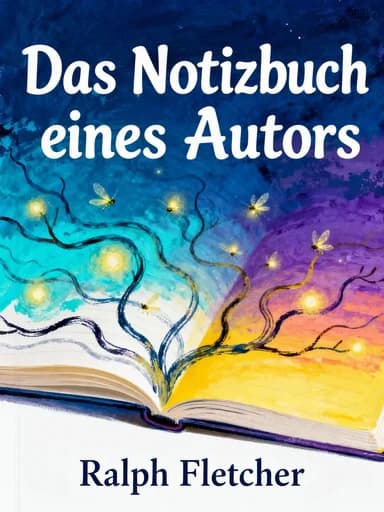
Ralph Fletcher's transformative guide unlocks the writer within, showing how a simple notebook becomes a creative sanctuary. Beloved by educators nationwide, this influential resource inspired countless young authors like Caramel, who began keeping his own notebook after discovering Fletcher's accessible, idea-sparking approach to capturing life's moments.
Ralph Fletcher, bestselling author of A Writer’s Notebook and a leading authority on writing education, blends his expertise as a children’s book creator and longtime educational consultant to empower young writers.
This practical guide, rooted in classroom-tested methods, encourages students to harness everyday observations through journaling—a theme reflecting Fletcher’s decades spent teaching writing workshops globally.
His acclaimed professional resources like Making Nonfiction from Scratch and What a Writer Needs have shaped literacy curricula worldwide, while his award-winning children’s novels Fig Pudding and Uncle Daddy showcase his storytelling versatility.
A Dartmouth and Columbia University graduate, Fletcher pioneered the Teachers College Writing Project in New York City schools, later collaborating with his educator wife JoAnn Portalupi on seminal texts like Craft Lessons. Over 30 years, his works have become classroom staples, with Fig Pudding earning an American Library Association Top Ten honor.
Ralph Fletcher's A Writer's Notebook explores the role of a writer's notebook as a dynamic tool for capturing life’s details (“Breathing In”) and sparking original writing (“Breathing Out”). It emphasizes observation, experimentation, and cultivating a writer’s mindset through snippets, quotes, and reflections. The book blends practical advice with philosophical insights, framing the notebook as essential for nurturing creativity and overcoming creative blocks.
This book is ideal for aspiring writers, educators, and anyone seeking to reignite their passion for writing. Fletcher’s approachable style makes it particularly valuable for young writers, but adults and seasoned authors will also find strategies to enhance their craft. Teachers can use its principles to inspire students to view writing as a natural, ongoing process.
Yes—readers praise its actionable advice, relatable tone, and timeless techniques. Reviews highlight its effectiveness in demystifying the writing process and providing flexible frameworks adaptable to individual styles. The emphasis on observation and revision makes it a resource writers return to repeatedly.
Fletcher encourages writers to mine their notebooks for “small moments” and unexpected connections. By revisiting fragments—a phrase, image, or memory—writers can spark new ideas. The book stresses that creativity flows from consistent practice, not waiting for inspiration.
Both books emphasize process over perfection, but A Writer's Notebook focuses specifically on using a notebook as a foundational tool, while How Writers Work addresses broader habits like drafting and finding one’s voice. They complement each other for writers seeking holistic guidance.
Some note the book’s brevity and lack of structured exercises. While its open-ended approach suits exploratory writers, those seeking step-by-step systems may find it too abstract. However, most praise its flexibility as a strength.
Teachers apply Fletcher’s methods to teach students to value “small moments,” practice revision, and view writing as a habit. The book’s emphasis on curiosity over correctness helps reduce anxiety and fosters a love for writing across genres.
In an age of digital overload, the book’s advocacy for slow, intentional observation resonates deeply. Its analog approach offers a counterbalance to quick-paced content creation, reminding writers to prioritize authenticity and reflection.
Fletcher likens the notebook to a “seedbed” for ideas and a “mirror” reflecting a writer’s inner world. The “Breathing In/Out” framework symbolizes the cyclical nature of creativity—gathering inspiration and transforming it into art.
While not genre-specific, the book teaches universal skills: sharpening observation for memoir, capturing dialogue for fiction, and curating details for poetry. Writers adapt Fletcher’s strategies to their preferred forms.
For structured guidance: The Artist’s Way by Julia Cameron. For academic writing: Bird by Bird by Anne Lamott. For visual learners: Steal Like an Artist by Austin Kleon. Fletcher’s How Writers Work offers a broader companion.
Erlebe das Buch durch die Stimme des Autors
Verwandle Wissen in fesselnde, beispielreiche Erkenntnisse
Erfasse Schlüsselideen blitzschnell für effektives Lernen
Genieße das Buch auf unterhaltsame und ansprechende Weise
Real inspiration isn't what media prescribes-it's the story lodged in your mind like a splinter.
Vague writing slides off the brain like water off glass.
Memories are a writer's most vital possession.
Dialogue reveals who we are more profoundly than physical description.
The most powerful writing emerges when you're emotionally overwhelmed
Zerlegen Sie die Kernideen von A Writer's Notebook in leicht verständliche Punkte, um zu verstehen, wie innovative Teams kreieren, zusammenarbeiten und wachsen.
Erleben Sie A Writer's Notebook durch lebhafte Erzählungen, die Innovationslektionen in unvergessliche und anwendbare Momente verwandeln.
Fragen Sie alles, wählen Sie Ihren Lernstil und gestalten Sie Erkenntnisse, die wirklich zu Ihnen passen.

Von Columbia University Alumni in San Francisco entwickelt
"Instead of endless scrolling, I just hit play on BeFreed. It saves me so much time."
"I never knew where to start with nonfiction—BeFreed’s book lists turned into podcasts gave me a clear path."
"Perfect balance between learning and entertainment. Finished ‘Thinking, Fast and Slow’ on my commute this week."
"Crazy how much I learned while walking the dog. BeFreed = small habits → big gains."
"Reading used to feel like a chore. Now it’s just part of my lifestyle."
"Feels effortless compared to reading. I’ve finished 6 books this month already."
"BeFreed turned my guilty doomscrolling into something that feels productive and inspiring."
"BeFreed turned my commute into learning time. 20-min podcasts are perfect for finishing books I never had time for."
"BeFreed replaced my podcast queue. Imagine Spotify for books — that’s it. 🙌"
"It is great for me to learn something from the book without reading it."
"The themed book list podcasts help me connect ideas across authors—like a guided audio journey."
"Makes me feel smarter every time before going to work"
Von Columbia University Alumni in San Francisco entwickelt

Erhalten Sie die A Writer's Notebook-Zusammenfassung als kostenloses PDF oder EPUB. Drucken Sie es aus oder lesen Sie es jederzeit offline.
Ever notice how the best ideas arrive at the worst times? In the shower, during a dream, while stuck in traffic? That flash of insight-a perfect phrase, a story angle, a memory that suddenly makes sense-vanishes before you can grab it. Writers lose entire novels this way, watching brilliance evaporate like morning fog. But here's what separates published authors from people who talk about writing someday: a simple notebook that fits in your pocket. Not a diary cataloging what you ate for lunch. Not a journal analyzing your feelings. Something far more powerful-a net that catches the fireflies of inspiration before they blink out forever. What actually goes in a writer's notebook? Not the mundane details of daily routine, but the moments that punch through the ordinary. The things that make you angry enough to shout, tender enough to cry, curious enough to wonder. Think of it as a ditch running alongside your life, catching fascinating creatures that would otherwise wash away. The difference between writers and everyone else isn't talent-it's awareness. Writers notice the woman placing fresh roses on a grave every morning, the tiny toad peeing on your fingers when you rescue it from the lawn mower, the man who stopped naming his dogs because they kept dying to save him from bears. These moments happen to everyone. Writers just write them down. Your notebook's physical form matters more than you'd think. Some prefer pocket-sized companions they can pull out anywhere. Others want beautiful hardbound journals that feel important to open. The point is finding something that feels like a friend, not a chore-a place you're genuinely eager to return to. Consider it your creative insurance policy. You'll fill pages with observations, most of which go nowhere. That's fine. Like a photographer taking hundreds of shots to get one perfect image, you're increasing your odds. The magic isn't in having extraordinary experiences-it's in recognizing which ordinary moments contain hidden depth.
Real inspiration isn't what media prescribes-it's the story lodged in your mind like a splinter. Your notebook captures these moments: newspaper headlines that shake your worldview, intimate scenes witnessed firsthand. A five-year-old shoplifter who charms everyone. Animals shot during floods because rescuers couldn't reach them. A lost wallet returned intact. These stories fascinate because they reveal something true about human nature. Even family moments contain story potential. Two children making competing Valentine's Day demands reveals something profound about impossible parental choices. Record these stories immediately, before memory smooths rough edges. Writer Don Murray once met a man who trained "bear dogs" to protect against wilderness attacks. The man deliberately avoided bonding because the dogs kept sacrificing themselves. One day, his dog confronted a bear while he escaped up a tree. From that perch, he watched his companion fight to the death. "I don't name them anymore," the man explained. Without Murray's notebook, this haunting story about sacrifice would have vanished forever. Some questions lodge in your mind like songs you can't stop humming. As a child, I became obsessed with my mother's description of Spy Pond as "bottomless." My young brain couldn't grasp it-how could anything have no bottom? These "fierce wonderings" deserve notebook space, regardless of whether they have answers. Joseph Powning captured infinity's dizzying nature: "If space goes on forever and ever, what is it going into?" These questions may never find answers, but exploring them develops something essential-a mind that remains open to mystery.
Vague writing slides off the brain like water off glass. "My Grandpa is really nice" tells us nothing. "My Grandpa pulled out his chest of war stuff and let me try on his old uniform" creates an immediate, vivid image that reveals character through concrete action. Mundane moments gain significance through detail. Anthony conveyed childhood loneliness by describing sitting in a dark playroom holding a hollow plastic telephone used to call imaginary friends-that single image communicates more than paragraphs of explanation. Joe the mechanic's permanently grimy hands reveal his dedication better than any certificate on the wall. To capture vivid "mind pictures," follow three steps: pay attention with all five senses, quickly write down observations before forgetting them, and later revisit these entries for writing ideas. The squeak of new sneakers on a basketball court, the particular smell of your school's hallway, the rough texture of tree bark-these sensory details create writing that feels three-dimensional.
Your notebook incubates fragile ideas, capturing writing fragments before they vanish. These "seed ideas" arrive unexpectedly. While reading to my two-year-old, I imagined children discovering a magical land where words grow like plants. I jotted this down, and it became my story "Where the Words Grow." Katherine Paterson made preliminary notes for "Flip-Flop Girl" a full year before writing, beginning with just "a little girl with sad brown eyes." Don't expect immediate germination. Paul Fleischman's note about a "traveling school teacher" became a character in "The Borning Room"-twelve years later. He maintains detailed notebooks with sections for story ideas, characters, descriptions, scenes, titles, names, and facts. Writers naturally make lists-favorite words, project ideas, goals, fascinating facts. Fifth-grader Sara Mae Zerner collects words like "zap" and "glimmering," while mine includes "persnickety" and "osprey." After weeding my garden for five hours, I freewrote thoughts about what makes a weed a weed, noting how children and bees don't distinguish between weeds and flowers. This brainstorming evolved into a finished poem. Children's author Louise Borden has kept notebooks since 1984, tracking potential titles and discovering recurring themes.
Memories are a writer's most vital possession-our unique histories contain nearly everything needed for storytelling. In my notebook, I "spade into the soil" of my past, capturing memories honestly. Fifth-grader Jennifer Young wrote about her family selling their beloved camp, using repetition for emotional impact: "No more Katie, no more neighborhood concerts, no more barefoot bike riding, no more boat rides, no more swimming." She concludes: "You are truly a legend, a memory, and a friend in my life." Your notebook can include drawings, artifacts, clippings, tickets, letters, photographs. When writing memories, recreate the sensory experience. Don't worry whether memories seem significant-often the smallest moments become most precious. Writers must become obsessed with how people speak. Dialogue reveals who we are more profoundly than physical description. One treasured entry records my grandmother's ninetieth birthday when she failed to recognize her son Johnny, mistaking him for Billy. Uncle John-who had fought in two wars and faithfully sent money home for decades-gently played along, telling her to "give Johnny my love." This heartbreaking moment stayed with me because I captured it immediately. My notebooks contain countless dialogue snippets: kindergarteners arguing about volcanoes, teens playing video games, my son observing people "puffing up" on a windy ferry ride. Capture not just what people intend to say but what actually comes out-regional expressions, slang, the beautiful mistakes children make, plus the rhythm and music of speech that makes each voice distinctive.
The most powerful writing emerges when you're emotionally overwhelmed - when your heart will burst if you don't write. Your notebook provides a safe space for vulnerable expressions. Fourth-grader Shavonia Wynn wrote about discovering adults cry too, while teacher Donna Barnes shared a divorce poem with students. Your notebook can hold letters, sent or unsent - I once wrote a difficult letter about not lending money anymore, a boundary I struggled to communicate. Perhaps most moving was a boy's letter to his deceased mother: "Hi Mom. It's me." These four words broke through silence and grief, maintaining connection with someone he'd lost. When facing emotional turmoil, your notebook offers immediate relief and preserves authentic reactions for later polishing. Your notebook can also serve as a personal anthology of inspiring writing. Try "writing off the text" - imitating admired styles to internalize techniques that become part of your unique voice. When collecting passages, note what moves you: the rhythm, unexpected metaphors, emotional honesty? This awareness helps you consciously incorporate these qualities into your own writing.
Rockhounding for Herkimer "diamonds" taught me patience-most rocks look ordinary until you crack them open. Your notebook works the same way. Reread entries with dual perspective-as both writer and reader. Ask: What seems interesting, bold, or original? What has emotional resonance or vivid imagery? Most entries never become finished pieces-like maple syrup production requiring forty gallons of sap for one gallon of syrup. Sometimes a single sentence holds promise, like my line "Morning twilight begins to erase the blackboard of stars" that sparked an entire picture book. Look for entries that evoke emotion, contain sensory details, capture authentic dialogue, or present unique perspectives. Notebooks aren't essential for everyone. Published authors like Cynthia Rylant never keep journals. Find what works-collecting photos, recording conversations, saving memorabilia. Test different styles: spiral versus sewn binding, size, lined versus unlined pages. Let your notebook reflect your unique interests-dialogue, nature descriptions, lengthy reflections, brief observations. Your notebook should be as individual as your fingerprint, cultivating mindfulness, encouraging empathy, preserving memories, and providing emotional outlet. There are no rules except those you create. Your notebook should feel like freedom, not obligation-a space where curiosity and imagination roam without judgment. In a world constantly demanding attention, your notebook becomes an act of rebellion-a declaration that your voice matters.