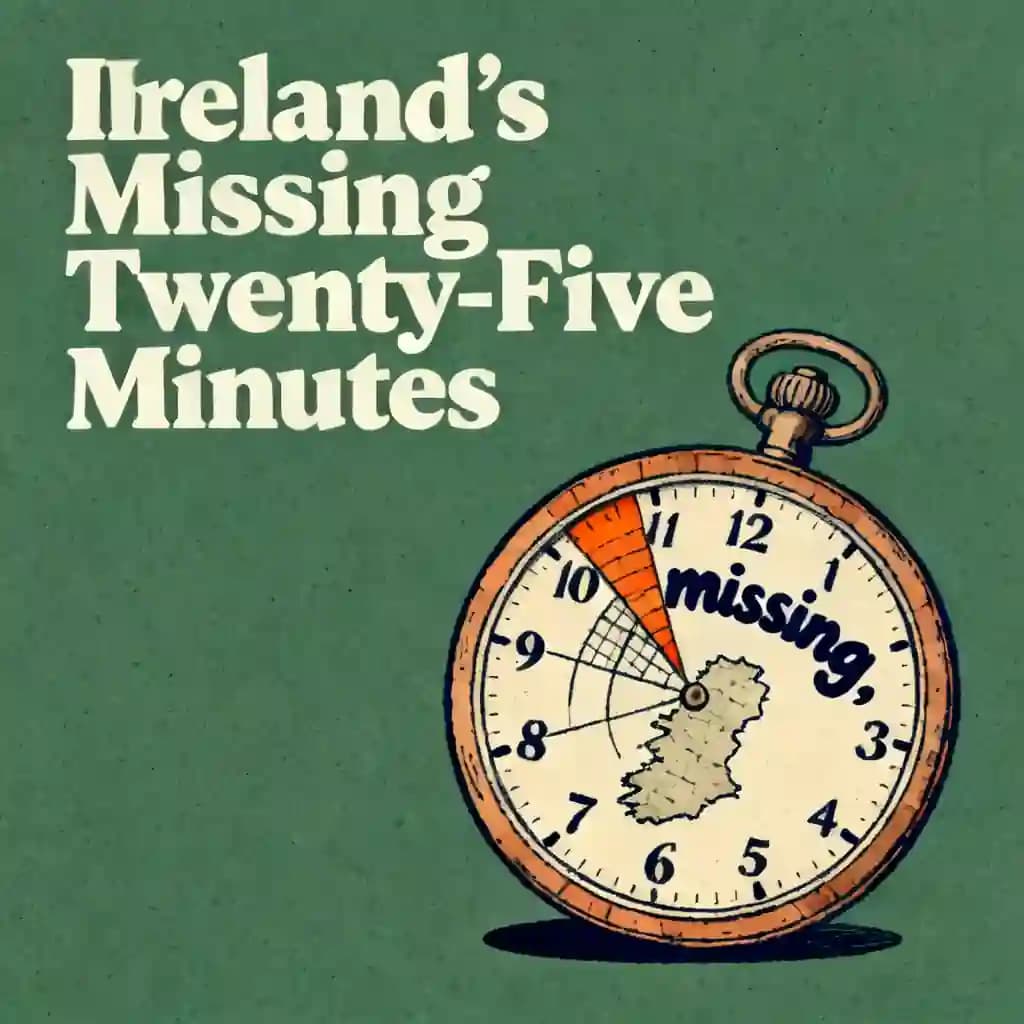
Ireland’s Time History and the 25-Minute Gap最佳语录
It’s fascinating because it shows how time isn't just about physics—it’s about politics and national identity too. Keeping 'Dublin Time' was a way of saying Ireland had its own center, its own meridian.

此音频课程由 BeFreed 社区成员创建
The history of time in Ireland and GMT

常见问题
Dublin Mean Time was the official time standard for Ireland between 1880 and 1916. It was established by the Statutes (Definition of Time) Act of 1880 to standardize the "localized chaos" of different towns following their own solar time based on the sun's position. This specific standard was based on the local mean time at Dunsink Observatory outside Dublin, which resulted in Ireland being exactly twenty-five minutes and twenty-one seconds behind Greenwich Mean Time in Great Britain.
The shift occurred during a period of intense political and military upheaval in 1916. While the Easter Rising was unfolding, the British government passed the Time (Ireland) Act to align Irish time with GMT. The primary driver was the practical necessity of the World War I effort, as the 25-minute discrepancy made it difficult to coordinate troop movements, naval operations, and telegraph communications. Aligning the clocks served as a wartime efficiency measure to ensure the entire British Isles operated on a single synchronized schedule.
While Ireland and the UK currently share the same time, they use opposite legal definitions for their standards. Under the Standard Time Act of 1968, Ireland defines its "Standard Time" as the summer period (UTC+1), while the winter period is officially called "Winter Time" (UTC+0). In contrast, the UK considers Greenwich Mean Time (UTC+0) its year-round standard and treats the summer shift as an adjustment called British Summer Time.
Solar time is based on the actual position of the sun in the sky, where "noon" occurs when the sun reaches its highest point at a specific longitude. However, because the Earth's orbit is elliptical and the planet tilts on its axis, solar noon can vary by up to 16 minutes throughout the year. To solve this inconsistency for mechanical clocks, astronomers created "Mean Time," which is a mathematical average of all solar days across the year to ensure a consistent 24-hour cycle.
Before the advent of radio signals and digital clocks, people relied on physical markers and specialized services. Some cities used a "time ball" that would drop at a specific hour at an observatory for visual synchronization. There were also professional "time sellers," such as Ruth Belville, known as the "Greenwich Time Lady," who carried a high-quality pocket watch set to GMT and visited businesses in person so they could manually sync their own clocks to hers.
发现更多

Irish Celtic
This plan offers a deep dive into the historical and mythological roots of Ireland. It is ideal for history enthusiasts and cultural students seeking to understand how ancient legends still define modern Irish identity.

Explore Iran's historical & modern evolution
Iran represents one of the world's oldest continuous civilizations with profound influence on global history, yet is often misunderstood through contemporary geopolitical lenses. This learning plan provides crucial historical context and cultural insights for anyone interested in Middle Eastern politics, international relations, or cultural studies.

Learn about German History
Understanding German history is essential for anyone looking to grasp the geopolitical landscape of modern Europe. This plan is ideal for students, history buffs, or travelers who want to move beyond the surface and explore the deep cultural and political shifts that defined the 20th century.

US History: Independence to Present Day
This plan provides a comprehensive overview of the pivotal events and ideologies that shaped the United States into a global leader. It is ideal for students, history buffs, or anyone seeking to understand the roots of modern American society and politics.

Learn major world-shaping historical events
This learning plan provides a comprehensive overview of the pivotal moments that defined human history, from ancient civilizations to the modern era. It is ideal for students, history enthusiasts, or anyone seeking to understand the historical roots of today's global political and economic systems.

The history of the British Monarchy
The British monarchy represents one of history's longest continuous political institutions, profoundly influencing global governance, culture, and society. This learning plan benefits history enthusiasts, political science students, and anyone interested in understanding how this ancient institution evolved and continues to shape modern Britain and the Commonwealth.

US-Iran Conflict: Past, Present & Future
This plan is essential for anyone seeking to understand the most volatile relationship in modern geopolitics. It is ideal for students of international relations, policy professionals, or curious citizens wanting to look beyond the headlines at the roots of Middle Eastern conflict.

The Time-Block Reading System
In an age of constant digital distraction, many struggle to find time for deep reading. This system is designed for busy professionals and lifelong learners who want to reclaim their focus and transform sporadic reading into a high-impact daily discipline.
"Instead of endless scrolling, I just hit play on BeFreed. It saves me so much time."


"I never knew where to start with nonfiction—BeFreed’s book lists turned into podcasts gave me a clear path."


"Perfect balance between learning and entertainment. Finished ‘Thinking, Fast and Slow’ on my commute this week."
"Crazy how much I learned while walking the dog. BeFreed = small habits → big gains."
"Reading used to feel like a chore. Now it’s just part of my lifestyle."

"Feels effortless compared to reading. I’ve finished 6 books this month already."
"BeFreed turned my guilty doomscrolling into something that feels productive and inspiring."

"BeFreed turned my commute into learning time. 20-min podcasts are perfect for finishing books I never had time for."
"BeFreed replaced my podcast queue. Imagine Spotify for books — that’s it. 🙌"

"It is great for me to learn something from the book without reading it."
"The themed book list podcasts help me connect ideas across authors—like a guided audio journey."
"Makes me feel smarter every time before going to work"
"Instead of endless scrolling, I just hit play on BeFreed. It saves me so much time."
"I never knew where to start with nonfiction—BeFreed’s book lists turned into podcasts gave me a clear path."
"Perfect balance between learning and entertainment. Finished ‘Thinking, Fast and Slow’ on my commute this week."
"Crazy how much I learned while walking the dog. BeFreed = small habits → big gains."
"Reading used to feel like a chore. Now it’s just part of my lifestyle."
"Feels effortless compared to reading. I’ve finished 6 books this month already."
"BeFreed turned my guilty doomscrolling into something that feels productive and inspiring."
"BeFreed turned my commute into learning time. 20-min podcasts are perfect for finishing books I never had time for."
"BeFreed replaced my podcast queue. Imagine Spotify for books — that’s it. 🙌"
"It is great for me to learn something from the book without reading it."
"The themed book list podcasts help me connect ideas across authors—like a guided audio journey."
"Makes me feel smarter every time before going to work"
"Instead of endless scrolling, I just hit play on BeFreed. It saves me so much time."
"I never knew where to start with nonfiction—BeFreed’s book lists turned into podcasts gave me a clear path."
"Perfect balance between learning and entertainment. Finished ‘Thinking, Fast and Slow’ on my commute this week."
"Crazy how much I learned while walking the dog. BeFreed = small habits → big gains."
"Reading used to feel like a chore. Now it’s just part of my lifestyle."
"Feels effortless compared to reading. I’ve finished 6 books this month already."
"BeFreed turned my guilty doomscrolling into something that feels productive and inspiring."
"BeFreed turned my commute into learning time. 20-min podcasts are perfect for finishing books I never had time for."
"BeFreed replaced my podcast queue. Imagine Spotify for books — that’s it. 🙌"
"It is great for me to learn something from the book without reading it."
"The themed book list podcasts help me connect ideas across authors—like a guided audio journey."
"Makes me feel smarter every time before going to work"
"Instead of endless scrolling, I just hit play on BeFreed. It saves me so much time."
"I never knew where to start with nonfiction—BeFreed’s book lists turned into podcasts gave me a clear path."
"Perfect balance between learning and entertainment. Finished ‘Thinking, Fast and Slow’ on my commute this week."
"Crazy how much I learned while walking the dog. BeFreed = small habits → big gains."
"Reading used to feel like a chore. Now it’s just part of my lifestyle."
"Feels effortless compared to reading. I’ve finished 6 books this month already."
"BeFreed turned my guilty doomscrolling into something that feels productive and inspiring."
"BeFreed turned my commute into learning time. 20-min podcasts are perfect for finishing books I never had time for."
"BeFreed replaced my podcast queue. Imagine Spotify for books — that’s it. 🙌"
"It is great for me to learn something from the book without reading it."
"The themed book list podcasts help me connect ideas across authors—like a guided audio journey."
"Makes me feel smarter every time before going to work"