China’s Chip War: The DUV Milestone and 7nm Mass Production
Explore China’s chip war milestone as Shanghai Aishengna Electronic Technology Group begins mass-producing domestic DUV lithography scanners for 7nm chips.
China’s Chip War: The DUV Milestone and 7nm Mass Production最佳语录
The 'homegrown ASML' isn't a leapfrog; it's a life raft. It keeps China in the game, but it doesn't mean they're winning it.
Generated by Aditya
Create a premium 45-60 minute audio lesson based on the attached article: "The strongest argument against the post’s core claim..." regarding China's immersion DUV lithography. Follow the 'Marc Andreessen analytical framework': lead with counterarguments, label every statement as FACT, INFERENCE, ESTIMATE, or SPECULATION, and assign confidence levels (High, Moderate, Low, Unknown). Target audience: complete beginners. Explain lithography, DUV vs EUV, multi-patterning, and the roles of SMEE, SMIC, Huawei, and ASML using first-principles and analogies (photocopiers, cookie cutters). Address the central question: Is China's DUV system a fundamental change or a strategic milestone? Explicitly contrast production volumes (5-20 machines) vs ASML's output. Conclude with 15 lessons, 20 mental models, corrected misconceptions, and bullish/bearish arguments. Use only provided source evidence; if missing, state 'Unknown from the source.'


常见问题
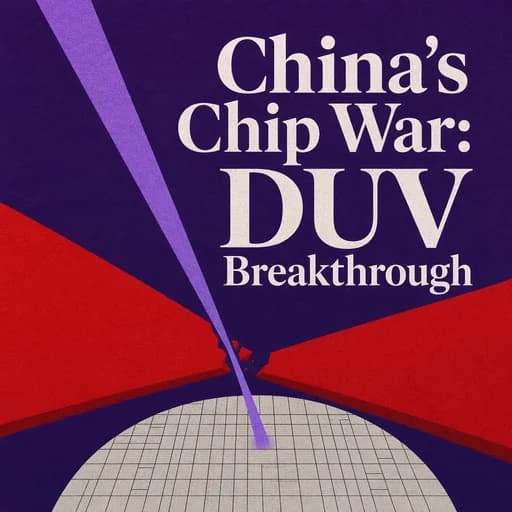
The DUV milestone represents a major shift in the global chip race and the ongoing semiconductor manufacturing struggle. On July 28, 2026, reports emerged that China began mass-producing its own domestic immersion DUV lithography scanners. This development is considered a significant milestone because it allows China to produce advanced technology internally, potentially bypassing the impact of international export controls and sanctions that previously limited their access to high-end chip-making equipment.
The production of these critical lithography tools is being led by a state-backed group based in Shanghai, now operating as the Shanghai Aishengna Electronic Technology Group. This group has successfully started churning out domestic immersion DUV lithography scanners, marking the first time a homegrown Chinese tool has been capable of aiming for 7-nanometer chip production. Their progress is viewed by experts as a real risk to the existing balance of global compute power.
Yes, the new immersion DUV lithography scanners produced by the Shanghai Aishengna Electronic Technology Group are designed to make the mass production of 7-nanometer chips a reality for China. These chips serve as the brains for AI and other advanced technologies. By creating the machines that make the chips, China is attempting to overcome the limitations imposed by AI technology sanctions and export controls that were designed to cut off their access to advanced hardware.
"Instead of endless scrolling, I just hit play on BeFreed. It saves me so much time."


"I never knew where to start with nonfiction—BeFreed’s book lists turned into podcasts gave me a clear path."


"Perfect balance between learning and entertainment. Finished ‘Thinking, Fast and Slow’ on my commute this week."
"Crazy how much I learned while walking the dog. BeFreed = small habits → big gains."
"Reading used to feel like a chore. Now it’s just part of my lifestyle."

"Feels effortless compared to reading. I’ve finished 6 books this month already."
"BeFreed turned my guilty doomscrolling into something that feels productive and inspiring."

"BeFreed turned my commute into learning time. 20-min podcasts are perfect for finishing books I never had time for."
"BeFreed replaced my podcast queue. Imagine Spotify for books — that’s it. 🙌"

"It is great for me to learn something from the book without reading it."
"The themed book list podcasts help me connect ideas across authors—like a guided audio journey."
"Makes me feel smarter every time before going to work"
"Instead of endless scrolling, I just hit play on BeFreed. It saves me so much time."
"I never knew where to start with nonfiction—BeFreed’s book lists turned into podcasts gave me a clear path."
"Perfect balance between learning and entertainment. Finished ‘Thinking, Fast and Slow’ on my commute this week."
"Crazy how much I learned while walking the dog. BeFreed = small habits → big gains."
"Reading used to feel like a chore. Now it’s just part of my lifestyle."
"Feels effortless compared to reading. I’ve finished 6 books this month already."
"BeFreed turned my guilty doomscrolling into something that feels productive and inspiring."
"BeFreed turned my commute into learning time. 20-min podcasts are perfect for finishing books I never had time for."
"BeFreed replaced my podcast queue. Imagine Spotify for books — that’s it. 🙌"
"It is great for me to learn something from the book without reading it."
"The themed book list podcasts help me connect ideas across authors—like a guided audio journey."
"Makes me feel smarter every time before going to work"
"Instead of endless scrolling, I just hit play on BeFreed. It saves me so much time."
"I never knew where to start with nonfiction—BeFreed’s book lists turned into podcasts gave me a clear path."
"Perfect balance between learning and entertainment. Finished ‘Thinking, Fast and Slow’ on my commute this week."
"Crazy how much I learned while walking the dog. BeFreed = small habits → big gains."
"Reading used to feel like a chore. Now it’s just part of my lifestyle."
"Feels effortless compared to reading. I’ve finished 6 books this month already."
"BeFreed turned my guilty doomscrolling into something that feels productive and inspiring."
"BeFreed turned my commute into learning time. 20-min podcasts are perfect for finishing books I never had time for."
"BeFreed replaced my podcast queue. Imagine Spotify for books — that’s it. 🙌"
"It is great for me to learn something from the book without reading it."
"The themed book list podcasts help me connect ideas across authors—like a guided audio journey."
"Makes me feel smarter every time before going to work"
"Instead of endless scrolling, I just hit play on BeFreed. It saves me so much time."
"I never knew where to start with nonfiction—BeFreed’s book lists turned into podcasts gave me a clear path."
"Perfect balance between learning and entertainment. Finished ‘Thinking, Fast and Slow’ on my commute this week."
"Crazy how much I learned while walking the dog. BeFreed = small habits → big gains."
"Reading used to feel like a chore. Now it’s just part of my lifestyle."
"Feels effortless compared to reading. I’ve finished 6 books this month already."
"BeFreed turned my guilty doomscrolling into something that feels productive and inspiring."
"BeFreed turned my commute into learning time. 20-min podcasts are perfect for finishing books I never had time for."
"BeFreed replaced my podcast queue. Imagine Spotify for books — that’s it. 🙌"
"It is great for me to learn something from the book without reading it."
"The themed book list podcasts help me connect ideas across authors—like a guided audio journey."
"Makes me feel smarter every time before going to work"