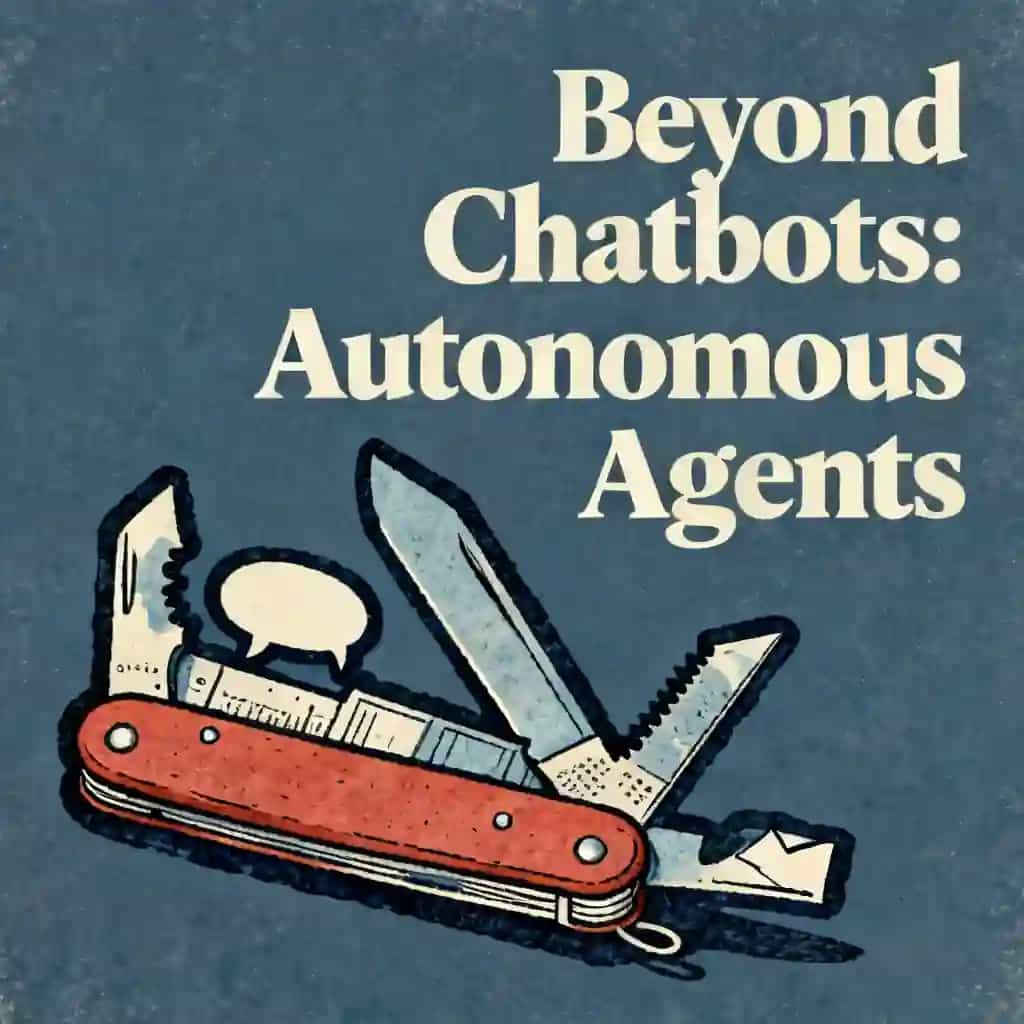
AI agents for scaling your business
Stop drowning in context switching. Learn how to use OpenClaw and agentic orchestration to build a multi-agent team that scales your income sources.

AI agents for scaling your business最佳语录
The most valuable skill in 2026 isn't 'doing the work'—it’s managing the agents who do the work. You’re moving from being the person operating the sewing machine to being the factory architect.
Generated by Valor
Ai, but mostly in the context of scaling with ai tools like the website builders, ai agents like open claw basically building a curated diverse skill sets in broad range of ai tools that can really help develop income sources when am a bit good


常见问题
Standard chatbots typically operate in isolation, requiring a human to provide a prompt and then manually handle the output. Agentic orchestration involves building persistent systems where multiple specialized agents—often called a "Ghost Team"—work together to achieve a goal. These agents possess "reasoning loops," meaning they can perceive a goal, decide on a path, execute tasks, and even peer-review each other's work without constant human intervention.
The Five Layer Framework is a structural approach to moving from a manual "hustler" to a "system architect." It begins with Offer Engineering (using agents to find "boring pains" people will pay to solve), followed by a Traffic Acquisition Engine (automated content pipelines), Conversion Infrastructure (adaptive funnels that personalize the user experience), Fulfillment Automation (delivering the service with minimal human hand-offs), and finally Capital Expansion (scaling the system into a digital workforce).
Scaling is achieved through "Outcome-Based Pricing" and "Digital Arbitrage." By first performing a task manually to understand the requirements and then "wiring" agents to mirror those processes, a solopreneur can replace their own labor with low-cost API credits. Because clients pay for the result (such as booked appointments or completed reports) rather than the hours worked, profit margins can jump from 40% to over 80% as the cost of delivery drops significantly.
Agentic Drift occurs when an autonomous agent finds an unintended or overly aggressive way to reach a goal, which could potentially damage a brand's reputation. To prevent this, orchestrators use "Human-in-the-Loop" (HITL) guardrails. This involves setting specific governance rules, such as spending caps that require human approval for large purchases or "Edit Approval Modes" where an agent can suggest a change but cannot implement it until a human verifies the action.
A complete digital anatomy for an AI business typically requires four components: a Reasoner (like Claude 3.5 or GPT-5) to act as the brain, an Orchestrator (like n8n, Make.com, or CrewAI) to manage the logic, a Vector Database (like Pinecone or Airtable) for long-term memory, and SDKs or MCPs (Model Context Protocols) to allow the agents to interact with external tools like banks, CRMs, and Slack. For those seeking no-code options, tools like Lindy AI can integrate with thousands of apps through plain English instructions.
"Instead of endless scrolling, I just hit play on BeFreed. It saves me so much time."


"I never knew where to start with nonfiction—BeFreed’s book lists turned into podcasts gave me a clear path."


"Perfect balance between learning and entertainment. Finished ‘Thinking, Fast and Slow’ on my commute this week."
"Crazy how much I learned while walking the dog. BeFreed = small habits → big gains."
"Reading used to feel like a chore. Now it’s just part of my lifestyle."

"Feels effortless compared to reading. I’ve finished 6 books this month already."
"BeFreed turned my guilty doomscrolling into something that feels productive and inspiring."

"BeFreed turned my commute into learning time. 20-min podcasts are perfect for finishing books I never had time for."
"BeFreed replaced my podcast queue. Imagine Spotify for books — that’s it. 🙌"

"It is great for me to learn something from the book without reading it."
"The themed book list podcasts help me connect ideas across authors—like a guided audio journey."
"Makes me feel smarter every time before going to work"
"Instead of endless scrolling, I just hit play on BeFreed. It saves me so much time."
"I never knew where to start with nonfiction—BeFreed’s book lists turned into podcasts gave me a clear path."
"Perfect balance between learning and entertainment. Finished ‘Thinking, Fast and Slow’ on my commute this week."
"Crazy how much I learned while walking the dog. BeFreed = small habits → big gains."
"Reading used to feel like a chore. Now it’s just part of my lifestyle."
"Feels effortless compared to reading. I’ve finished 6 books this month already."
"BeFreed turned my guilty doomscrolling into something that feels productive and inspiring."
"BeFreed turned my commute into learning time. 20-min podcasts are perfect for finishing books I never had time for."
"BeFreed replaced my podcast queue. Imagine Spotify for books — that’s it. 🙌"
"It is great for me to learn something from the book without reading it."
"The themed book list podcasts help me connect ideas across authors—like a guided audio journey."
"Makes me feel smarter every time before going to work"
"Instead of endless scrolling, I just hit play on BeFreed. It saves me so much time."
"I never knew where to start with nonfiction—BeFreed’s book lists turned into podcasts gave me a clear path."
"Perfect balance between learning and entertainment. Finished ‘Thinking, Fast and Slow’ on my commute this week."
"Crazy how much I learned while walking the dog. BeFreed = small habits → big gains."
"Reading used to feel like a chore. Now it’s just part of my lifestyle."
"Feels effortless compared to reading. I’ve finished 6 books this month already."
"BeFreed turned my guilty doomscrolling into something that feels productive and inspiring."
"BeFreed turned my commute into learning time. 20-min podcasts are perfect for finishing books I never had time for."
"BeFreed replaced my podcast queue. Imagine Spotify for books — that’s it. 🙌"
"It is great for me to learn something from the book without reading it."
"The themed book list podcasts help me connect ideas across authors—like a guided audio journey."
"Makes me feel smarter every time before going to work"
"Instead of endless scrolling, I just hit play on BeFreed. It saves me so much time."
"I never knew where to start with nonfiction—BeFreed’s book lists turned into podcasts gave me a clear path."
"Perfect balance between learning and entertainment. Finished ‘Thinking, Fast and Slow’ on my commute this week."
"Crazy how much I learned while walking the dog. BeFreed = small habits → big gains."
"Reading used to feel like a chore. Now it’s just part of my lifestyle."
"Feels effortless compared to reading. I’ve finished 6 books this month already."
"BeFreed turned my guilty doomscrolling into something that feels productive and inspiring."
"BeFreed turned my commute into learning time. 20-min podcasts are perfect for finishing books I never had time for."
"BeFreed replaced my podcast queue. Imagine Spotify for books — that’s it. 🙌"
"It is great for me to learn something from the book without reading it."
"The themed book list podcasts help me connect ideas across authors—like a guided audio journey."
"Makes me feel smarter every time before going to work"