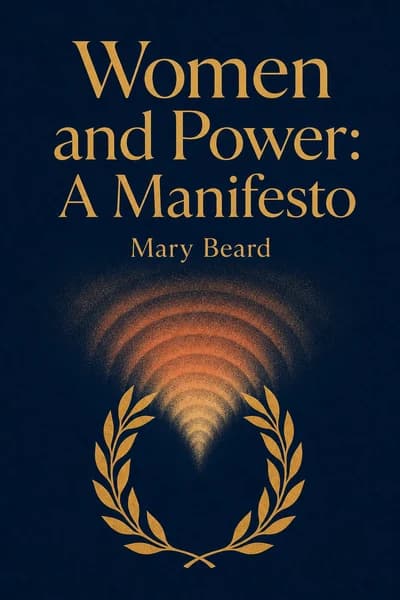
In "Women & Power," Cambridge professor Mary Beard exposes how women's voices have been silenced since ancient Greece. Released during #MeToo, this manifesto brilliantly connects Medusa myths to modern politics, challenging us to redefine power rather than force women into male structures.
Dame Winifred Mary Beard, acclaimed classicist and bestselling author of Women & Power: A Manifesto, merges her expertise in Ancient Rome with incisive feminist thought to trace misogyny’s roots across millennia.
A professor of classics at Cambridge’s Newnham College and classics editor of the Times Literary Supplement, Beard anchors her analysis of gendered power dynamics in historical parallels, from Homer’s silenced women to modern political figures.
Her acclaimed works, including SPQR: A History of Ancient Rome and Pompeii: The Life of a Roman Town, blend scholarly rigor with public engagement, amplified through her TLS blog “A Don’s Life” and her role in the BBC/PBS series Civilisations.
A trustee of the British Museum and frequent media commentator, Beard has shaped global discourse on antiquity and contemporary gender issues. Women & Power, hailed as a “modern feminist classic” by The Guardian, distills her decades of research into a provocative critique of institutionalized sexism, selling over 500,000 copies and translated into 28 languages.
Women & Power examines the historical roots of misogyny, tracing how Western culture has systematically excluded women from positions of authority since antiquity. Through examples like Penelope’s silencing in Homer’s Odyssey and modern politicians like Hillary Clinton, Beard argues that power structures must be redefined to include women’s voices rather than forcing them into male-defined norms.
This book is essential for feminists, classics enthusiasts, and anyone interested in gender politics. It’s particularly relevant for readers analyzing systemic sexism in leadership, public discourse, or cultural narratives.
Yes. The book’s concise, provocative essays offer a groundbreaking perspective on gender and power, blending historical analysis with modern relevance. It has been hailed as a “modern feminist classic” for its incisive critique of misogyny.
Beard draws parallels between classical examples (e.g., Roman women labeled “androgynes” for speaking publicly) and contemporary issues like online trolling of female leaders. She highlights how assumptions about women’s voices as “shrill” or “untrustworthy” persist across millennia.
These lines encapsulate the book’s critique of systemic exclusion and its call for structural change.
Beard critiques traditional notions of leadership as inherently masculine, arguing that women often face ridicule or marginalization when adopting these roles (e.g., Angela Merkel’s “male-coded” attire). She advocates redefining power as an action (“to power”) rather than a possession.
Beard analyzes incidents like Elizabeth Warren being told to “sit down” during a Senate debate, linking them to ancient patterns of suppressing women’s voices. She argues that female politicians are still judged more harshly for their tone and appearance than male counterparts.
Rather than incremental changes, Beard urges a radical rethinking of power structures. This includes challenging the male-centric definition of leadership and creating systems where women’s contributions are valued without requiring assimilation into patriarchal norms.
Beard reflects on her personal experiences with sexist trolling, connecting digital harassment to historical tactics used to silence women. The book underscores how online abuse reinforces traditional power imbalances.
Some reviewers note the book’s brevity (based on two lectures) leaves less room for detailed solutions. Others desire more intersectional analysis, though Beard’s focus remains on Western classical traditions.
As debates about gender equity persist in politics, workplaces, and online spaces, Beard’s analysis remains critical for understanding enduring biases. Its insights apply to ongoing struggles for representation and equitable leadership.
通过作者的声音感受这本书
将知识转化为引人入胜、富含实例的见解
快速捕捉核心观点,高效学习
以有趣互动的方式享受这本书
Speech will be the business of men, all men, and of me most of all.
Our language still undermines women's public speech through subtle mechanisms.
Sorry, love, you just don't understand.
Women's voices remain niched into speaking only about women's causes.
The silencing continues, echoing across millennia.
将《Women and Power: A Manifesto》的核心观点拆解为易于理解的要点,了解创新团队如何创造、协作和成长。
将《Women and Power: A Manifesto》提炼为快速记忆要点,突出坦诚、团队合作和创造力的关键原则。

通过生动的故事体验《Women and Power: A Manifesto》,将创新经验转化为令人难忘且可应用的精彩时刻。
随心提问,选择声音,共同创造真正与你产生共鸣的见解。

"Instead of endless scrolling, I just hit play on BeFreed. It saves me so much time."
"I never knew where to start with nonfiction—BeFreed’s book lists turned into podcasts gave me a clear path."
"Perfect balance between learning and entertainment. Finished ‘Thinking, Fast and Slow’ on my commute this week."
"Crazy how much I learned while walking the dog. BeFreed = small habits → big gains."
"Reading used to feel like a chore. Now it’s just part of my lifestyle."
"Feels effortless compared to reading. I’ve finished 6 books this month already."
"BeFreed turned my guilty doomscrolling into something that feels productive and inspiring."
"BeFreed turned my commute into learning time. 20-min podcasts are perfect for finishing books I never had time for."
"BeFreed replaced my podcast queue. Imagine Spotify for books — that’s it. 🙌"
"It is great for me to learn something from the book without reading it."
"The themed book list podcasts help me connect ideas across authors—like a guided audio journey."
"Makes me feel smarter every time before going to work"

免费获取《Women and Power: A Manifesto》摘要的 PDF 或 EPUB 版本。可打印或随时离线阅读。
When Telemachus ordered his mother Penelope back to her quarters in Homer's Odyssey nearly three millennia ago, declaring "speech will be the business of men," he wasn't just having a family spat. He was articulating what would become the foundation of Western attitudes toward women's voices. This moment-the first documented silencing of a woman in Western literature-established a template that still shapes our world today. The Greek word Telemachus used, *muthos*, specifically referred to authoritative public speech. He wasn't merely asking for quiet; he was declaring that meaningful discourse belongs exclusively to men. Throughout classical antiquity, this exclusion wasn't subtle-it was deliberately paraded. Women who spoke publicly were characterized as unnatural, described as "androgynes" or "barking" rather than speaking. The Roman elite male was explicitly defined as "a good man, skilled in speaking." Even scientific treatises linked men's deeper voices to courage and women's higher pitches to cowardice. This wasn't just about custom-public speaking constituted the very definition of masculinity itself. When women did speak publicly, it was only in two narrow circumstances: as victims just before their deaths, or occasionally to defend specifically female interests. Even then, they were marked as exceptions that proved the rule. What makes this ancient history so disturbing isn't its distance from us, but its proximity. Our modern traditions of debate and rhetoric draw directly from these classical roots-and so do our prejudices.