第 1 章
The Mind Games We Play: Understanding Our Collective Cognitive Crisis
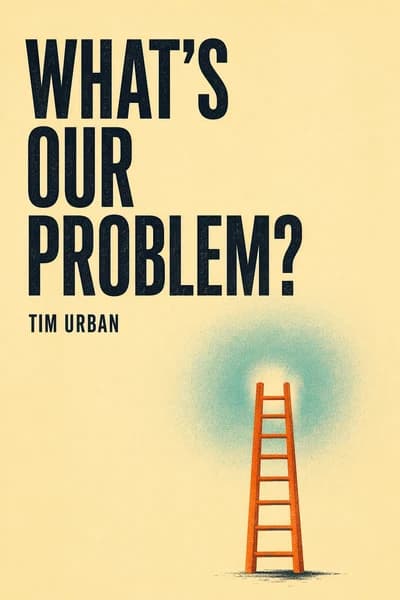
In a world where social media algorithms push us toward tribal extremes and political discourse increasingly resembles a blood sport, Tim Urban's "What's Our Problem?" arrives as a timely diagnosis of our societal dysfunction. The book has become a favorite among tech leaders like Marc Andreessen and Sam Altman, who praise its framework for understanding why smart people can reach wildly different conclusions about reality. Urban, known for his stick-figure-illustrated blog "Wait But Why," spent six years researching this work after becoming alarmed by what he saw as America's intellectual and moral regression. The result is a compelling exploration of how human thinking goes wrong and what we might do about it-a book that's simultaneously disturbing in its diagnosis and hopeful in its prescription.
第 2 章
The Ladder: A Framework for Understanding Human Thinking
Urban introduces "the Ladder" as a framework for understanding how humans think, with four distinct rungs representing progressively worse cognitive approaches. At the top, "Scientists" begin with "I don't know" and follow evidence wherever it leads, gathering diverse information, evaluating it with calibrated skepticism, and forming independent conclusions. They're willing to change their minds when presented with compelling evidence.
One rung down, "Sports Fans" believe they're seeking truth but suffer from confirmation bias. They still gather information but cherry-pick sources that support their existing beliefs. They apply excessive skepticism to disagreeable information while readily accepting agreeable claims. Despite learning less than Scientists, they typically feel more confident in their beliefs. Yet their Higher Mind remains influential-they still fundamentally care about finding truth.
The third rung belongs to "Attorneys," who start with predetermined conclusions and work backward to defend them. Unlike Sports Fans who ultimately value truth over confirmation, Attorneys prioritize winning above all. They treat preferred beliefs as clients who must be defended regardless of evidence. Nothing could convince them they're wrong, yet they still acknowledge the concept of knowledge-building.
At the bottom rung, "Zealots" treat ideas not as experiments to test but as precious babies to protect. They don't research whether their viewpoints are correct-they simply know they are, with absolute conviction. Zealots automatically trust anything supporting their views and instantly reject anything challenging them. Their Primitive Mind completely distorts both self-perception and worldview, making them see simple black-and-white distinctions where complexity exists.
Urban divides these into "high-rung thinking" (Scientist and Sports Fan) and "low-rung thinking" (Attorney and Zealot). High-rung thinking is independent and productive, allowing revision of ideas, while low-rung thinking makes you subservient to your ideas. Everyone spends time on the low rungs without realizing it, but psychological evolution means spending more time on the high rungs.
第 3 章
Idea Labs vs. Echo Chambers: The Social Dimension of Thinking
While the Ladder describes individual thinking, Urban introduces a social dimension with two contrasting environments: Idea Labs and Echo Chambers. Idea Labs foster high-rung thinking through open discourse, treating ideas like scientific hypotheses rather than precious identities. They welcome challenging perspectives and maintain intellectual humility. In these environments, participants actively seek out opposing viewpoints, engage in steel-manning opposing arguments, and view disagreement as an opportunity for learning rather than conflict. Successful Idea Labs often implement specific practices like scheduled devil's advocate sessions, structured debate formats, and regular reflection on cognitive biases.
Echo Chambers, conversely, cultivate low-rung thinking by treating certain beliefs as sacred. They reward conformity rather than critical thinking, equate people with their ideas (making disagreement feel like personal rudeness), and enforce conformity through social penalties ranging from status reduction to excommunication. Echo Chambers can form either through groups collectively holding certain ideas sacred or through intellectual bullies intimidating others. These environments often develop elaborate social rituals and language patterns that signal in-group belonging - from specific terminology to shared narratives that become untouchable truths.
Echo Chambers protect themselves through three sophisticated mechanisms. First, information filtering occurs through partisan media that cherry-picks stories supporting the narrative while downplaying contradictory information. This filtering extends beyond traditional media to social media algorithms, selective sharing within communities, and the creation of entire alternative information ecosystems. Social pressure within these chambers rewards expressing only narrative-confirming views, often through subtle social cues, likes, shares, and public validation.
Second, information twisting thrives on logical fallacies like presenting anecdotes as trends when convenient or misinterpreting correlation as causation to support preferred narratives. This process becomes particularly powerful when combined with emotional reasoning and moral arguments that make rational counter-arguments appear not just wrong but evil. The chamber develops specialized rhetorical techniques to dismiss outside evidence while amplifying supporting information, no matter how tenuous.
Third, confirmation bias is reinforced through multiple dependencies: social dependence (fear of alienation and loss of community), intellectual dependence (dulled critical thinking skills from lack of practice), and self-esteem dependence (where beliefs become intertwined with personal identity and self-worth). These dependencies create a psychological lock-in effect where leaving the chamber threatens not just social connections but one's sense of self.
The result is a self-reinforcing system terrible for discovering truth but excellent for protecting belief - where narrative-confirming information is welcomed and amplified, while dissenting information faces multiple sophisticated barriers. This system becomes particularly resistant to change because it operates on multiple levels simultaneously: cognitive, social, emotional, and identity-based. Breaking free requires not just new information but often a complete restructuring of one's social and intellectual framework.
第 4 章
Political Disney World: How Low-Rung Politics Transforms Reality
When low-rung thinking dominates politics, it transforms complex reality into what Urban calls "Political Disney World" - a binary realm of pure good versus pure evil. People become either heroes or villains, policies either entirely right or wrong, and nuance disappears. This binary thinking stems from primitive psychology taking over, creating tribal "golems" that demand absolute conformity and obsess over common enemies. These mental constructs function like psychological fortresses, where questioning any aspect of the tribe's beliefs becomes tantamount to betrayal.
These political golems survive through sophisticated mechanisms of self-preservation: maintaining strict conformity, reinforcing belief in their guiding narrative, and aggressively fighting any doubt that threatens their existence. They operate through powerful emotional drivers - fear, anger, and moral outrage - which override rational analysis. Unlike high-rung political environments where people recognize complexity and maintain collaborative attitudes between opposing viewpoints, Political Disney World divides everything into pure good (1s) and pure bad (0s), leaving no room for middle ground or compromise.
This distortion creates entirely separate realities between tribes, each operating within their own carefully constructed narrative universe. Urban illustrates this with a hypothetical example of how pro-dog and pro-raccoon media might twist the same six news stories to support opposite narratives. For instance, a simple incident of a dog chasing a raccoon becomes either "Brave Dog Protects Neighborhood from Dangerous Pest" or "Innocent Wildlife Terrorized by Aggressive Canine," depending on the tribal lens. The result is that people living in different Political Disney Worlds literally experience different versions of reality, making productive conversation nearly impossible.
The situation has grown particularly acute in the digital age, where social media algorithms and targeted content delivery systems reinforce these separate realities. Urban argues that America has entered a vortex of negative feedback loops: tribal media makes people more partisan, creating demand for even more tribal content; partisan politicians pull constituents deeper into Political Disney World, while voters increasingly reward inflammatory rhetoric over mature governance. With fewer undecided voters in the middle, political candidates focus on firing up their base rather than persuading moderates - a strategy that further polarizes the electorate and deepens the divide between competing Political Disney Worlds.
This self-reinforcing cycle has profound implications for democratic discourse. When people can no longer agree on basic facts or share a common understanding of reality, the foundation for meaningful political dialogue crumbles. The result is a political landscape where compromise becomes impossible and where the very notion of objective truth loses meaning in the face of competing tribal narratives.
第 5 章
How America Got Here: The Perfect Storm of Polarization
Several interconnected factors have accelerated America's descent into hyperpartisanship, creating a self-reinforcing cycle of division that continues to intensify. Geographic sorting has created stark physical separation between political tribes - in 1976, only 27% of Americans lived in "landslide counties" where one party dominated by 20+ percentage points, but by 2020, that figure had risen to 58%. This dramatic shift means most Americans now live in politically homogeneous echo chambers. These environments further radicalize residents, as demonstrated by multiple studies showing citizens become more extreme in their views after discussing political issues with like-minded neighbors. The effect is particularly pronounced in suburban and rural areas, where alternative viewpoints are increasingly rare.
Media fragmentation has replaced shared information sources with partisan outlets that present entirely different versions of reality. While Americans once gathered around three major television networks and a handful of national newspapers, they now choose from hundreds of channels and millions of online sources. Internet algorithms exacerbate this by serving increasingly tailored content that captures attention but rarely challenges existing beliefs. These recommendation systems create self-reinforcing feedback loops, where users are shown more extreme versions of content they already engage with. Social media platforms amplify the most emotional and tribal content, not the most accurate, as their business models prioritize engagement over truth.
The result is what Urban calls "hypercharged tribalism" - when a concentrated tribal divide reaches religious war intensity, subsuming society and overriding individuals' intellect and humanity. This manifests in both everyday interactions and institutional behavior. Political scientists measure this through voting loyalty: in the 1970s, the correlation between presidential and congressional voting was 0.54 (many split their tickets); by 2018, it reached 0.97, making cross-party voting nearly unthinkable regardless of candidate quality. This shift reflects a fundamental change in how Americans view politics - no longer as a contest of ideas, but as an existential battle between good and evil.
Most concerning is the awakening of disgust - a basic emotion that evolved to protect us from disease but can be redirected toward people and ideas we perceive as threatening. Research shows disgust makes us harsher moral judges and more xenophobic, while simultaneously reducing our capacity for rational thought and empathy. It's the gateway to dehumanization, as seen in history's worst atrocities, from the Holocaust to Rwanda. Political bigotry has become so normalized that research shows partisan discrimination now exceeds racial discrimination in hiring, housing, and dating preferences, yet remains largely untaboo. Studies reveal that 42% of voters in both parties view their opponents as "downright evil," while nearly 20% occasionally wish harm upon them - numbers that would have been unthinkable a generation ago.
第 6 章
The Republican Descent: From Reagan to Trump
Urban traces the Republican Party's evolution from Ronald Reagan's optimistic conservatism to Donald Trump's tribal demagoguery. Reagan appealed to "your best hopes, not your worst fears" and described America as "a refuge for all those people in the world who yearn to breathe free" with doors "open to anyone with the will and the heart to get here." In stark contrast, Trump characterized America as "a dumping ground for everybody else's problems," claimed Mexican immigrants were "bringing drugs... crime... rapists," and led rally chants of "Build the wall!"
This transformation accelerated in the 1990s when Newt Gingrich, though not a hardline conservative, mastered low-rung political tactics to break Democrats' 25-year House majority. Gingrich reframed congressional elections as tribal warfare, instructing Republicans to use dehumanizing language about Democrats ("betray," "anti-family," "traitors") and deliberately undermining Congress to hurt the majority party.
The party's low-rung approach intensified under George W. Bush with us-versus-them rhetoric and government overreach Reagan would have opposed, culminating in the Tea Party movement and unprecedented obstruction during Obama's presidency, including blocking his Supreme Court nominee Merrick Garland.
The 2011 debt ceiling crisis exemplified this obstructionism at its most dangerous. While raising the debt ceiling had been a routine procedure done 67 times since 1960, Republicans in 2011 genuinely threatened to let the U.S. default on payments, which would damage America's credit rating and credibility. This hostage-taking continued until just two days before default, when Republicans secured a deal without tax increases. The damage was done-Standard & Poor's downgraded America's credit rating for the first time in history.
By 2020, the party had become defined by low-rung thinking (tribal reasoning over truth-seeking), low-rung morality (power over principle), and low-rung tactics (undermining democratic norms). Following the 2020 election, Republican leaders initially dismissed Trump's stolen election claims but quickly fell in line as the "tug-of-war had moved too far downward." By the 2022 midterms, over half of Republican nominees questioned Biden's victory.
第 7 章
Social Justice Fundamentalism: The Rise of a New Orthodoxy
Urban distinguishes between two approaches to social justice: Liberal Social Justice (LSJ) and Social Justice Fundamentalism (SJF). LSJ activists see America through two parallel narratives: the official story grounded in Enlightenment values promising equality, liberty, and justice for all, and the hidden narrative where these foundational principles were systematically violated when expedient. LSJ advocates work within existing frameworks to make America live up to its stated promises while preserving scientific reasoning, individual rights, and liberal democratic ideals.
In contrast, SJF emerged from a sophisticated philosophical merger of neo-Marxist critique, American social justice concerns, and postmodern theory. This framework views society through a lens of power dynamics and systemic oppression. Unlike liberals who seek to reform institutions while preserving liberalism's core tenets, SJF views liberal systems themselves as inherently exploitative structures designed to maintain existing power hierarchies. They argue these systems require complete dismantling rather than mere reform.
Key concepts in SJF include privilege - extensively developed through Peggy McIntosh's influential "invisible knapsack" metaphor, which catalogs the often-unconscious advantages certain groups possess. Intersectionality, conceived by legal scholar Kimberle Crenshaw, provides a framework for understanding how discrimination compounds for individuals with multiple marginalized identities - for instance, how a Black woman might face unique challenges distinct from either Black men or white women. SJF also embraces postmodern skepticism toward objective truth and scientific methods, arguing that these too are culturally constructed tools of power.
Urban argues that SJF operates on the lower rungs of the Ladder of Reasoning because it fundamentally rejects scientific thinking and empirical methodology. While high-rung thinking begins with epistemic humility - "I don't know" - and works toward truth through evidence and falsifiable hypotheses, SJF treats its worldview as axiomatic. It assumes racism and other forms of oppression are omnipresent forces, as fundamental as gravity, requiring no proof but only recognition. This approach manifests in several problematic ways: complex social issues are reduced to binary categories (privileged/oppressed, white/POC), claims are structured to be unfalsifiable, and religious-style language describes invisible "forces" that "seduce and compel us to participate" in systems of oppression.
The movement's fundamentalist nature appears in its tendency to treat questioning of core tenets as heresy rather than legitimate inquiry. Concepts like "white fragility" create kafka traps where denial of racism becomes evidence of racism itself. This circular reasoning, combined with moral certainty and resistance to empirical challenge, leads Urban to classify SJF as a lower-rung belief system despite its sophisticated theoretical framework.
第 8 章
Campus Conquest: How SJF Captured Higher Education
Universities traditionally embrace truth as their telos (purpose), with 38 U.S. universities featuring "truth" in their mottos. Harvard's "VERITAS" seal, like Thomas Jefferson's declaration that the University of Virginia would "follow truth wherever it may lead," signals that these institutions are meant to function as Idea Labs with open discourse, vigorous debate, and diverse viewpoints.
However, Urban documents how SJF has transformed many campuses through several mechanisms. First, disinvitations and shutdowns prevent unwelcome speakers from being heard. Since 2015, over 100 speakers have had invitations revoked, including Supreme Court Justice John Roberts, IMF head Christine Lagarde, and ex-Muslim feminist Ayaan Hirsi Ali. When disinvitation fails, physical disruption often follows-at Middlebury, students shut down Charles Murray's debate by chanting "Shut it down!" before physically assaulting both Murray and the professor escorting him, causing her a concussion.
Second, SJF has become mandatory through diversity training in freshman orientation and required coursework. California State University now legally requires students to take ethnic studies courses that "critique dominant narratives of power" and concepts like meritocracy. A study of 60 representative U.S. universities found that 51 require social-justice-related classes-not as academic areas but as specific political ideology.
Third, faculty hiring has been transformed by requiring "equity justifications" not just for candidates but for positions themselves. Hundreds of American colleges now require "diversity statements" in faculty applications, reminiscent of loyalty oaths from the McCarthy era. UC Berkeley's hiring process for Life Science professors demonstrates how this works: from 893 qualified applicants, the first review evaluated candidates "solely on contributions to diversity, equity and inclusion," eliminating over 75% before academic credentials were considered.
The political homogeneity on college campuses has become extreme. A 2021 study of elite universities found STEM fields maintained some diversity (4.5:1 ratio of progressives to conservatives in Chemistry), while humanities showed extreme imbalances: English (26.8:1), Sociology (27:1), and Anthropology (42.2:1). Most lopsided were interdisciplinary fields like gender studies where researchers couldn't find a single Republican. Political donations showed even greater disparities-21:1 overall favoring Democrats, with some elite institutions like Harvard (96:1) and Brown (113:1) showing extreme imbalances.
第 9 章
The Illiberal Staircase: SJF's Expansion Beyond Campus
Urban introduces the "illiberal staircase" as a framework for understanding how far society has fallen from liberal principles. The staircase measures degrees of illiberalism, with a healthy liberal society at the top and increasingly illiberal behaviors on descending steps.
Step 1 is Speech Control-classic cancel culture incidents that demonstrate breakdowns in liberal rules. Urban documents numerous cases including Donald McNeil, a veteran New York Times reporter forced to resign for mentioning (not using) a racial slur in an educational context; Alexi McCammond, who lost her Teen Vogue editor position over decade-old tweets from when she was 17; and James Bennet, forced out as New York Times Opinion editor for publishing Senator Tom Cotton's controversial op-ed.
Step 2 is Forced Listening, where people must engage with SJF messaging. This includes mandatory diversity trainings that research consistently shows are ineffective and often counterproductive. Studies demonstrate these trainings can actually reduce sympathy, reinforce bias, cause discrimination claims to be taken less seriously, and decrease morale. In K-12 education, teacher education programs increasingly prioritize SJF ideology over pedagogical training, with curricula redesigned through an SJF lens.
Step 3 is Forced Speaking, where coercion escalates to requiring active affirmation of SJF views. Following George Floyd's murder in 2020, the concept "silence is violence" gained traction, representing an escalation beyond "dissent is violence." This manifested as employees being required to publicly express allegiance to SJF views on social media, tech companies making eerily similar statements about racial justice, and students and faculty being pressured to affirm SJF ideas in educational settings.
第 10 章
The Cycle of Illiberalism: How Political Golems Feed Each Other
Urban argues that SJF has been an enormous gift to America's "big red golem"-the right-wing political movement. Just as Donald Trump's rise fueled SJF activism, SJF provides endless content for Fox News, right-wing political campaigns, and conspiracy forums.
States have responded to SJF with restrictive legislation. Multiple states including Tennessee, Iowa, and Oklahoma have banned teaching that makes students "feel discomfort, guilt, or anguish solely because of their race or sex." North Dakota banned teaching that "racism is systemically embedded in American society." Urban criticizes these bills as "fighting illiberalism with more illiberalism" and notes a similar pattern emerged around gender ideology in schools in 2022.
This creates a cycle where "Golem A does something illiberal, which is met by both liberal pushback from the high rungs and illiberal pushback from the opposing Golem B." Political echo chambers make all times seem desperate, justifying the breaking of shared norms as "desperate measures." America's political golems increasingly break with liberal norms for short-term victories, with each illiberal step by one golem justifying similar steps by the other.
Urban observes that the golems both hate and need each other as villains, while their true enemies are the "genies" above them-principled progressives who push back against SJF, or conservatives who value principles over loyalty to Trump. This explains why golems harshly police their own political neighborhoods, with the blue golem labeling dissenters as racists or transphobes, while the red golem brands them as groomers or RINOs.
第 11 章
Changing Course: An Upward Spiral of Awareness and Courage
Urban identifies several reasons for cautious optimism: the "exhausted majority" represents a sleeping giant with immense potential; the internet, despite enabling mob behavior, also preserves free speech; most concerning incidents are very recent developments rather than entrenched problems; and the tide appears to be slowly turning.
He proposes countering societal downward spirals with an upward spiral of awareness and courage. Awareness begins with humility-recognizing we all sometimes behave as "Attorneys" or even "Zealots," identify too strongly with certain ideas, suffer from confirmation bias, dehumanize out-groups, and act tribally. Urban suggests a self-audit to identify where our "Primitive Mind" takes control, examining our beliefs, values, opponents' perspectives, identity, and hatred.
While awareness is an "Inner Self" project, courage is an "Outer Self" endeavor. Urban outlines three levels of courage: (1) Stop saying things you don't believe, even when socially pressured; (2) Start expressing your authentic thoughts privately with trusted people; and (3) Go public with your views in various settings. He reassures that fear of consequences is often exaggerated and suggests focusing on earning respect from people who value authenticity rather than conformity.
Urban concludes by framing our current moment as a "struggle for the soul" of our institutions, political parties, and nations. The book's central message emerges clearly: Us vs. Them thinking is always a delusion. The Story of Us isn't about good guys versus bad guys, but about the tug-of-war within each human mind, each community, and each society. In this epic journey toward an uncertain future, there is no Them-just one big Us.