第 1 章
The Courage to Live When Death Awaits
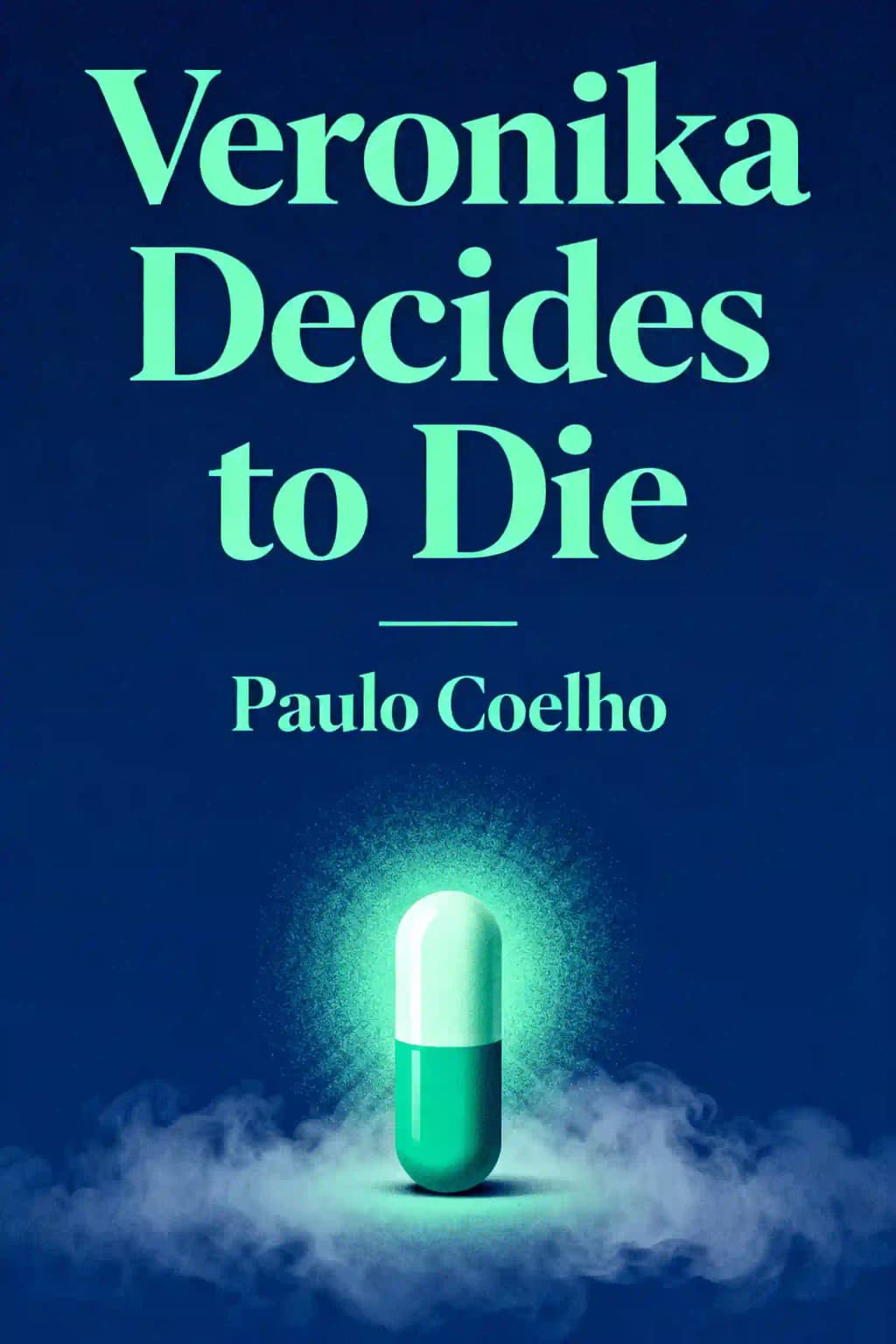
What would you do if you had only one week to live? Paulo Coelho's "Veronika Decides to Die" confronts this question through the journey of a 24-year-old Slovenian woman who survives a suicide attempt only to learn she has just days to live due to irreversible heart damage. This international bestseller, translated into 61 languages and selling over 75 million copies worldwide, draws from Coelho's own experiences in mental institutions during Brazil's military dictatorship. The book has profoundly influenced celebrities like Madonna and inspired a major motion picture starring Sarah Michelle Gellar. Beyond its commercial success, the novel sparked global conversations about mental health and prompted legislation in Coelho's native Brazil to reform psychiatric institutions. Through Veronika's journey, Coelho invites us to confront our own mortality and question whether we're truly living or merely existing.
第 2 章
When the End Becomes the Beginning
On November 11, 1997, Veronika meticulously cleans her rented convent room in Ljubljana, Slovenia, arranging every possession with deliberate care. The twenty-four-year-old librarian, beautiful and seemingly successful, methodically swallows four packs of sleeping pills with a calculated detachment. As she waits for death, she reads a magazine article asking, "Where is Slovenia?" - a question that provokes an unexpected surge of patriotic indignation. This irritation leads her to compose perhaps the most peculiar suicide note in literature: a brief geographical description of her homeland, nestled between Austria, Italy, and Croatia. She's not ending her life from sadness or depression - common motivations she considers too simplistic - but from a profound weariness with the monotonous predictability of existence and her powerlessness to fix the world's seemingly endless problems.
When Veronika regains consciousness, she finds herself in Villete, Slovenia's infamous mental asylum - a Gothic structure on the outskirts of Ljubljana that locals whisper about with equal parts fear and fascination. The sterile fluorescent lights and antiseptic smell are a jarring contrast to the peaceful death she had imagined. A matter-of-fact nurse informs her that while her suicide attempt failed, her heart sustained irreversible damage from the pills. The prognosis is stark: she has only five to seven days to live. Rather than showing distress at this news, Veronika's response is a smile and a quietly delivered, "So I succeeded, then" - words that reveal both her determination to die and the complex psychology driving her actions.
The irony of her situation is devastatingly sharp. Having tried to escape life's predictable patterns through suicide, Veronika now faces the very thing she sought - death - but under circumstances that force her to confront what living actually means. Her remaining days become a countdown that transforms her perspective entirely, each hour taking on new significance. The certainty of imminent death creates an unexpected freedom that was notably absent when life stretched before her as an endless, meaningless expanse. She begins to notice details she'd previously ignored: the way sunlight creates patterns on the asylum walls, the varied rhythms of other patients' movements, the taste of hospital food she'd normally dismiss as bland.
This paradox forms the philosophical backbone of the novel: sometimes we must confront our mortality to discover what makes life worth living. Through Veronika's experiences in Villete, among people society has labeled as insane, she begins to question fundamental assumptions about sanity, freedom, and the nature of a life well-lived. Her journey isn't about learning to avoid death but about learning to truly live before dying - a distinction that makes all the difference. The asylum becomes both her prison and her liberation, a space where conventional rules of society dissolve and where she's free to explore the very essence of what it means to be alive.
第 3 章
The Prison of Sanity
Villete isn't what Veronika expected. Instead of the chaotic scenes from movies, she finds an oppressively silent institution where patients seem reluctant to share their inner worlds. The asylum, established by European businessmen in abandoned barracks after Slovenia's independence, operates with questionable ethics. Anyone with money can commit relatives for reasons ranging from inheritance disputes to hiding criminal suspects. It houses both genuinely mentally ill patients and those merely accused or pretending.
During her first days, Veronika meets Zedka, a woman being treated for depression who explains that being crazy means "living in your own world." According to Zedka, this applies not just to schizophrenics but also to visionaries like Einstein and Columbus. She shares a parable about a kingdom where everyone drinks poisoned water and goes mad except the king and queen. When the people rebel, the royal couple choose to drink the water too, becoming "mad" like their subjects, who then consider them wise rulers again.
This story illuminates one of the novel's central themes: sanity is merely conformity to majority opinion. Dr. Igor, Villete's director, reinforces this when he explains to Veronika that mental illness is defined not by who's correct but by who aligns with collective thinking. Using his tie as an example, he notes that while a "normal" person would simply identify it as a tie, a "lunatic" might describe it as a useless, potentially dangerous piece of cloth.
"And all of us, one way or another, are insane," Zedka concludes, defining insanity as "the inability to communicate your ideas" - like being in a foreign country where you understand everything but can't express yourself in the local language.
Through these interactions, Veronika begins to question the rigid boundaries between sanity and madness. She discovers that Villete contains a group called the Fraternity - people who could leave but choose to stay because inside they can behave as they wish without criticism. During government inspections, they pretend to be dangerous maniacs to maintain their state-funded residency.
The asylum thus becomes a metaphor for society itself - a place where conformity is rewarded and divergence pathologized, where the "sane" may be those most deeply imprisoned by convention and fear.
第 4 章
The Poison of Bitterness
Dr. Igor, Villete's ambitious director, has developed a theory about a toxic substance he calls "Vitriol" - the bitterness that poisons the soul. Released during frightening situations, this metaphorical poison attacks the will, causing people to build high defensive walls against the outside world while limiting their internal growth. The embittered continue functioning automatically but lose all passion and desire.
We see this poison at work in Veronika's pre-suicide life. She had abandoned her true vocation as a pianist because her mother convinced her it wasn't practical, steering her toward law instead. Though she earned a good degree, she ended up as a librarian, discovering too late that she should have pursued her passion. Her life became a series of empty routines - frequenting the same bars, walking around the same lake, watching the same TV programs. She maintained emotional distance in relationships, choosing security over risk at every turn.
Mari, another patient, exemplifies how this bitterness can manifest differently. Once a successful lawyer, Mari suffered debilitating panic attacks that led to her hospitalization. Though her condition improved, she chose to remain in Villete rather than return to her legal career, which she had come to see as part of a broken system where laws weren't created to solve problems but to prolong quarrels indefinitely.
In a letter explaining her departure from Villete, Mari reveals she had always tried to be a "cistern" with rigid inner walls rather than an overflowing fountain. She had contained herself within society's expectations until she realized that life inside Villete was identical to life outside - "people building walls to protect their mediocre existences."
Eduard, a young schizophrenic patient, carries perhaps the most tragic example of Vitriol's effects. The son of a Yugoslavian ambassador in Brazil, Eduard abandoned his diplomatic studies to pursue painting his "visions of paradise." When his father made an emotional appeal asking Eduard to change "in the name of love," Eduard examined his paintings, found them mediocre, and gave up his passion. The next day, his parents found him unresponsive, having "crossed the abyss that separates a man from his dream" and unable to go either forward or back.
Through these characters, Coelho illustrates how bitterness develops not just from life's tragedies but from the small compromises we make with our authentic selves - compromises that accumulate until we no longer recognize who we've become.
第 5 章
The Awakening of Desire
As Veronika's remaining days dwindle, she experiences a profound awakening of desires she had long suppressed - a transformation that challenges her previous understanding of herself and her relationship to pleasure. In one of the novel's most provocative scenes, she stands naked before Eduard and begins masturbating - not to draw him out of his schizophrenic world but to explore her own forbidden fantasies. She surrenders completely to imagining scenarios she'd never allowed herself to consider before, becoming "both queen and slave, dominatrix and victim." This act of sexual self-discovery marks her first step toward embracing the full spectrum of her desires, free from societal judgment or self-imposed limitations.
This sexual liberation represents a broader awakening that ripples through every aspect of her life. Having always maintained emotional distance in relationships - protecting herself through casual encounters and surface-level connections - Veronika suddenly finds herself capable of genuine intimacy. When Eduard is subjected to electric shock treatment, she stays by his side despite suffering another heart attack herself, demonstrating a depth of care she'd previously thought impossible. Zedka, observing this transformation, recognizes it as true love, telling Veronika she's experienced something rare and precious - a moment of genuine connection that transcends conventional relationships. "You have nothing to lose by embracing it," Zedka advises, "and everything to gain by living fully in whatever time remains."
Veronika's musical passion, long confined to proper recitals and acceptable venues, also undergoes a dramatic reawakening. Finding a piano in Villete's living room, she initially approaches it with raw emotion, pounding chaotic, dissonant chords that channel years of suppressed rage until it dissolves completely. This cathartic release gives way to something deeper - she begins playing with heart and soul, realizing she's finally achieving her dream of making music purely for its own sake. Her only audience is a young schizophrenic who seems to understand her music on an intuitive level, yet this becomes the most authentic performance of her life.
When Dr. Igor probes her sexual awakening, wondering if repressed desires contributed to her suicide attempt, he offers a philosophical perspective about society's sexual restrictions that extends beyond mere physical pleasure. "When everyone dreams, but only a few realize their dreams, that makes cowards of us all," he observes, drawing from decades of psychiatric practice. He's discovered that seemingly "normal" people harbor diverse sexual fantasies they rarely act upon, remaining afraid of being different, constrained by societal expectations and self-imposed limitations. This repression, he suggests, contributes to broader psychological distress.
This awakening of desire - sexual, musical, emotional - forms a powerful counterpoint to the bitterness that had previously defined Veronika's existence. Where bitterness builds walls, desire breaks them down, creating pathways to genuine connection. Where bitterness disconnects, desire connects, fostering authentic relationships with others and herself. Where bitterness diminishes, desire expands, opening new possibilities for experiencing life's full range of emotions. In her final days, Veronika discovers that authentic living requires embracing rather than suppressing our deepest longings - a lesson that transforms her approaching death into a celebration of life's most fundamental truths.
第 6 章
The Two Faces of Love
Throughout the novel, love appears as both poison and cure, prison and liberation. Eduard's story particularly illustrates this duality. His father's love, expressed through the emotional appeal to change "in the name of love," becomes the very thing that destroys Eduard's passion for painting and pushes him into schizophrenia.
Veronika connects this to a childhood memory of a painting showing the Virgin Mary standing on a snake. When she asked her grandmother if the woman wasn't afraid of being bitten, her grandmother explained the snake represented good and evil, which the woman kept in check with her love. Veronika tells Eduard this story, noting how his parents' love nearly destroyed him, showing that love has two faces.
Eduard later disagrees with this interpretation, explaining that the Virgin standing on the snake represents female energy mastering wisdom, not good and evil - "love above wisdom." This subtle distinction reveals how love can be either controlling or liberating depending on whether it seeks to impose its will or nurture authenticity.
Mari's experience with an "Impossible Love" from her youth further explores this theme. She had pursued this man across oceans, accepting the role of mistress while secretly plotting to become his wife. When the relationship failed, she eventually recovered and married a kind man. Years later, after defending her Serbian heritage during Yugoslavia's breakup, she encountered a statue of the poet Preseren who spent his life gazing at his own Impossible Love. This triggered her depression as she obsessively questioned whether she had fought hard enough for her first love.
Through astral journeys during insulin shock treatment, Zedka came to understand her Impossible Love was merely an excuse to escape a life that wasn't truly fulfilling her. The love she had idealized had become a prison rather than a liberation.
In contrast, the love that develops between Veronika and Eduard in their final days together represents love's liberating potential. It doesn't demand change or conformity but accepts and nurtures authenticity. When Eduard suggests they leave Villete together, Veronika warns their time won't last long. "It will last an eternity," Eduard replies - longer than all his identical days trying to forget his visions of paradise.
This distinction between love that imprisons and love that liberates becomes central to understanding the novel's perspective on authentic living. True love doesn't ask us to be someone else; it gives us the courage to be who we truly are.
第 7 章
The Freedom of Madness
"Stay insane, but behave like normal people," advises a Sufi master who visits Villete, encouraging patients to discover their real "I" - "what you are, not what others make of you." This paradoxical instruction captures the novel's perspective on madness as a potential path to freedom.
The Fraternity, a group of Villete patients who could leave but choose to stay, investigates "prohibited experiences," challenging the government's teaching that spiritual searching distracts from "real problems." They recognize that within Villete's walls, they enjoy freedoms unavailable in the supposedly "sane" world outside.
Zedka, preparing to leave Villete after recovering from depression, tells Veronika she plans to live authentically outside, proudly embracing her "madness" while reconnecting with her husband and finding meaning in life. She has learned to value her unique perspective rather than conform to societal expectations.
Mari, in her farewell letter, explains that after being hospitalized for panic attacks, she returned to being contained like a "cistern" with rigid inner walls. Now at sixty-five, she's leaving for Bosnia to be useful, believing "the danger of an adventure is worth a thousand days of ease and comfort." The Fraternity members conclude Mari has finally gone insane - a judgment that ironically confirms she has found her freedom.
Eduard's schizophrenia began when he "crossed the abyss that separates a man from his dream" - unable to pursue his passion for painting but equally unable to embrace the diplomatic career his father desired. His madness represents both the consequence of denying his authentic self and a refuge from a world that couldn't accommodate his visions.
When Eduard and Veronika finally escape Villete together, Eduard acknowledges the apparent recklessness of their action with a simple statement: "Crazy people do crazy things." In this context, madness becomes not a clinical condition but a willingness to defy convention, to risk disapproval, to pursue authentic living despite societal pressures to conform.
The novel thus inverts traditional understandings of sanity and madness. True insanity lies not in those who see the world differently but in a society that values conformity over authenticity, security over passion, and predictability over genuine experience. The truly mad are not those in asylums but those who build internal asylums through their fear of living fully.
第 8 章
The Experiment of Living
In the novel's final revelation, we learn that Dr. Igor has been conducting an elaborate psychological experiment using Veronika as his unwitting subject. Through carefully controlled doses of Fenotal, he induced symptoms that perfectly mimicked heart attacks while studying his controversial theory that "an awareness of death encourages us to live more intensely." The deception was complete - from the initial diagnosis to the weekly medical updates - all designed to create a convincing illusion of impending death. Veronika was never dying; each symptom was carefully orchestrated to test whether a direct confrontation with mortality could cure the deep-seated bitterness that had led to her suicide attempt.
The experiment's results exceeded even Dr. Igor's optimistic projections. Not only was Veronika's Vitriol (bitterness) transformed into vitality, but her journey sparked a cascade of positive changes throughout Villete. Mari, inspired by Veronika's embrace of life, requested discharge after years of institutional comfort. Other long-term patients began questioning their own diagnoses and seeking case reviews. The ripple effects demonstrated how one person's authentic engagement with life could catalyze change in an entire community.
Dr. Igor's experiment serves as a sophisticated metaphor for the novel itself, challenging readers to examine their own relationship with mortality. Rather than treating death awareness as something to be feared or suppressed, the story presents it as a philosophical tool - a lens that brings life's true priorities into sharp focus. Through Veronika's transformation, we see how the certainty of death can paradoxically lead to a more vibrant appreciation of life.
The culmination of this theme plays out when Eduard and Veronika celebrate their escape from Villete at Ljubljana's most prestigious restaurant. Their celebration becomes increasingly uninhibited as they share expensive wine, leading to an impromptu adventure to the castle overlooking the city. In this heightened moment, Veronika extracts a powerful promise from Eduard - to return to his art, to paint her, and to continue painting afterward. Her declaration that her life found meaning by helping him rediscover his artistic path reveals how facing death had taught her to recognize the profound impact even a brief life can have.
The novel's penultimate scene unfolds on the castle grounds, where Veronika, believing death is imminent, falls into a deep sleep in Eduard's arms after they exchange declarations of love. The morning brings a moment of exquisite tension when a policeman discovers them and Eduard briefly believes Veronika has died. Her simple stirring and question - "What's going on?" - is met with Eduard's profound response: "Nothing. Or rather a miracle happened: another day of life."
This exchange distills the novel's essential wisdom: authentic living requires us to hold death awareness not as a dark shadow but as an illuminating force. The experiment of living fully demands that we embrace each day with the same intensity Veronika found when she thought her days were numbered. Through this lens, ordinary moments become extraordinary, and the simple fact of waking to another day transforms from routine into miracle. The novel suggests that this perspective - treating each day as both precious and precarious - might be the key to breaking free from the spiritual malaise that initially drove Veronika to despair.
第 9 章
The Paradox of Death and Rebirth
The novel's central paradox is that Veronika must "die" to truly live. Her suicide attempt and subsequent diagnosis create a transformative space where conventional limitations fall away. Knowing she has only days to live, she finds herself free to explore desires, express emotions, and make connections that were impossible when life stretched before her as an endless, meaningless expanse.
This paradox extends beyond Veronika to other characters. Zedka experiences symbolic death during insulin shock treatment, her spirit floating near the ceiling while her body lies strapped to the bed. Through these astral journeys, she gains perspective on her depression and the Impossible Love that triggered it. Mari "dies" to her former identity as a respected lawyer, choosing instead to pursue humanitarian work in Bosnia. Eduard "dies" to his parents' expectations, reclaiming his passion for painting his "visions of paradise."
The pattern echoes ancient initiation rites and spiritual traditions where symbolic death precedes rebirth into a more authentic existence. It suggests that transformation requires us to let go of who we think we are before we can become who we might be.
When Veronika plays piano in Villete, she experiences this death-rebirth cycle in miniature. First, she pounds chaotic, dissonant chords, releasing her rage - a kind of death to her former controlled self. Then, peace floods her soul as she contemplates "Infinity and Eternity walking hand-in-hand," and she begins playing a sonata for the moon and stars - a rebirth into artistic expression.
The novel's final scene completes this cycle. After falling asleep in Eduard's arms, believing death is approaching, Veronika wakes to a new day - literally reborn into a life now recognized as miraculous. Though she doesn't yet know Dr. Igor's deception, her transformation is real. She has died to her former self and been reborn into a life of authentic connection, passion, and purpose.
This paradox offers readers a profound invitation: without literally facing death, can we nevertheless "die" to the limitations, fears, and compromises that prevent us from living authentically? Can we, like Veronika, find the courage to embrace the uncertainty of genuine living rather than the security of mere existence?
In the end, Coelho suggests that true living requires a continuous cycle of death and rebirth - letting go of who we've been to become who we might be. Each day offers this possibility, this miracle of another chance to live fully rather than merely exist. The question is whether we have the courage to embrace it.