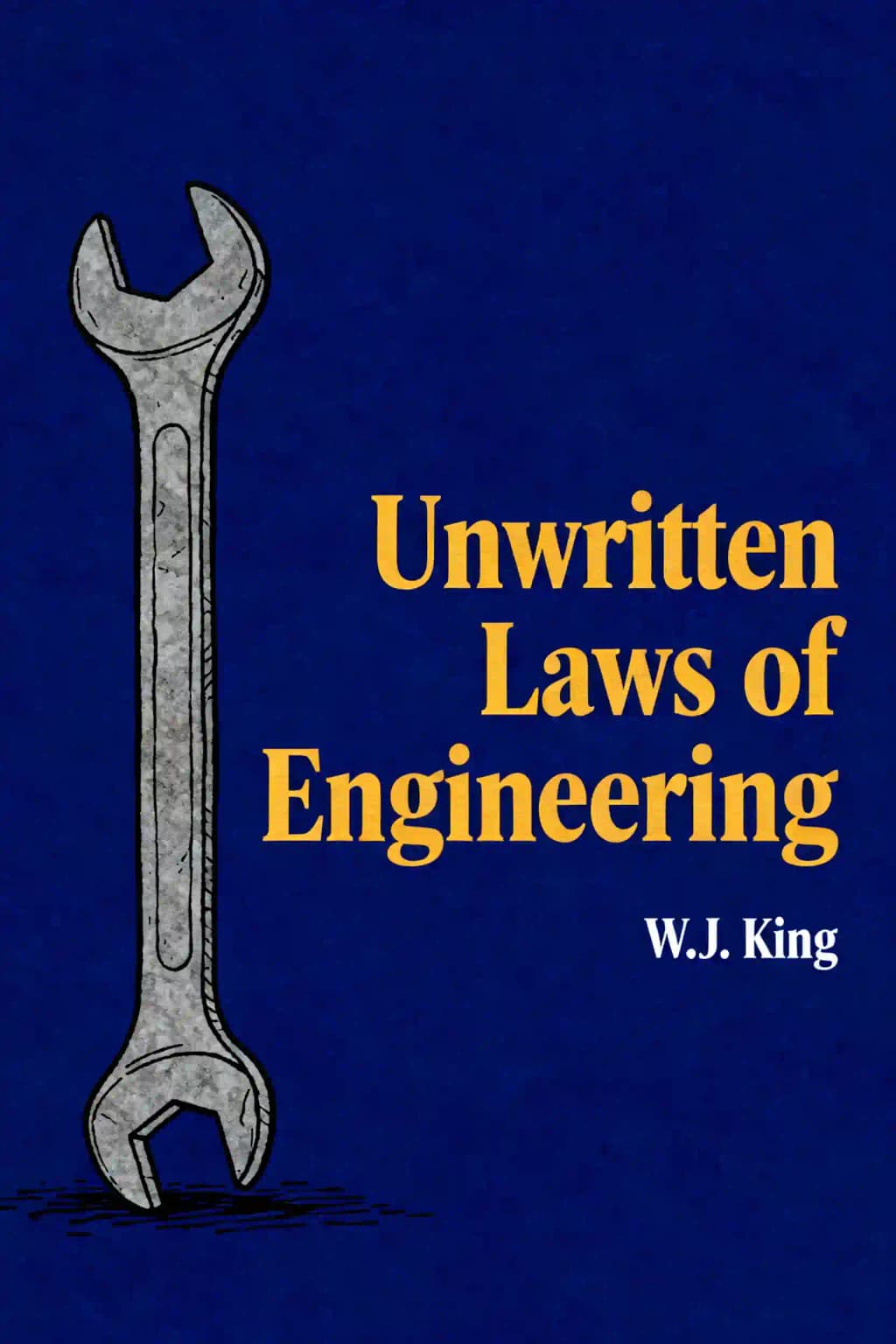
Published in 1944 yet still indispensable, "The Unwritten Laws of Engineering" reveals the hidden social dynamics that determine engineering success more than technical skills. For 75+ years, this timeless classic has shaped professional standards across industries - what career-defining wisdom are you missing?
W.J. King (William J. King), author of The Unwritten Laws of Engineering, was a distinguished engineer and educator whose work reshaped professional development literature.
Originally published in 1944 by the American Society of Mechanical Engineers as a guide for new engineers, his book evolved into a cross-industry classic on workplace dynamics and leadership principles.
A former General Electric engineer and longtime UCLA engineering professor, King drew from decades of industrial and academic experience to craft pragmatic advice for navigating organizational hierarchies and technical challenges. His companion work, The Unwritten Laws of Business, further expanded these principles for managerial audiences.
King’s succinct, actionable maxims—emphasizing ethics, interpersonal skills, and systemic thinking—remain foundational in engineering education and corporate training programs worldwide. The book has been republished in over 30 editions and translated into 40 languages, cementing its status as a perennial resource for professionals seeking to master the unwritten rules of career success.
The Unwritten Laws of Engineering by W.J. King is a professional guide addressing non-technical challenges in engineering careers. Originally published in 1944, it outlines practical "house rules" for workplace conduct across three areas: essential advice for beginners, leadership principles for managers, and personal/professional ethics. The book emphasizes administrative wisdom, interpersonal dynamics, and proactive problem-solving over technical skills.
This book is essential for new engineers, technical managers, and professionals seeking career advancement. It’s particularly valuable for those struggling with workplace dynamics, communication, or leadership challenges. Experienced engineers also benefit from revisiting its timeless principles to refine their professional conduct.
Yes. Despite its age, the book remains a cornerstone of engineering literature for its concise, actionable advice. Reviewers praise its focus on soft skills—like communication and accountability—that are critical for long-term career success. The 60-page format makes it a quick yet impactful read.
New engineers should:
Managers learn to:
Key personal guidelines include:
A hallmark line advises, “Let’s go see!”—encouraging engineers to investigate problems firsthand rather than relying on secondhand reports. This embodies the book’s emphasis on proactive problem-solving and collaboration.
Both books share W.J. King’s core principles, but The Unwritten Laws of Business broadens the audience to non-engineers. The original engineering-focused version includes industry-specific examples, while the latter adapts advice for general corporate settings.
Its focus on human dynamics in technical fields transcends technological changes. Remote work, AI integration, and interdisciplinary teams amplify the need for soft skills like communication and adaptability—areas the book addresses comprehensively.
W.J. King was a General Electric engineer and UCLA professor who wrote the book in 1944 after observing workplace failures stemming from poor professional conduct, not technical errors. His pragmatic insights stemmed from decades of industry and academic experience.
Some note its brevity and lack of technical depth, but most agree its purpose—to codify implicit workplace norms—is fulfilled effectively. Modern readers may need to contextualize older examples, but the core principles remain universally applicable.
通过作者的声音感受这本书
将知识转化为引人入胜、富含实例的见解
快速捕捉核心观点,高效学习
以有趣互动的方式享受这本书
Technical skills may get you hired, it's your professional behavior that determines how far you'll go.
Projects progress in direct proportion to follow-up and expediting.
Solving problems requires insight developed through first-hand observation.
No manager likes surprises, but solid recommendations will significantly improve difficult situations.
Whatever your supervisor wants done takes top priority.
将《Unwritten Laws of Engineering》的核心观点拆解为易于理解的要点,了解创新团队如何创造、协作和成长。
将《Unwritten Laws of Engineering》提炼为快速记忆要点,突出坦诚、团队合作和创造力的关键原则。

通过生动的故事体验《Unwritten Laws of Engineering》,将创新经验转化为令人难忘且可应用的精彩时刻。
随心提问,选择声音,共同创造真正与你产生共鸣的见解。

"Instead of endless scrolling, I just hit play on BeFreed. It saves me so much time."
"I never knew where to start with nonfiction—BeFreed’s book lists turned into podcasts gave me a clear path."
"Perfect balance between learning and entertainment. Finished ‘Thinking, Fast and Slow’ on my commute this week."
"Crazy how much I learned while walking the dog. BeFreed = small habits → big gains."
"Reading used to feel like a chore. Now it’s just part of my lifestyle."
"Feels effortless compared to reading. I’ve finished 6 books this month already."
"BeFreed turned my guilty doomscrolling into something that feels productive and inspiring."
"BeFreed turned my commute into learning time. 20-min podcasts are perfect for finishing books I never had time for."
"BeFreed replaced my podcast queue. Imagine Spotify for books — that’s it. 🙌"
"It is great for me to learn something from the book without reading it."
"The themed book list podcasts help me connect ideas across authors—like a guided audio journey."
"Makes me feel smarter every time before going to work"

免费获取《Unwritten Laws of Engineering》摘要的 PDF 或 EPUB 版本。可打印或随时离线阅读。
Engineering education equips you with formulas and technical knowledge, but leaves a critical gap in professional conduct that determines your ultimate success. When W.J. King published "The Unwritten Laws of Engineering" in 1944, he created what Bill Gates would later call "a book I'd recommend to every engineer." This enduring classic reveals a fundamental truth: technical skills may get you hired, but your professional behavior determines how far you'll go. While you're mastering thermodynamics and calculus, no one teaches you how to navigate office politics, manage relationships with supervisors, or lead teams effectively. Yet these unwritten rules make the difference between stagnation and stellar advancement in your engineering career.