第 1 章
The Science of Strategic Productivity: How Two Hours Can Transform Your Day
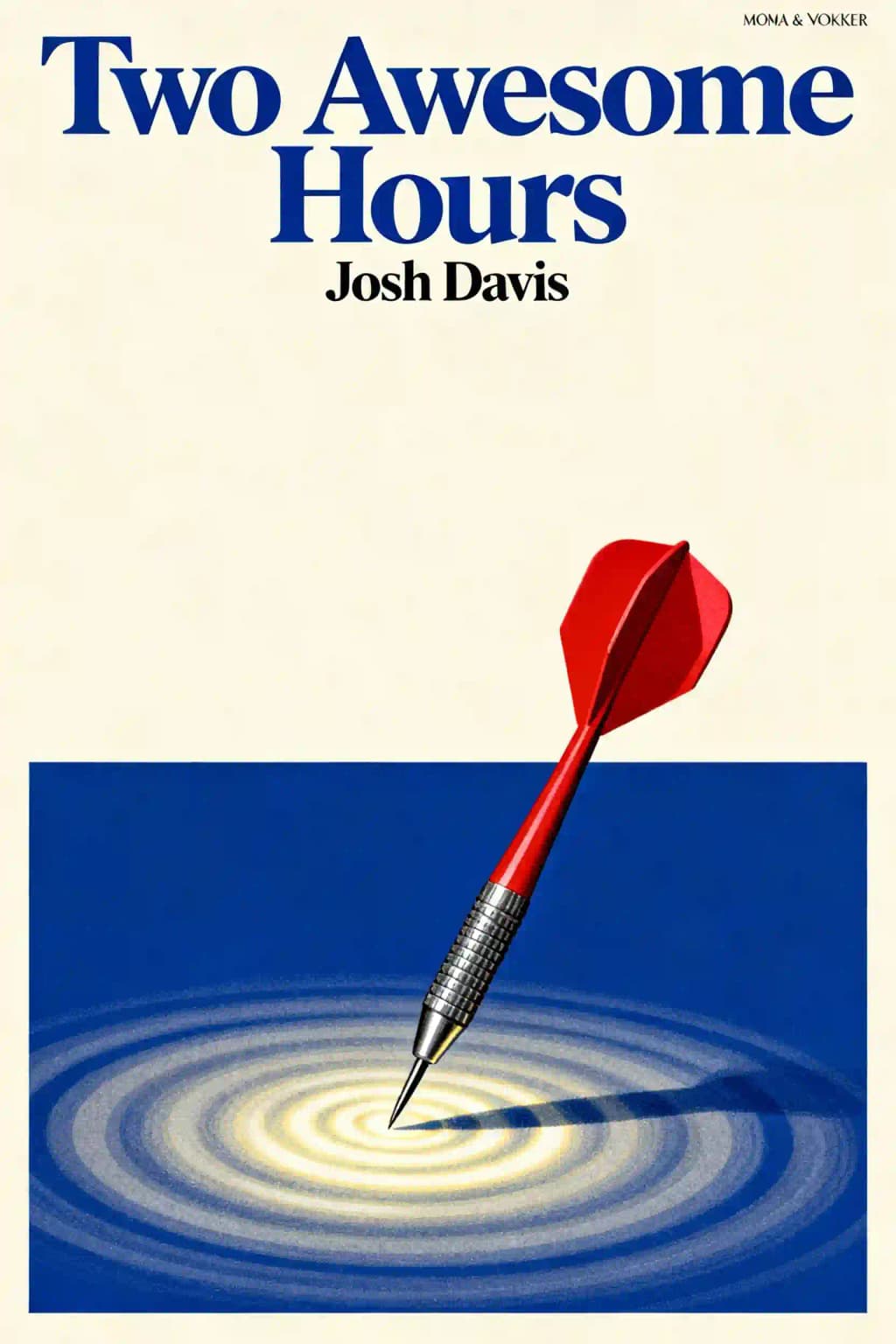
Have you ever felt like you're drowning in work despite spending countless hours at your desk? You're not alone. In a world obsessed with productivity hacks and time management techniques, Josh Davis offers a revolutionary perspective in "Two Awesome Hours." As Elon Musk's reported weekend read and a favorite among Silicon Valley executives, this book challenges our fundamental understanding of productivity. Rather than cramming more tasks into every minute, Davis argues that structuring just two hours of truly effective work can transform your professional life. Drawing from neuroscience, psychology, and biology, the book has gained cult status among high-performers who recognize that working with our biology-not against it-is the secret to exceptional results. Let's explore how you can achieve more by doing less, but doing it better.
第 2 章
The Efficiency Trap: Why Working Harder Isn't Working
We've been sold a dangerous myth: that productivity means constant output. Most of us respond to overwhelming workloads by either forcing ourselves to stay on task without breaks or by working longer hours. Both approaches stem from the belief that managing workload means eliminating "wasted" time-being "efficient." This mindset has become particularly prevalent in our digital age, where the always-on culture of emails, Slack messages, and endless notifications creates an illusion that constant engagement equals productivity.
This approach fundamentally misunderstands how our brains work. While efficiency works wonderfully for computers and machines that never tire, we're biological creatures subject to what scientists call "embodied cognition"-the many ways having a body influences thought. Our physical postures affect hormone levels and decision-making. Our memories aren't installed like software but grown through neural changes requiring time. Research shows that even simple actions like standing up straight can increase testosterone levels by 20% and boost confidence, while chronic sitting and poor posture can decrease cognitive performance by up to 20%.
Consider Benjamin Franklin, history's paragon of productivity-author, inventor, scientist, printer, philosopher, politician, and diplomat. While we imagine him as work-obsessed, Franklin's autobiography reveals he devoted enormous time to hobbies, friends, and intellectual pursuits. He created daily conditions for peak effectiveness rather than cramming work into every available hour, even scheduling two-hour lunch breaks and evening time for "music or diversion, or conversation." His morning routine began with the question "What good shall I do this day?" and ended with reflection time. His extraordinary accomplishments came because he made time for pleasure, learning, creativity, and social connection-not despite it.
Modern neuroscience supports Franklin's intuitive approach. Studies show that the brain's default mode network-active during periods of apparent "idleness"-is crucial for creativity, memory consolidation, and problem-solving. When we're constantly busy, we suppress this vital mental process. Research from the University of Illinois found that brief diversions from a task dramatically improve performance, while Microsoft research showed that back-to-back meetings without breaks significantly increase stress and reduce ability to focus and engage.
Trying to be efficient constantly blocks our human potential. Like muscles that can't perform thousands of repetitions without rest, our brains accomplish little under constant work but can achieve remarkable results under the right conditions. The key to fantastic effectiveness is working with our biology rather than against it. This means incorporating regular breaks (ideally 15-20 minutes every 90 minutes), allowing time for reflection and creative thinking, and recognizing that periods of apparent "non-productivity" are often when our most valuable insights emerge. Companies like Google and 3M have long recognized this, building free time into their employees' schedules and seeing significant returns in innovation and problem-solving capacity.
第 3 章
Decision Points: The Hidden Opportunity Between Tasks
Most of the time, we function in automatic mode-following nonconscious routines that guide our thoughts, feelings, and behaviors. Like computer programs, these neural routines run until completed or interrupted. Whether flossing teeth or answering emails, we engage in these activities with little conscious monitoring.
As Charles Duhigg explains in "The Power of Habit," we often respond automatically to the right cues. These habits are necessary mental energy savers, allowing our conscious minds to focus on solving new problems. However, the downside is that we frequently jump between tasks without considering what makes sense to do next, wasting tremendous time and energy.
The key is recognizing those few moments during each day-when a task ends or is interrupted-when we have the opportunity to choose our next activity. These decision points are crucial but easily overlooked as we rush to feel "productive." Hurrying through a decision point might save five minutes but starting the wrong task could cost an hour.
When a neural routine ends or is interrupted, self-awareness suddenly increases, sometimes jarringly. These moments when neural routines stop leave us temporarily adrift. Our dorsal anterior cingulate cortex activates as an alarm system when such conflicts arise, bringing more conscious resources online.
To maximize decision points, follow three key practices:
1. Savor each decision point by stepping back from immediate concerns to reconnect with what matters before deciding your next action. Research shows that creating psychological distance leads to high-level thinking that keeps the big picture in mind.
2. Plan your decision points in advance by identifying events likely to occur during your day and forming plans to pause for decision points when they happen. For example, when interrupted by colleagues with "quick questions," use that moment to reassess whether you should continue your current task or switch to something more valuable.
3. Don't start a new task without consciously deciding it's the right one. When hitting a decision point, immediately jumping to the next task often wastes more time than taking a few moments to decide properly. Label the moment as a decision point, perhaps standing up, walking away from your computer, or drinking some water.
第 4 章
Managing Mental Energy: The Real Currency of Productivity
Every task takes a mental toll, with some depleting our minds significantly. Each task also triggers emotions that affect our performance on subsequent tasks. While we'd like to bring our A-game to everything, there's only so much mental energy available. To create awesome hours of productivity, we must strategically choose what deserves our best mental energy and postpone tasks that might deplete it unnecessarily.
Consider Tom, a marketing director preparing to pitch a classic tennis line revival to his company's leadership. The night before his presentation, he's brimming with excitement and ideas. The next morning, needing to prepare for his 11 AM meeting, he first checks his neglected email inbox "just to get caught up quickly." Ninety minutes later, having finally answered all emails, he opens a document to jot down his pitch ideas-and draws a blank. His previously vibrant ideas seem forgettable or foolish, and he questions his ability to handle the project.
What Tom doesn't realize is that he's exhausted his brain's executive functions-the control and direction-setting mechanisms that handle decision-making, planning, short-term memory, and self-inhibition. Self-control tends to wear out with use. After exercising self-control in one situation, we typically act as though our brain's self-control mechanisms have been depleted.
Even typical, everyday decisions can leave us mentally fatigued and less motivated immediately afterward. This explains Tom's predicament. Answering emails, though seemingly simple, involves constant decision-making: Should I reply? Now or later? How should I phrase this? Delete or save? Each email requires decisions about time, value, social consequences, and emotions-significantly taxing mental resources even for seemingly unimportant messages.
Beyond mental fatigue, our emotions significantly impact task performance. Every task on our to-do list elicits emotions that affect how well we complete that task and subsequent ones. Emotions have adaptive value-they help us respond appropriately to situations. Anger uniquely facilitates approach-oriented behavior, sadness offers surprising benefits for certain tasks like making less biased decisions, anxiety and readiness are physiologically almost identical, and positive emotions are particularly valuable for discovering new insights and fostering creativity.
To manage your mental energy effectively:
1. Limit your mental fatigue by identifying which activities substantially deplete your resources and avoiding them before times when peak performance matters.
2. Anticipate the emotions certain tasks elicit and use this emotional awareness strategically-schedule tasks requiring creativity and problem-solving after activities likely to generate positive emotions.
3. Practice strategic incompetence by choosing not to complete everything on your lists to preserve energy for what truly matters. Choose your moments of peak performance and sacrifice liberally around them.
第 5 章
Breaking Free from Distractions: Working with Your Brain's Natural Tendencies
Even after choosing the right task at the right time, maintaining focus remains challenging. Many of us believe we simply need more willpower, but this approach hasn't worked for years. Why? Because our brains aren't designed for indefinite focus on a single task but rather to rapidly switch between different foci of attention.
This evolutionary adaptation helped our ancestors detect approaching dangers while searching for resources. Parts of our brain specifically handle disengaging and reorienting to changing environments. Our attention system excels at scanning, detecting novelty, and responding to the unexpected-essentially zeroing in on distractions. When we encounter something like a report, our brain initially finds it interesting but soon becomes habituated to its presence and starts ignoring it in favor of anything new or different.
Fighting this natural tendency with willpower backfires spectacularly-telling yourself not to think about something activates precisely those neural networks, making the distraction more prominent. Though removing distractions seems obvious, most of us do little to create distraction-free workspaces. Our devices-computers, phones, tablets-play into the brain's urge to frequently shift focus, keeping us constantly monitoring emails, texts, and alerts.
To maximize attention, limit noise, turn off devices for twenty-minute intervals, close email applications, disable notifications, close your office door or wear noise-canceling headphones, and forward calls to voicemail. Research shows meditation can improve sustained attention, but simply removing predictable distractions dramatically increases your chances of productive work blocks.
Though we're taught from childhood that sustained attention equals good performance and daydreaming indicates laziness, research suggests mind wandering may actually benefit our most cognitively challenging professional tasks: creative problem solving and long-term planning. Creative problem solving isn't limited to traditionally creative fields-professionals in every industry face complex challenges requiring unique solutions.
Researchers from UC Santa Barbara found that participants whose minds wandered most showed significant improvement when repeating creative tasks. This suggests mind wandering specifically helps solve problems we've previously encountered. Research even indicates frequent daydreamers tend to be more creative generally.
To increase productivity through deliberate focus breaks, try actively enabling mind wandering: after concentrating on a problem, switch to a mildly engaging task that doesn't tax your working memory. Choose activities that naturally conclude within minutes-like appreciating artwork, organizing your desk, listening to music mindfully, or playing simple games.
We set ourselves up for failure when expecting indefinite focus. Your brain is designed to find distractions-you can limit them temporarily but can't will yourself to ignore all distractions indefinitely. The only effective approach is acceptance: allow for valuable mind wandering, then gently return to your task.
第 6 章
The Power of Movement: How Exercise Transforms Mental Performance
Physical exercise has profound immediate effects on mental performance. Nelson Mandela maintained clarity of thought during his 27-year imprisonment through disciplined exercise, running in place and doing calisthenics in his tiny cell. This practice not only preserved his physical health but kept his mind sharp under extreme conditions. Unlike long-term health benefits that take weeks or months to manifest, exercise provides immediate cognitive improvements: just 10-40 minutes of moderate activity enhances executive functions, particularly self-control and decision-making capabilities.
Extensive research demonstrates how exercise transforms our mental state through multiple pathways. It sharpens attention by increasing blood flow to the brain, stabilizes blood sugar levels which prevents cognitive dips, reduces anxiety through the release of GABA neurotransmitters, amplifies positive emotions via endorphin release, and increases energy by improving mitochondrial function. The optimal formula appears to be 20-30 minutes of high-intensity exercise (like interval training) or 30-40 minutes of moderate-intensity exercise (like a brisk walk), with mood benefits typically peaking within 30 minutes after finishing. Exercise essentially works as a mental reset button, making it a reliable strategy for improving cognitive performance before important meetings, presentations, or challenging tasks.
Rather than advocating for regular exercise as a general health practice, the key insight is using physical activity strategically to boost thinking abilities and mental energy at specific times. When facing high-stakes presentations, complex projects, anxiety-inducing meetings, or periods of mental fatigue, moderate exercise can make all the difference in performance outcomes. Even simple movement practices like walking meetings have shown significant benefits for creativity and problem-solving.
For maximum cognitive benefit, consider these specific strategies:
• Take a 30-40 minute brisk walk when feeling mentally sluggish, especially mid-afternoon
• Use stairs for 10-20 minutes as an accessible workout in any office building
• Visit the gym for a moderate 20-30 minute workout before challenging tasks, focusing on cardio activities
• Schedule exercise before anxiety-provoking meetings to calm nerves and improve mood through reduced cortisol levels
• Plan workouts before particularly challenging tasks or schedule them after draining activities to restore mental energy
• Incorporate movement breaks every 90 minutes during intensive work periods
• Use morning exercise to set a positive tone for important days
• Consider walking meetings for one-on-one discussions that don't require note-taking
If Nelson Mandela could maintain a consistent exercise routine in his confined jail cell, you can certainly make time for strategic movement before important meetings. The key is viewing exercise not just as a health maintenance activity, but as a powerful tool for optimizing mental performance when it matters most. Even short bursts of movement can provide significant cognitive benefits, making it a practical strategy for busy professionals seeking to enhance their mental capabilities.
第 7 章
Food as Fuel: Strategic Eating for Optimal Brain Function
What and when you eat and drink can significantly impact your energy level, mood, and executive functions in the minutes and hours that follow, offering another way to optimize productivity when exercise isn't possible.
Research comparing macronutrients reveals surprising effects on cognition. Carbs provide only a brief mental boost (minutes only), with attention improving fifteen minutes after consumption but executive functions declining within an hour. High-protein meals enhance memory after an hour. Most surprisingly, fats may be most beneficial for executive function, with one study showing improvements lasting three hours after consuming fats compared to proteins or carbs, possibly because fats cause less dramatic blood sugar fluctuations.
Stable blood sugar levels are optimal for cognitive performance and mood stability. Research shows higher GI breakfasts correlate with increased hostility, while low GI breakfasts improve executive functions like self-inhibition and attention compared to high GI breakfasts or skipping breakfast entirely. These benefits typically emerge about two hours after eating, though individual glucose metabolism affects outcomes.
Meal size and frequency significantly impact cognitive performance. Those who consumed smaller, more frequent meals made significant improvements on reaction time, verbal reasoning, and memory tests. Researchers believe smaller, spaced-out meals help regulate blood sugar levels, which particularly benefits working memory.
What we drink affects our mental energy as much as what we eat. Even mild dehydration (just a 2% drop in hydration) impairs attention and short-term memory. For peak mental performance, drink water regularly throughout the day, especially if you haven't had any in the previous hour or two.
Caffeine affects cognitive performance in complex ways. Research shows moderate caffeine consumption (around 150mg) can increase alertness and improve attention, though higher doses may increase anxiety. Studies demonstrate that smaller doses often provide better benefits-one found 200mg improved attention while 400mg offered no additional advantage.
Being intentional about what you consume before important work can dramatically improve productivity. Key strategies include:
• Splitting meals to eat half now and half later
• Avoiding carb-rich foods when needing sustained focus
• Choosing meals with balanced proteins, low glycemic index carbs and healthy fats
• Staying hydrated with water
• Using caffeine judiciously, keeping portions small and adding cream to stabilize blood sugar levels
第 8 章
Engineering Your Environment: Creating Spaces That Enhance Performance
Environmental noise poses a significant challenge to cognitive performance, with research consistently showing its detrimental effects on productivity. Intermittent speech-such as fragments of conversations from nearby cubicles or phone calls-proves particularly disruptive because our brains naturally attempt to process and complete these partial verbal inputs. A comprehensive meta-analysis examining 242 studies revealed that cognitive tasks were most severely disrupted by intermittent speech compared to continuous speech or mechanical noise. While many people attempt to mask office noise with background music, studies show this actually impairs reading comprehension and complex problem-solving abilities. Even instrumental music can interfere with verbal processing tasks. White noise, though popular, typically proves less effective than simple quiet, with the exception of individuals diagnosed with ADHD or severe attention difficulties, for whom it can provide beneficial sensory regulation.
Light exposure fundamentally shapes our cognitive function through multiple pathways. The 2002 discovery of intrinsically photosensitive retinal ganglion cells (ipRGCs) revolutionized our understanding of how light affects the brain. These specialized cells connect directly to the suprachiasmatic nucleus-our internal clock-and other brain regions controlling alertness and mood. Blue light, which mimics natural daylight (around 5500-6500K), proves particularly effective at enhancing cognitive performance. Workers exposed to bluish-white light demonstrate 12% faster response times on attention tests and score significantly higher on decision-making tasks. However, lighting needs vary by task type-dim lighting (around 150 lux) enhances creative thinking by reducing inhibitions and promoting exploratory thinking, though it simultaneously decreases analytical performance by up to 30%.
Workspace design profoundly influences both physical and cognitive performance through multiple mechanisms. Research at Harvard Business School demonstrated that expansive postures and movements increase testosterone levels by 20% while decreasing stress hormone cortisol by 25%, leading to improved confidence and decision-making ability. Extended sitting severely impacts energy levels-even fifteen minutes of static posture reduces alertness and positive affect. Studies of treadmill desk users show walking at just 1-2 mph while working increases creative output by 60% and improves analytical thinking, with benefits persisting for up to 30 minutes after returning to seated work.
The restorative potential of workspace elements shouldn't be underestimated. Research shows that adding even a single plant to a workspace improves attention span by 15%. Natural sounds, particularly bird songs, accelerate mental recovery from demanding tasks by 30-50%. Views of water features reduce stress markers in saliva samples within minutes. Personalizing your space-through photos, meaningful objects, or artwork-reduces emotional exhaustion and increases engagement, provided these elements don't create visual clutter.
Your environment functions as a behavior architecture, subtly guiding your actions and mental states throughout the day. It determines interruption frequency, depletes or conserves willpower through exposure to temptations, triggers emotional responses, and either facilitates or hinders healthy behaviors like movement and rest. Strategic environmental design can reduce cognitive load by 20-30%, making it easier to maintain focus during your peak performance periods. To optimize your workspace, regularly audit your environment for distractions, adjust lighting throughout the day, incorporate movement opportunities, and maintain a balance between personalization and order.
第 9 章
Working with Your Biology, Not Against It: The Path to True Productivity
We've all lamented not getting enough done, typically responding by seeking greater efficiency-eliminating downtime, working longer hours, multitasking. But this approach misunderstands human performance. While efficiency works for machines, effectiveness is the proper metric for humans. Our brains operate according to biological needs, performing remarkably well under the right conditions and poorly under the wrong ones.
Rather than cramming more work hours into each day, structure your time around achieving two awesome hours of real effectiveness by implementing the strategies in this book:
1. Recognize your decision points-those moments between finishing one task and starting another. Instead of rushing through these moments, learn to recognize and savor them, taking time to reconnect with your real priorities before deciding what truly deserves your attention.
2. Manage your mental energy by recognizing that not all hours are equal. Your brain fatigues and needs rest to regenerate, so tackling work when you have the right mental energy is key. Schedule around your peak mental energy periods and strategically choose which activities to skip to preserve your cognitive resources.
3. Stop fighting distractions by understanding that our attention systems are designed to regularly refresh. Counterintuitively, letting your mind wander briefly may be exactly what you need to regain focus. A few minutes of daydreaming typically returns you to your task much faster than switching to another activity.
4. Leverage your mind-body connection by recognizing that feeling overwhelmed isn't just "in your head"-it manifests physically. Exercise reliably reduces anxiety, elevates mood, and enhances cognitive function. Similarly, eating smaller meals more frequently, staying hydrated, and consuming a moderate amount of caffeine can optimize mental performance.
5. Make your workspace work for you by understanding how your physical environment affects productivity. While you often can't change your workplace entirely, small adjustments to ensure your environment supports rather than undermines your productivity can make a significant difference.
By understanding and working with your biology rather than against it, you can achieve remarkable results in just two awesome hours of truly effective work each day. This approach not only increases your productivity but also restores sanity and balance to your life, allowing you to excel at your craft while maintaining your wellbeing.