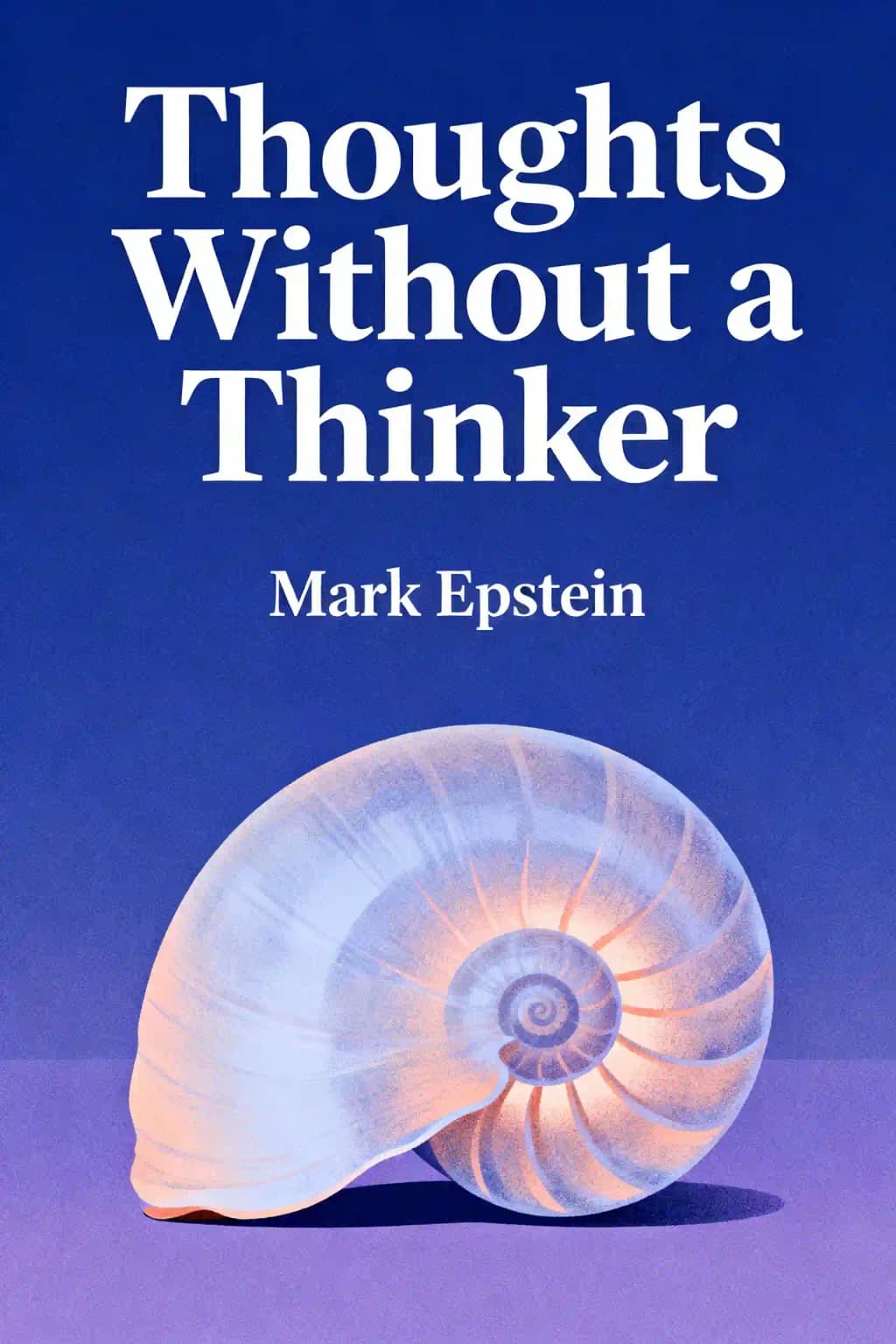
Where Buddhism meets psychotherapy: Mark Epstein's groundbreaking fusion, endorsed by the Dalai Lama himself. Discover why this seminal work appears on "100 Best Buddhism Books" lists, challenging Western notions of self while offering ancient solutions to modern suffering.
Mark Epstein, MD, is a Harvard-educated psychiatrist and bestselling author of Thoughts Without a Thinker: Psychotherapy from a Buddhist Perspective, recognized for pioneering the integration of Buddhist philosophy with contemporary psychotherapy.
Blending clinical expertise with decades of Buddhist practice, Epstein explores themes of trauma, self-identity, and mindfulness in this foundational work. A clinical assistant professor at New York University’s Postdoctoral Program in Psychotherapy, he has authored influential titles like Going to Pieces Without Falling Apart and The Trauma of Everyday Life, which further examine the synergy between Eastern wisdom and psychological healing.
Epstein’s insights have been featured in The New York Times, O: The Oprah Magazine, and PBS’s documentary The Buddha, cementing his role as a bridge between spiritual and scientific communities. A contributing editor to Tricycle: The Buddhist Review, his works are widely cited in academic circles and translated into over 15 languages, with Thoughts Without a Thinker remaining a cornerstone text in mindfulness-based psychotherapy since its 1995 release.
Thoughts Without a Thinker explores the integration of Buddhist philosophy and Western psychotherapy, offering insights into healing emotional suffering through mindfulness and meditation. Mark Epstein argues that Buddhist teachings on emptiness and non-attachment complement Freudian analysis, providing therapists tools to cultivate presence and patients methods to observe thoughts without identification.
This book is ideal for therapists, mindfulness practitioners, and readers interested in psychology or Eastern spirituality. It bridges clinical practice and Buddhist principles, making it valuable for clinicians seeking meditative techniques and individuals exploring self-awareness through non-dualistic thinking.
Yes—critics praise it as a groundbreaking work that reframes psychotherapy through Buddhist psychology. Epstein’s blend of clinical expertise, personal meditation practice, and lucid writing makes complex ideas accessible, offering timeless strategies for emotional resilience.
Epstein identifies parallels between Buddhist teachings (e.g., anattā, or non-self) and psychoanalytic concepts like Freud’s “evenly suspended attention.” He shows how mindfulness helps therapists remain present with patients and how Buddhist practices address trauma by dissolving rigid self-narratives.
Meditation is framed as a foundational tool for therapists to develop non-judgmental awareness, aligning with Freud’s recommendation to avoid premature intervention. For patients, it cultivates detachment from intrusive thoughts, reducing identification with transient mental patterns.
The phrase challenges the Western notion of a permanent self, suggesting thoughts arise independently of a controlling ego. Epstein uses this Buddhist concept to argue that mental suffering stems from clinging to illusions of a fixed identity.
A key line states: “Emptiness is not a thing in itself, yet it is nonetheless the vehicle for maintaining a proper view of the road in front of us.” This emphasizes non-attachment as a guide for navigating life’s uncertainties without distortion.
It advocates meditation to enhance therapists’ capacity for presence, mirroring Freud’s “blank slate” ideal. By observing their own reactions without judgment, clinicians can better attune to patients’ unconscious material.
Epstein argues Western psychology often overlooks the illusory nature of the self, leading to overemphasis on ego-strengthening. Buddhist practices, by contrast, address root causes of suffering by examining the transient, selfless nature of thoughts.
Some note its dense academic style may challenge casual readers. Others suggest Epstein oversimplifies Freudian theory or neglects socioeconomic factors influencing mental health.
As mindfulness gains traction in mental health, Epstein’s framework remains vital for addressing modern anxiety. The book’s focus on non-attachment offers tools to navigate rapid technological and cultural shifts.
Unlike Going to Pieces Without Falling Apart (which focuses on creativity) or The Trauma of Everyday Life (Buddhist trauma theory), this book specifically maps Buddhist psychology onto clinical practice, making it essential for therapists.
通过作者的声音感受这本书
将知识转化为引人入胜、富含实例的见解
快速捕捉核心观点,高效学习
以有趣互动的方式享受这本书
We cannot sustain the illusion of self-sufficiency.
The Buddha's message is that our narcissistic attachment to an illusory self-image is the very source of our suffering.
Buddhism doesn't deny pleasure but warns against attachment to sensory experiences.
Understanding suffering and its cessation takes precedence over philosophical speculation.
将《Thoughts without a thinker》的核心观点拆解为易于理解的要点,了解创新团队如何创造、协作和成长。
将《Thoughts without a thinker》提炼为快速记忆要点,突出坦诚、团队合作和创造力的关键原则。

通过生动的故事体验《Thoughts without a thinker》,将创新经验转化为令人难忘且可应用的精彩时刻。
随心提问,选择声音,共同创造真正与你产生共鸣的见解。

"Instead of endless scrolling, I just hit play on BeFreed. It saves me so much time."
"I never knew where to start with nonfiction—BeFreed’s book lists turned into podcasts gave me a clear path."
"Perfect balance between learning and entertainment. Finished ‘Thinking, Fast and Slow’ on my commute this week."
"Crazy how much I learned while walking the dog. BeFreed = small habits → big gains."
"Reading used to feel like a chore. Now it’s just part of my lifestyle."
"Feels effortless compared to reading. I’ve finished 6 books this month already."
"BeFreed turned my guilty doomscrolling into something that feels productive and inspiring."
"BeFreed turned my commute into learning time. 20-min podcasts are perfect for finishing books I never had time for."
"BeFreed replaced my podcast queue. Imagine Spotify for books — that’s it. 🙌"
"It is great for me to learn something from the book without reading it."
"The themed book list podcasts help me connect ideas across authors—like a guided audio journey."
"Makes me feel smarter every time before going to work"

免费获取《Thoughts without a thinker》摘要的 PDF 或 EPUB 版本。可打印或随时离线阅读。
What happens when ancient Buddhist wisdom collides with modern psychoanalysis? Mark Epstein's groundbreaking work reveals that the Buddha was perhaps the first psychoanalyst, understanding human suffering with remarkable psychological sophistication 2,500 years before Freud. This isn't merely academic curiosity - it's a roadmap for navigating our most profound psychological struggles. The Buddha recognized that our suffering stems not from external circumstances but from our relationship with our own minds. We create elaborate mental prisons, believing ourselves victims of outside forces when we're actually trapped by our own unrecognized patterns. Think about it: how often do you blame circumstances for emotional states that actually originate within? The Buddhist psychological model offers something Western psychology is only beginning to fully appreciate - a comprehensive understanding of how we create our own suffering and, more importantly, how we can release ourselves from it.